
Best AI Video APIs for High-Volume Workflows in 2027
Best AI video APIs for high volume workflows in 2027: compare concurrency, async jobs, retries, delivery, observability, and usable cost.

A video job can return completed and still fail production. Its URL may expire before ingestion, a callback may arrive twice, or a retry may create a second billable clip. For engineering teams generating video every day or week, those failures matter more than a clean demo.
This guide to the best AI video APIs for high volume workflows is a planning snapshot verified on October 2, 2026. I reviewed current API, pricing, lifecycle, and billing documentation, then built one load-test contract around the gaps. I did not run account-level load tests, so this is a documentation audit and reproducible evaluation plan.
The numbers are navigation, not rank. The fixed workload is 100 image-to-video jobs using one licensed product image, one prompt, six seconds, 16:9, and the closest 720p setting. Approval requires a valid download, intact product identity, and no blocking artifact.
How We Evaluated High-Volume AI Video APIs
Concurrency, Queueing, Async Jobs, Webhooks, and Retries
Submit waves of 1, 5, 10, and 25 concurrent jobs, stopping where the account limit intervenes. Record HTTP acceptance, job ID, queue time, processing start, terminal status, callback attempts, duplicates, and download result. Keep client retries disabled until the original job is reconciled.
A timed-out submission is ambiguous because acceptance may precede disconnection. The worker still needs a deterministic workload key, job ledger, and dead-letter queue.
Model Stability, Asset Delivery, Observability, and Usable Cost
This sheet records public documentation, not measured load-test behavior.
| API | Async contract | Callback path | Version control | Delivery and billing checkpoint |
|---|---|---|---|---|
| fal.ai | Queue ID, position, logs | Webhook | Endpoint model ID | Verify retention and failure charges |
| Google Veo | Long-running operation | Polling | Named IDs; preview status matters | Gemini download or customer GCS |
| Luma | Generation ID and state | Update callbacks | ray-2 or ray-flash-2 | Verify asset life and failed-job billing |
| Replicate | Prediction lifecycle and metrics | Signed webhook flow | Exact version hash available | API files default to one-hour retention |
| Runway | Task ID, THROTTLED, terminal states | Polling | Model plus API-version header | Expiring JWT URLs; safety failures can cost |
| WaveSpeedAI | Prediction ID, status, timing | Signed webhook | Catalog model path | Temporary output; per-prediction billing search |
Usable cost is (generation charges + charged retries + storage + review labor) / approved clips. Prices were checked on the snapshot date but are not frozen here because models, durations, and billing units differ.
-
fal.ai — Broad Model Endpoint Choice
Best High-Volume Use Case
fal.ai fits teams wanting one integration across a changing model set. Its async inference flow exposes queue position, logs, inference timing, polling, cancellation, and webhooks. It suits creative testing where one brief moves across providers without rebuilding the runner.
Route a sample to several endpoints, score it, then scale the selected route. Store endpoint ID, schema, seed, price snapshot, and acceptance result.
For the canary, compare queue position with inference time. That separates platform waiting from model execution and keeps a slow queue from being misdiagnosed as a slow model.
Current Limits and Verification Points
Breadth creates drift: parameters, retention, moderation, and billing remain endpoint-specific. Automatic queue retries also require separating provider recovery from client resubmission. Verify webhook authentication, duplicates, concurrency, retention, and revision. A slug is not an immutable snapshot unless documented as one.
-
Google Veo API — Google Cloud Video Workflows
Best High-Volume Use Case
Google Veo fits teams already using Google Cloud and governed storage. The Veo generation guide returns a long-running operation and can write to a specified Cloud Storage bucket. Vertex AI documents dynamic shared quota and provisioned throughput routes.
Choose Vertex AI when IAM, project separation, billing export, and storage lifecycle are delivery requirements. Gemini API is a separate commercial route; its per-second rates are not Vertex AI contract pricing.
Current Limits and Verification Points
The public example polls rather than documenting completion webhooks. Some Google documentation still references Veo 3.1 preview IDs, although Google’s release notes deprecated those preview endpoints in March 2026, so record the exact supported model ID for the route you use.
Google’s successful-generation billing note for certain Gemini audio failures is not a blanket Vertex AI promise. Confirm SKU, quota, region, and throughput terms.
-
Luma API — Luma Video Workflows
Best High-Volume Use Case
Luma suits teams that have selected its video behavior. Current video generation documentation exposes IDs, polling, dreaming, completed, and failed states, plus update callbacks. Receivers must be idempotent.
The documented Build tier lists 10 concurrent Ray generations and 20 create requests per minute. Larger queues require a confirmed Scale arrangement.
Test callback loss by withholding 200 once, then reconcile the same generation ID through polling. A replacement generation is the wrong recovery action until failure is terminal.
Current Limits and Verification Points
Non-200 callbacks receive up to three quick retries, too brief to replace polling reconciliation. The current reference lists ray-2 and ray-flash-2; capture the parameter.
Before volume, verify output retention, callback signing, failed-generation charges, and account ceiling. Public pages do not resolve every point. This is where my data ends.
-
Replicate — Model-Level Experimentation
Best High-Volume Use Case
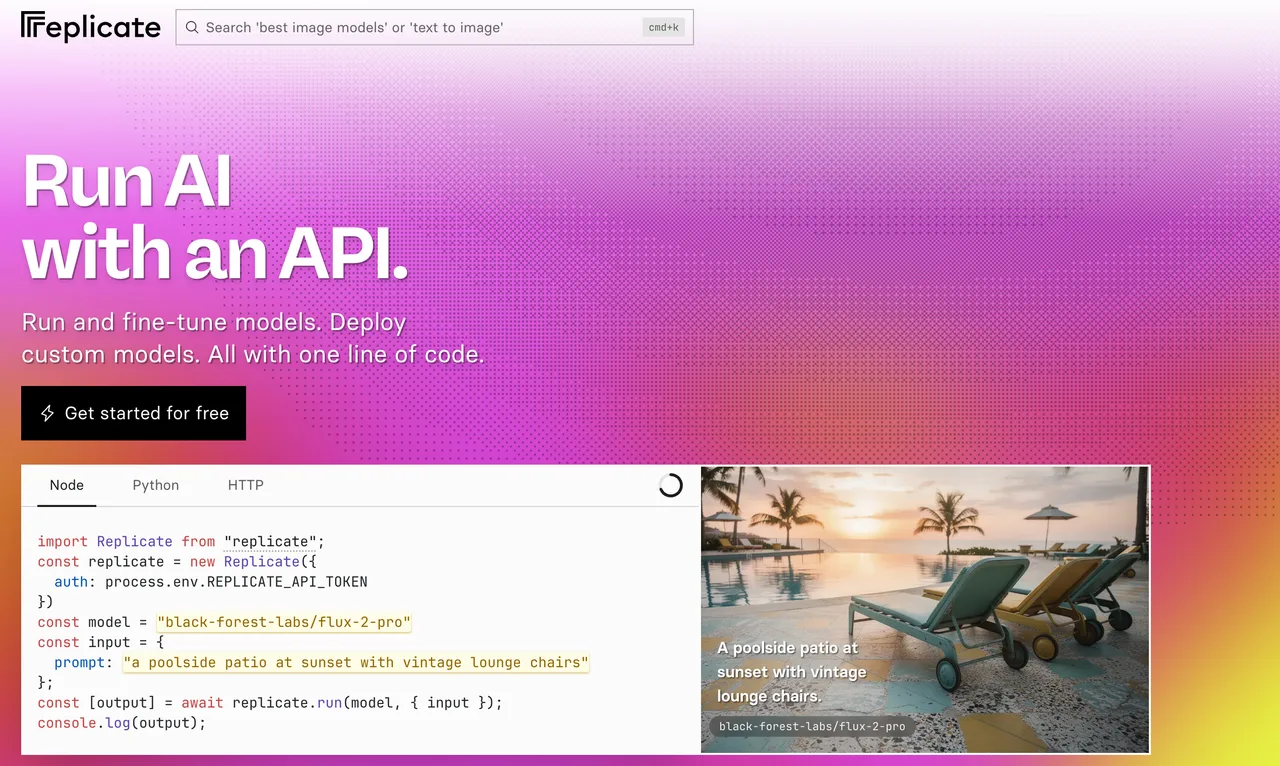
Replicate fits teams comparing public or custom models with clear provenance. Predictions expose status, timestamps, logs, metrics, and exact version hashes. Its webhook documentation supports start, output, logs, and completed events; deployments add scaling bounds, canaries, and rollback.
Use a deployment when cold starts or shared queues conflict with the service objective. The 600 prediction-creation requests per minute limit is not guaranteed inference concurrency.
Record both total time and predict_time. Their difference is a practical queue-and-startup signal, while version hashes keep reruns tied to the same implementation.
Current Limits and Verification Points
API prediction data and files are removed after one hour by default. Copy assets immediately. Terminal webhooks retry, but duplicates and out-of-order events are possible.
Failed runs are generally free; canceled official runs may incur compute, while private models or deployments can bill active instance time. Log prediction ID, version, predict_time, status, and retry number.
-
Runway API — Runway-Native Generation
Best High-Volume Use Case
Runway fits teams committed to its models and credit-based limits. Usage-tier documentation distinguishes concurrency, queued THROTTLED tasks, rolling daily generations, and monthly spend. Excess jobs can wait for slots.
The SDK provides polling and terminal errors, while early task IDs support durable tracking.
Measure time spent in THROTTLED separately from generation. A large accepted queue may protect the client from 429 responses while still missing the campaign deadline.
Current Limits and Verification Points
SDK guidance recommends polling at five seconds or longer with jitter. I found no general completion-webhook contract. Successful output URLs contain a JWT and expire within 24–48 hours; copy them promptly.
Safety failures can consume successful-generation credits, so record failureCode separately from network errors. Model IDs and X-Runway-Version improve traceability but do not prove immutable model snapshots.
-
WaveSpeedAI — Unified Multi-Model Access

Best High-Volume Use Case
WaveSpeedAI fits teams needing one surface across many video models. I applied the same standard here; it gets no free pass. Its webhook contract documents terminal states, HMAC verification, ten-second acknowledgement, three retries, and polling recovery.
Tiers publish predictions per minute and concurrency. Billing search filters by prediction UUID, model, key, and time. Failed requests and system timeouts are eligible for credit reversal.
The canary should join each prediction to its billing row and output checksum. That exposes missing refunds, replacement tasks, and approvals without relying on aggregate balance movement.
Current Limits and Verification Points
There is no batch-submission endpoint; clients submit individual jobs concurrently. Media URLs generally expire within seven days. Retain model ID, prediction ID, timing, callback attempt, approval, and billing record.
Submission does not promise an idempotency key. Guidance warns against repeating a disconnected POST because the task may exist and be billed. Catalog paths identify routes, not guaranteed immutable snapshots. Verify schema, price, and limits per campaign.
Choose by Operational Failure Mode
Separate Model Quality From Queue Reliability
Choose the failure the team can own. Replicate offers clear version pinning and deployment controls. Google Vertex AI fits GCP governance and owned storage. Runway exposes throttling and failure semantics. fal.ai and WaveSpeedAI favor multi-model routing; Luma keeps a narrower surface.
Run the brief twice: one request for model suitability, then controlled concurrency for platform behavior. Quality rejection belongs to the model score; lost callbacks, expired URLs, duplicate charges, and unreconciled states belong to the platform score.
Calculate Cost per Delivered and Approved Clip
Keep three denominators: submitted, delivered, and approved. If 100 jobs cost $80, 92 download, and 70 pass review, cost is $0.80 per submission, $0.87 per delivery, and $1.14 per approved clip before storage and labor.
Track job ID, workload key, attempt, state, charge/refund, checksum, review result, and rejection reason. That makes video API pricing auditable.
FAQ
Which APIs support idempotency keys?
None of the six public video-submission documents clearly promises a universal idempotency key. Replicate and WaveSpeedAI require duplicate-safe callbacks; WaveSpeedAI warns that repeating an ambiguous POST may create another charge. Use an internal key and reconcile IDs first.
Can providers pin a model version per project?
Replicate provides exact version hashes and deployment controls. Others expose model or route IDs without establishing immutable per-project pinning for every video model. Treat preview aliases and aggregator routes as movable.
Which APIs sign output-download URLs?
Runway documents expiring, JWT-bearing output URLs. Google can deliver into customer Cloud Storage, where customers may create signed URLs. I found no equally explicit proof that fal.ai, Luma, Replicate, or WaveSpeedAI signs every video URL. Copy outputs immediately.
Which APIs provide a dedicated staging environment?
No candidate documents a universal video staging environment equivalent to production. Google projects, Replicate deployments, fal sandboxes, and separate accounts can isolate tests without promising matched capacity. Runway’s router dry run previews routing only.
Can billing exports separate retries from completed jobs?
Only with a stored provider ID and state per attempt. WaveSpeedAI filters billing by prediction UUID; Replicate exposes metrics; Google exports project/SKU costs; Runway offers qualifying organizations per-generation reporting. Luma and fal.ai do not publicly disclose equivalent retry-separated exports. Keep an internal ledger.
Conclusion
The best AI video APIs for high volume workflows depend on the failure boundary. fal.ai and WaveSpeedAI suit multi-model access; Google Veo suits governed cloud delivery; Luma suits focused Ray work; Replicate suits versioned experiments; Runway suits its native stack.
My gate requires a 100-job canary, zero unreconciled submissions, durable copying, duplicate-safe callbacks, version capture, and approved-clip cost. Recheck quarterly. This conclusion has an expiration date — models update fast.
Previous posts:
Related Articles
/filters:quality(82)/media/images/1790879706333726948_TmjHVhrF.webp)
Introducing AI Cinema Studio on WaveSpeedAI: Direct Cinematic AI Video Shots
/filters:quality(82)/media/images/1790934887466368319_r2GQZ8hr.webp)
LTX Studio Review 2027: Does the Video Workflow Hold Up?
/filters:quality(82)/media/images/1790935090456133598_u9CLU4dm.webp)
Segmind Review 2027: Can Its Media APIs Scale?
/filters:quality(82)/media/images/1790935248497016685_6cZjDPeF.webp)
Best Shotstack Alternatives in 2027 for Video APIs
/filters:quality(82)/media/images/1790935438012010745_IjwFOnwG.webp)
Best Sync Labs Alternatives in 2027 for Lip Sync
/filters:quality(82)/media/images/1790903936921698253_6vhqAJT2.webp)