
Luma AI Pricing 2026: App and API Costs Explained
Luma AI pricing 2026 separates app plans from API usage and shows how resolution, retries, and workflow type affect usable video cost.
Hello, guys. Dora here. I tried to reconcile a 300-credit App generation with a $0.90 API clip in the same budget sheet. Two units that refuse to reconcile. I paused here.
For product and creative teams choosing between a shared workspace and an integration, Luma AI pricing is really a routing decision. My hypothesis was that the model matters less than where the work runs and how many outputs survive review. The batch below is a planning example, not a claim of hands-on testing.
Separate Luma App and API Pricing
Individual and Team App Plans
The Luma App sells workspace access plus monthly credits. Current individual Luma pricing plans are Plus at $30 per month, Pro at $90, and Ultra at $300. Team and Enterprise pricing requires a quote.
Those fees buy more than model calls. The App includes projects, agents, editing, and third-party models. Dividing a subscription by a “generations” estimate ignores which model, resolution, and operation consumed the credits.
Luma’s structured product description is explicit: the App is the creative workspace, while the API is the developer surface.
Pay-As-You-Go and Capacity-Based API Access
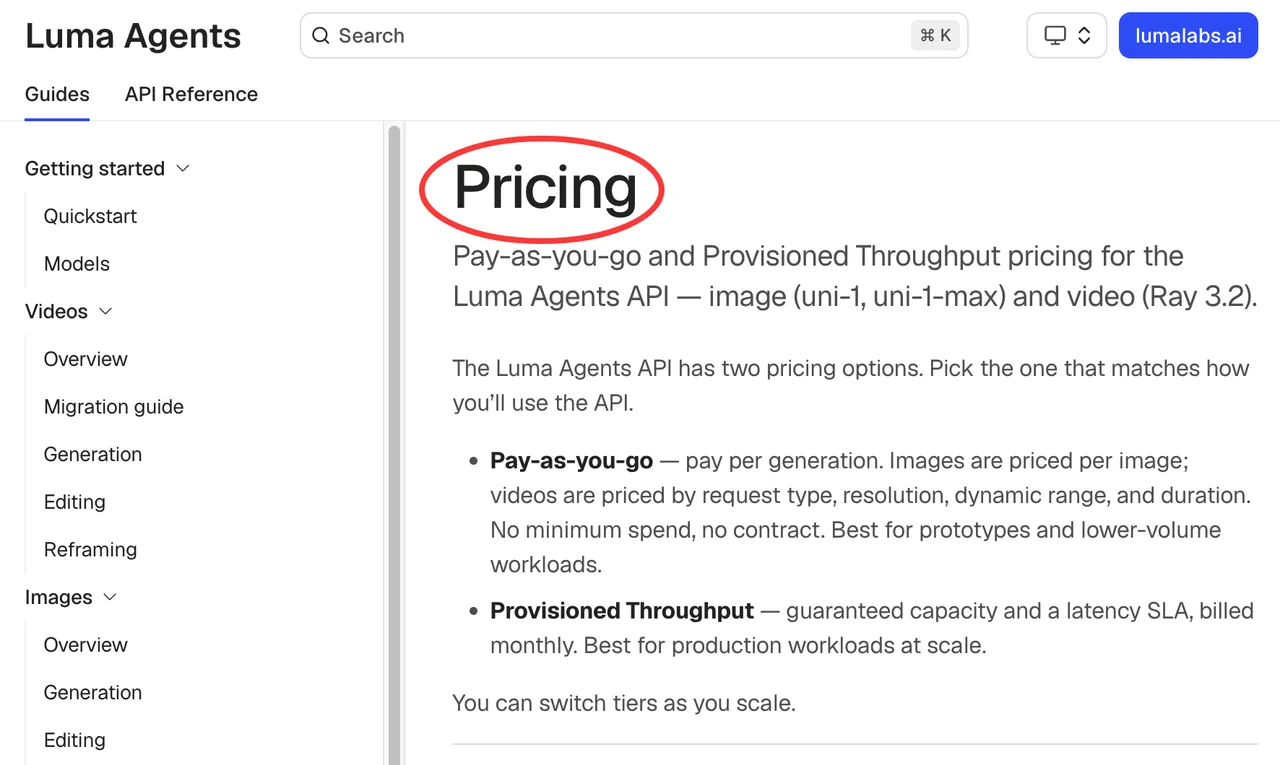
The API has two routes. Build is pay-as-you-go with shared capacity, rate limits, no minimum, and no latency SLA. Provisioned Throughput buys dedicated capacity and an SLA.
Public capacity prices cover images. Ray3.2 video uses a separate class and requires a quote. The current API pricing documentation says video rates may change before general availability. This is the authoritative Luma video API pricing source for Build, not a capacity quote.
Understand the Current Luma Model Lineup
Luma Ray for Video Generation
Ray3.2 is Luma’s current video model. Billing varies by operation, duration, resolution, and dynamic range.
For standard T2V or I2V, the September 19 API snapshot is:
| Output | 5 seconds | 10 seconds |
|---|---|---|
| 360p draft | $0.06 | $0.18 |
| 540p | $0.15 | $0.45 |
| 720p | $0.30 | $0.90 |
| 1080p | $1.20 | $3.60 |
A ten-second standard edit costs $1.44 at 540p, $2.16 at 720p, and $4.32 at 1080p. HDR and EXR use separate rates. One “cost per video” number hides too much.
Why Legacy Dream Machine Pricing Causes Confusion
Search results still use Luma dream machine as if it were the current model. Luma’s own structured page says not to do that: Dream Machine and Ray2 are deprecated, and Ray3.2 is current.
Old credit tables, Ray2 rates, App allowances, and Ray3.2 API dollars describe different products. A usable record needs the surface, model ID, operation, resolution, duration, dynamic range, and date.
Calculate Cost per Video
Duration, Resolution, and Workflow Type
API generation uses a price per complete request. Ten seconds is not always twice five seconds. At 720p, generation rises from $0.30 to $0.90; a ten-second edit costs $2.16. Reframe is $0.12 per second.
The practical formula is:
generation spend = completed billable requests x price for that exact request type
The dashboard reports each USD charge. Model IDs and parameters still belong in the cost log.
A Worked Example for a Small Production Batch
Assume a team submits 20 ten-second, 720p I2V jobs through Ray3.2 Build. Every completed generation costs $0.90.
- 18 jobs complete; two fail and are refunded.
- 11 of the 18 outputs pass review.
- Five rejected shots are regenerated once.
- One retry passes, bringing the batch to 12 usable clips.
Twenty-three billable generations cost 23 x $0.90 = $20.70. Cost per accepted clip is **$20.70 / 12 = $1.73**.
The example uses refundable failures. Luma says synchronous errors are free; content_moderated, generation_failed, and output_not_found are refunded. budget_exhausted can carry a partial charge.
Calculate Cost per Usable Result
Regeneration, Failed Jobs, and Manual Review
Generation spend is only the first subtotal. If reviewing 23 completed outputs takes two minutes each, the batch needs 46 minutes of operator time. At an internal rate of $45 per hour, review adds $34.50.
The batch now costs $55.20 before storage or editing: $4.60 per accepted clip. So that’s where the bottleneck was. The API rate stayed fixed. Acceptance did not.
App Credits Versus API Charges
The App uses Luma credits. A standard ten-second Ray3.2 generation currently consumes 60 credits in draft, 150 at 540p, 300 at 720p, or 1,200 at 1080p. HDR is 2x the base credit cost; HDR plus EXR is 3x.
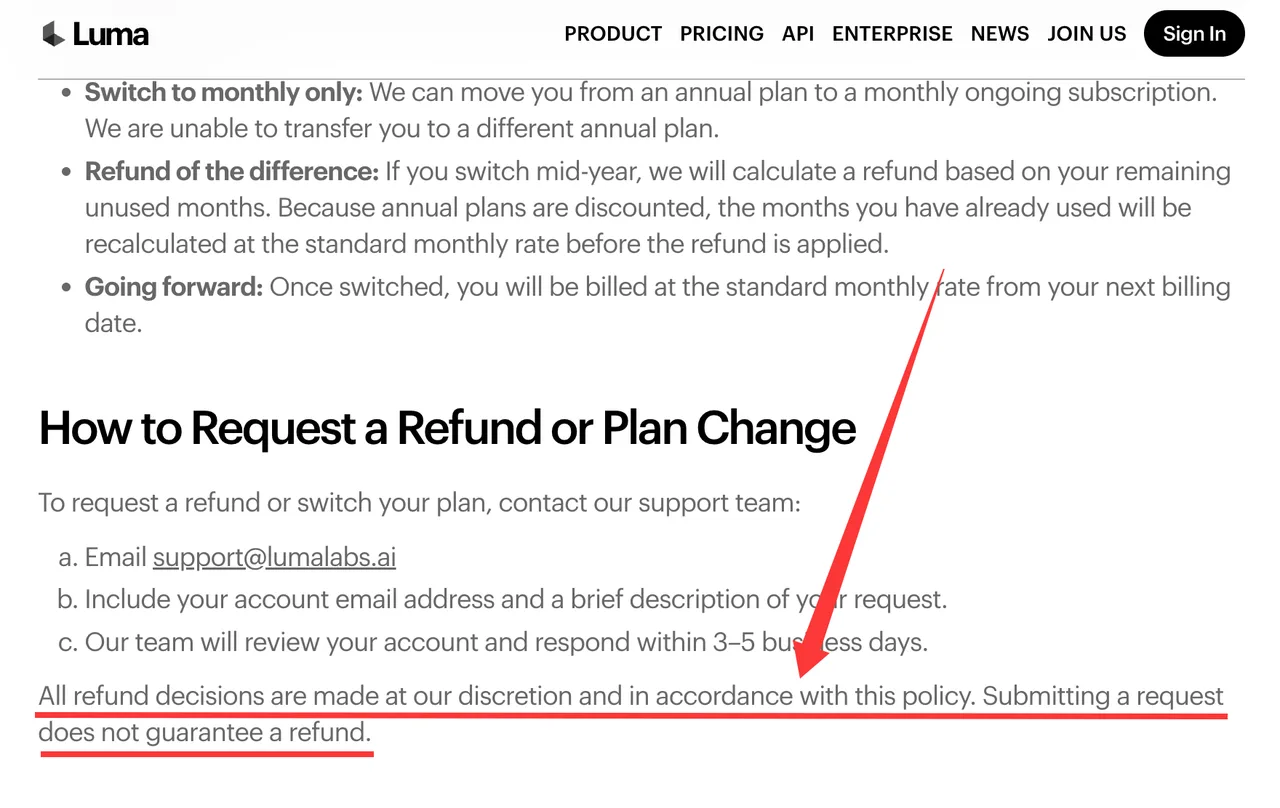
Credits are not API dollars. They expire each billing cycle, failed App generations are returned, and extra usage can be capped. The App billing policy makes refunds discretionary and generally limits them to the latest billing period. Monthly fees do not create a guaranteed clip price.
Choose the Right Luma Billing Path
App Plans for Collaborative Creative Work
The App fits prompting, comparing, editing, sharing, and review inside projects. Team controls matter when several people touch the same assets. The fee covers that workspace as well as generation.
It fits poorly when a product needs request records, callbacks, or generation inside its own interface. Manual export is still an integration.
API Billing for Product Integration
Build fits prototypes and variable traffic. Production still needs timeouts, polling, failure logs, idempotent application logic, and an external spending cap.
Dedicated capacity addresses queue variance. It is not automatically cheaper per clip. The API terms provide no uptime or response-time commitment unless an executed order says otherwise.
Check These Terms Before Paying
Model Availability, Credit Expiry, and Refunds
Save the dated rate card. Luma can change API features and prices. App credits reset each cycle, while failed-generation treatment varies by code and surface.
An unused App plan may qualify for review, but repayment is not guaranteed. Consumed additional credits are non-refundable.
Commercial Use, Team Controls, and Capacity Commitments
Paid individual plans list commercial use. Team adds controls; Enterprise and API agreements add obligations. API users must disclose AI-generated output and observe restrictions on resale, benchmarking, training, and high-risk uses.
This is not legal advice. Rights depend on the plan, inputs, third-party models, and current agreement.
FAQ

Can Luma set project-level API spending limits?
No public documentation confirms project-level API caps. The App has an account cap for extra credits; the API supports balance reload thresholds. Neither proves project controls. Enforce them in the calling service.
Does Luma publish uptime history for its API?
Yes. Luma publishes service status history for API and Agents incidents. It is not a contractual SLA; dedicated commitments depend on the order form.
Can billing admins export usage by model and workspace?
Team advertises usage analytics, and the API dashboard shows request charges. Public documentation does not confirm an export segmented by model and workspace. Verify it before procurement.
Can enterprise customers choose a data-processing region?
Luma does not publicly promise selectable regions. Its privacy policy says services are hosted in the US and data may move elsewhere. Put regional requirements in the DPA and order form.
Which payment currencies and tax documents does Luma support?
API prices are in USD. Luma uses Stripe, but Stripe’s currency support does not prove which options Luma enables. Luma publishes no complete currency or tax-document matrix. Its terms place applicable taxes on the customer. Confirm settlement currency, VAT invoices, and exemptions for the billing country.
Conclusion
The useful reading of Luma AI pricing has three columns: App credits for collaborative creation, pay-as-you-go API charges for variable integration traffic, and quoted capacity for predictable throughput. The $0.90 clip in the example became $4.60 after acceptance and review. That is the number I would budget first.
This conclusion has an expiration date. Ray rates, credit costs, and capacity terms can move. The next check is the invoice against the request log, not the marketing estimate.
Previous posts:
Related Articles
/filters:quality(82)/media/images/1790589731632080935_0wwFPY8h.webp)
Google Veo 3 Pricing 2026: API Costs and Access
/filters:quality(82)/media/images/1790589262955077611_p3tThHZg.webp)
Veo Automation Guide 2026: Batch Video Workflows
/filters:quality(82)/media/images/1773962750383987480_n3hqzHRZ.webp)
Kling 4.0 vs Kling 3.0: What Is Expected to Change and How to Upgrade
Kling 4.0 vs Seedance 2.5: How to Choose for Commercial Video
Kling 4.0 vs Veo 3.1 vs Seedance 2.5: Choosing a Flagship Video Model