Best AI Video Platforms for Production Teams in 2027
Best AI video platforms 2027 compares six production options by model access, workflow control, team fit, and usable output cost.
Six tabs, six credit systems, and one product image that still has to become 40 campaign clips. That is the production problem behind the best AI video platforms 2027 search. Model demos are easy to admire. Repeatable delivery is where the list gets less tidy.
I’m Dora. I paused here. Without original outputs, queue logs, and billing receipts from all six platforms, I am not going to manufacture a tested leaderboard. This guide ranks verified workflow fit and provides one matched test for measuring the missing performance data.
Feature and pricing snapshot: September 18, 2026. This is an advance 2027 planning guide, not a guarantee of 2027 availability or pricing.
The Best AI Video Platforms for Production Teams
There is no unconditional winner. Pollo AI is the clearest API-first multi-model candidate. Deevid AI offers a broader creator workspace. Lanta AI and Clipfly AI suit browser-led production. Luma has the strongest publicly documented combination of direct API and team controls. Vexub AI is the specialist for narrated, captioned social video.
Pollo AI and Deevid AI for Multi-Model Access

Pollo AI is the strongest fit when model switching must sit behind an application. Its public API documentation shows asynchronous generation with a taskId, status polling, reported credit and USD cost, and optional webhooks. That is more useful to a production engineer than a homepage claiming to have many models. The Pollo API generation schema also exposes resolution, duration, aspect ratio, and audio controls for documented routes.
The main concern is version transparency. A platform may display a provider name while routing through a specific model revision, wrapper, or optimized preset. A production log needs the platform route, displayed model name, request settings, and returned version metadata. If the response does not identify a revision, reproducibility stops at the platform boundary.
Deevid AI is better framed as a multi-model creative workspace. Its public catalog lists Sora, Kling, Hailuo, Runway, Pika, Luma, Vidu, Wan, and other families. Deevid also presents Agent, Canvas, and Editor as one workflow. That makes it relevant when a team wants generation, revision, and finishing in one browser rather than raw model access alone.
The Deevid model catalog identifies model families, but I could not locate public developer documentation with stable model IDs, request schemas, rate limits, or webhook behavior. That keeps Deevid in the creative-production shortlist, not the confirmed API-first shortlist.
Lanta AI and Clipfly AI for Browser-Led Production
Lanta AI fits teams comparing short video models without building an integration. Its current browser interface exposes text-to-video and image-to-video routes across models including Lanta, Kling, Wan, Seedance, Grok Imagine, Sora, and Veo. Duration, aspect ratio, resolution, audio, and model-dependent controls appear in the generator.
Lanta also advertises batch generation and keeps generations in a browser history. Those are useful for creative testing, but public evidence for shared workspaces, role-based access, approval queues, or a production API was not found. Its public privacy notice was last updated in November 2024 and retains data “as long as necessary” rather than publishing an asset-specific deletion period. That wording in the Lanta privacy notice is too broad for confidential campaign references without a separate agreement.
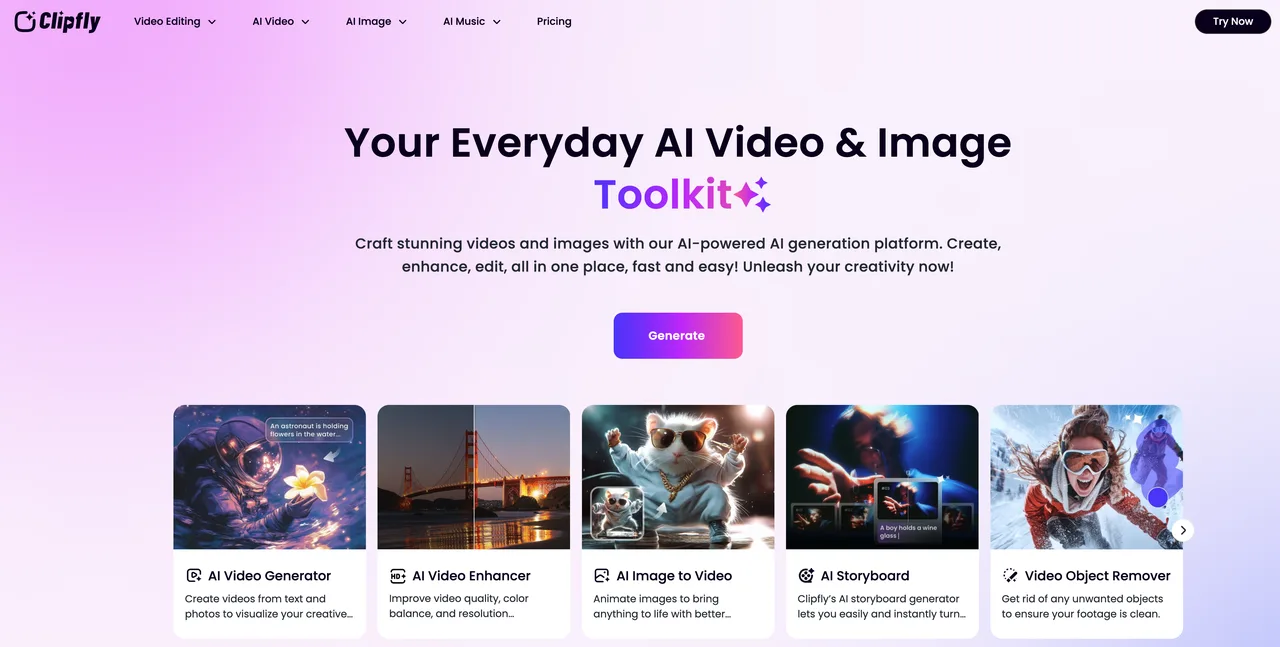
Clipfly AI is the more editing-oriented browser option. It combines model access with trimming, cropping, resizing, captions, audio tools, enhancement, background work, and exports. Its current Seedance page also claims batch generation and support for multiple reference types.
The gap is operational evidence. Clipfly’s public legal pages load through a client-side document interface, and I could not verify public API documentation, workspace roles, model-version pinning, or service commitments. Its Clipfly terms page therefore needs manual review during procurement. A convenient editor is useful. An unread contract is still an unread contract.
Luma AI and Vexub AI for Specialized Workflows
Luma is the strongest specialist for teams needing a documented API plus account-level administration. Its public materials describe member and admin roles, shared credits, usage analytics, team organization, SSO, and API access. Current Agents API documentation covers asynchronous polling and model selection; legacy Dream Machine API documentation also documents generation callbacks.
One naming correction matters. Searches for Luma Dream Machine can surface stale comparisons. Luma’s current official information says the active video line is Ray, with Ray3.2 identified as the current model, while “Dream Machine” is an older name. The Luma model reference is the safer source for each quarterly update.
Luma’s terms also restrict publishing benchmarks or performance information. A matched evaluation can still inform an internal procurement decision, but public score publication may require written permission. That clause is easy to miss and materially changes how a review can be documented.
Vexub AI is not a direct substitute for a cinematic image-to-video workbench. It specializes in turning text, MP3 audio, MP4 footage, or scripts into complete social videos with voices, visuals, and subtitles. That is a clearer fit for faceless channels, educational clips, explainers, and short-form publishing.
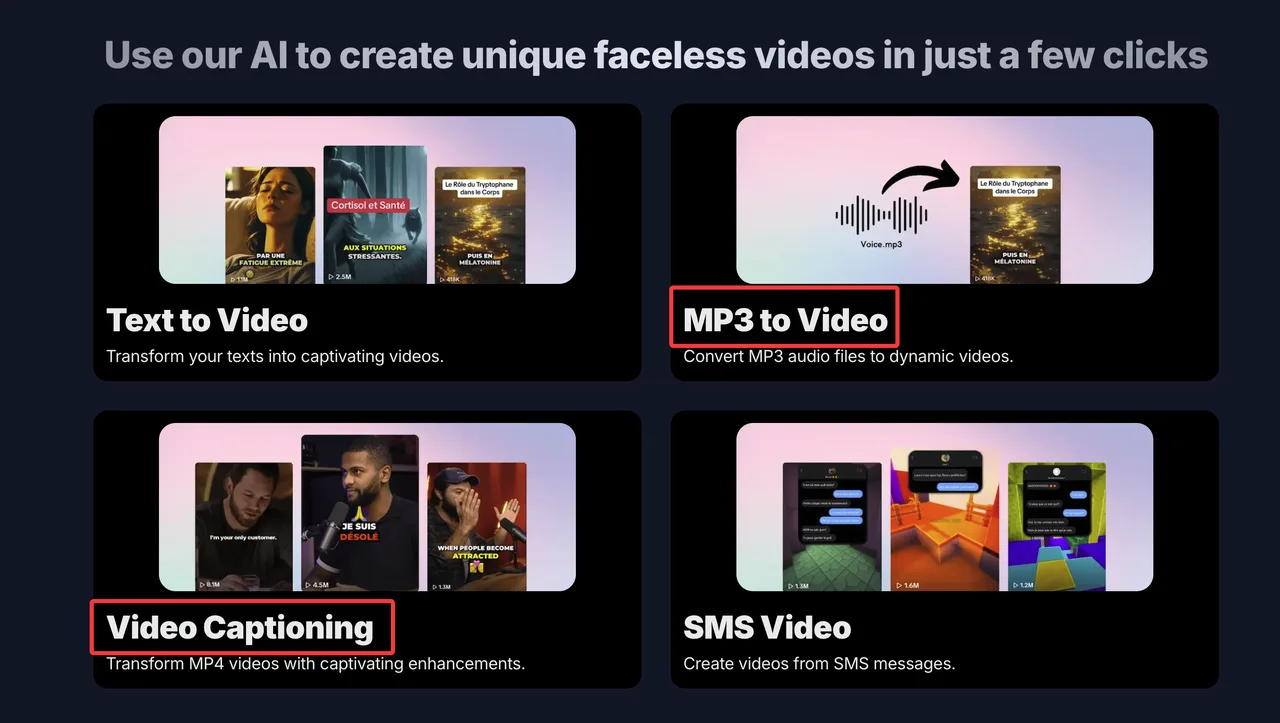 Its public pages do not provide a comparable developer API reference or detailed model-version contract. Vexub is therefore a workflow specialist, not the first choice for an application that needs direct control over individual I2V jobs.
How We Evaluate Production Platforms
Model Breadth, Version Transparency, and Access Stability
Counting logos is the easy part. The useful questions are narrower:
- Is the exact model revision disclosed?
- Can a route be pinned for repeatable output?
- Are deprecations announced before removal?
- Does the platform preserve the same parameters across revisions?
- Can jobs fall back to another model without silently changing behavior?
A platform earns credit for a documented model ID and change policy, not merely for adding the newest provider badge. Model breadth without version history creates more choice and less auditability at the same time.
Workflow Controls, Collaboration, and Export Options
The comparison should record projects, folders, reusable references, batch submission, approval status, member roles, shared billing, revision history, and export formats.

Luma currently provides the clearest public evidence for formal team administration. Clipfly provides the broadest visible editing surface in this six-platform set. Pollo exposes the clearest API job lifecycle. Deevid presents an integrated agent-to-editor path. Lanta concentrates on browser model comparison. Vexub packages script, voice, subtitles, and visuals into a social-video workflow.
These are different products wearing the same “AI video platform” label.
Cost per Usable Clip, Retries, and Throughput
The matched test uses one owned product image: a matte-black insulated bottle on a neutral background. The target is a five-second, 16:9, 720p clip without generated audio.
Use this fixed brief:
Preserve the bottle’s exact shape, cap, logo, and matte finish. Add a slow 15-degree camera orbit with soft moving reflections. Keep the background neutral. Do not add text, hands, extra objects, or shape changes.
Run five generations per platform. If a platform cannot produce the exact duration or resolution, record its nearest native setting rather than upscaling or trimming before scoring.
For every run, log:
| Field | What to record |
|---|---|
| Route | Platform, displayed model, model ID or “not disclosed” |
| Settings | Duration, resolution, ratio, audio, reference count |
| Completion | Success, failure, moderation block, or timeout |
| Waiting | Queue time and end-to-end completion time |
| Quality | Product identity, geometry, motion, logo, background |
| Intervention | Prompt edits, reruns, manual fixes, downloads |
| Cost | Credits charged, cash equivalent, refunded failures |
| Acceptance | Usable without regeneration: yes or no |
“Successful” means the platform returned a downloadable file. “Usable” means the product survived the motion and passed the delivery checks. Those rates are not interchangeable.
Calculate:
cost per usable clip = all generation charges / accepted clips
Also report reviewer time. A cheap generation that needs four reruns and ten minutes of repair is not a cheap production result.
Compare the Six Platforms Side by Side
Model Access and Production Controls
| Platform | Clearest verified role | Model access | Production-control gap |
|---|---|---|---|
| Pollo AI | Multi-model API and creative suite | Broad catalog with documented API routes | Revision pinning varies by route |
| Deevid AI | Agent, canvas, editor, and model selection | Broad named model families | Public model IDs and API schema not found |
| Lanta AI | Browser model comparison and short clips | Multiple current video families | Team administration not publicly documented |
| Clipfly AI | Browser generation plus editing | Multiple model integrations | Version and API transparency remain limited |
| Luma AI | Direct models, third-party models, API, teams | Current Ray line plus external models | Public benchmark restrictions |
| Vexub AI | Script and audio to social video | Provider models inside a packaged workflow | Weak fit for controlled I2V evaluation |
Team Features, API Paths, and Billing Structure
Pollo offers the clearest public API path, while Luma documents both API and team administration. Deevid, Lanta, Clipfly, and Vexub are primarily verified through their browser products in this snapshot.
All six use some form of credits, subscriptions, usage billing, or a mixture. Credit totals are not directly comparable because a “credit” has no shared value across platforms. Model, duration, resolution, audio, priority, and retry policy all change the effective cost.
This is where my data ends. Without the 30 raw test runs and matching invoices, assigning numeric success, latency, or cost rankings would be decoration rather than evidence.
Choose the Right Platform for Your Workflow
High-Volume Creative Testing
Pollo AI is the clearest candidate when testing must be automated across models. Lanta AI fits a smaller team running the same comparison manually in a browser. Deevid AI becomes relevant when the desired output includes editing and assembled creative, not only isolated clips.
The selection turns on one question: does the team need model access, or a completed media workflow? Those are not the same purchase.
Product Video and Campaign Variants
Clipfly AI fits browser-led teams that need editing after generation. Deevid AI fits teams moving from a product brief into multiple media components. Lanta AI suits quick model and motion comparisons.
Vexub AI becomes more relevant when the deliverable includes narration, subtitles, pacing, and a social-ready structure. It is less convincing for a controlled product-shot benchmark where source-image fidelity is the main acceptance condition.
API-First Media Applications
Pollo API and Luma API are the two confirmed starting points here. Compare authentication, callbacks, cost fields, error handling, rate limits, version retention, and data processing before comparing visual quality.
None of the other four should be treated as API-ready until current developer documentation and commercial access are verified directly. A marketing mention of automation is not an API contract.
Limits and Trade-Offs
Aggregator Convenience Versus Direct Provider Control
An aggregator reduces account switching and integration work. It also introduces another billing layer, moderation layer, storage policy, and version boundary. When a provider changes a model, the aggregator may expose that change later or package it differently.
Direct access provides clearer provider documentation and fewer routing questions. It also leaves the team maintaining more integrations. One fewer switch sounds small. Adds up fast. So does one more dependency.
Why Model Availability and Prices Need Rechecking
The quarterly review should capture model additions and removals, exact version labels, credit rates, API fields, concurrency, commercial-use terms, storage periods, subprocessors, and failed-job billing.
Keep a dated change log. Any unsupported claim should be removed within seven days of discovery. This conclusion has an expiration date because the platforms change faster than annual list titles suggest.
FAQ
Which platforms publish accessibility conformance reports?
I could not locate a public VPAT or Accessibility Conformance Report for any of the six as of September 18, 2026. General accessibility copy is not equivalent to a formal report. The W3C conformance methodology explains what a structured accessibility evaluation contains. Procurement teams may need to request current ACRs directly.
Which platforms offer contractual data-residency regions?
None of the six publicly documents customer-selectable contractual processing regions in the reviewed materials. Vexub says its servers are in France while service providers operate in the EU and United States, but that is not a selectable residency commitment. The Vexub privacy policy provides the current transfer statement.
Which platforms attach C2PA provenance metadata to exports?
No platform in this list publishes a blanket promise that every video export carries C2PA metadata. Luma documents C2PA credentials for certain image-layer outputs, not all video exports. The C2PA specification also makes clear that credentials record provenance, not factual accuracy. Test the final downloaded file from each route.
Which platforms publish SLA service-credit terms?
No public service-credit schedule was found for the six consumer products. Luma documents a latency SLA for provisioned API throughput, but its public page does not state the credit remedy. Pollo markets availability figures, yet a marketing percentage is not a contractual service-credit clause. Required remedies belong in the signed order.
Which platforms publish deletion windows for uploaded reference assets?
None publishes a complete, asset-specific deletion window covering uploads, generated clips, backups, and downstream model providers. Luma gives customers a 30-day export period after termination before input may be deleted. Vexub states personal-data retention periods, while Pollo and Lanta use purpose-based language. These statements do not answer every reference-asset question.
Conclusion
The best AI video platforms 2027 choice depends on the work being handed over. Pollo leads this shortlist for documented multi-model API access. Luma has the clearest team and direct-provider controls. Deevid, Lanta, and Clipfly address different browser production needs. Vexub owns a narrower script-to-social workflow.
The next decision comes from the five-run product test, not the platform logos. Record every rejection, retry, minute, and charge. The cheapest successful clip is irrelevant when the production team cannot approve it.
Previous posts: