
H3 Max Review: Is 35× Faster Useful in Production?
H3 Max review for production teams: assess whether fal's speed-focused design improves iteration without hiding output and workflow trade-offs.
A five-second draft that arrives before an artist leaves the review screen can change a video workflow. This H3 Max review examines one loop only: rapid draft, human review, and targeted rerun. It is an official-evidence review, not a hands-on benchmark. fal reports a five-second generation in under three seconds and roughly 35× the throughput of the official MiniMax H3 endpoint. That is a useful claim within its test boundary, not a universal speed fact.
Quick Verdict for Production Video Teams
Where faster drafts change the workflow
H3 Max deserves a controlled pilot when artists spend more time waiting for concept clips than reviewing them. fal says it post-trained the open-weight MiniMax H3 and co-optimized the serving stack. If the reported latency survives queueing and file delivery, operators can test composition, motion, and prompt changes while the brief remains active.
The gain is a shorter interval between an idea, a decision, and a corrected attempt. That can reduce context switching and make feedback more precise.
Where H3 Max is not the right route
It is not a substitute for frame-level editing, final mastering, guaranteed typography, long-scene continuity, or an immutable model revision. Teams needing native delivery above the documented resolution range should also use another route.
A good single output does not mean the production workflow is ready. H3 Max production value depends on accepted drafts per operator hour, not the fastest successful render.
What the 35× Claim Measures
Model throughput versus end-to-end wait time
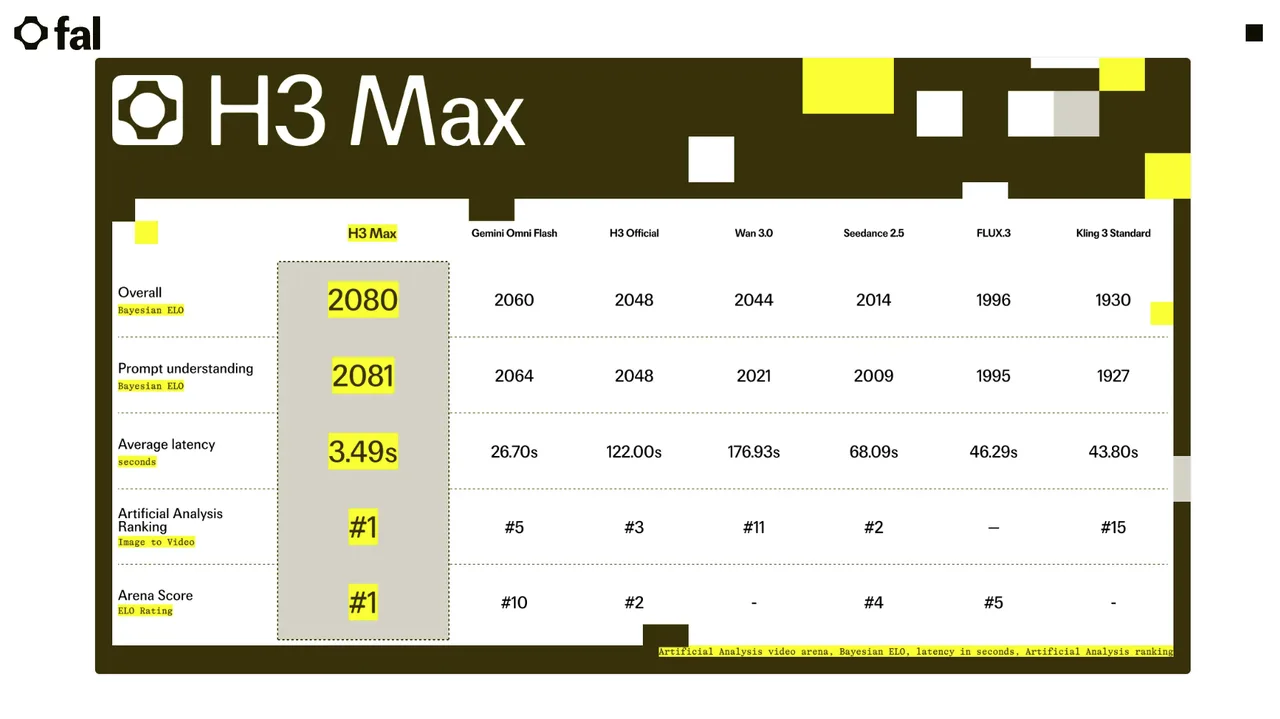
In fal’s launch report, 35× compares H3 Max with the official MiniMax H3 endpoint for a five-second generation. fal reports under three seconds of wall time; its chart shows about 2.4 seconds. These are provider measurements, not a service guarantee.
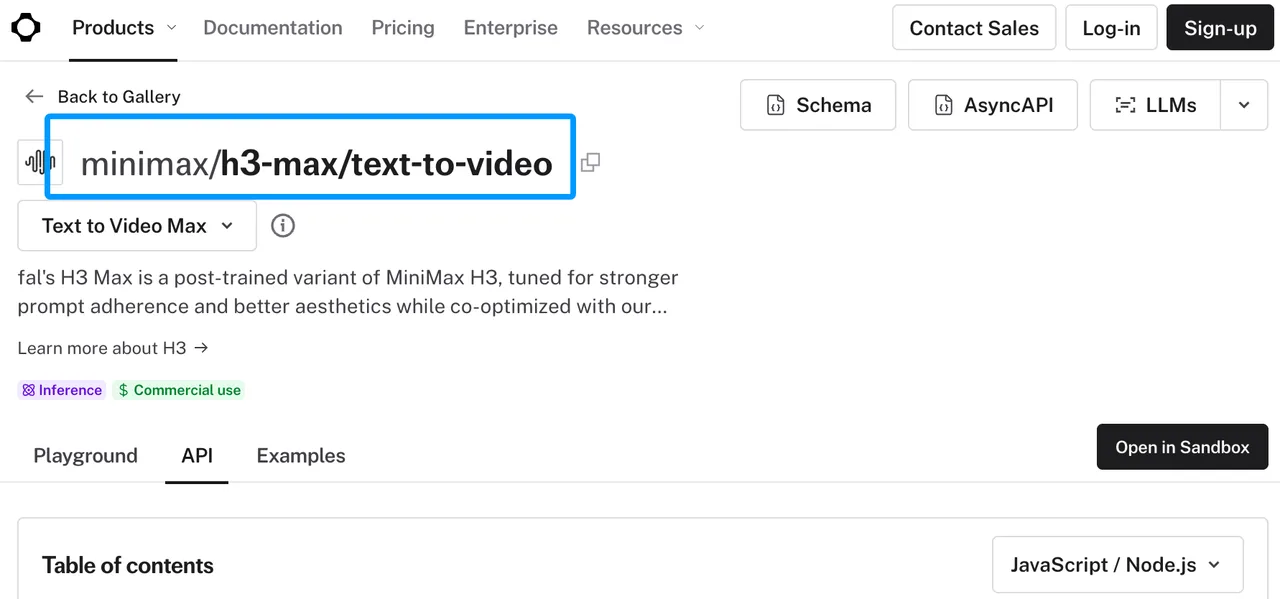
The text-to-video API documentation says timings.inference measures GPU-backend DiT denoising. It does not represent the complete user wait. Queueing, request overhead, expansion, CDN delivery, download, and review can add time. Balanced prompt expansion is described as taking about one second; quality mode may take up to 30 seconds.
The baseline and settings behind the comparison
The baseline is the official H3 endpoint. fal also reports an internal human-preference evaluation against 12 video models, using overall preference, prompt understanding, and aesthetics, then aggregating results with Bayesian Elo and 95% confidence intervals.
The publication does not fully disclose the prompt set, internal sample count, hardware, concurrency, queue conditions, cold-versus-warm state, or every generation setting. A related chart specifies five-second 768p clips, but that does not establish one reproducible configuration for every claim. Treat H3 Max speed and H3 Max quality as hypotheses to retest.
Evaluate One Rapid-Iteration Workflow
Draft generation, review, and reruns
Build a small set of real briefs in the same proportions your team receives. Fix duration, 768p resolution, aspect ratio, safety checking, and prompt-expansion mode. Record the original and expanded prompts, seed, request ID, submission time, completion time, and output.
Review each clip for required subject, action order, camera behavior, visible defects, audio, and editability. When a draft fails, change one prompt variable and rerun. This tests deliberate correction instead of random sampling.
Usable-output rate and operator time
Track p50 and p95 submit-to-download latency, attempts per accepted clip, review time, and correction time. The decision metric is total operator time per accepted draft. A three-second render has little value if queues spike or several reruns are needed.
Compare H3 Max with the current draft route under identical briefs and acceptance rules. Speed matters, but stable speed matters more.
Limits and Trade-Offs
Resolution and control boundaries
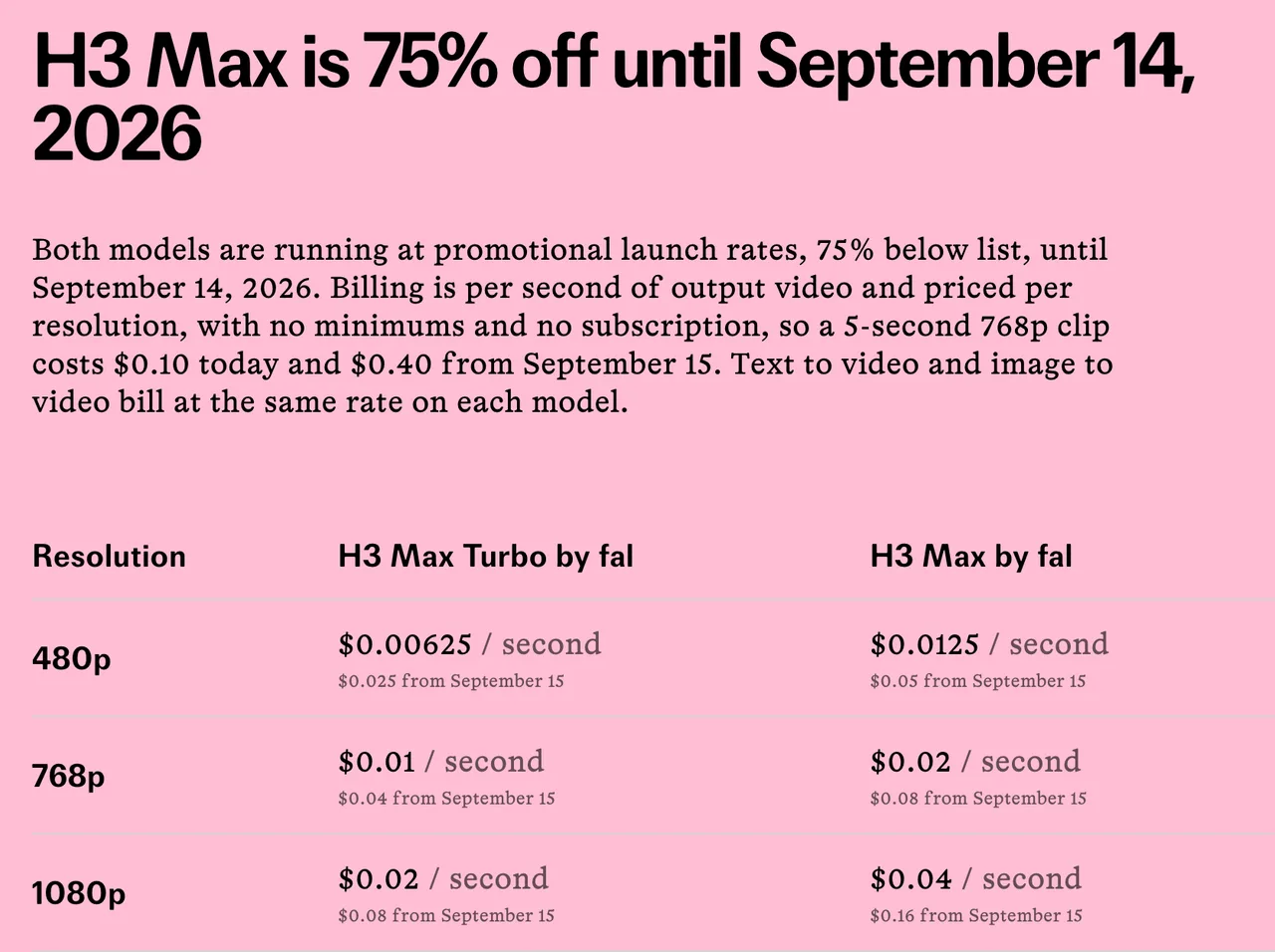
The current MiniMax H3 Max page lists 480p, 768p, and 1080p; the API schema describes 1080p as latent refinement from a native 768p source, while 2K work is directed to standard H3. The image-to-video schema also lists a 1080p option described as latent refinement from a native 768p source. Treat the active route schema as the request-time authority and verify the delivered file.
Available controls include seed, safety checking, prompt expansion, and first and last images on the image route. A seed helps trace a run but does not guarantee identical output after an endpoint update.
Provider-specific claims require independent checks
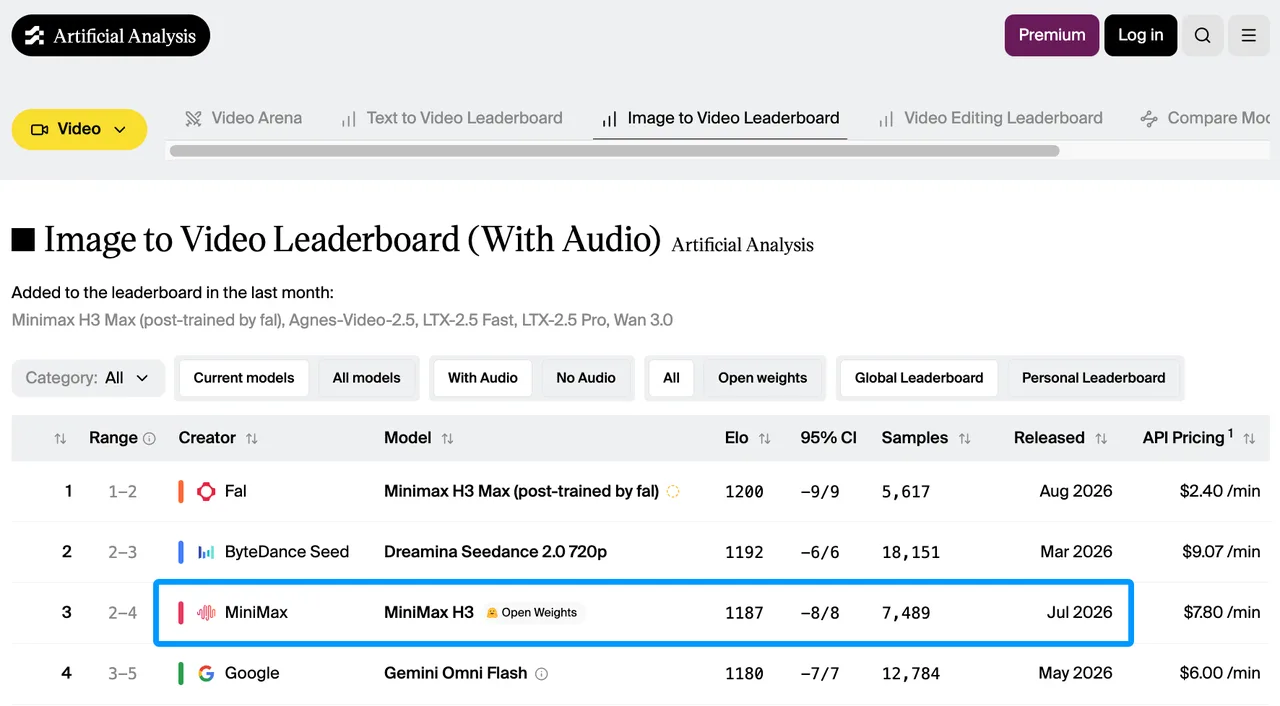
fal’s evaluation supports a pilot; it does not establish performance on your briefs. The Artificial Analysis image-to-video leaderboard provides an independent preference signal for H3 Max with audio, but it does not verify fal’s 35× claim or your end-to-end latency.
Run at expected concurrency and different times. Keep failed outputs and request evidence, then compare accepted-draft time with the incumbent route. This cannot be judged by feel. It needs a sample run.
FAQ
Can teams pin an H3 Max model revision?
The checked schema has no documented revision parameter. The endpoint points to the active deployment. Teams needing immutable behavior should ask fal about versioning and deprecation notice, and archive the schema, endpoint ID, prompts, seed, and evaluation date.
Which H3 Max output containers are available?
The text-to-video schema example shows video/mp4. Async results return a hosted URL; sync_mode can return base64 data. No output-container selector is documented.”
Are H3 Max videos visibly watermarked?
The current model page and schema neither state that outputs carry a visible watermark nor expose a watermark control. That is not a guarantee of watermark-free delivery. Inspect files and confirm requirements with fal.
Where is H3 Max API access regionally available?
No H3 Max-specific country list or region selector is published in the checked documentation. Confirm market availability, processing location, and residency requirements directly with fal.
Does H3 Max expose request-level usage metadata?
Calls provide a request ID, queue status, logs, and optional timing data. fal’s platform usage API reports unit quantity and price by endpoint, but the H3 Max result object has no dedicated billing record. Join platform records with an internal request ledger.
Conclusion
The reported H3 Max speed could turn generation into an active review loop, but 35× alone cannot approve a production route. The H3 Max review verdict is to pilot one fixed draft-review-rerun workflow and require better p95 completion time without lowering the usable-output rate.
Previous posts:
/filters:quality(82)/media/images/660b4b48-6351-40cd-ba00-51322b7455f4.webp)
/filters:quality(82)/media/images/273bf240-30e3-4e6c-8ae4-e3346b487bc7.webp)
/filters:quality(82)/media/images/bb7ec772-f694-45f4-9a9a-c0e5fd2e7d60.webp)
/filters:quality(82)/media/images/444431ee-1387-4a40-81ad-866e095a7c75.webp)
/filters:quality(82)/media/images/81212eb5-4b43-4cc4-92f4-38a0c439d258.webp)
/filters:quality(82)/media/images/5f15570a-6a68-432e-a6f1-1dcbf799ba81.webp)