
Real-Time AI Video Generation: Inside Infinite TV
Trace Infinite TV's real-time AI video generation pipeline from chat input through LTX generation, continuity handling, and RTMP delivery.
In a live stream, the failure point is rarely “can the model make a clip?” The harder question is whether real-time AI video generation can keep moving while chat input, prompt state, LTX rendering, frame buffering, and RTMP delivery all run at once. Infinite TV is useful because its README and code show the pipe.
As of September 4, 2026, this is a code-and-docs read.
From Twitch Chat to a Video Prompt
Input Filtering and Prompt State
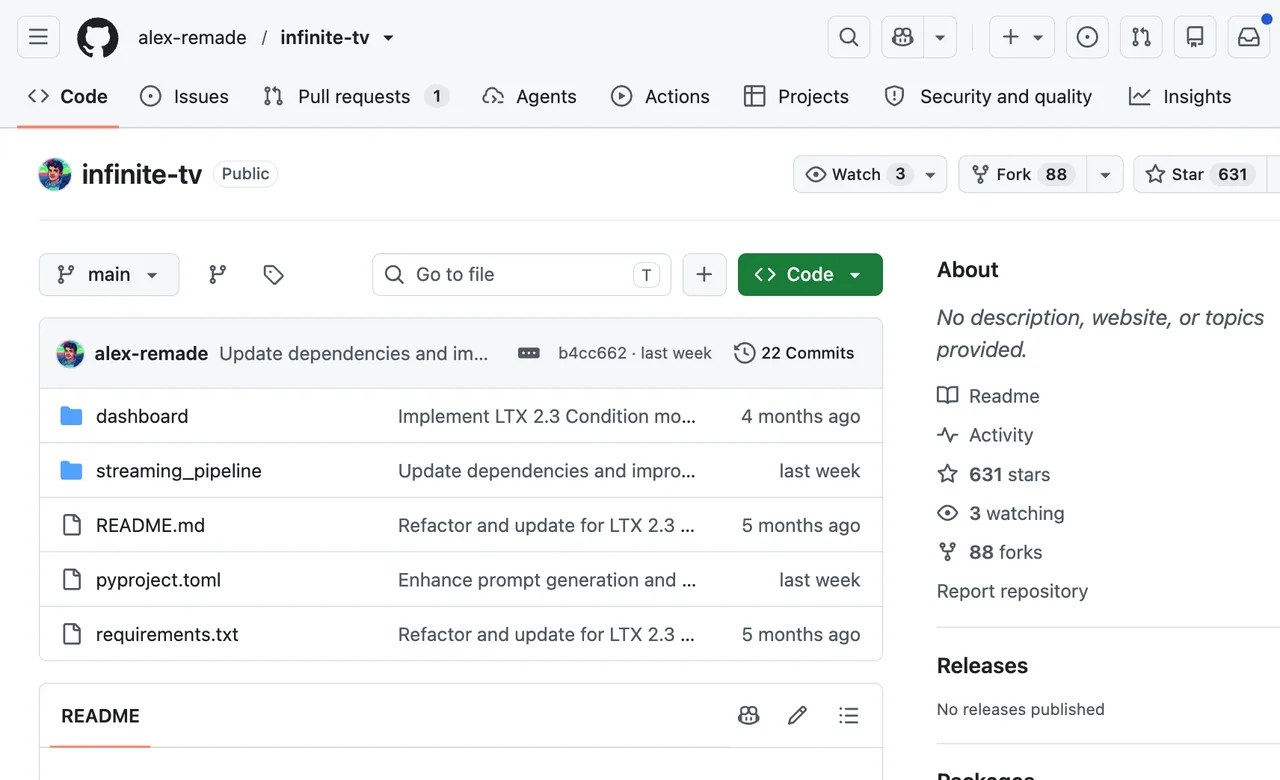
The Infinite TV GitHub repo describes a realtime LTX demo that listens to Twitch chat, generates contextual video, adds text overlays, and streams to RTMP endpoints. The named pieces are present under streaming_pipeline/ and dashboard/.
Twitch IRC -> Prompt Generator -> LTX Video Generator
           -> Frame Processor -> Text Overlay -> FFmpeg RTMP Stream -> Twitch
The Twitch chat video pipeline connects to irc.chat.twitch.tv:6667, joins with a generated justinfan... name, parses PRIVMSG, and stores username, message, and timestamp in a bounded queue. The official Twitch IRC docs describe IRC limits, duplicate or out-of-order messages, and PING/PONG keepalive requirements. The code recognizes PING, but I did not see it send PONG. I would fix that before volume testing.
Filtering is mostly prompt selection, not moderation. The prompt generator asks an LLM to choose or ignore recent comments, include visual context when available, and return JSON. That can keep a story moving. It does not replace policy filters, blocklists, or moderator override.
Queueing and Generation Triggers
The Twitch comment queue maxes at 100 items. The generation loop pulls queued comments, asks for the next prompt after the latest video has produced a fresh frame, then immediately starts another pass. This design favors continuity over maximum parallelism.
Before running further, I would log comment arrival time, selected comment, generated prompt, model route, generation time, frames queued, frames dropped, and recovery after errors.
How LTX Frames Become a Continuous Stream
Context, Looping, and Scene Handoffs
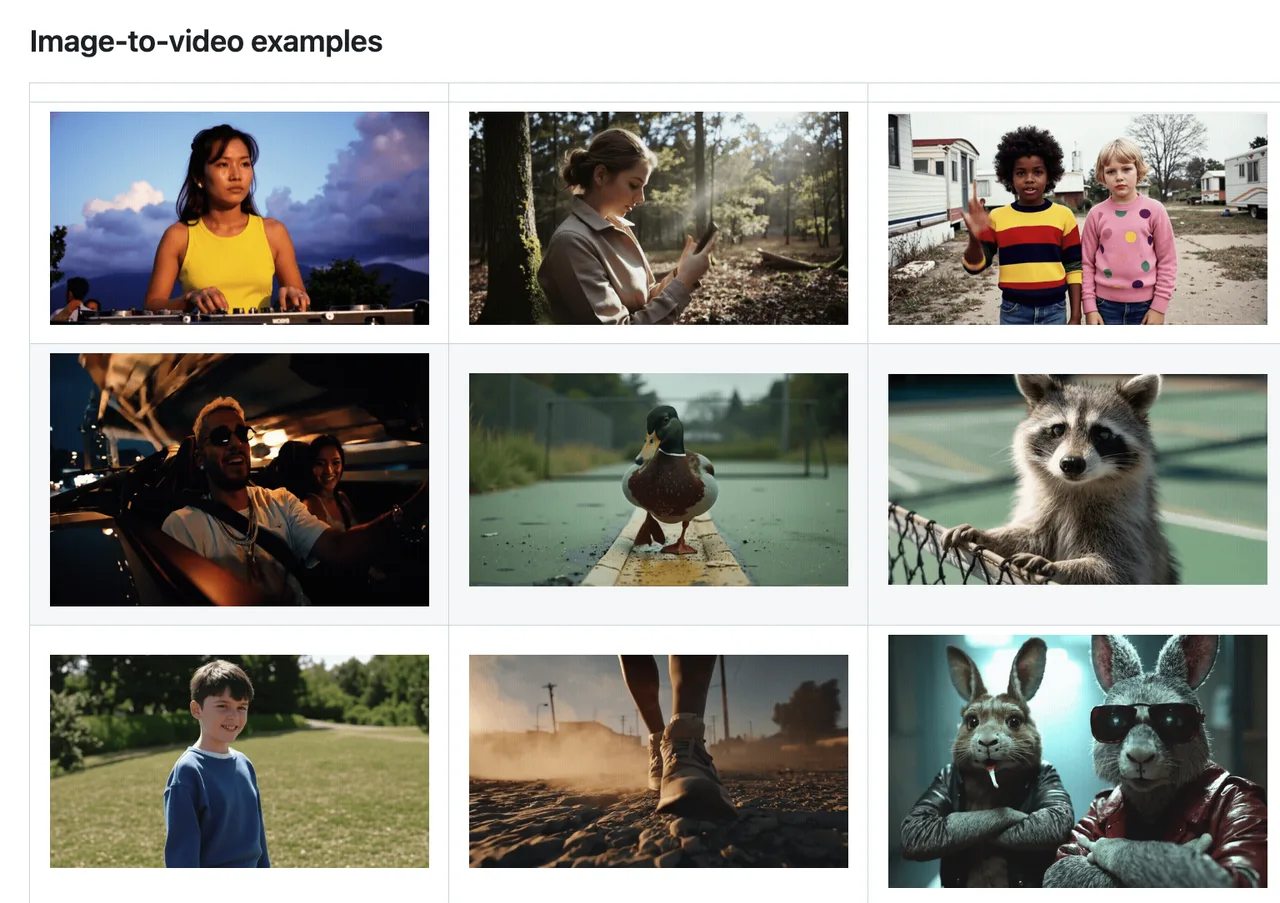
For LTX video streaming, Infinite TV has several routes. Infinite TV lists local Hugging Face LTX and hosted fal.ai backends; the code includes local LTX 0.9.8, local LTX 2.3 variants, and a hosted fal-ai/ltx-2.3/image-to-video/fast call. LTX is a Lightricks model family; the official LTX-Video repo is the source to watch for capabilities and licenses.
Scene continuity is handled operationally. The engine stores the last frame as base64, passes it into the next request, and appends prompts to previous_prompts. For the hosted path, the code sends a data URI plus prompt to fal, downloads the returned video, extracts frames, and feeds them to the streamer. The fal LTX 2.3 API docs confirm image URL or data URI inputs, queued jobs, output video URLs, duration ranges, resolution options, FPS options, and optional audio. Infinite TV’s hosted call sets generate_audio to False.
Encoding and RTMP Delivery
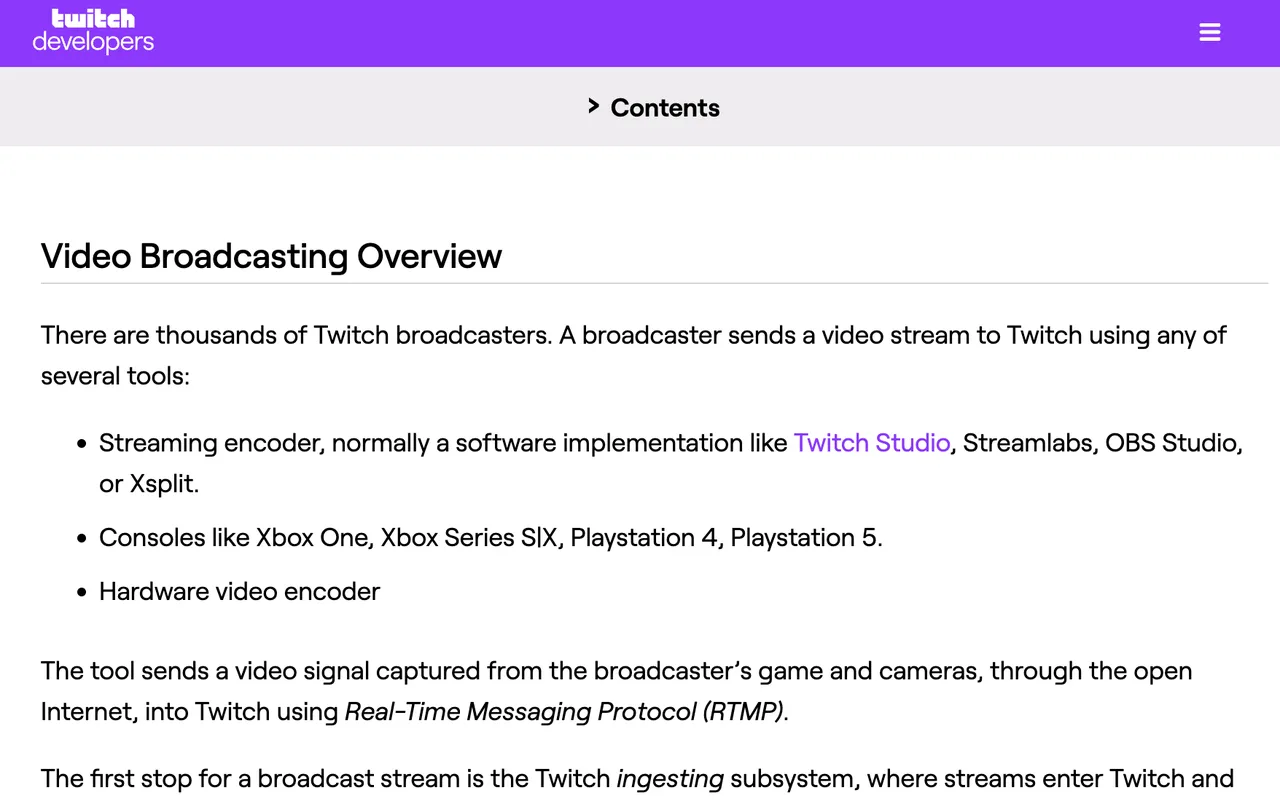
The RTMP AI stream is driven by FFmpeg. FFmpegRTMPStreamer pipes raw RGB frames into FFmpeg, encodes H.264, uses AAC audio, and outputs FLV to rtmp://live.twitch.tv/app/{stream_key}. Twitch’s video broadcast docs use the same RTMP stream-key shape for ingest.
The frame queue is the live buffer. If it fills, the streamer drops the oldest frame. If it empties, it repeats the last real frame with slight variation or shows a placeholder. That is a sensible demo tactic. It also shows the production floor: when generation is slower than playback, continuity becomes synthetic.
Bottlenecks Builders Must Engineer Around
Latency, Backpressure, and Failure Recovery
Real-time here means orchestrated continuity, not zero-latency generation. Chat can arrive faster than video models render. The code handles that by sampling recent comments, keeping queues bounded, retrying prompt generation in text-only mode after some rate-limit failures, and continuing after generation errors.
Useful, but incomplete. I would add backpressure rules: drop low-signal chat, rate-limit repeated users, cap prompt retries, freeze scene state after repeated video failures, and expose “stale frame seconds” as a metric. This cannot be judged by feel. It needs a sample run.
Observability and Production Hardening
The project has monitoring hooks: logs for server, generation, and queue behavior; dashboard metrics for FPS, latency, success rate, frame buffers, memory, errors, and chat activity; WebSocket metrics on /metrics/ws. That is the right direction for live video orchestration.
The hardening list is longer: authenticated chat, PING/PONG, moderation, stream-key secrecy, model-route pinning, retention rules, provider fallback, and a stop button operators trust. Demos show the ceiling. Production shows the floor.
FAQ
What license governs commercial deployment of the Infinite TV codebase?
The README says the project is MIT licensed, but the expected LICENSE file returned 404 during this check. Treat the README as a signal, not a legal review. Commercial use also depends on LTX, fal, Twitch, and prompt-model terms.
Which GPU models does Infinite TV officially support for self-hosting?
I did not find a formal self-hosted GPU matrix in the checked Infinite TV README or repository. The FAL app code references GPU-B200, while LTX docs mention hardware for their own models. Do not translate that into Infinite TV support.
Does Infinite TV retain Twitch account identifiers after streams end?
The listener stores username, message, and timestamp in memory. It does not populate user_id in the visible anonymous parser, but logs may print usernames and messages. I did not find a retention policy.
Can Infinite TV archive generated segments for later replay?
Not as a documented feature. The hosted path receives video URLs and extracts frames; local paths return frames. Segment storage would be extension work, not current pipeline behavior.
Can generated audio stay synchronized with live video?
Partly, but verify it. Local LTX 2.3 code includes PCM conversion and frame-rate alignment. RTMP can enable native audio. The hosted fal path disables generated audio, so hosted sync is not demonstrated there.
Real-time AI video generation in Infinite TV is best read as live orchestration: chat intake, prompt state, LTX generation, frame buffering, encoding, and monitoring. It is not a turnkey production stream. The next engineering step is one controlled session with logs, not a public launch.
Previous posts:
/filters:quality(82)/media/images/b73c2438-6bdd-4b80-a229-8d71d8f819cf.webp)
/filters:quality(82)/media/images/427fd9f2-347d-4f86-a2d5-aee110cda01d.webp)
/filters:quality(82)/media/images/1773962750383987480_n3hqzHRZ.webp)
/filters:quality(82)/media/images/43fa0e7f-a0db-48d7-9bab-921d1225db30.webp)
/filters:quality(82)/media/images/5799ff56-3a73-40ca-a666-e4965d878496.webp)
/filters:quality(82)/media/images/7a8850fc-caf6-482f-ac4d-5ddbe64ec47c.webp)