
Runway Solaris Review: What We Know So Far
This Runway Solaris review summarizes confirmed interface-generation capabilities, early-access status, and what builders should verify after launch.
A generated interface demo can push a team into planning too early. The risk is building a prototype schedule around an early-access neural software surface. This Runway Solaris review is for AI builders deciding whether Solaris belongs in a generative interface backlog now, before Runway confirms access, controls, pricing, and API shape.
Checked on September 2, 2026. I did not run Solaris, and I did not find a reproducible third-party product review.
What Runway Has Confirmed About Solaris

Interface World Model Scope
Runway introduced Solaris on August 31, 2026 as the first model in a family it calls Interface World Models. In the Solaris announcement, Runway describes a system that generates apps and websites as they are used, with the screen itself rendered by the model.
This is not a public React generator, a UI kit, or a published operating system. The confirmed scope is narrower: a visual interface is generated directly, without first translating the design into HTML, CSS, or another intermediate layer. For builders, the near-term use case is prototype exploration for Runway Interface World Model behavior, not replacing production frontends.
Generated Frames and Interactive State
Runway says Solaris synthesizes every frame while the user interacts. Clicks, drags, and typed instructions condition the next frames. A language model decides how the scene should evolve, while the world model renders the visual response.
The public description says a user provides a starting state, such as a brand environment or product scene, and Solaris streams frames as the session changes. Runway names three engineering targets: real-time interaction, session coherence, and 720p visual quality. Those are targets to verify, not guarantees to build a launch plan on.
What Early Access Shows So Far
Public Demonstrations and Confirmed Behaviors
The public demos show direct manipulation: moving furniture, changing colors, building a salad, dragging objects, and creating interactive demonstrations. That supports one practical reading. Solaris is aimed at interactive generation where the state is visual, spatial, and motion-heavy.
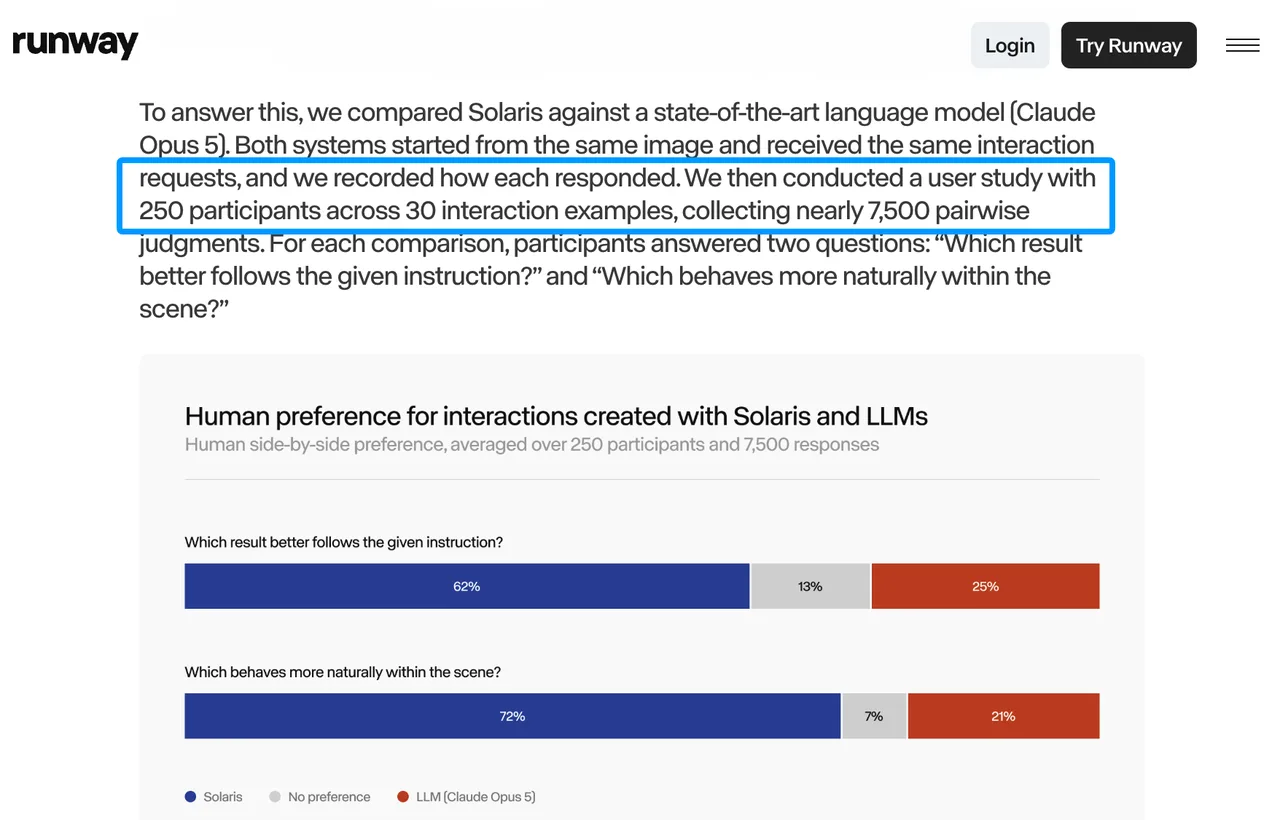
Runway also reports an internal user study with 250 participants, 30 interaction examples, and nearly 7,500 pairwise judgments. Participants preferred Solaris over coded interface results in Runway’s measured categories. Keep the label on that evidence: vendor-reported, useful for framing a pilot, and not an independent benchmark.
Limits of Pre-Launch Evidence
The strongest part of the announcement is that it names the hard parts. Runway says stable real-time text is still difficult, trust in instructional or commercial sessions remains active research, long sessions can drift, and accessibility/integration still need work.
Those limits are not footnotes. Interface prototypes fail on labels, disabled states, keyboard behavior, repeatable controls, and audit trails. Demos show the ceiling. Production shows the floor. For real-time AI interfaces, Solaris is still closer to a research preview than a production component.
What Builders Should Verify After Launch
Access, Controls, and Repeatability
The current public path is an early-access request form. Runway says it is working with key partners toward a public launch, but it does not publish a general availability date, acceptance criteria, model ID, rate limit, or self-serve developer path for Solaris.
When access opens, run one fixed prototype: a product configurator with one reference scene, five allowed actions, and ten invalid actions. Log the starting state, prompt, references, interactions, outputs, and recovery behavior. If a generated control changes meaning after three actions, stop. That is the sample run doing its job.
Pricing, Licensing, and API Availability
Pricing is not disclosed for Solaris. A public Solaris endpoint is also not visible in the current Runway API reference, which lists other generation and realtime-session surfaces but not Solaris as a confirmed model route. Do not assume existing API economics apply.
Licensing is conditional too. Runway’s Terms of Use says Runway does not claim ownership of user content, but Solaris-specific early-access terms for imported scenes, generated frames, and interactive sessions are not disclosed on the announcement page. Commercial use needs contract review before any customer-facing pilot.
FAQ
Does Solaris retain prompts or generated session data after early access?
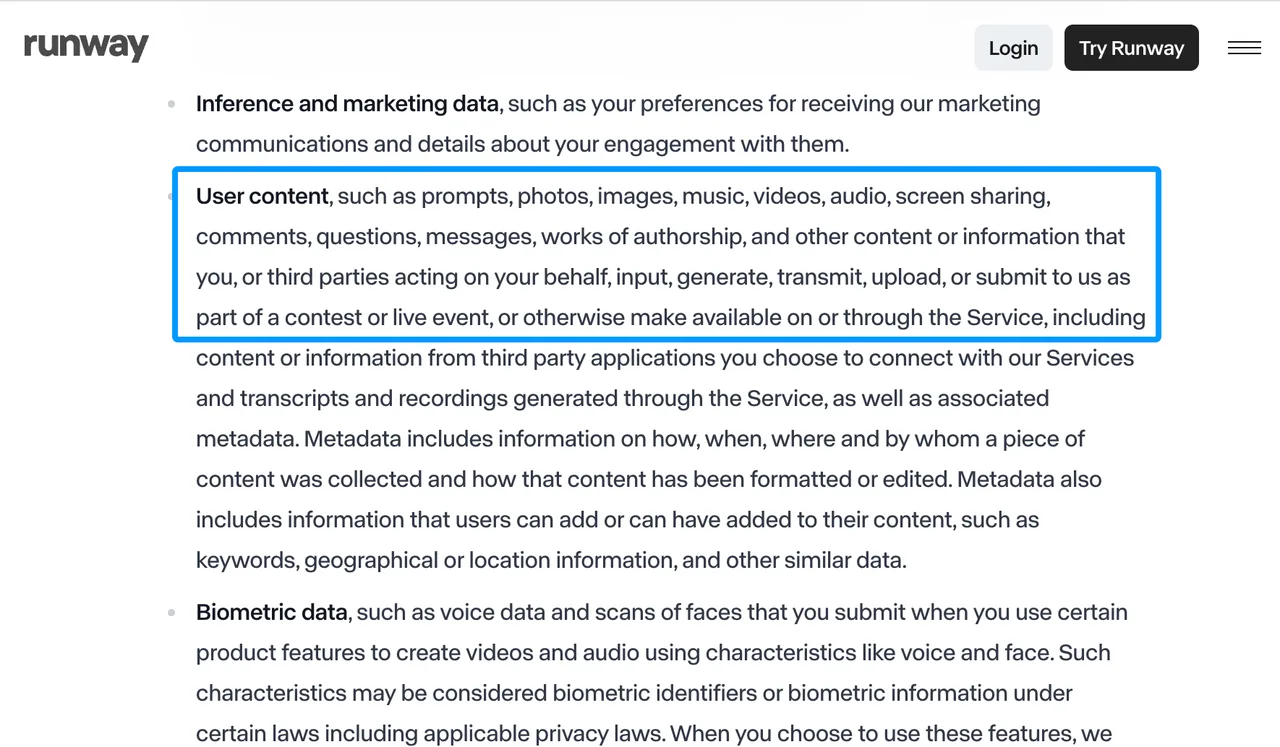
Runway has not published Solaris-specific retention language. The general Privacy Policy says user content can include prompts, outputs, uploaded media, and metadata, and that information is retained as needed for service, safety, security, compliance, and dispute resolution. Treat early-access terms as the controlling document.
Which content moderation rules apply to Solaris-generated interactive interfaces?
No Solaris-specific moderation rules are public yet. The general Runway Usage Policy applies automated systems and internal human review to inputs and outputs, with prohibitions around child safety, explicit content, rights violations, misleading content, harassment, hate, self-harm, and other harmful use.
Can teams report Solaris security issues through Runway’s disclosure program?
Runway’s data security page says it runs a private bug bounty for select researchers and does not permit unauthorized scanning. For Solaris, teams should ask for the approved disclosure route before testing session security or prompt-driven control abuse.
Does Solaris preserve provenance metadata for imported and generated assets?
Runway says it implements C2PA so AI-generated content can be traced to its source, but I did not find a Solaris-specific provenance guarantee for generated session frames or imported references. Ask whether each frame, exported clip, or saved state carries verifiable credentials.
Does Solaris expose accessibility semantics for generated controls?
Not confirmed. Runway identifies assistive technologies and accessibility APIs as an open integration challenge. Until Solaris exposes roles, names, state, focus order, and keyboard behavior, treat generated controls as visual prototypes rather than accessible software.
For now, the Runway Solaris review verdict is simple: put it on the pilot list, not the production plan. The first launch test should prove repeatability, text stability, control semantics, data terms, and API access before a team builds around it.
Update note: Solaris remains in early access as of publication. We will revise this article when Runway confirms public access, pricing, API availability, or production capabilities.
Previous posts:
/filters:quality(82)/media/images/b73c2438-6bdd-4b80-a229-8d71d8f819cf.webp)
/filters:quality(82)/media/images/427fd9f2-347d-4f86-a2d5-aee110cda01d.webp)
/filters:quality(82)/media/images/1773962750383987480_n3hqzHRZ.webp)
/filters:quality(82)/media/images/43fa0e7f-a0db-48d7-9bab-921d1225db30.webp)
/filters:quality(82)/media/images/5799ff56-3a73-40ca-a666-e4965d878496.webp)
/filters:quality(82)/media/images/7a8850fc-caf6-482f-ac4d-5ddbe64ec47c.webp)