
HUMAIN M3 Benchmark: Reading the Arabic Scores
HUMAIN M3 benchmark results explained through test scope, prompting, and missing evidence so builders can judge the Arabic scores responsibly.
John. A benchmark table can move a model onto a shortlist too quickly. That is the risk here. The HUMAIN M3 benchmark numbers on the current Node page look strong, but they are HUMAIN’s own evaluation of a preview checkpoint, not an independent retest. For an Arabic AI team, the job is simple: read what the scores cover, mark what they miss, then rerun the model on your own Arabic workload.
What the Seven Arabic Benchmarks Measure
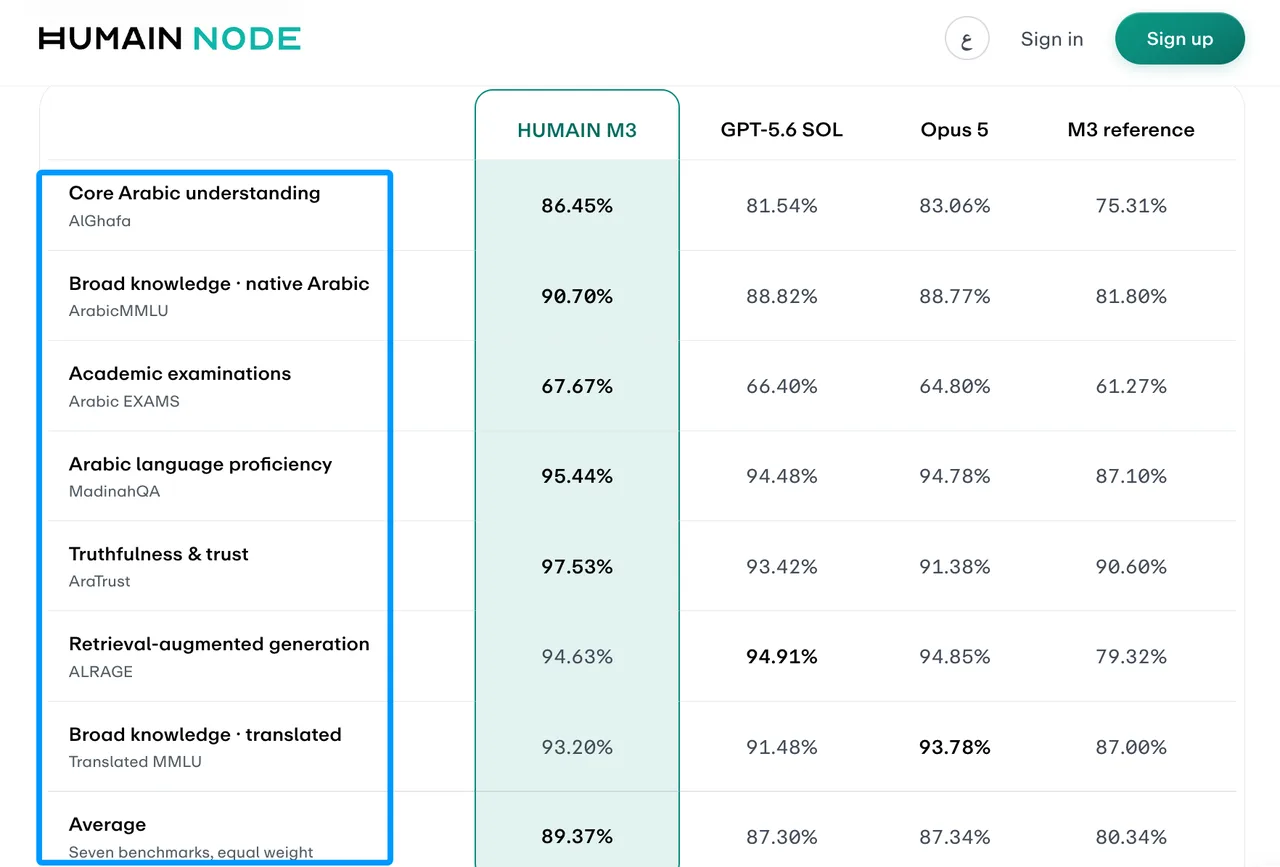
The HUMAIN Node page says its suite spans core Arabic understanding, native and translated knowledge, academic examinations, language proficiency, truthfulness, and retrieval-augmented generation.
The benchmark names also line up with the Open Arabic LLM Leaderboard v2 family described in the OALL v2 announcement.
Read them as seven slices, not one truth meter:
- AlGhafa: core Arabic understanding across native Arabic NLP tasks.
- ArabicMMLU: broad native-Arabic knowledge in Modern Standard Arabic.
- Arabic EXAMS: academic examination-style questions.
- MadinahQA: Arabic language and grammar proficiency.
- AraTrust: truthfulness, safety, and trust checks.
- ALRAGE: Arabic retrieval-augmented generation.
- Translated MMLU: broad knowledge through a translated route.
That is a useful Arabic model benchmark bundle. It is still mostly text. It does not prove dialect handling, product RAG quality, multimodal reliability, or tool-use behavior.
How HUMAIN M3 Compares in the Published Table
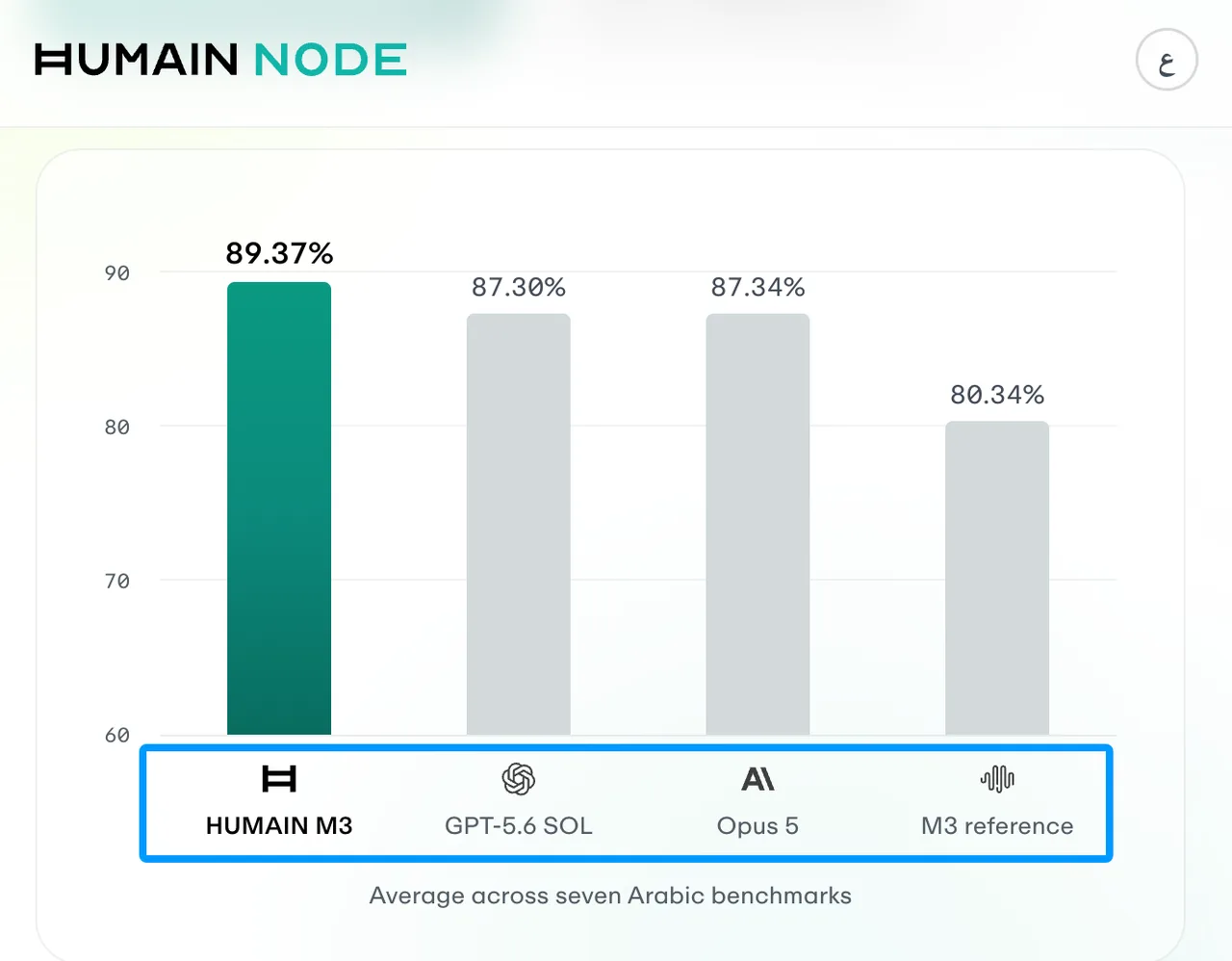
HUMAIN reports the previewed humain-m3 checkpoint at 89.37% average across seven equally weighted Arabic benchmarks. The same table reports GPT-5.6 SOL at 87.30%, Opus 5 at 87.34%, and the M3 reference at 80.34%.
The individual HUMAIN M3 evaluation scores are 86.45% on AlGhafa, 90.70% on ArabicMMLU, 67.67% on Arabic EXAMS, 95.44% on MadinahQA, 97.53% on AraTrust, 94.63% on ALRAGE, and 93.20% on Translated MMLU. HUMAIN says the model leads five of seven benchmarks.
This is enough to justify a retest. It is not enough to skip one.
Stronger and Weaker Result Areas
The strongest visible areas are AraTrust and MadinahQA, both above 95%. ArabicMMLU also clears 90%, which is useful for native Arabic knowledge tasks.
The weaker reading starts in two places. Arabic EXAMS is the lowest absolute score at 67.67%, so education, exam-prep, and academic QA teams should not judge by the average alone. HUMAIN M3 also does not lead ALRAGE or Translated MMLU. GPT-5.6 SOL is slightly higher on ALRAGE, while Opus 5 is higher on Translated MMLU.
The Reference Model and Comparator Setup
The cleanest comparison is against the M3 reference. HUMAIN reports 80.34% average for that reference and 89.37% for HUMAIN M3, supporting its claim that Arabic post-training adds about nine points on average.
The frontier comparator setup needs caution. The public page does not show full harness details, prompt templates, sampling settings, exact model versions, raw outputs, confidence intervals, or contamination checks.
Evidence the Scoreboard Does Not Provide
The scoreboard does not answer the production questions I would ask before deployment:
- Which dialects were separated?
- Were retrieval answers judged on your domain corpus?
- How did long Arabic documents, tables, PDFs, or mixed Arabic-English records behave?
- Did tool calls complete correctly?
- Were image and video inputs evaluated with published multimodal metrics?
- What changed between preview checkpoints?
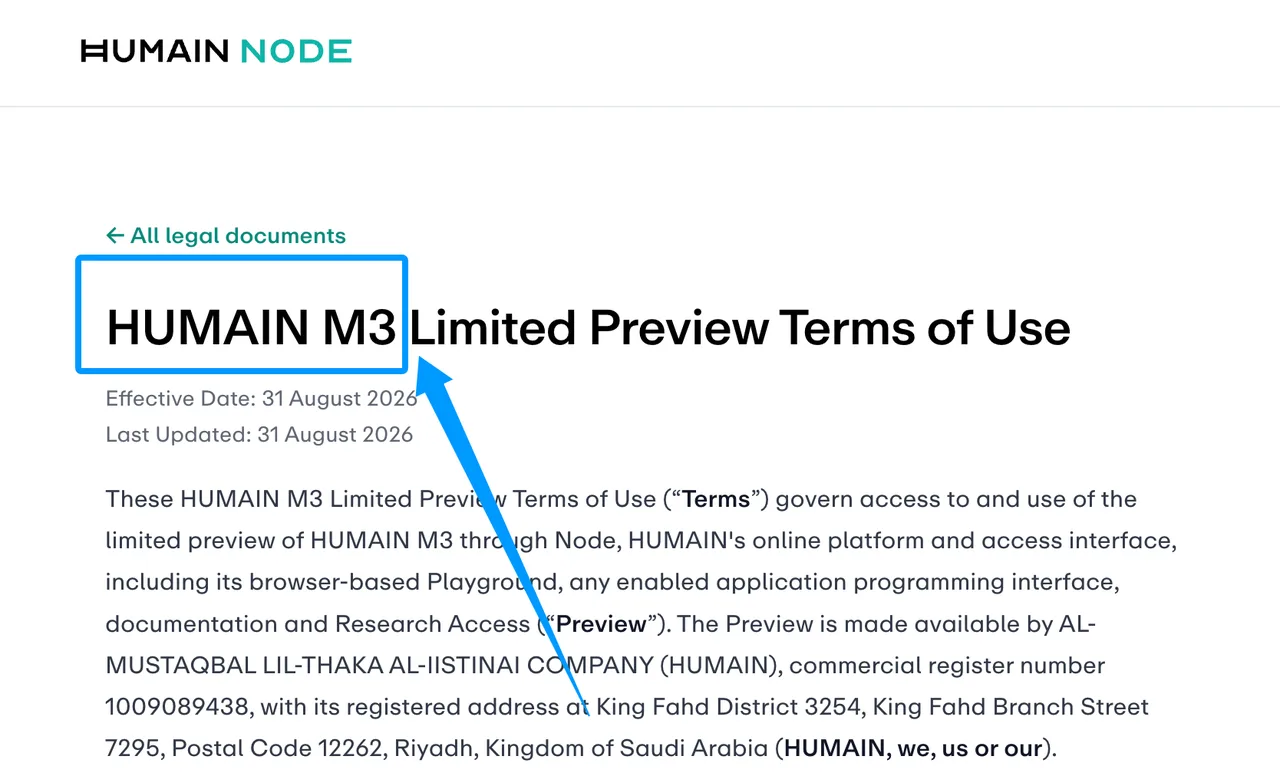
The legal boundary matters. The HUMAIN terms describe HUMAIN M3 as experimental, incomplete, and not production-grade. They also say access is for evaluation, testing, and non-production prototyping. A shortlist can start from the scoreboard. A production decision cannot.
Add a Product-Specific Arabic Evaluation
Dialect and Retrieval Tasks
Build a private Arabic evaluation set before any go-or-no-go decision. Use real task shapes, but scrub sensitive data. Include support turns, search queries, policy questions, product names, named entities, and dialect-heavy messages.
For RAG, test answer faithfulness, citation grounding, refusal behavior, and Arabic morphology in retrieval. ALRAGE is a useful signal, but your corpus decides the floor. Demos show the ceiling. Production shows the floor.
Multimodal and Tool-Use Checks
HUMAIN says M3 is natively multimodal and built for agentic work, including images, video, tool use, and long-horizon workflows. Treat that as a claim to evaluate, not a passed acceptance test.
Run screenshot QA, form-reading tasks, short video understanding, and tool workflows with failed-tool recovery. Log latency, refusal rate, wrong-tool calls, and reviewer overrides. The HUMAIN privacy notice says prompts and responses are recorded during preview, so do not use confidential production data.
FAQ
Can companies license HUMAIN benchmark tables for internal reports?
HUMAIN does not publish a separate benchmark-table license on the Node page. For internal reports, quote sparingly, attribute HUMAIN, and ask legal before redistribution. This is not legal advice.
Does HUMAIN provide downloadable benchmark data in machine-readable formats?
Not from the Node page I checked. HUMAIN publishes the table on-page, but I did not find raw run data, configs, or JSON/CSV results.
Does HUMAIN disclose energy use for its benchmark runs?
Not on the Node page I checked. The official page discloses scores and model-scale claims, but I did not find energy, hardware use, or carbon reporting.
Does HUMAIN assign persistent identifiers to published benchmark revisions?
Not publicly on the Node page. Legal documents have update dates, but the benchmark table does not show a DOI, commit hash, or revision ID.
Can researchers submit corrected results to HUMAIN benchmark repositories?
I did not find an official HUMAIN benchmark repository or correction workflow. Independent OALL submissions belong to the OALL process, not HUMAIN’s self-reported table.
Conclusion
The HUMAIN M3 benchmark is strong enough to earn a shortlist slot for Arabic-first AI teams. The average is high, the gains over the M3 reference are clear, and the seven-benchmark spread covers more than one narrow task.
But it is still a vendor-published preview table. Before adopting HUMAIN M3, rerun your own dialect, RAG, multimodal, and tool-use checks with versioned prompts and clean failure logs. This conclusion only fits the published evidence as of September 7, 2026.
Previous posts:
/filters:quality(82)/media/images/5f15570a-6a68-432e-a6f1-1dcbf799ba81.webp)
/filters:quality(82)/media/images/b73c2438-6bdd-4b80-a229-8d71d8f819cf.webp)
/filters:quality(82)/media/images/427fd9f2-347d-4f86-a2d5-aee110cda01d.webp)
/filters:quality(82)/media/images/1773962750383987480_n3hqzHRZ.webp)
/filters:quality(82)/media/images/43fa0e7f-a0db-48d7-9bab-921d1225db30.webp)
/filters:quality(82)/media/images/5799ff56-3a73-40ca-a666-e4965d878496.webp)