
Claude Fable 5.1 Review for Long-Running Work
Claude Fable 5.1 review for builders deciding whether its long-running work capabilities justify a premium route in their model stack.
It’s Dora here. I began this Claude Fable 5.1 review with the part that usually gets less applause: routing hygiene. Not a leaderboard screenshot. Not a launch quote. The practical question is what happens after the model has been working for hours, a tool call fails, a safety fallback appears, and the product team still needs a result they can explain.
That is the only decision this review covers. Should Fable 5.1 enter a premium route for high-value builder work, or should teams keep most traffic on cheaper models until internal evals prove the difference? I did not run private tests. This is a launch-day source review for AI product leads and platform engineers evaluating long-running AI tasks.
Quick Verdict for Long-Running Builder Workloads
Fable 5.1 is worth testing as a premium route. I would not make it the default route on launch week.
Anthropic’s Claude Fable page presents Fable 5.1 as its strongest generally available model for coding, knowledge work, agents, and long-running projects. The claim is not just higher reasoning. The pitch is sustained work: planning, using tools, recovering when steps fail, reading visual context, and keeping users updated while a task runs.
That matters. A weak model can look acceptable in a short chat and still be costly in a six-hour agent session. It may choose the easy patch, skip evidence, forget a constraint, or stop after producing something plausible. Fable 5.1 is aimed at exactly that failure class.
Still, premium routing should stay selective. Short rewriting, metadata extraction, simple classification, first-pass summaries, and low-risk code edits do not need the most expensive path. Put Fable 5.1 where the cost of a shallow answer is higher than the model premium.
What Changes the Production Decision
Sustained Task Execution and Recovery
The real test is not whether Fable 5.1 can solve one dramatic prompt. The real test is whether Fable 5.1 agents can keep their shape across phases: inspect, plan, modify, test, repair, and summarize.
For production, I would require checkpoints, tool transcripts, retry records, budget limits, and final evidence. If the model recovers from a failed step but your system cannot show what happened, the route is not ready. Long-running work needs memory, but it also needs receipts.
This is where Fable 5.1 looks most relevant. The launch materials point toward multi-hour coding, cross-application workflows, and complex knowledge work. My inference is narrow: test it first on tasks where human review time is expensive and where earlier models tend to lose the plot.
Multimodal Context and Output Review
Fable 5.1 supports text and image input with text output. That is useful for builder work because many failures are not visible in plain text. A UI can compile and still miss the design. A chart can be present but misread. A slide deck can answer the question and still look unusable.
Multimodal review should be treated as a quality gate, not proof. Use it to inspect screenshots, tables, diagrams, and generated artifacts before a human reviewer opens the result. The model can catch mismatches earlier. Final acceptance still belongs to the team.
Latency and Oversight Trade-Offs
Fable 5.1 is not the route for impatient chat. It is for asynchronous work where a slower answer may still be cheaper than cleanup.
The oversight model should be explicit. Set maximum runtime, maximum tool calls, spend limits, failure states, and escalation points. A premium route without job control becomes expensive optimism. A premium route with good observability can become a useful queue for work that used to require a senior engineer’s uninterrupted afternoon.
Where Fable 5.1 Fits in a Routing Stack
Premium Route for High-Value Tasks
In Claude model routing, Fable 5.1 belongs at the top of the stack for jobs with high review cost: cross-repo debugging, multi-hour coding changes, incident analysis, dense research, financial or legal document review, and agent workflows that cross several tools.
Artificial Analysis reports strong results for Fable 5.1, including top-tier intelligence measurements. That is third-party measurement, not your production workload. Treat it as a reason to build an eval, not as permission to reroute everything.
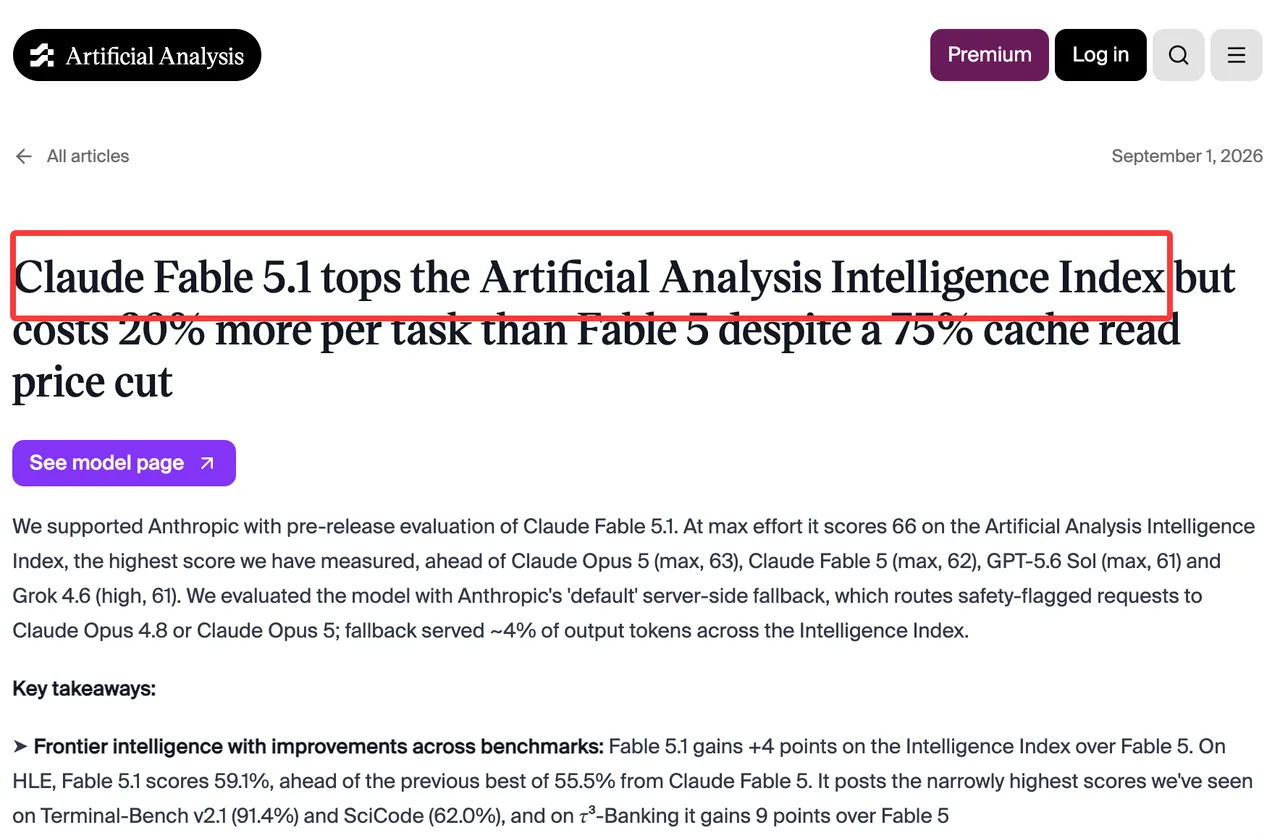 The route reason should be logged. So should task type, expected duration, tools allowed, actual model returned, fallback events, total cost, and reviewer outcome. A good frontier model review ends in instrumentation, not vibes.
Lower-Cost and Fallback Routes
Cheaper models still have a place. Use them for triage, short drafts, simple transforms, routing decisions, and tasks where a bad answer is easy to discard. Send only the hard remainder to Fable 5.1.
Fallback also needs care. Anthropic’s refusals and fallback documentation describes safety refusals, fallback response fields, and beta server-side fallback behavior. It also separates safety fallback from rate limits, overload, and server errors. Your usage reporting should keep those cases separate.
Limits of a Launch-Day Review
This is where my data ends: I did not run Fable 5.1 against a private workload, and launch claims need local proof.
Before production use, I would test four owned workflows: a long coding change, a failure-recovery task, a multimodal artifact review, and a document-heavy research job. Measure completion quality, reviewer edits, fallback rate, latency, cost, tool failures, and audit quality. Also compare against Opus, Sonnet, and your current fallback stack. The useful number is not “best model.” It is “least total cost for accepted work.”
Data policy is another gate. Anthropic’s API and data retention documentation describes Fable 5.1 as a Covered Model with 30-day retention unless otherwise authorized. That matters for regulated workloads, customer data, and internal repositories. Check contract terms before sending sensitive tasks.
FAQ
Which cloud marketplaces currently list Claude Fable 5.1?
Anthropic’s public materials state that Fable 5.1 is available through its platform and major cloud routes, including AWS, Google Cloud, and Microsoft Foundry. Account access and region availability still need direct verification.
What data-retention options apply to Fable 5.1 API use?
Public docs point to 30-day retention by default for Fable 5.1. Zero-retention or enterprise safeguard options require eligibility or explicit authorization.
Can teams pin a specific Fable 5.1 model snapshot?
Use the explicit model ID, claude-fable-5-1. Also log the returned model, because fallback may serve the final response.
Which regions support US-only Fable 5.1 inference?
Anthropic documents US-only inference for supported routes at premium pricing. Cloud providers handle geography through their own endpoint, deployment, or regional controls, so verify the route you actually use.
How are fallback events exposed in usage reports?
Fallback can appear through the returned model, fallback content blocks, and usage iteration records. Your product should preserve those fields instead of flattening all usage into the requested model.
Conclusion
My Claude Fable 5.1 review is simple: evaluate it for premium long-running builder work, but do not make it the default on reputation alone. It looks relevant for Fable 5.1 agents, complex recovery, multimodal review, and high-value tasks where a shallow answer wastes real time. The production decision still depends on your evals, retention requirements, fallback logging, and cost tolerance.
Previous posts:
/filters:quality(82)/media/images/b73c2438-6bdd-4b80-a229-8d71d8f819cf.webp)
/filters:quality(82)/media/images/427fd9f2-347d-4f86-a2d5-aee110cda01d.webp)
/filters:quality(82)/media/images/1773962750383987480_n3hqzHRZ.webp)
/filters:quality(82)/media/images/43fa0e7f-a0db-48d7-9bab-921d1225db30.webp)
/filters:quality(82)/media/images/5799ff56-3a73-40ca-a666-e4965d878496.webp)
/filters:quality(82)/media/images/7a8850fc-caf6-482f-ac4d-5ddbe64ec47c.webp)