
Fable 5.1 Artificial Analysis: Reading the Scores
Fable 5.1 Artificial Analysis scores explained through effort, fallback, and cost without treating a leaderboard as production proof.
I opened the Fable 5.1 Artificial Analysis article because one number was already moving faster than the model itself: first place. Useful, but incomplete. If a model platform team uses third-party rankings for a shortlist, the real work starts after the ranking. I checked the September 1, 2026 Artificial Analysis launch note and the current model page on September 7, 2026, Asia/Shanghai. Same model family. Not always the same measurement surface.
This is a note on effort, fallback, benchmark cost per task, and comparability. Not a production claim.
What Artificial Analysis Actually Tested
Index Scope and Effort Settings
Artificial Analysis tested Claude Fable 5.1 under adaptive reasoning with effort settings. The launch article reports max effort at 66 on the Intelligence Index, ahead of Claude Opus 5 at 63, Fable 5 at 62, GPT-5.6 Sol at 61, and Grok 4.6 at 61. It also reports xhigh at 65 and low at 58.
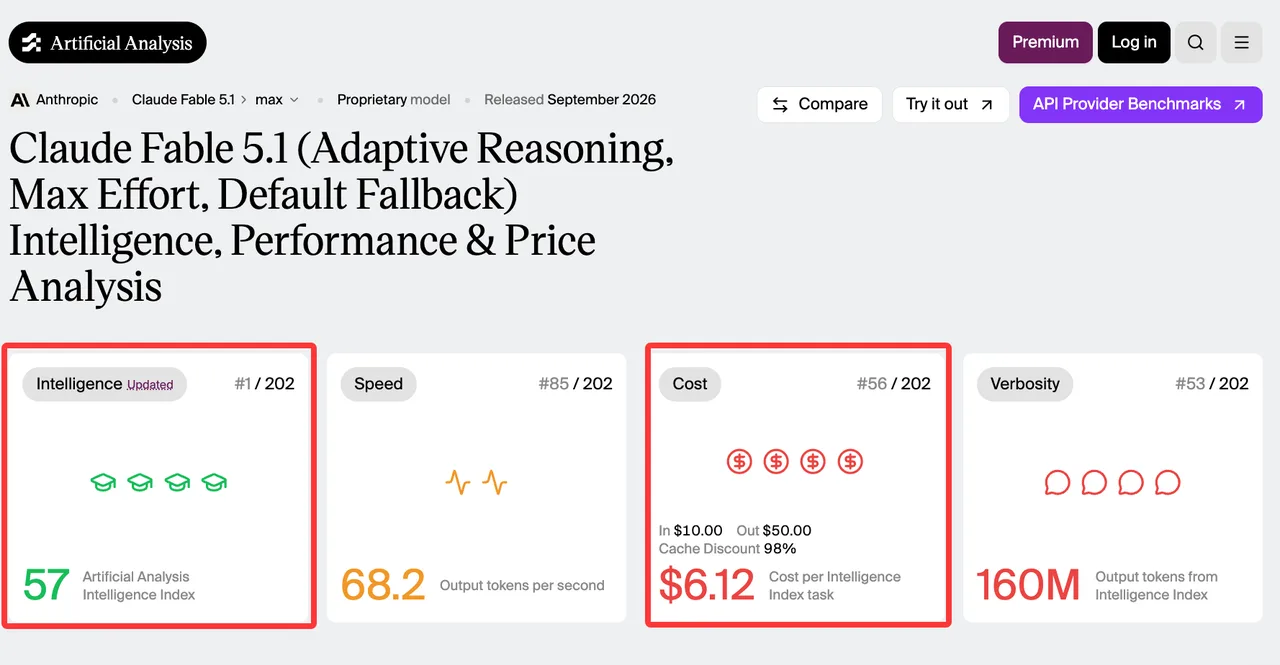
I paused here because the live page is different. The current Fable 5.1 model page I read on September 7 lists the max-effort, default-fallback variant at 57, rank #1 of 202, with $6.12 cost per Intelligence Index task. The article is a launch snapshot. The model page is the live dashboard. I would not mix those numbers without a date column.
The current Index v4.2 combines agentic work, coding, scientific reasoning, long-context reasoning, document reasoning, and knowledge reliability through 10 named evaluations. Useful for model evaluation shortlist work. Not your application workload.
Default Fallback in the Test Setup
The launch article says Artificial Analysis evaluated Fable 5.1 with Anthropic’s default server-side fallback. Safety-flagged requests could route to Claude Opus 4.8 or Opus 5, and fallback served about 4% of output tokens across the Intelligence Index.
That matters. The score is partly a configured route, not one model answering every task. Anthropic’s fallback help article describes similar behavior for Fable 5 and 5.1, including cyber and biology routing. API teams need served-model logs before comparing internal numbers with public results.
Reading Score and Cost Together
Performance Across Effort Levels
The Fable effort levels are the part I would test first. Max effort gets the headline score in the launch article. Xhigh lands one point lower at 65, with lower reported task cost. Low still reports 58, which is not a toy score.
The trap is assuming effort names transfer cleanly into production. Anthropic’s official Fable page positions the model for long-running coding and knowledge work, with 1 million tokens of context, 128K max output, and default high effort in developer docs. Artificial Analysis shows the curve. Your routing policy decides when max is worth the extra tokens.
Output Usage and Cost per Task
The launch article’s cost story is narrow. Anthropic cut cache read pricing from $1 to $0.25 per million cached input tokens, while standard input and output stayed at $10 and $50 per million tokens. Artificial Analysis says that cut saves about $1.40 per Intelligence Index task in its setup.
Then the other line hits. At max effort, the article reports $3.76 per task for Fable 5.1, 20% above Fable 5 at $3.14, because Fable 5.1 used about 1.7x the output tokens. Without the cache cut, max effort would have cost about $5.16 per task. The live model page I checked shows $6.12, with 160M output tokens for the Intelligence Index run. Date the number.
Benchmark cost per task is still useful. It forces input, cache hit, cache write, reasoning, and answer tokens into one line. It does not know your retry policy, user abandonment rate, or human review cost.
What the Ranking Cannot Decide
A public rank cannot decide production fit. It cannot decide latency tolerance, compliance review, regional processing, fallback policy, or whether users value concise answers over exhaustive ones. It also cannot decide whether a stronger attempt rate is a feature or a liability where wrong answers are expensive.
The ranking is good for a shortlist. It is weak as a deployment gate. I would use it to pick candidates for a two-day internal sweep, not to skip the sweep. Good enough. That’s the most honest assessment I can give.
Turn the Public Results Into an Internal Evaluation
Start with one real task family: coding agent, research agent, finance document review, customer operations, or long-context retrieval. Run low, medium, high, xhigh, and max. Keep prompts, tools, retrieval corpus, and cache policy fixed.
Record accepted-result rate, output tokens, cache-hit share, fallback share, total cost, and time to usable answer. Then review failures manually. A model that scores higher by answering more often may also hallucinate more often. The article notes that pattern in AA-Omniscience: higher attempt rate improved accuracy, but incorrect attempted answers also rose.
FAQ

Are the benchmark prompts released under a reusable license?
Not as a blanket package from the pages I checked. Artificial Analysis publishes methodology details and some example assets, but the article and model page do not grant a reusable license for every prompt or private test set.
Are Fable 5.1 results available through the Artificial Analysis API?
Yes, with tier limits. The Artificial Analysis API docs describe language model endpoints with Free, Pro, and Commercial access. Free exposes headline fields. Paid tiers expose more detail.
Can organizations license Artificial Analysis data for internal dashboards?
Yes, depending on tier and contract. Commercial access is used for broader provider data, performance history, and custom access. Attribution rules still apply.
Does Anthropic cite these scores in official Fable 5.1 documentation?
I did not find Anthropic citing the Artificial Analysis benchmark score in the official Fable page I checked. Anthropic publishes its own benchmark claims, customer quotes, pricing, safeguards, and availability notes.
Do cloud providers publish matching Fable 5.1 benchmark snapshots?
I did not find matching cloud-provider snapshots for the Artificial Analysis score. Anthropic lists availability through Claude API, Amazon Bedrock, Claude Platform on AWS, Google Cloud, and Microsoft Foundry. Availability is not reproduced benchmarking.
Conclusion
Fable 5.1 Artificial Analysis results are useful because they show the trade-off: high score, expensive output, meaningful cache relief, and fallback inside the measured route. The ranking belongs in a shortlist. It does not belong as a production verdict.
My working rule is simple. Read the dated article. Read the live model page. Keep effort, fallback, and cost-per-task columns separate. Then run your own workload. That’s where the answer starts.
Previous posts:
/filters:quality(82)/media/images/5f15570a-6a68-432e-a6f1-1dcbf799ba81.webp)
/filters:quality(82)/media/images/b73c2438-6bdd-4b80-a229-8d71d8f819cf.webp)
/filters:quality(82)/media/images/427fd9f2-347d-4f86-a2d5-aee110cda01d.webp)
/filters:quality(82)/media/images/1773962750383987480_n3hqzHRZ.webp)
/filters:quality(82)/media/images/43fa0e7f-a0db-48d7-9bab-921d1225db30.webp)
/filters:quality(82)/media/images/5799ff56-3a73-40ca-a666-e4965d878496.webp)