
Wan 3.0 Prompt Guide for Repeatable Video Tests
Use this Wan 3.0 prompt guide to structure motion, camera, timing, references, and audio for repeatable T2V, I2V, and R2V tests.
The fastest way to waste a video budget is to let every operator “just write a better prompt.” I have seen that turn one approved brief into ten different versions before review even starts. This Wan 3.0 prompt guide is built for the less glamorous job: turning a creative brief into repeatable tests, with inputs, parameters, failures, and costs recorded before anyone scales the run.
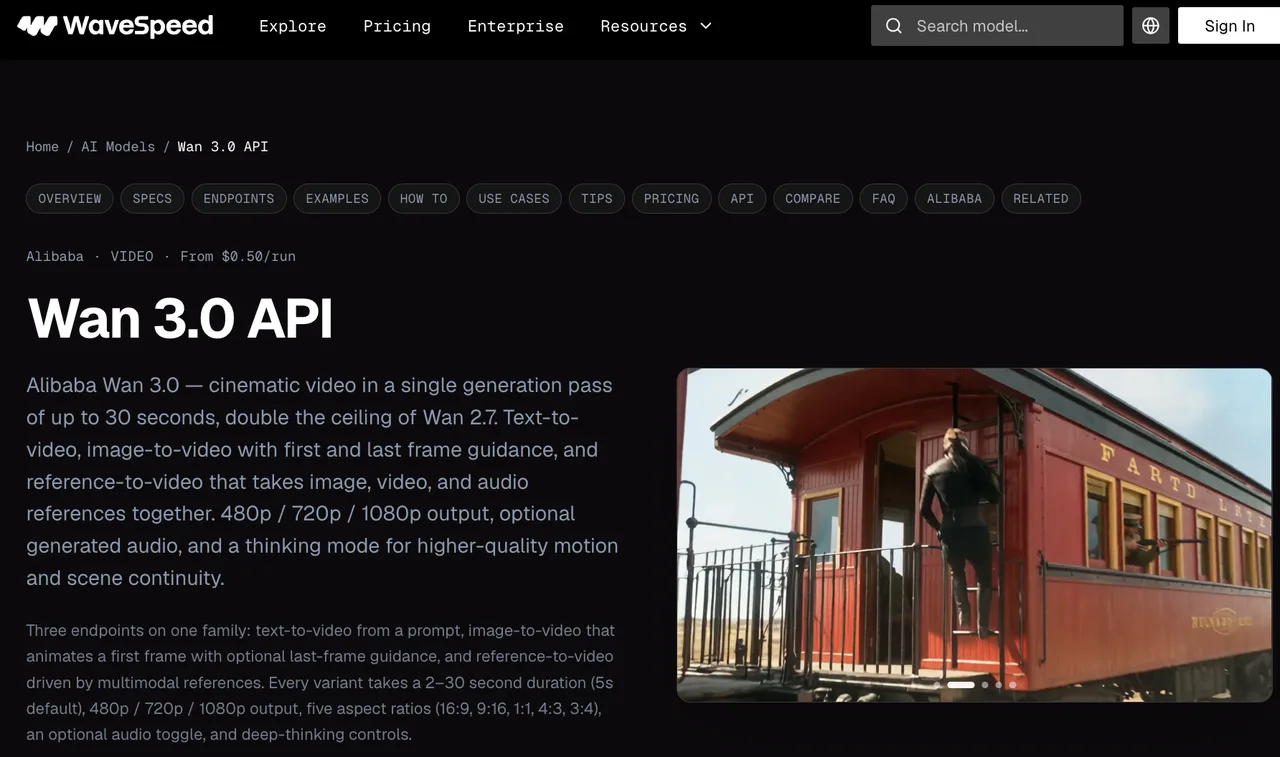
Alibaba’s Wan3.0 API reference lists Wan3.0-video as a preview model supporting text-to-video, image-to-video, first-last-frame video, and reference-based video generation. WaveSpeed exposes the family through separate endpoint surfaces, including a current Wan 3.0 API surface. This article does not claim a live benchmark. It gives a prompt test method you can reproduce.
Define the Video Test Before Prompting
Choose one input mode and acceptance criteria
Do not start with the sentence. Start with the test.
Pick one mode: text-to-video, image-to-video, or reference-to-video. If you mix modes too early, you will not know whether the output changed because of the prompt, the first frame, the reference image, the audio input, the duration, or the model interpreting everything at once.
For a repeatable test, write acceptance criteria before generation:
- Subject identity stays recognizable.
- Camera move follows the planned direction.
- Motion reaches the expected beat by the target second.
- Dialogue or sound cue does not fight the visual action.
- Output is usable without full regeneration.
This cannot be judged by feel. It needs a sample run.
Separate prompt instructions from API parameters
A prompt should not carry settings that belong in request fields. Keep “9:16,” “720p,” “10 seconds,” “audio on,” and seed values in parameters when the platform exposes them.
Alibaba’s current Wan3.0 schema uses parameters.resolution, ratio, duration, audio, seed, prompt_extend, and watermark. WaveSpeed’s current endpoints use fields such as resolution, aspect_ratio, duration, thinking_mode, enable_audio, and seed. Same production idea. Different field names.
One person can remember parameters. A team cannot.
Build a Wan 3.0 Prompt
Subject, action, environment, and visual direction
A useful Wan prompt has four plain blocks:
Subject: original delivery robot with a scratched blue shell and one amber status light.
Action: rolls across a wet rooftop walkway, pauses, scans a damaged solar panel.
Environment: early morning service roof, low fog, city towers behind glass railings.
Visual direction: grounded product-film look, soft backlight, realistic reflections, no fantasy elements.
That is enough for a first Wan 3.0 examples set. Do not add ten moods and five genre labels yet. If the subject fails at this stage, more adjectives will not save the run.
Camera, timing, audio, and reference roles
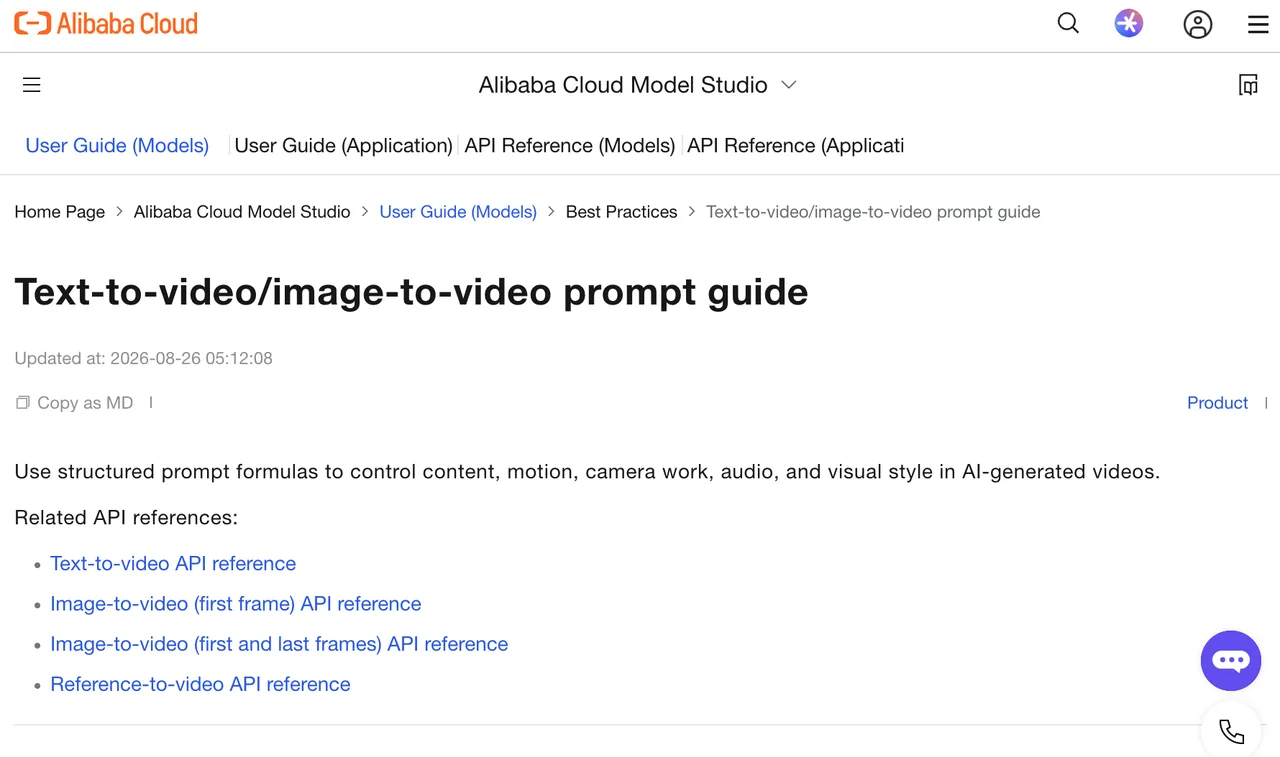
The Alibaba prompt guide recommends describing entity, scene, motion, aesthetic control, stylization, and camera behavior. For a production test, I would make camera and timing explicit:
Camera: fixed low-angle shot for 2 seconds, then slow push-in toward the amber light.
Timing: robot reaches the damaged panel at second 5 and stops before second 7.
Audio: low rooftop wind, one soft motor hum, no dialogue, no background music.
A Wan 3.0 camera prompt should name only one main camera action per shot. “Push in, orbit, crane up, shake handheld” is not direction. It is a meeting transcript.
Adapt the Prompt to Each Input Mode
Text-to-video and image-to-video prompts
For text-to-video, the prompt defines the whole scene. Include subject, environment, action, camera, lighting, and audio intent.
For image-to-video, the image already defines the subject, composition, and much of the style. The prompt should focus on what changes: motion, camera, expression, lighting shift, and end state. If you repeat everything visible in the image, you create more room for mismatch.
A practical I2V prompt looks like this:
The service robot remains the same shape and color as the input image. Its amber light turns on slowly. The camera pushes in slightly. Thin rain moves across the frame. No new characters enter.Reference-to-video and longer narrative prompts
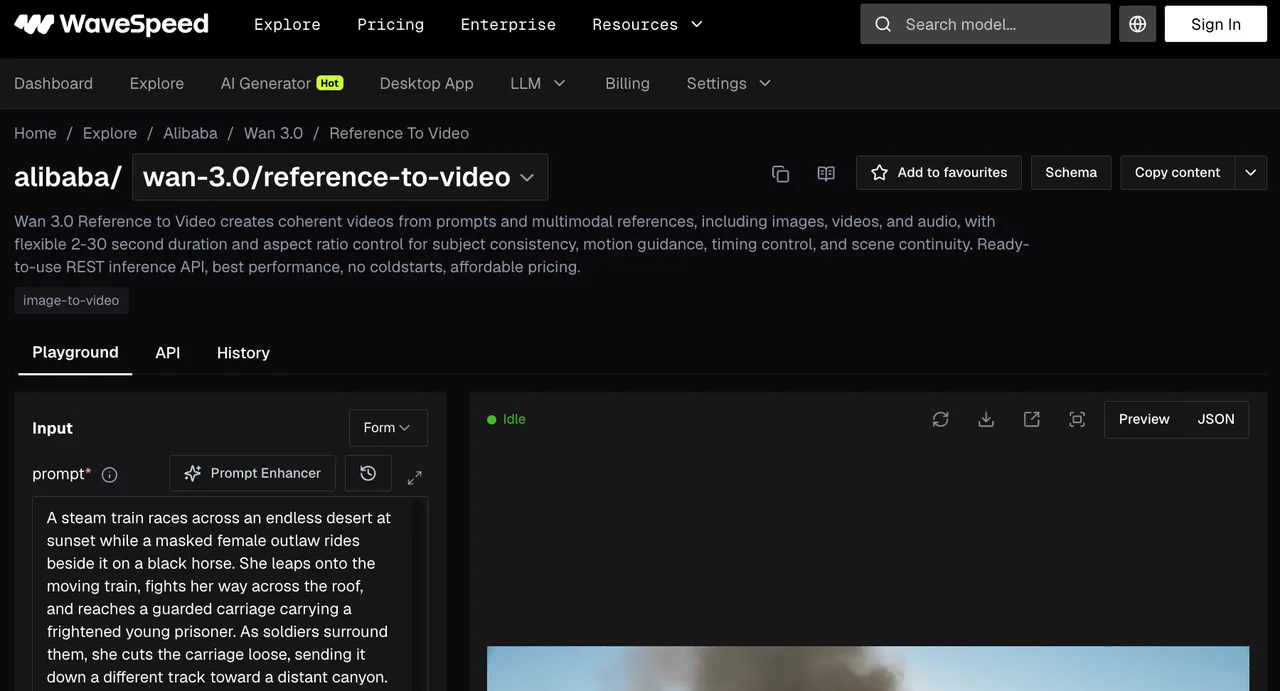
Reference-to-video needs roles. On Alibaba’s current Wan3.0 API, media references can be called “Image 1,” “Video 1,” or “Audio 1” based on their order. The current WaveSpeed reference-to-video schema lists reference_images, reference_videos, and reference_audios, with limits per media type.
For longer scenes, use timestamps. A Wan 3.0 30 second video should not be one long paragraph. Break it into beats:
[0-6s] Robot crosses the rooftop walkway.
[6-12s] It stops beside the solar panel and scans the crack.
[12-20s] The amber light pulses while rain gets heavier.
[20-30s] Camera pulls back to show the full rooftop repair site.
Run a Controlled Prompt Test
Change one variable per generation
If you change the prompt, seed, duration, reference image, and audio setting at the same time, the test is gone. You still generated a video. You did not learn anything.
Use a small run first: three variants for one input mode. Variant A tests motion, Variant B tests camera, Variant C tests audio wording. Keep the same resolution, duration, seed policy, and reference assets.
Record inputs, outputs, failures, and costs
A good log saves the next operator from guessing.
| Field | What to record |
|---|---|
| Test date | August 26, 2026 or your actual run date |
| Platform and endpoint | Alibaba Wan3.0, WaveSpeed T2V/I2V/R2V, or another verified route |
| Input mode | T2V, I2V, first-last-frame, or R2V |
| Prompt version | Full prompt text, not a summary |
| Parameters | Resolution, ratio/aspect ratio, duration, audio, seed, thinking/prompt rewrite setting |
| References | File URL or asset ID, plus role name used in prompt |
| Cost basis | Estimated charge, final charge, and failed-output count |
| Failure sample | Identity drift, camera miss, timing miss, unwanted dialogue, weak audio, artifact |
Cheap does not always mean cost-saving. Unusable generations are expensive.
Diagnose Weak Results
Remove conflicting directions and overloaded scenes
When the result is weak, cut first. Do not add.
Conflicts usually look like this: “fixed camera with dynamic orbit,” “quiet scene with dramatic battle music,” “single-shot continuity with hard cuts,” or “product close-up while showing a wide city reveal.” The model may still produce something, but the review team will not know which instruction won.
If you are learning how to prompt Wan 3.0, make the first test boring on purpose. Boring is diagnosable. Overloaded is not.
Adjust timing, references, or controls before adding detail
If the subject is wrong, check the reference. If the motion is wrong, simplify the action. If the scene ends too early, adjust duration or timestamp structure. If audio fights the shot, remove lyrics or dialogue first.
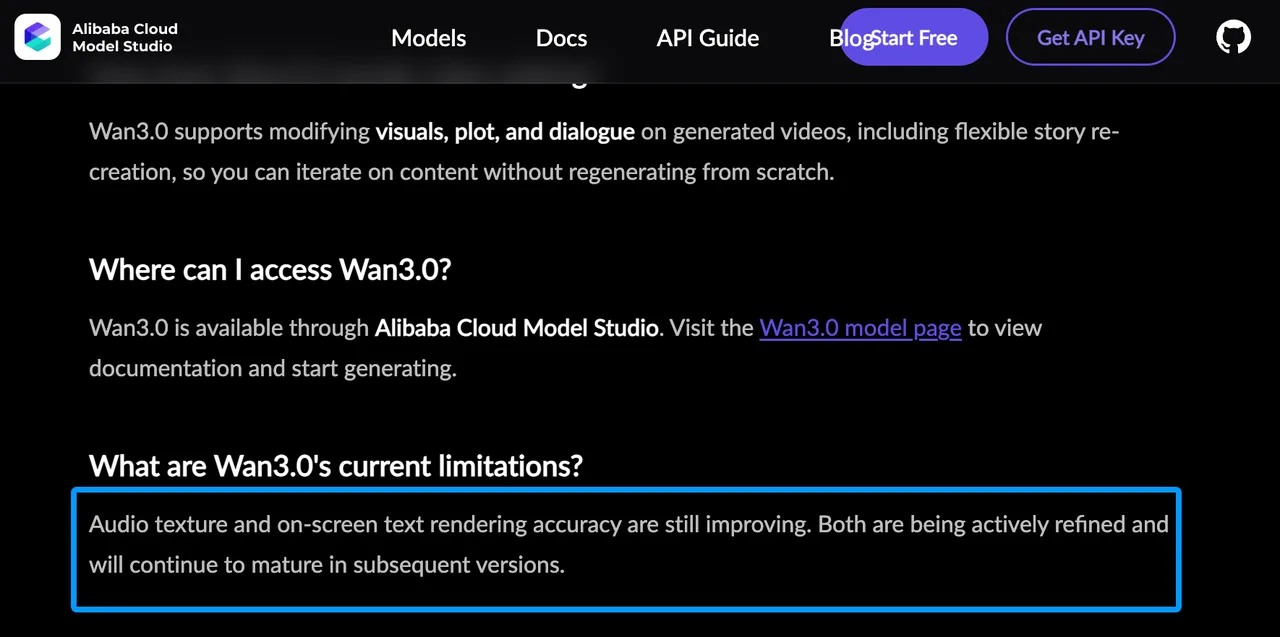
Alibaba’s Wan3.0 release post says audio texture and on-screen text accuracy were still areas of active improvement at release. Treat those as review items, not guaranteed pass conditions.
Reuse Prompts in Production
Map prompt blocks to structured request fields
A reusable template should split creative language from request fields:
PROMPT_SUBJECT=
PROMPT_ACTION=
PROMPT_SCENE=
PROMPT_CAMERA=
PROMPT_AUDIO=
PARAM_DURATION=
PARAM_RESOLUTION=
PARAM_AUDIO=
PARAM_SEED=
REFERENCE_ROLES=
This is not fancy. It just stops the prompt from becoming a drawer full of old decisions.
Version templates and preserve evaluation evidence
Store each accepted prompt with its endpoint, schema date, parameters, input assets, output URL, reviewer notes, and rejection reasons. When a provider changes a schema or default, rerun the smallest accepted test before scaling.
A Wan3 prompting guide for a team is not a list of beautiful prompts. It is a record of what survived review.
Limits and Trade-Offs
Longer prompts do not guarantee stronger control
Long prompts can help when they add structure. They hurt when they hide contradictions. If a 300-word prompt fails, make a 90-word version and test the core action again.
Provider interfaces may expose different controls
Alibaba’s current Wan3.0 API uses one Wan3.0-video model with media types and parameters. WaveSpeed separates endpoint surfaces and uses different field names. Do not copy parameter names across platforms without checking the current schema.
FAQ
Does Wan 3.0 enforce a maximum prompt length?
Alibaba’s current Wan3.0 API reference says input.prompt supports Chinese and English and allows up to 20,000 characters, with excess content automatically truncated. WaveSpeed’s checked model pages did not publish the same prompt-length ceiling, so verify inside the current schema before a large batch.
Can prompts reference uploaded filenames instead of URLs?
Do not rely on filenames. Alibaba documents media as URL, temporary OSS URL, or Base64 input, then references assets in the prompt as “Image 1,” “Video 1,” or “Audio 1.” WaveSpeed schemas also use structured media fields rather than local filename references.
Which languages are currently supported for generated dialogue?
The checked Wan3.0 API reference confirms Chinese and English prompt support. I did not find a full official language matrix for generated spoken dialogue. For production tests, keep dialogue in a verified language and record the result before expanding.
Does Wan 3.0 support negative prompts across every endpoint?
Not in the checked Wan3.0 documents. Alibaba’s Wan3.0 API reference does not list negative_prompt, and the checked WaveSpeed Wan 3.0 T2V/I2V/R2V pages do not expose a negative prompt field. Do not carry older Wan2.7 behavior into Wan3.0 without a fresh schema check.
Does a fixed seed reproduce audio and video together?
A fixed seed can reduce randomness, but it should not be treated as a full audiovisual lock. Record the seed, prompt, references, duration, audio setting, and endpoint version together. Then rerun a sample. That is the only honest way to know how stable the template is.
Conclusion
A useful Wan 3.0 prompt guide does not start with clever wording. It starts with a controlled video test: one input mode, one accepted task, one prompt structure, and one change per generation. Once that holds, scale carefully. A good single output does not mean the production workflow is ready.
Previous posts:
/filters:quality(82)/media/images/c347367a-a007-4466-b8f7-d37f5fb52819.webp)
/filters:quality(82)/media/images/cd4db796-7728-45fb-8267-6813ed28e173.webp)
/filters:quality(82)/media/images/1791535252286714222_v4jvJT2a.webp)
/filters:quality(82)/media/images/1791451065663755033_qNqAKS1a.webp)
/filters:quality(82)/media/images/1791359984291066138_tW5eOX6f.webp)
/filters:quality(82)/media/images/1773962750383987480_n3hqzHRZ.webp)