
Best ModelsLab Alternatives in 2027 for Media APIs
ModelsLab alternatives for AI builders: compare model coverage, integration fit, job behavior, and cost per usable output.

Replacing a media API rarely starts clean. There is already a ModelsLab key in production, polling code in a worker, and output URLs passing through review. The useful question behind ModelsLab alternatives is: which provider can take over without making the team rebuild everything around it?
This guide compares fal.ai, Replicate, Segmind, and WaveSpeedAI by model fit, job lifecycle, asset retention, and migration work. It is not a benchmark.
Why Replace ModelsLab in a Media App?
A migration needs a measurable reason: a missing model, an unsuitable queue pattern, a retention requirement, or costly maintenance across separate endpoints. “Another provider looks faster” is not enough. Demos show the ceiling. Production shows the floor.
ModelsLab does not expose one universal request contract. Its API documentation index describes JSON-body authentication, endpoint-specific fetch routes, three common response states, and webhook fields on many endpoints. Inventory the routes, IDs, inputs, callbacks, retries, and storage your application uses.
Match the Exact Model and Task, Not a Catalog Count
Catalog totals are weak evidence. Two services can list “FLUX” while exposing different variants, owners, schemas, or version policies. A search for Stable Diffusion API alternatives may find the same family name; it does not prove support for your inpainting, ControlNet, LoRA, or image-to-video task.
For each live route, record the task, version, inputs, seed behavior, format, and license. Mark a candidate as exact, adapter required, or unavailable. Unavailable is a valid result.
| Migration record | What to capture |
|---|---|
| Request contract | Model, task, inputs, defaults, file limits |
| Job lifecycle | Submit, queue, poll or webhook, cancel, terminal states |
| Output contract | URL or object, format, expiry, storage owner |
| Operational behavior | Rate limits, timeout, retry, duplicate-request risk |
| Acceptance | Usable output criteria and rework required |
Compare Auth, Async Jobs, Failures, and Accepted-Output Cost
The expensive differences appear after submission. Normalize every candidate into queued, running, succeeded, failed, and cancelled, while retaining the provider’s raw status and error. A generic “generation failed” message leaves support unable to choose between retrying, refunding, or fixing the input.
Do not wire the replacement straight into the product UI. Put a provider-neutral adapter between them with four operations: submit, read status, cancel, and receive a webhook. Its result object should keep the internal job ID, provider request ID, model version, normalized state, raw state, error, outputs, timestamps, and charge.
Store raw webhook bodies before transforming them. During shadow traffic, this contract lets the team compare providers from one log format and roll back by changing routing instead of rewriting product code. The adapter is the most reusable part of the migration; a hand-edited field map is not.
Compare cost per accepted output: run the same authorized inputs, apply one review rule, and divide all charges by shippable assets. Unusable generations are expensive. Record wall-clock time separately from inference time; queues and uploads affect the user too.
-
fal.ai for Model-Specific Media Endpoints

fal.ai fits teams that know the endpoint they need. Each model page defines its own arguments and output object, so ModelsLab field names will not necessarily carry across.
Deployment and Integration Fit
fal recommends asynchronous inference. Its queue API returns request, status, response, and cancel references. The lifecycle uses IN_QUEUE, IN_PROGRESS, and COMPLETED; completion may still carry an error. Webhook handlers must tolerate duplicates.
It fits named endpoints better than a plan that assumes one schema across unrelated models.
Endpoint and Workflow Trade-Offs
fal separates request records from generated-media storage. Check both retention settings before moving traffic; changing payload storage does not automatically remove files already placed on its CDN.
The adapter should preserve request_id, endpoint name, raw error, and output URL. Without those four fields, webhook disputes become guesswork.
-
Replicate for Broad Model Experimentation
Replicate helps teams evaluate public, official, or custom models. Its breadth makes version governance part of the application.
Model Selection and Version Use
A Replicate prediction object records model, version, status, timestamps, logs, output, errors, and timing. Pin versions where required and store the version with each result. A model name without its owner, version policy, and schema is not a migration mapping.
Custom-model support still requires checking a LoRA’s base model, format, license, and serving path.
Production and Cost Trade-Offs
Public models may cold boot. Official models may charge by output or input; other workloads may charge for compute time. Price the exact model and deployment pattern.
There is a sharper operational limit: API output files expire after one hour by default. Copy accepted assets into storage you control as part of the success handler. A URL saved in a database is not the same thing as a retained asset.
-
Segmind for Media Model APIs
Segmind offers model APIs and PixelFlow workflows. Evaluate them separately: a direct call and a graph execution have different states, limits, and debugging surfaces.
Image and Video Workflow Fit
The Segmind Python SDK uses the v2 asynchronous gateway by default. run() submits and polls; submit_async() exposes deadline and polling control for longer video jobs.
PixelFlow webhooks report node and graph events, not a drop-in equivalent of every ModelsLab callback.
Model and Job Limits
Check input size, resolution, duration, concurrency, and output type per model. The SDK’s default wait is 600 seconds; slow video examples use a longer timeout.
Segmind’s logging policy says generated outputs remain for seven days, while inference input media is not stored. Save the result URL promptly.
Segmind also says new fine-tuning jobs are no longer accepted, although existing fine-tunes remain available. Teams that retrain LoRAs should mark that as a gap.
-
WaveSpeedAI for Unified Model Access
WaveSpeedAI is relevant when several media models need one API surface. It can reduce provider-specific code only for tasks actually present in its catalog.
Migration Path for Supported Models
Map each ModelsLab route to a verified WaveSpeedAI model path, translate inputs in an adapter, and return a provider-neutral response. The WaveSpeedAI API guide documents bearer authentication, asynchronous submission, polling, and five terminal states.
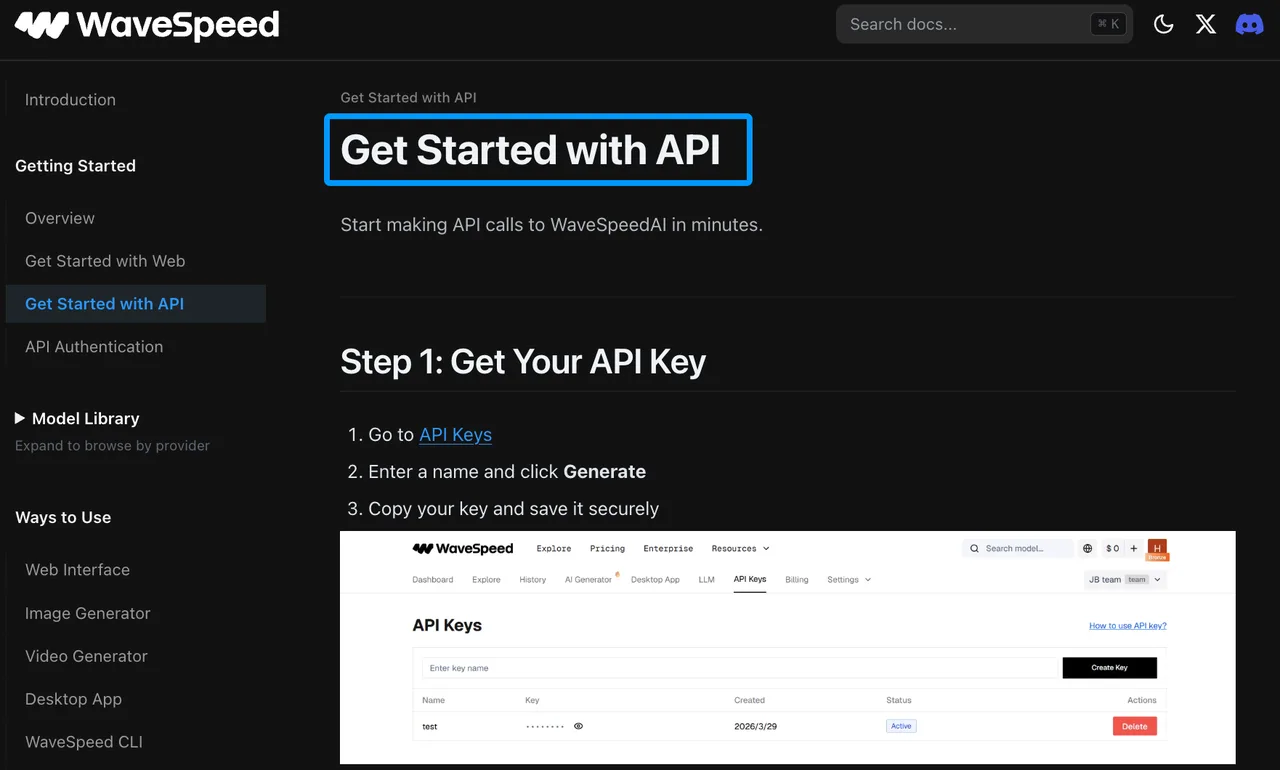
Save the prediction ID first. Generation may succeed while webhook delivery fails, so the result endpoint must remain the recovery path. This step cannot be skipped.
Current Catalog and Feature Gaps
WaveSpeedAI documents a large multi-provider catalog, but verify owner, version, task, inputs, sync support, and output contract. Only some models support sync mode; long video work should remain asynchronous.
Generated media is temporary. The data retention policy says files generally expire within seven days, while prediction metadata and API logs may be kept as needed for billing, support, and analytics. Move required outputs into your own storage and define deletion rules there.
Choose by Migration Risk
Choose the provider that removes the current constraint without widening the failure surface. One critical model may favor a direct endpoint. A multi-model image API plus a video generation API may favor unified access.
Keep a Direct Provider When One Model Drives the Product
Keep a direct provider for a specific version, provider-only control, or tuned latency profile. An aggregation layer adds little when the application never switches models and may expose fewer parameters.
Most lists of alternatives to ModelsLab miss this: staying put is valid. Migration must repay adapter work, regression testing, asset handling, support updates, and rollback.
Test Output, Latency, and Failure Behavior Before Switching
Use a fixed, authorized test set. Lock the acceptance rule; record total time, terminal status, expiry, billed amount, usable result, and rework minutes. Never compare one provider’s best output with another’s first output.
Run shadow traffic, then move a small slice and keep the old route available. After a client timeout, blind retries may create a second billable job. The real bottleneck is often recovery.
FAQ
Can ModelsLab model IDs be mapped to another provider automatically?
Not safely. flux, for example, is not enough information to identify an equivalent endpoint elsewhere. Map the model family, owner, version, task, schema, defaults, and license. Automate the lookup only after a person approves that mapping.
What happens to ModelsLab result URLs after account closure?
The public ModelsLab API index documents hosted outputs and asset-history endpoints, but I could not verify one platform-wide retention promise for every endpoint or a specific account-closure window.
Download required assets before closing the account and ask ModelsLab support for the policy covering the endpoints you use. Do not build an archive around provider URLs.
Can a replacement import existing custom LoRA files?
Sometimes, but there is no universal import path across generative media API providers. Check the base model, weight format, trigger words, license, file-size limit, and whether the provider supports uploaded weights or only its own training flow.
Segmind currently does not accept new fine-tuning jobs, which rules out one common migration path there.
Are failed ModelsLab inference calls billed when no asset is returned?
I could not find a universal failed-call billing rule in the public ModelsLab API documentation reviewed for this article.
Separate validation errors, queued jobs, inference failures, client timeouts, webhook failures, and expired URLs. They are different events. Keep the request ID and invoice record, then confirm disputed cases with ModelsLab support rather than assuming “no asset” means “no charge.”
Can historical ModelsLab request logs be exported for migration audits?
ModelsLab documents generated-asset history and request-count endpoints, but its public API index does not document a bulk export for complete historical request logs.
Ask support what can be exported before cancellation. If no export exists, preserve the records your application already controls: request ID, model, sanitized input hash, timestamps, status, error, charge, and final asset location.
Conclusion
The strongest ModelsLab alternatives are not interchangeable. fal.ai suits exact endpoint adoption, Replicate suits broad model and version exploration, Segmind combines APIs with workflow execution but has a current fine-tuning gap, and WaveSpeedAI is worth evaluating when several supported media models need one access layer.
Do not choose from the catalog page. Build the endpoint map, test accepted-output cost, store assets yourself, and keep a rollback route until the new failure behavior is understood. The conclusion is valid only for the models and workload you verify.
Previous posts:
Related Articles
/filters:quality(82)/media/images/c347367a-a007-4466-b8f7-d37f5fb52819.webp)
Best AI Video Previsualization Tools for 2027
/filters:quality(82)/media/images/1791535252286714222_v4jvJT2a.webp)
ModelsLab Review 2027: One API for Media Models?
/filters:quality(82)/media/images/1791451065663755033_qNqAKS1a.webp)
Best AI Video Background Removal Tools in 2027
/filters:quality(82)/media/images/1791359984291066138_tW5eOX6f.webp)
Best Comfy Cloud Alternatives in 2027
/filters:quality(82)/media/images/1773962750383987480_n3hqzHRZ.webp)
Qwen Image 2.1 vs Qwen Image 3.0: What Changes and When to Upgrade