
Holo4 API vs Local Deployment: Which Fits Your Agent?
Holo4 API vs local deployment compares setup burden, data control, and task economics for one computer-use agent workflow.
A working demo can still become an operations problem. Hosted is easy until security asks about screenshots. Local keeps data close, but somebody owns GPU failures. I’m John. My Holo4 API verdict: start hosted unless policy, control, or sustained utilization requires local operation. Choose the workflow, not a benchmark chart.
This is an evidence review and pilot design, not hands-on testing.
Quick Verdict by Deployment Constraint
Hosted validates one computer-use agent deployment before building operations. Holo4 local deployment fits firm network boundaries, permitted weights, and capable operators. Neither is automatically cheaper.
Test the Hosted API Against Your Pilot Constraints
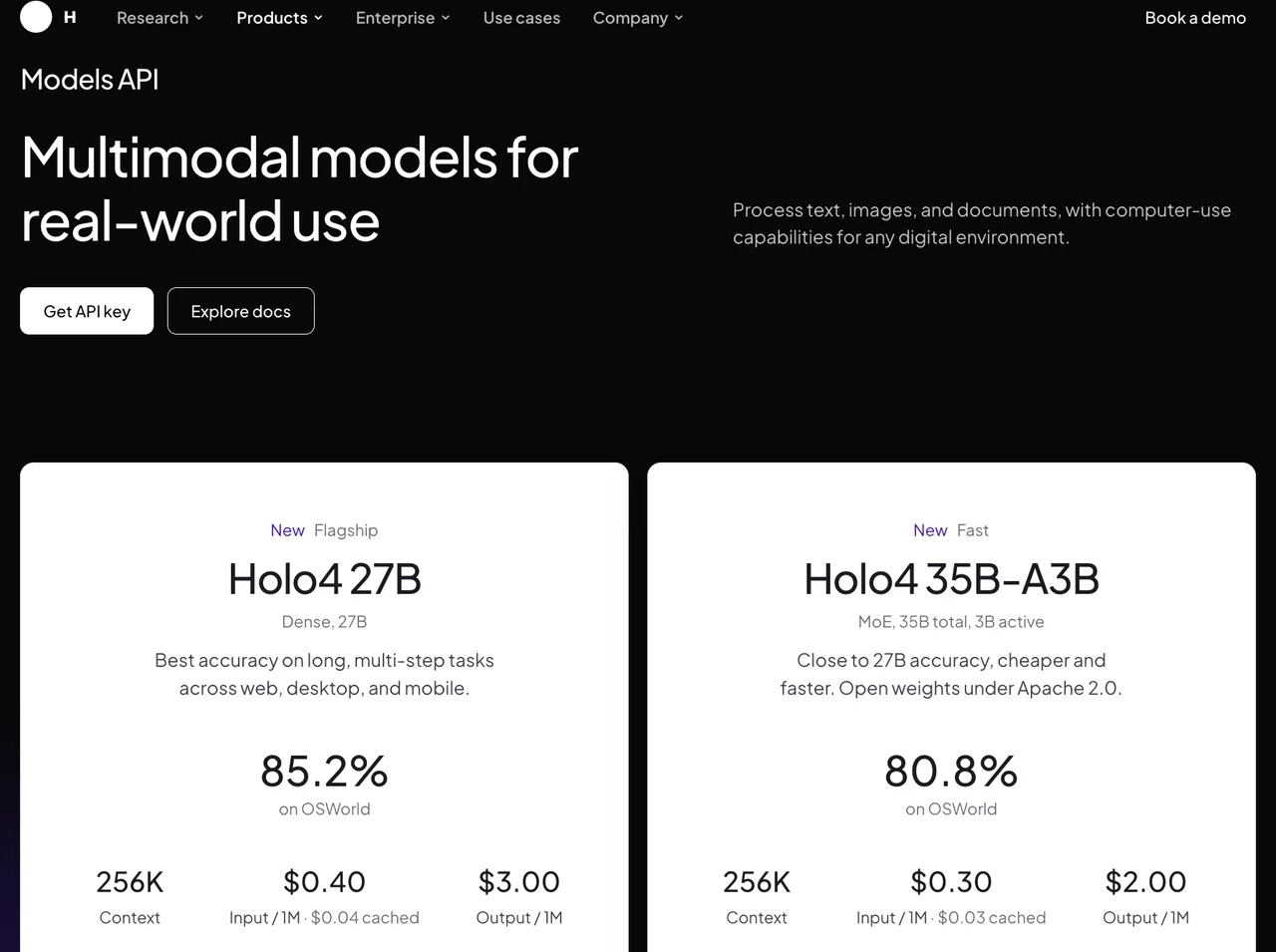 The H Models API serves
 holo4-27b and holo4-35b-a3b through OpenAI-compatible chat completions. Both list 262,144-token context. On October 5, 2026, million-token prices were $0.40 input/$3 output/$0.04 cached for 27B and $0.30/$2/$0.03 for 35B-A3B.
Holo4 requires a paid tier. Documentation gives no universal paid rate limit; confirm yours before load testing. Cache hits are best effort, not a guaranteed discount.
Choose Local Deployment for Control and Permitted Self-Hosting
Choose local when prompts, screenshots, and tool results must stay inside your infrastructure. H Company’s local-inference guide supports vLLM for BF16, FP8, and NVFP4, and llama.cpp for Q4 GGUF. NVFP4 needs Blackwell hardware.
No published hardware figure covers every precision, context, and concurrency level. Size the checkpoint, vision encoder, and KV cache. A 256K configuration does not prove your workload fits.
Compare One Computer-Use Agent Workflow
Keep the Task, Harness, and Acceptance Test Constant
Use one sandbox task: update an authorized test CRM record and export confirmation. Keep the prompt, screenshot size, tool schema, reasoning, action budget, timeout, starting state, and harness identical.
Define success externally: the correct record changed, nothing else changed, and confirmation exists. A good single output does not mean the production workflow is ready.
Measure Setup Time, Latency, Failures, and Operator Work
Record setup hours, first-token time, step latency, completion time, success rate, retries, timeouts, and rescues. For local Holo4 inference, add load time, GPU memory, queue depth, utilization, and restart recovery.
Run at least 20 attempts per route so one lucky completion cannot decide the deployment, and separate model errors from harness, network, tool, and verifier failures during review.
Label warm and cold runs. Save API metadata, checkpoint revision, runtime, precision, and failed traces.
Compare the Three Deployment Trade-Offs

Operations and Scaling
Hosted removes weight downloads, GPU scheduling, and serving. You still own the harness, retries, observability, and tool failures. Local adds upgrades, scaling, health checks, rollback, and capacity. Without an owner, “self-hosted” means “unowned.”
Data Path and Security Control
Local creates the clearest boundary: H says prompts, screenshots, and tool results stay on your network. Hosted documentation says the Models API defaults to zero retention, keeping only request metadata.
H’s general privacy policy instead describes 30-day retention for EEA users and 90 days elsewhere for parts of its services. Do not guess. Get written confirmation covering the Models API, region, metadata, and deletion.
Task Economics and Hardware Commitment
Hosted cost includes tokens, retries, and operator time. Local adds GPUs, idle capacity, monitoring, engineering, and failures. Compare monthly cost per accepted task, not tokens per second.
Test expected concurrency and context. Local may win at sustained utilization; hosted may suit bursty demand. This cannot be judged by feel. It needs a sample run.
Plan a Safe Pilot
Sandbox Tools and Restrict Credentials
Use test accounts, synthetic records, scoped keys, allowlisted destinations, and a disposable sandbox. Block password managers, personal profiles, production databases, and unrelated apps. Cap runtime and spend; log every action.
When that independent platform is involved, apply the WaveSpeed Acceptable Use Policy alongside H Company’s rules and your controls.
Keep Human Approval for Consequential Actions
Require approval before payments, permission changes, external messages, publication, deletion, or irreversible calls. Pause and show the target, payload, and consequence. Approval belongs at execution, not in a vague prompt.
Limits and Migration Risks
Hosted and Local Runtimes May Behave Differently
Quantization, runtimes, caching, and hosted updates can change behavior. Pin local revisions and retain regression tests. Poll GET /v1/models for status, pricing, limits, and deprecation_date; it exposes no checkpoint hash.
I checked WaveSpeed’s directory and public LLM list on October 5, 2026; neither listed Holo4—recheck the live /v1/models response before publication. Do not claim a WaveSpeed endpoint, price, or integration. It remains a separate inference layer.
Model Licenses Limit Which Local Route Is Commercially Viable
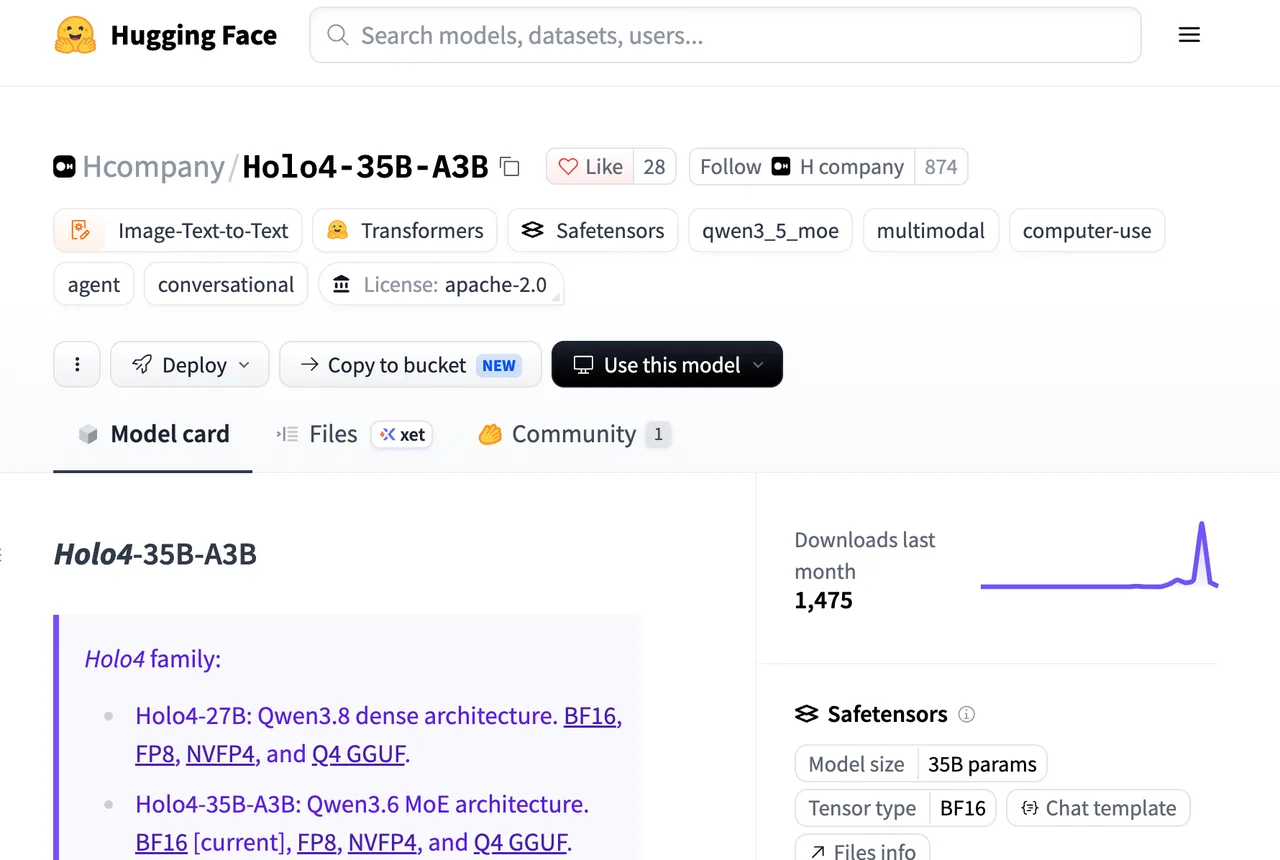
Downloadable does not mean commercially deployable. The Holo4 27B model card uses CC BY-NC 4.0 and is non-commercial. The 35B-A3B card uses Apache 2.0.
FAQ
Does local Holo4 require an H Platform account after download?
No H Platform account is documented as necessary after download. The local server uses your endpoint; Hugging Face access or dependency downloads may still be required during setup.
Can Holo4 run offline once the weights are cached?
H does not explicitly promise a fully air-gapped installation. Cache weights, container images, tokenizer, dependencies, and test assets, then verify startup with outbound networking blocked.
Which local runtimes support Holo4 image inputs?
H documents vLLM for BF16, FP8, and NVFP4, plus llama.cpp for Q4 GGUF. Its examples accept image input; validate the runtime and checkpoint together.
Does the H Models API stream Holo4 responses?
Yes. Set stream: true on chat completions. The API documents server-sent chunks with reasoning in delta.reasoning and response content in delta.content.
How are hosted Holo4 model revisions announced to API users?
I could not verify a checkpoint-specific notification policy. GET /v1/models exposes lifecycle and deprecation metadata; H’s changelog covers the Agents API, SDKs, and CLI. Monitor both and ask support about hosted revisions.
The right Holo4 API choice survives the same acceptance test, security review, and cost calculation. Pilot hosted first; move local only when control or sustained economics justify the operations.
Previous posts:
Related Articles
/filters:quality(82)/media/images/1791192288445452271_ToxGQZ8i.webp)
Holo4 27B vs 35B-A3B: Which Fits Your Agent?
/filters:quality(82)/media/images/1790934318687045151_6DhqzIS1.webp)
Best AI Video APIs for High-Volume Workflows in 2027
/filters:quality(82)/media/images/1790879706333726948_TmjHVhrF.webp)
Introducing AI Cinema Studio on WaveSpeedAI: Direct Cinematic AI Video Shots
/filters:quality(82)/media/images/1790934887466368319_r2GQZ8hr.webp)
LTX Studio Review 2027: Does the Video Workflow Hold Up?
/filters:quality(82)/media/images/1790935090456133598_u9CLU4dm.webp)
Segmind Review 2027: Can Its Media APIs Scale?
/filters:quality(82)/media/images/1790935248497016685_6cZjDPeF.webp)