
Muse Spark 1.3 Max Review: Is More Reasoning Worth It?
Review Muse Spark 1.3 Max for one long-horizon agent task and decide whether extra reasoning improves outcomes enough to justify the added usage.
A coding agent that thinks longer is useful only when extra turns rescue the task. Otherwise, the team pays in latency, tokens, and review time. This Muse Spark 1.3 Max review examines one workload: resolve a multi-file repository issue, run its tests, and deliver a reviewable patch. It is an evidence-based evaluation plan, not independent testing.
Quick Verdict for Long Agent Tasks
When Max reasoning can help
The Muse Spark max reasoning mode is worth testing when a task has interacting constraints, an unfamiliar repository, several plausible causes, and tool results that force replanning. Meta says Muse Spark 1.3 was trained for longer-horizon coding and agent work, including preserving requirements and correcting planning gaps.
As checked on September 9, 2026, the Meta release page says Max reasoning is available in Muse Code and the Meta Model API. That confirms the surfaces, not the improvement on your codebase.
When a lower effort is the safer default
Use a lower agent reasoning effort for narrow fixes with a clear reproduction, known files, fast tests, and little ambiguity. Extra reasoning can increase wall time and token use without changing acceptance. It may also produce more speculative edits.
My default is the lowest effort that repeatedly completes the task. Max must raise accepted-task rate or reduce operator intervention.
Test One Agentic Workload
Lock the task, harness, tools, and stopping rule
Freeze one repository at a specific commit. Give each run the same issue report, failing test, environment, instructions, tool permissions, and context. Require tracing behavior across several modules, applying a scoped fix, adding a regression test, and running prescribed checks.
Keep the same shell, search and edit tools, timeout, compaction policy, maximum turns, and network access. Stop when tests pass and the model submits its summary, when it reaches the limit, or when it requests an unauthorized action.
Run both a lower effort and Max more than once. One clean patch proves very little.
Compare success, turns, latency, and token use
Accept the task only when the reproduction is fixed, regression tests pass, existing tests remain green, and review finds no unrelated changes. Record turns, tool calls, input and output tokens, elapsed time, retries, and reviewer minutes.
Meta reports that 1.3 used about 20% fewer tool calls and 25% fewer tokens than Muse Spark 1.2 in comparisons by Meta engineers. That compares model generations, not Max with a lower 1.3 effort.
Interpret the Evidence
Separate Meta claims from matched results
Meta’s evaluation methodology says published 1.3 results use Max, while Muse Spark 1.2 uses xhigh. Agentic coding also uses named products or benchmark-specific harnesses. A score therefore reflects the model, effort, harness, tools, and stopping policy together.
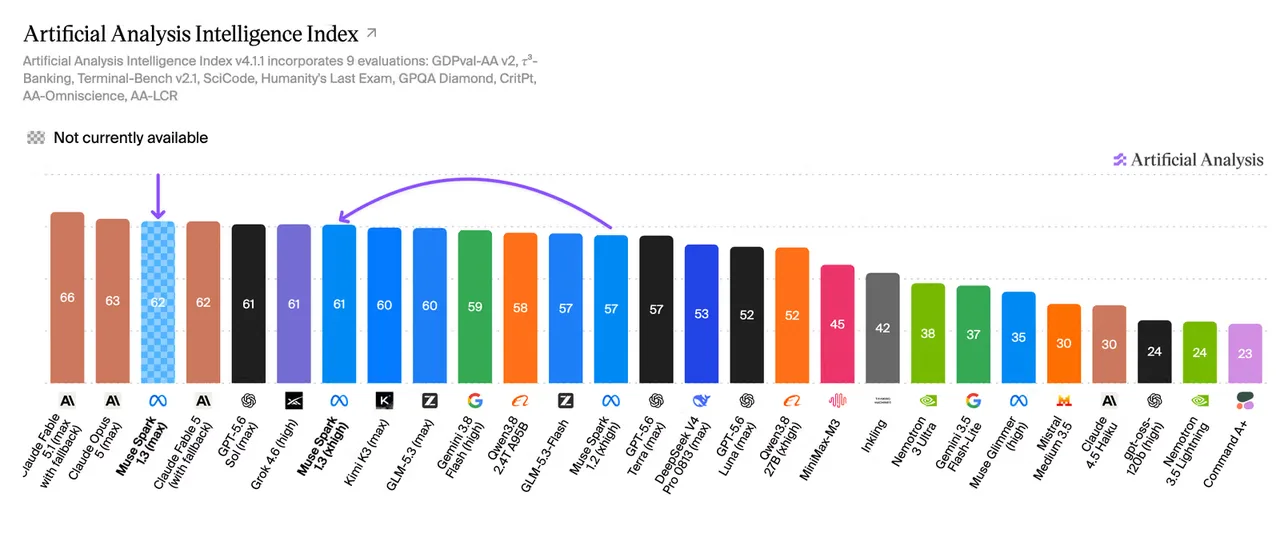
Independent Artificial Analysis testing compared Max with xhigh on its agent evaluations. Max improved some task scores while using more turns and reasoning tokens. Useful evidence, yes, but it does not reproduce your repository or acceptance checks.
Judge cost per accepted task, not benchmark rank
Use a replaceable calculation:
cost per accepted task = total model and tool cost across attempts / accepted tasks
Add reviewer and infrastructure cost when they differ. Max can be cheaper overall when it prevents failed attempts or manual rescue. If both settings pass equally often, the faster, less token-heavy route is better.
A benchmark rank cannot answer this. Your unit of value is an accepted patch.
Limits and Trade-Offs
Reasoning effort does not fix weak tool design
More thinking cannot repair a broken test command, missing context, vague permissions, lossy compaction, or incomplete tool output. It may simply reason longer over bad evidence.
Log tool arguments, results, errors, approvals, and truncation. Separate model failures from harness failures before comparing effort. A tool that enters production must first avoid creating new problems.
Availability and behavior can change by surface
Muse Code supplies an agent loop, prompts, tools, and session behavior. A direct API call leaves more orchestration to your application. Results from one surface do not automatically transfer to the other.
Launch reporting from Axios confirms the initial Muse Code and API rollout; Meta’s current page now states that Max is available. Record the surface, model identifier, effort, date, and harness revision.
FAQ
Can Max reasoning be selected per API request?
Meta confirms Max through the Model API, but its public release page does not publish the request field or value. The detailed Meta Model API reference requires sign-in. Verify its current authenticated schema before implementing per-request selection.
Does Muse Code expose reasoning-token usage?
Public Muse Code materials do not document a separate reasoning-token counter. Do not treat total output tokens as a confirmed reasoning breakdown. Record the usage fields returned by the current client and mark unavailable components as unknown.
Can a session change effort levels mid-task?
Meta has not publicly documented whether a Muse Code session can switch effort without restarting, or how an API-side change affects retained state. Treat the change as a new test arm and preserve the transcript.
Are Max responses eligible for prompt caching?
Public Meta materials do not confirm Max-specific caching eligibility, cache-write rules, or cache-hit reporting. Verify account-level documentation and billing output before forecasting savings.
Is Max available in every supported region?
Meta publishes no complete Max-specific region matrix. Availability on Muse Code and the Model API does not prove coverage for every country, account type, or processing region. Confirm access from each deployment location.
Conclusion
The Muse Spark 1.3 Max review verdict is simple: test Max on one frozen, long repository task, but do not make it the default from benchmark results. Keep it only when matched runs improve cost per accepted patch, reliability, or reviewer effort enough to justify more reasoning.
Previous posts:
/filters:quality(82)/media/images/660b4b48-6351-40cd-ba00-51322b7455f4.webp)
/filters:quality(82)/media/images/273bf240-30e3-4e6c-8ae4-e3346b487bc7.webp)
/filters:quality(82)/media/images/bb7ec772-f694-45f4-9a9a-c0e5fd2e7d60.webp)
/filters:quality(82)/media/images/444431ee-1387-4a40-81ad-866e095a7c75.webp)
/filters:quality(82)/media/images/81212eb5-4b43-4cc4-92f4-38a0c439d258.webp)
/filters:quality(82)/media/images/5f15570a-6a68-432e-a6f1-1dcbf799ba81.webp)