
Claude Mythos Preview Access: Is It Public Yet?
Claude Mythos Preview is invitation-only via Project Glasswing. Here's the current access status, eligibility signals, and what to use while you wait.
Short answer: no. As of today, Claude Mythos Preview is not something you can sign up for, apply for, or buy credits into. It’s invitation-only, and Anthropic has said it does not currently plan a general release.
Use Claude in production today on WaveSpeedAI — no preview waitlist, transparent per-token pricing, OpenAI-compatible endpoint. Claude Opus 4.7 API → · Claude Sonnet 4.6 API →
I’m Dora. I’ve seen the same question from three different people this week — a solo dev, a security researcher at a small firm, and someone on a platform engineering team. All of them assumed that somewhere on the Anthropic site there must be a request form. There isn’t one. I spent about forty minutes checking, partly because I didn’t believe it either.
This post is what I actually found. It’s aimed at anyone who’s been trying to figure out whether they’re eligible, whether there’s a waitlist, or whether they should stop searching and use something else today.
Current Access Status (As of Publication)
Invitation-only: not open to public sign-up
There is no public sign-up. According to the Claude Models Overview documentation, Mythos Preview “is offered separately as a research preview model for defensive cybersecurity workflows as part of Project Glasswing. Access is invitation-only and there is no self-serve sign-up.”
That last phrase is worth reading twice. No self-serve sign-up. Not “limited” sign-up, not “waitlist” — none.
Who currently has access
Launch partners listed on Anthropic’s Project Glasswing page: Amazon Web Services, Apple, Broadcom, Cisco, CrowdStrike, Google, JPMorgan Chase, the Linux Foundation, Microsoft, NVIDIA, and Palo Alto Networks.
Beyond those twelve, Anthropic has extended access to over 40 additional organizations that “build or maintain critical software infrastructure.” Those names aren’t public. The total program is roughly 50 organizations, backed by $100M in usage credits plus $4M in direct donations to open-source security groups.
That’s the audience. It’s narrow on purpose.
General API: not available
Mythos Preview is not in the standard Claude API. Approved Project Glasswing participants can reach it through the Claude API, Amazon Bedrock, Google Vertex AI, or Microsoft Foundry — but only after approval. Anthropic has explicitly stated in its Mythos Preview risk report and model card that it has decided not to make the model generally available at this stage.
So if your workflow depends on having Mythos through a normal paid API account: it doesn’t exist yet, and there’s no announced date for when it will.
Eligibility and Current Access Path
What Anthropic has said about who qualifies
The consistent language across Anthropic’s materials is “organizations responsible for building or maintaining critical software infrastructure.” Operating systems. Major web browsers. Cloud platforms. Core open-source projects. Financial infrastructure. The partner list tells you the shape of it.
Individual developers aren’t in this category. Neither are most startups. Neither are most security research labs, unless they sit inside or under one of the named organizations. That’s not a gap in the communication — it’s the actual boundary.
No public application portal
This part matters because it’s where a lot of articles go wrong. As of April 2026, there is no public Mythos application page. No waitlist form. No “request access” button on the Anthropic site that turns Mythos on for you specifically.
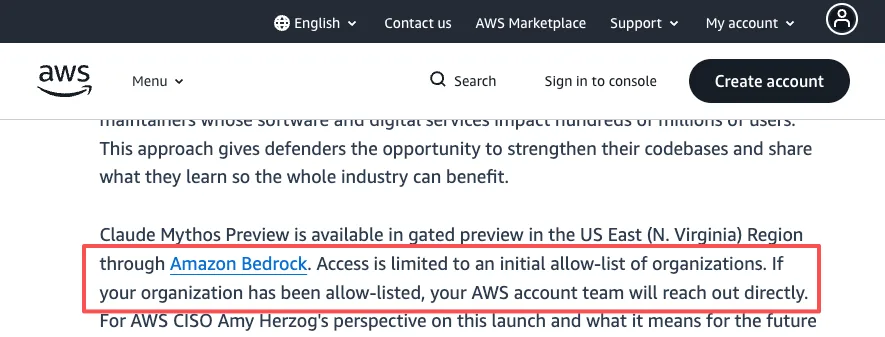
The Amazon Bedrock launch note is explicit: “Access is limited to an initial allow-list of organizations. If your organization has been allow-listed, your AWS account team will reach out directly.” The direction of contact is backward from the usual flow. They reach out. You don’t apply in.
How to signal interest
If you genuinely believe your organization fits — you maintain a widely-used OS component, a browser, a piece of critical internet infrastructure — the practical path is through existing Anthropic or cloud-provider relationships. Talk to your Anthropic account contact, your AWS account team, your Google Cloud rep. There’s also Anthropic’s Claude for Open Source program, which is a possible intake channel for maintainers of significant open-source projects. It’s not a guaranteed Mythos route, and shouldn’t be treated as one.
If none of that applies to you, the honest answer is: there’s nothing to apply to right now. I know that’s not satisfying. It’s what’s actually true.
What “Research Preview” Means in Practice
Research preview is not a marketing label. It’s a commitment level.
Capabilities in a research preview can change before any broader release. There’s no production SLA. No API stability commitment at this stage. If you were somehow building a product on top of Mythos today, the model you depend on could shift underneath you, and you’d have no contractual recourse.
The UK AI Security Institute’s evaluation describes Mythos Preview as a step up over previous frontier models on cyber capabilities — succeeding on 73% of expert-level capture-the-flag tasks, and completing the 32-step attack simulation “The Last Ones” from start to finish in 3 out of 10 attempts. That’s the upside. The downside of that same capability is why Anthropic gated it. Research preview status is how both sides get managed at once.
Practical takeaway: even if you got in, this is not the model you build your production application on. It’s the model a defender uses to audit their own code under controlled conditions.
Claude Models Available Today
If you’re reading this because you wanted Mythos for your work, the useful question is what’s actually in your hands right now.
Claude Opus 4.7
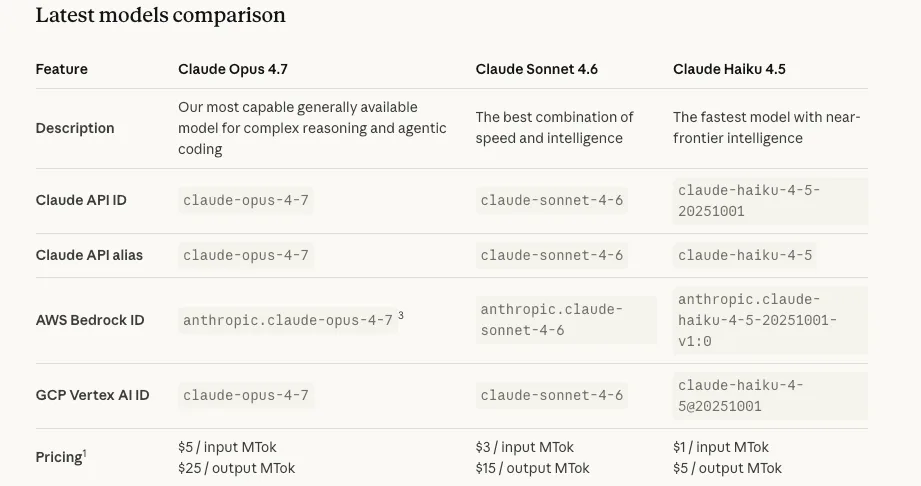
Anthropic’s current flagship for general access. It replaced Opus 4.6 as the top generally-available model. Full 1M token context window at standard pricing. Anthropic describes it as a “step-change improvement in agentic coding over Claude Opus 4.6.” For the hardest reasoning work, code generation, and long-context analysis, this is where to start.
Claude Opus 4.6
Still available, still very capable. 1M context window. Lower intelligence ceiling than 4.7, but in many workloads the difference isn’t the bottleneck. Worth keeping as a comparison if you’ve already tuned prompts against it.
Claude Sonnet 4.6
Balanced speed and capability. 79.6% on SWE-bench Verified — about 1.2 points below Opus 4.6 — at roughly 40% of the cost. Also 1M context window. For most coding and agent work, this is the pragmatic default. I’d start here unless the task clearly needs Opus.
Claude Haiku 4.5
High-speed, cost-efficient. 200K context window. Around one-third the cost of Sonnet. Best for high-volume classification, routing, extraction, and tasks where latency matters more than ceiling intelligence.
That’s the current lineup. None of them are Mythos. They’re also not trying to be. Mythos is a specialized, restricted-access research artifact. The public lineup is what you actually run production workloads on.
FAQ
Is there a waitlist for Claude Mythos Preview? No public waitlist has been described in Anthropic’s current materials. Access is invitation-based rather than a queue anyone can join.
Can I access Claude Mythos via the standard Claude API? No. Mythos Preview is separate from the standard Claude API model list. Approved Project Glasswing participants can access it through the Claude API, Bedrock, Vertex AI, or Microsoft Foundry — approval first, platform choice second.
Will Claude Mythos replace Opus 4.6 for regular users? No. Mythos Preview is not a drop-in upgrade. Anthropic has said it does not currently plan to make Mythos generally available. Opus 4.7 is the current top-tier model for general access.
Is Claude Mythos available on Claude.ai? No. Claude.ai runs the generally-available models. Mythos Preview is not exposed in consumer or Pro interfaces.
What’s the difference between Mythos Preview and current Claude models? Mythos Preview is specialized toward autonomous vulnerability discovery and exploitation — Anthropic’s internal tests and AISI’s evaluations both show meaningful capability jumps on cybersecurity benchmarks. General-access Claude models (Opus 4.7, Opus 4.6, Sonnet 4.6, Haiku 4.5) cover the full range of reasoning, coding, and agentic work without those restrictions. For almost every non-security use case, the public models are what you want.
That’s where my data ends. If Anthropic changes the access model — opens a waitlist, expands Glasswing, or publishes a formal intake channel — the situation shifts. Until then, the honest move is to stop searching for a sign-up page and use what’s already in the API.
Previous Posts:
Related Articles
/filters:quality(82)/media/images/1773962750383987480_n3hqzHRZ.webp)
Seedance 2.5 vs WAN 3.0 vs Kling 4.0: Specs, References and Price Compared
/filters:quality(82)/media/images/660b4b48-6351-40cd-ba00-51322b7455f4.webp)
How to Use Kling 4.0 Keyframes for a Product Reveal
/filters:quality(82)/media/images/273bf240-30e3-4e6c-8ae4-e3346b487bc7.webp)
Kling 4.0 Pricing: What Does One Usable Clip Cost?
/filters:quality(82)/media/images/bb7ec772-f694-45f4-9a9a-c0e5fd2e7d60.webp)
Kling 4.0 Reference-to-Video: Keep a Product Consistent
/filters:quality(82)/media/images/444431ee-1387-4a40-81ad-866e095a7c75.webp)
Kling 4.0 Review: Can It Handle Product Video Ads?
/filters:quality(82)/media/images/81212eb5-4b43-4cc4-92f4-38a0c439d258.webp)