
Breeze TTS 2 Review: Quality, License, and Fit
Breeze TTS 2 review for voice builders evaluating speech quality, language fit, local deployment, and the commercial limits of its model license.
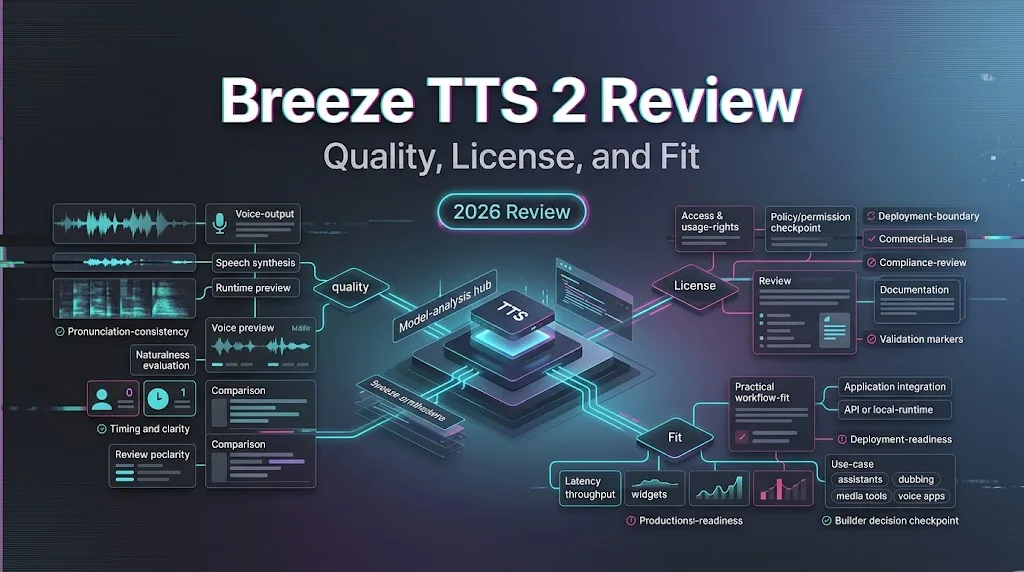
Hey, guys. You know I would not start a self-hosted TTS evaluation by asking whether the sample sounds good. That comes later. This Breeze TTS 2 review starts with a duller question: can a voice AI team use the model without misreading the license? The public files separate runtime code from model materials.
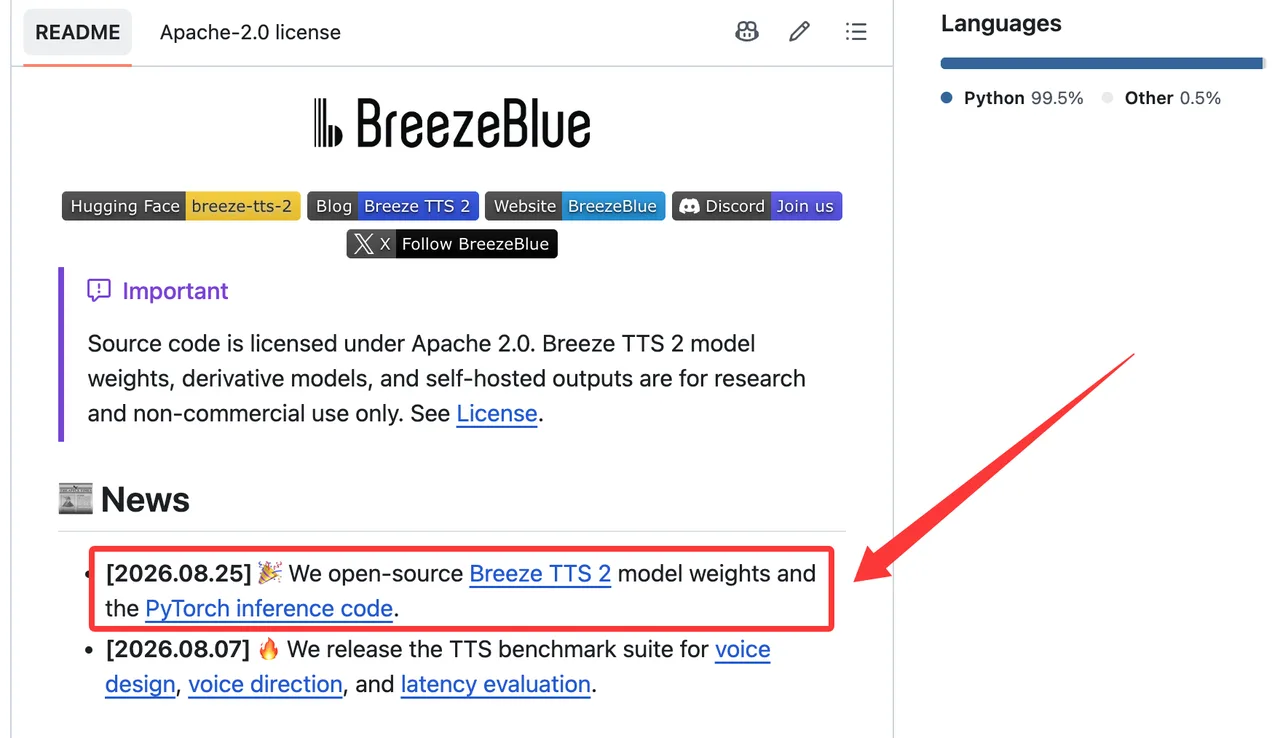
The official repository says Breeze TTS 2 model weights and PyTorch inference code were opened on August 25, 2026.
Verdict for Voice AI Builders
Breeze TTS 2 is a serious evaluation candidate for self-hosted speech synthesis, latency testing, voice cloning, bilingual output, and instruction-based voice direction.
It is not a default commercial production choice under the public weights license. The code is permissive. The weights are not. Self-hosted outputs are restricted too. I paused here, because teams often compress this into one unsafe phrase: open-weight TTS.
For this Breeze TTS 2 review, the fit is clear: useful for research and controlled evaluation, blocked for ordinary commercial deployment unless a separate written commercial license exists.
Review One Multilingual Speech Workflow
Text Input, Voice Output, and Language Coverage
Test one workflow first. English text in. Chinese text in. Voice output out. Then add one reference-free voice design prompt and one reference-guided voice direction prompt.
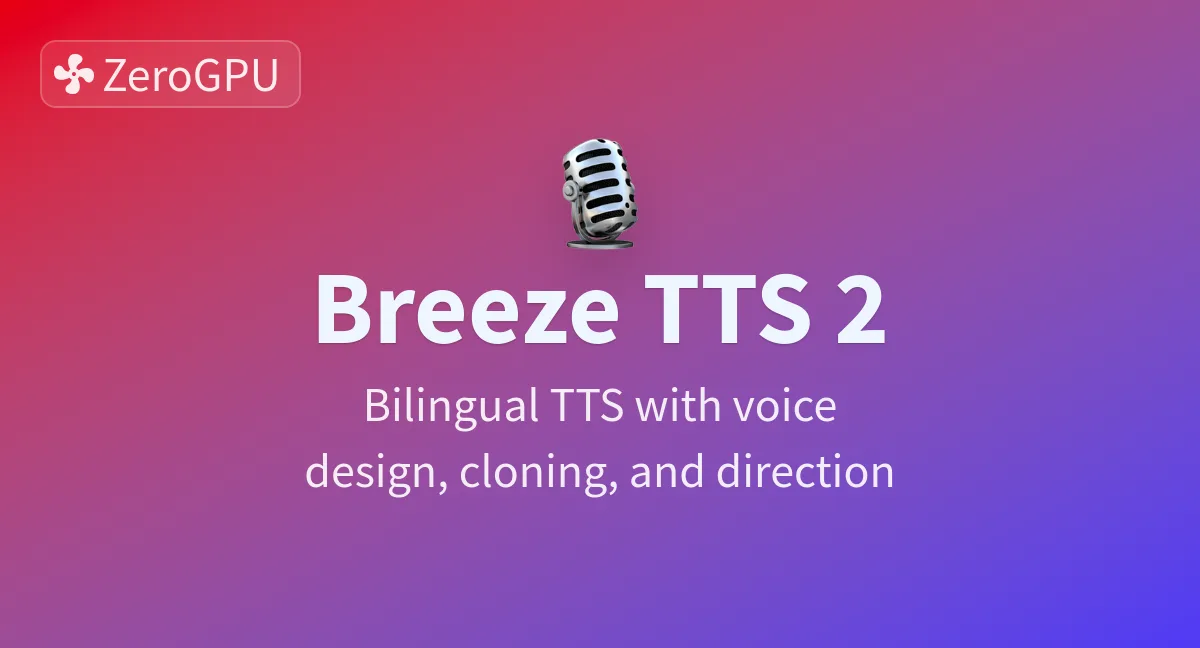
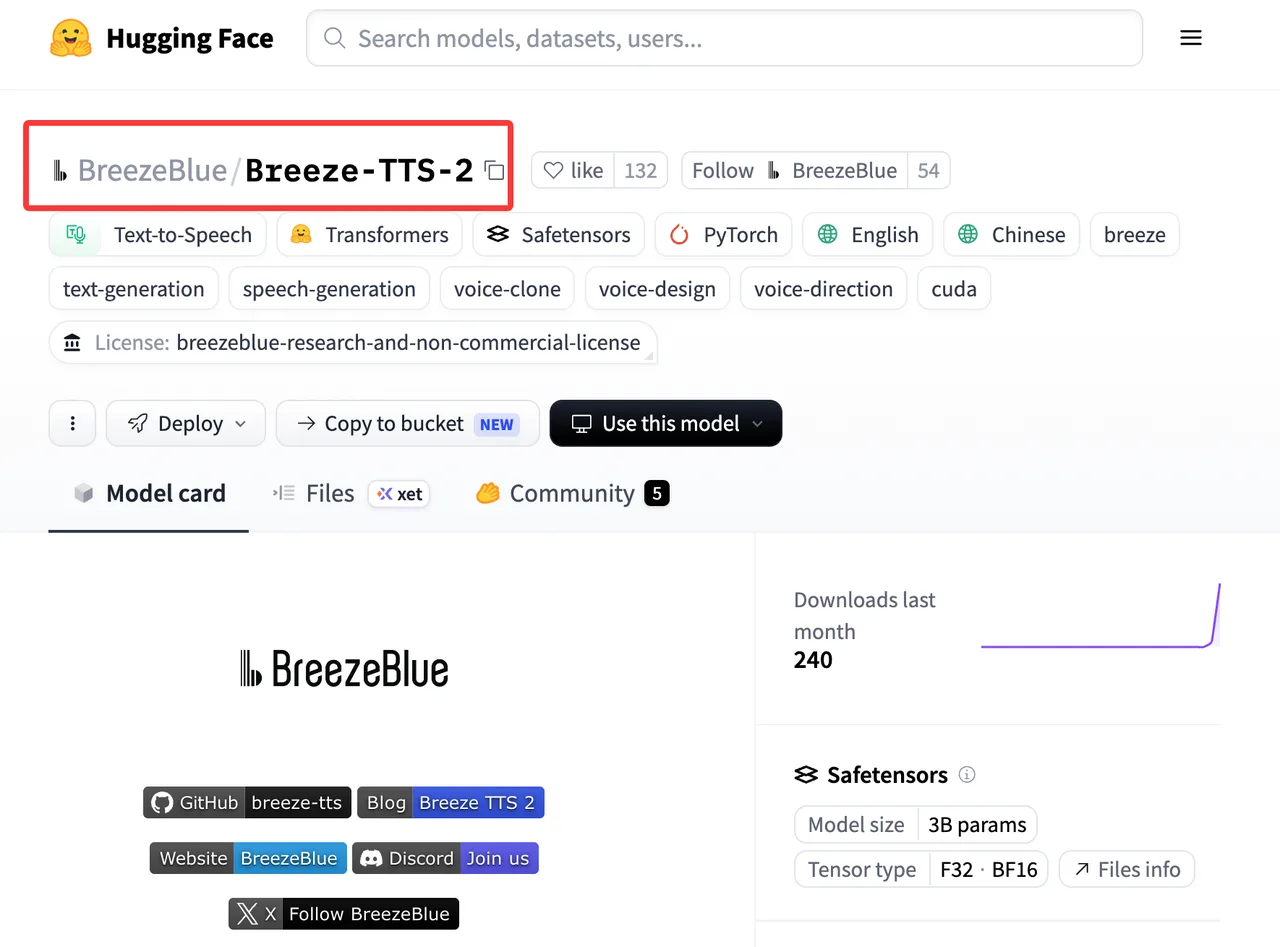
The Hugging Face model card lists the model as text-to-speech, with English and Chinese tags, a 3B parameter size, and the BreezeBlue research and non-commercial license. The README examples cover voice clone, voice design, voice direction, vocal events, and a local streaming API.
The hardware is not casual. The README asks for Linux, Python 3.10 or newer, a CUDA-capable NVIDIA GPU, about 7.7 GiB of GPU memory for eager inference, and 14.4 GiB with the full fast path. It recommends 12 GB for eager use and 24 GB for fast-path testing.
The local streaming API returns mono 24 kHz signed 16-bit little-endian PCM. If the product needs WAV, MP3, subtitles, loudness targets, or metadata, log that conversion step.
Quality Signals That Need Listening Tests
I did not run a listening test for this article, so I am not calling the audio natural, production-ready, or better than another system.
The official materials claim strong benchmark placement and low latency under H100 fast-path conditions. Treat that as a reason to test, not a final answer.
| Signal | Why it matters | Test method |
|---|---|---|
| Intelligibility | Speech must stand without transcript help | Blind review of English and Chinese clips |
| Prosody | Flat delivery breaks agents and narration | Rate pauses, stress, pace, emotion |
| Reference match | Voice clone can drift | Compare timbre, rhythm, artifacts, consent scope |
| Latency | Real-time systems feel delay fast | Record TTFA, warmup state, hardware |
| Repeatability | One good sample proves little | Run multiple seeds and keep failures |
Found the pattern on the third try: TTS reviews get weak when only the winning clip survives.
Separate Code Access From Weight Licensing
The Repository License and Runtime Code
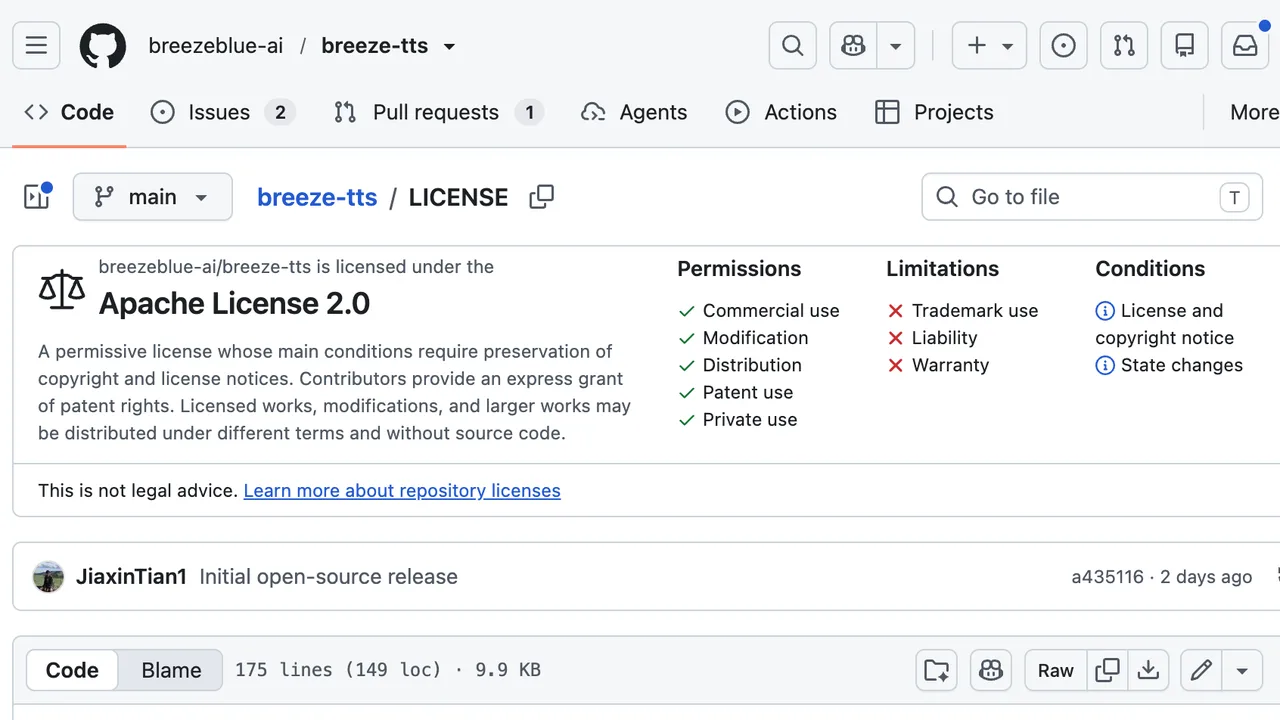
The repository source code is under the Apache License 2.0. That covers the runtime code as software. It allows inspection, modification, and redistribution under Apache terms, with notice obligations.
That does not make the whole project commercially open. Code access is one layer. Model use is another.
Research and Non-Commercial Limits on Model Use
The weights, checkpoints, adapters, derivative models, and self-hosted outputs are governed by the Research and Non-Commercial License, last updated August 25, 2026. The license says it permits research and non-commercial use, grants no commercial rights, and is not an open-source license.
Its commercial-purpose definition is broad. It includes production use, model hosting through an API or app, paid client work, advertising, subscription revenue, monetized activity, and internal business operations beyond limited evaluation.
Derivative models need the same caution. The license covers fine-tunes, LoRA, merges, quantizations, distillations, and similar derivatives. Outputs are not derivative models, but lawful output ownership does not remove the non-commercial restrictions or third-party rights issues.
This is general information, not legal advice. For voice AI, review consent, publicity rights, recording rights, copyright, and applicable disclosure rules before production use.
Decide Whether Breeze TTS 2 Fits
Strong Fits for Evaluation and Research
Breeze TTS 2 fits teams studying multilingual TTS, self-hosted latency, voice direction, red-team behavior, or reference-voice controls.
A clean evaluation record should keep the commit SHA, model file hashes, hardware, CUDA setup, prompt text, reference audio source, transcript, seed, CFG scale, outputs, failures, and listener notes. Boring records beat pretty demos.
Cases That Need a Commercially Permissive Alternative
Use another route when the plan includes customer-facing speech, paid media, client deliverables, production agents, monetized video, commercial apps, or internal operations beyond limited evaluation.
Also test alternatives if the product needs more than English and Chinese, CPU-only serving, hosted uptime commitments, vendor support, or a signed commercial weights license.
FAQ
Can enterprises negotiate a separate commercial weights license?
The public materials say commercial use requires separate written authorization from BreezeBlue or RESONIA, INC. Inquiry is possible. Approval, price, scope, indemnity, and support are not public facts.
Who owns consent records for custom reference voices?
The using organization needs to keep them. Store speaker identity, allowed use, expiration, revocation route, source recording rights, and reviewer approval with the project record.
Does the project publish a security disclosure policy?
I did not find a SECURITY.md file or public vulnerability disclosure policy in the repository on August 28, 2026. Treat that as unconfirmed until maintainers provide one.
Can organizations request long-term support for a pinned release?
No public LTS policy is visible. The GitHub releases page showed no formal releases on August 28, 2026. Pin commits and checkpoint hashes for evaluation.
How should teams document synthetic speech for end users?
Record model name, version or commit, generation date, input text, reference voice status, consent ID, output file, reviewer, and disclosure placement. I do not know a better shortcut.
Conclusion
The Breeze TTS 2 review answer is narrow: promising open-weight TTS for research and evaluation, with Apache-licensed code and restricted model materials. Run the listening test. Read the license twice. Then decide whether the workflow fits the job. Run it yourself. That’ll tell you more than anything I say.
Previous posts:
/filters:quality(82)/media/images/c347367a-a007-4466-b8f7-d37f5fb52819.webp)
/filters:quality(82)/media/images/cd4db796-7728-45fb-8267-6813ed28e173.webp)
/filters:quality(82)/media/images/1791535252286714222_v4jvJT2a.webp)
/filters:quality(82)/media/images/1791451065663755033_qNqAKS1a.webp)
/filters:quality(82)/media/images/1791359984291066138_tW5eOX6f.webp)
/filters:quality(82)/media/images/1773962750383987480_n3hqzHRZ.webp)