
Qwen3 TTS API Pricing: Models, Regions, and Cost Math
Qwen3 TTS API pricing varies by model, region, and billing unit. Compare real-time and batch rates, free quotas, voice costs, and workload estimates.
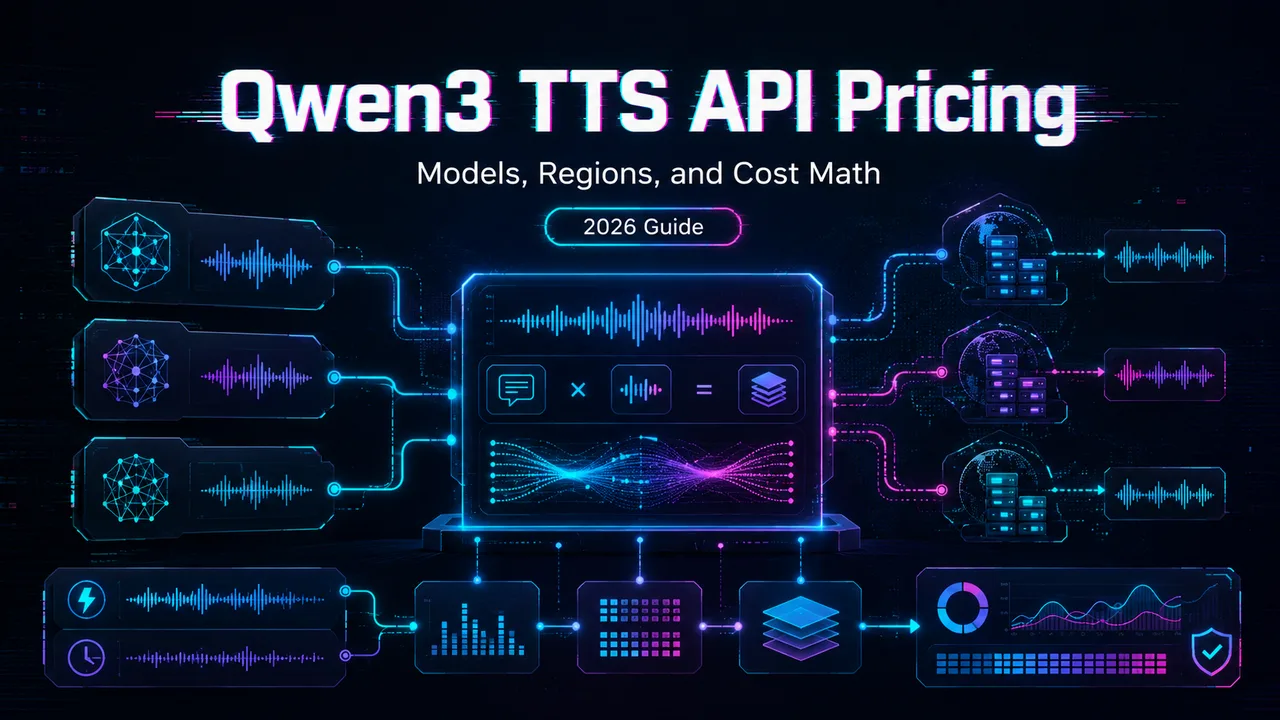
The bill usually goes wrong before any invoice arrives. A product team prices one demo script, then ships longer prompts, retries failed generations, tests realtime audio, and creates cloned voices under a different region key. That is why Qwen3 TTS API pricing needs to be calculated by model ID, region, API mode, and workload shape, not by one copied rate.
Price capture: August 14, 2026. Alibaba Cloud’s Model Studio model pricing page was last updated July 15, 2026. This article uses that page as the pricing source and treats all calculations as examples, not lowest-price promises.
How Qwen3 TTS API Billing Works
Character-Based and Token-Based Pricing
For Qwen3-TTS models, Model Studio bills by input text characters. Output audio is listed as free for those Qwen3-TTS rows. That makes the basic formula simple:
TTS cost = billable input characters / 10,000 * model rate
The old Qwen-TTS rows are different. Legacy qwen-tts-* models are token-based, with separate input and output token prices. Do not mix those with Qwen3-TTS. If a spreadsheet uses token math for Qwen3-TTS, stop there. The cost sheet is already drifting.
This is where I split the problem into three parts: text volume, voice creation, and retry overhead. They do not behave the same way.
Why Model Family and Region Change the Bill
The same script can cost a different amount depending on deployment scope. Model Studio separates Singapore international pricing from China (Beijing) Chinese mainland pricing. Some free quotas appear only in the international service deployment scope and are valid for 90 days after Model Studio activation.
Region also affects API keys. Alibaba’s voice cloning docs note that Singapore and Beijing region API keys are different. Match the key, workspace, endpoint, and model region before you trust any test bill.
Do not switch models yet. Look at the workflow first.
Compare Qwen3 TTS Model Pricing
Flash, Instruct, Voice Clone, and Voice Design Models
The speech synthesis model list separates Qwen3-TTS models by API type and capability. Flash is standard TTS. Instruct adds instruction control. VC is voice cloning. VD is voice design. Realtime models use the -realtime suffix and WebSocket access.
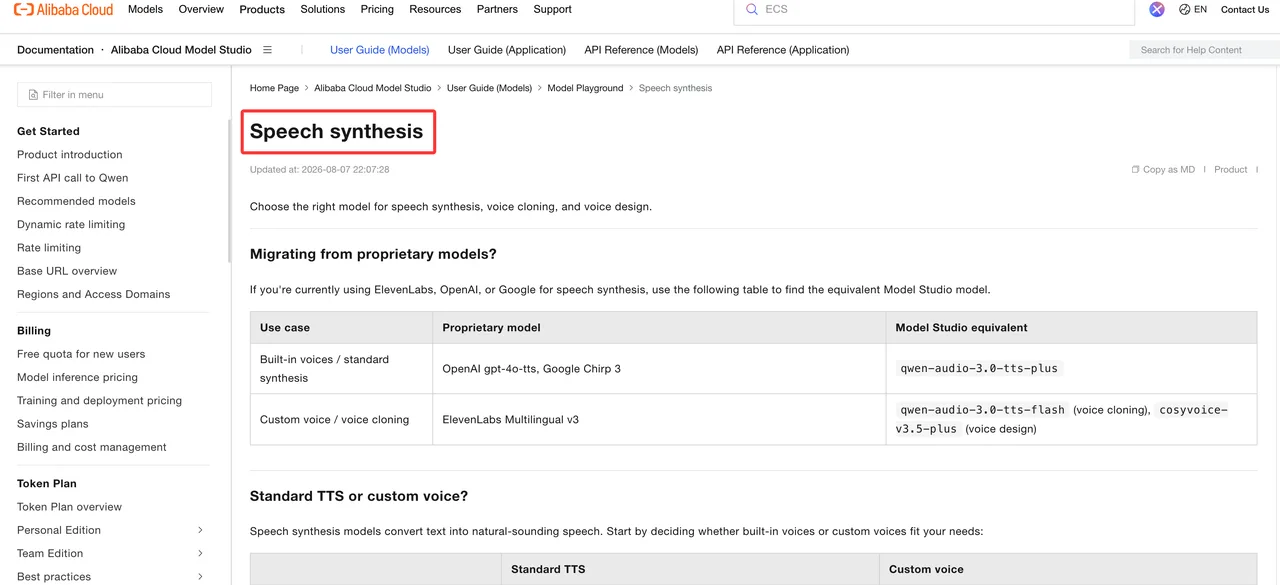
Current Model Studio TTS pricing for the main Qwen3-TTS rows looks like this:
| Model group | International, Singapore | Chinese mainland, Beijing | Notes |
|---|---|---|---|
| qwen3-tts-flash HTTP | $0.10 / 10,000 chars | $0.114682 / 10,000 chars | Output free |
| qwen3-tts-instruct-flash HTTP | $0.115 / 10,000 chars | $0.115 / 10,000 chars | Output free |
| qwen3-tts-vc-2026-01-22 HTTP | $0.115 / 10,000 chars | $0.115 / 10,000 chars | TTS use only, voice creation separate |
| qwen3-tts-vd-2026-01-26 HTTP | $0.115 / 10,000 chars | $0.115 / 10,000 chars | TTS use only, voice design separate |
| qwen3-tts-flash-realtime | $0.13 / 10,000 chars | $0.143353 / 10,000 chars | WebSocket realtime |
| qwen3-tts-instruct-flash-realtime | $0.143 / 10,000 chars | $0.143 / 10,000 chars | WebSocket realtime |
For the Qwen3 TTS price table, I would record the exact model ID, snapshot ID, deployment scope, unit, currency, free quota, and capture date. The alias model can point to a snapshot, and that mapping can change.
Real-Time and Non-Real-Time Rates
Non-realtime Qwen3-TTS uses HTTP. The non-real-time speech synthesis guide describes complete text input and audio returned as a URL or stream, depending on mode. This is usually the better fit for content production, course narration, and batch audio.
Realtime Qwen3-TTS uses WebSocket. The Qwen-TTS realtime API is built for streaming interaction, where first audio timing matters more than batch throughput.
That is the core Qwen3 TTS realtime pricing decision: you are not only buying audio. You are buying a different interaction pattern. If the product is a voice assistant, realtime may be necessary. If the task is 2,000 product narration clips overnight, HTTP may be easier to control.
Estimate a TTS Workload
Calculate Character Volume and Request Count
Start with text, not users. Finance cannot budget “10,000 monthly active users” until product translates usage into characters.
Use this formula:
Monthly characters = requests * average characters per request * retry multiplier
Example:
80,000 requests * 180 characters * 1.08 retry multiplier = 15,552,000 characters
If this workload uses qwen3-tts-flash in Singapore international scope:
15,552,000 / 10,000 * $0.10 = $155.52
If the account still has the 110,000-character free quota:
(15,552,000 - 110,000) / 10,000 * $0.10 = $154.42
Small difference here. Bigger difference in small pilots.
This cannot be judged by feel. It needs a sample run.
Add Voice Creation, Free Quotas, and Retry Overhead
Qwen voice cloning cost has two layers. The first is voice creation. The second is TTS usage with that voice.
For Qwen-TTS voice cloning, Model Studio lists qwen-voice-enrollment at $0.01 per voice clone. In the international scope, it shows a 1,000 voices per account free quota, valid for 90 days after activation. In China (Beijing), the listed price is $0.01 per voice clone with no free quota shown.
Voice design is separate. qwen-voice-design is listed at $0.20 per created voice, with 10 free voices per account in the international scope for the same 90-day activation window. China (Beijing) lists $0.20 per created voice.

The voice cloning guide also says a voice is bound to the target speech synthesis model. If you need the same speaker across multiple target models, plan for separate voice creation. One voice ID is not a universal passport.
Avoid Common Pricing Mistakes
Match the API Key to the Deployment Region
A Singapore key, a Beijing endpoint, and a Chinese mainland price should not sit in the same row unless the team is deliberately testing failure behavior.
For each environment, store:
environment -> region -> workspace -> API key owner -> model ID -> billing tag
One person can remember this for a week. A team cannot.
For production, add a guardrail that rejects model IDs outside the approved region. The mistake is boring. The invoice is not.
Check Snapshot IDs and Temporary Discounts
Qwen3-TTS aliases can map to snapshot IDs, such as qwen3-tts-flash currently mapping to qwen3-tts-flash-2025-11-27 in the pricing table. If your app pins a snapshot, price it by that snapshot. If it uses an alias, review the alias mapping before release.
The pricing page also says it lists standard prices and points users to the Model Studio console for latest promotions. If a temporary discount is used in a cost deck, write the cutoff time next to it. A discount without an end date is not a budget.
Limits and Trade-Offs
List Prices Can Change After Publication
This article uses official list prices checked on August 14, 2026. Alibaba Cloud can update model IDs, aliases, quotas, or promotional labels after publication.
For launch approval, keep a pricing evidence folder: captured pricing page, model ID list, region, date, calculator sheet, and the first invoice sample. The more tools you use, the more the workflow needs a shared language.
Price Alone Does Not Measure Speech Quality or Latency
Cheaper character rates do not automatically mean lower production cost. If a model needs more retries, fails brand review, or causes latency problems in a realtime product, the final cost moves.
Cheap does not always mean cost-saving. Unusable generations are expensive.
Choose the model with a sample set: 20 to 50 real product scripts, target languages, cloned or designed voices if needed, and the same approval criteria the shipped product will use.
FAQ

Can procurement teams receive separate invoices by deployment region?
They should confirm this in Alibaba Cloud billing and account setup before committing. From a FinOps view, the safer design is to separate regions by account, workspace, API key, tag, or internal cost center so invoices can be reconciled without manual guessing.
What billing evidence should finance retain for an API invoice dispute?
Keep the invoice, usage export, model IDs, region, request logs, timestamps, API key or workspace mapping, pricing capture date, and any promotion evidence. Store sampled request IDs if available. Do not rely on screenshots alone.
Who should own alerts when TTS spending exceeds a product budget?
The product owner should own the budget decision. Platform or FinOps should own alert plumbing. Engineering should own the response path: throttle, switch model, disable retries, or pause non-critical generation.
Are taxes and currency conversion included in list prices?
Do not assume they are. The pricing table lists model rates in dollars, but final billing can depend on account, contract, tax treatment, and currency settlement. Finance should check the billing console and contract terms.
Can teams separate costs by application or API key?
Yes, if they design for it early. Use separate API keys, workspaces, tags, or accounts per application where possible. At minimum, log app_id, model ID, region, and request owner for every TTS call.
Conclusion
Qwen3 TTS API pricing is manageable when the team keeps the model, region, unit, free quota, voice creation cost, and retry rate in separate lines. It gets messy when realtime, non-realtime, VC, VD, Flash, and legacy Qwen-TTS are treated as one rate.
For the next production run, price one real workload with current official rates, then compare the estimate against the first invoice. The conclusion is valid at this scale.
Previous posts:
/filters:quality(82)/media/images/c347367a-a007-4466-b8f7-d37f5fb52819.webp)
/filters:quality(82)/media/images/cd4db796-7728-45fb-8267-6813ed28e173.webp)
/filters:quality(82)/media/images/1791535252286714222_v4jvJT2a.webp)
/filters:quality(82)/media/images/1791451065663755033_qNqAKS1a.webp)
/filters:quality(82)/media/images/1791359984291066138_tW5eOX6f.webp)
/filters:quality(82)/media/images/1773962750383987480_n3hqzHRZ.webp)