Agnes API Cost: Free-Tier Production Economics
Agnes API cost depends on successful-task economics, including retries, throttling, engineering work, outages, fallback capacity, and migration risk.
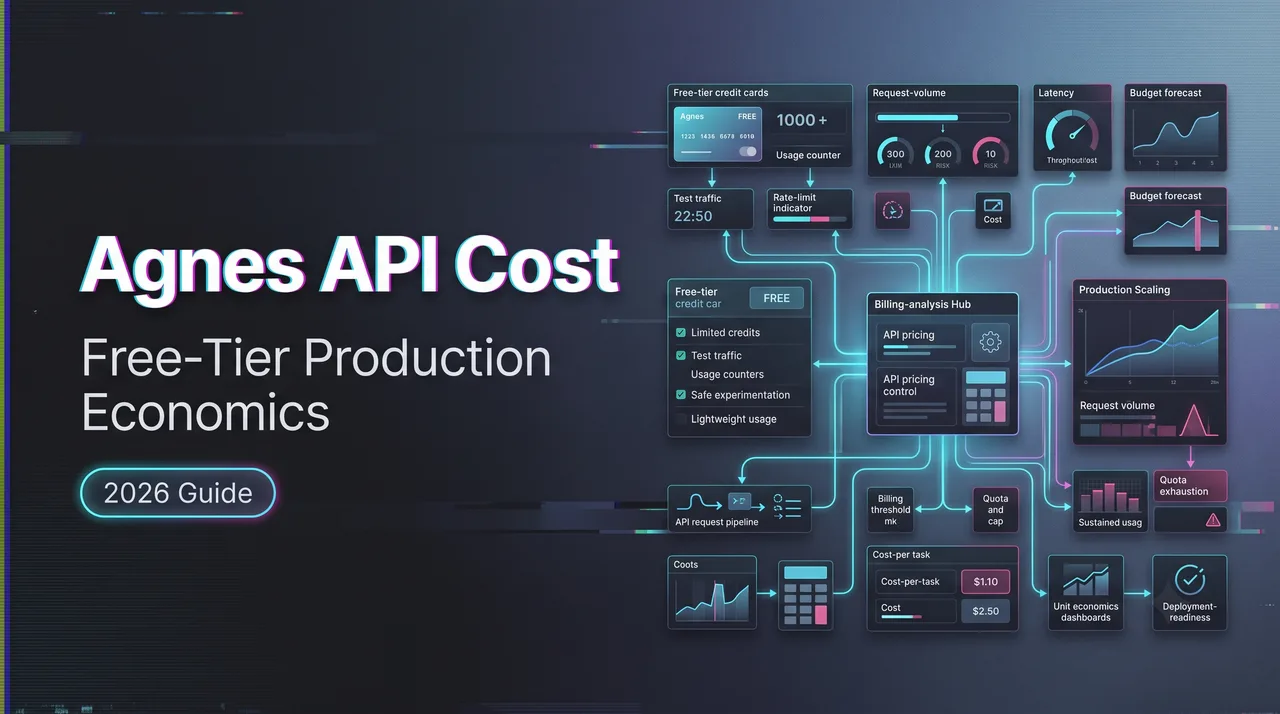
Agnes API cost is not the same as the price of one request. For production teams, the useful number is the cost of one successful task after retries, throttling, fallback, support work, and human correction.
This article does not explain the API ecosystem, model list, key setup, base URL, or registration flow. The question here is narrower: when can a free tier support real production traffic, and when does it quietly move cost into engineering, support, and paid fallback?
All limits, pricing, SLA terms, and data terms should be checked again on the publication date. Public reference values can change.
Measure Cost per Successful Production Task

Requests, retries, tool failures, and human correction
Start with the production task, not the API call.
A task might be “generate one accepted product image,” “finish one agent action,” “summarize one support ticket,” or “return one customer-ready draft.” One task may need several requests. It may also need validation, retry, fallback, or manual repair before the output is usable.
Use this formula:
cost per successful task = total workload cost / accepted completed tasks
Total workload cost should include:
- Initial API requests
- Retries after timeout, throttling, or malformed output
- Paid fallback calls
- Tool-call failures
- Human review and correction
- Support time
- Customer credits or refunds after disruption
- Engineering work to monitor and maintain the route
This is the difference between free AI API cost and production cost. A free request can still create a paid task if the first result fails and the system falls back to another provider.
Why zero unit price does not mean zero task cost
Zero unit price is useful during testing. It is not enough for production planning.
A free call that succeeds on the first try has low task cost. A free call that times out, retries twice, fails validation, then moves to a paid provider may cost more than using the paid route first. A free call that creates a customer support ticket costs even more.
Classify every task into four outcomes:
- Accepted: The output meets the product rubric without repair.
- Repairable: The output can be fixed through retry, validation, editing, or review.
- Rejected: The output cannot be used.
- Disrupted: The task was delayed, throttled, or failed in a customer-visible way.
A free tier is production-ready only when accepted and repairable tasks stay inside the workload’s tolerance. If rejected and disrupted tasks grow with traffic, the savings are probably fake. They just moved to another budget line.
Model Free-Tier Capacity Constraints
Rate limits, concurrency, queueing, and traffic variability
Free-tier rate limits are capacity limits. They decide how much work the route can finish before queueing, throttling, or fallback begins.
The public Agnes AI model catalog lists reference access and limits. As of its 2026 public reference, free/default text access is listed at 20 actual RPM, image limits are resolution-specific, and free/default video access is listed at 1 actual RPM. The same documentation says model availability, rate limits, pricing, and quota rules may change, so these values should be treated as launch-day verification items.
Do not size production from daily averages. Use peak-minute traffic.
Track:
- Peak requests per minute
- Concurrent jobs
- Queue delay
- Retry rate
- Timeout rate
- Throttling rate
- Accepted-task rate during peak load
- Paid fallback triggered by capacity shortfall
A free tier can pass a quiet integration test and still fail the first real traffic spike. That is not a moral failure. It is just math.
Capacity shortfalls and paid fallback demand
A production plan should assume fallback will happen.
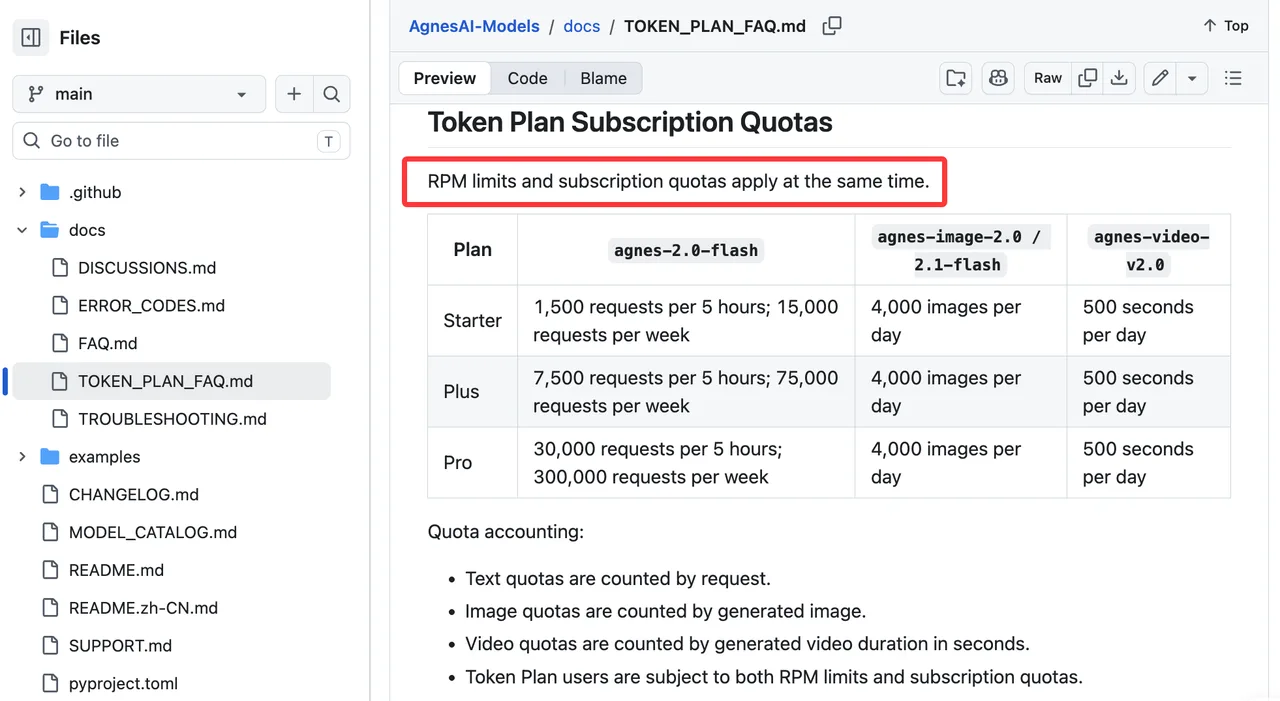
The Agnes Token Plan FAQ states that RPM limits and subscription quotas apply at the same time, and that multiple keys of the same type do not increase the shared limit pool. That matters for teams tempted to treat extra keys as extra capacity.
Calculate fallback demand like this:
fallback demand = expected production demand - confirmed free-tier capacity + retry overflow
Then choose a fallback rule:
Prototype: Stop when the free tier is unavailable.
Internal workload: Queue or delay non-urgent jobs.
Customer-facing workflow: Use paid fallback when delay would break the user promise.
High-priority workflow: Route directly to the paid provider unless the free tier has proven capacity and reliability at peak load.
The policy should be written before launch. During an incident, nobody wants to discover that “free” means “we forgot who approves paid overflow.”
Add Engineering and Reliability Costs
Monitoring, incident response, integration maintenance, and testing
A free-tier route still needs production controls.
At minimum, log provider, model ID, account tier, request timestamp, retry count, error class, latency, fallback route, final task status, and acceptance result. Store enough evidence to replay failures without giving broad access to customer data.
Engineering cost should include:
- Dashboards for throttling, latency, failures, and accepted-task rate
- Alerts for sustained 429s, timeout spikes, and fallback surges
- Regression tests after prompt, model, or provider changes
- Runbooks for support and on-call teams
- Approval records before traffic increases
This is where API retry cost becomes visible. If retry volume rises, the system may still look cheap on the provider bill while becoming expensive to operate.
Outages, model changes, and service discontinuity
A free-tier dependency needs an incident model.
Separate four event types:
- Capacity event: The route is healthy, but your workload exceeds available limits.
- Provider event: The provider has degraded behavior or service interruption.
- Model-change event: Outputs, formatting, latency, or tool behavior change after an update.
- Policy event: Pricing, limits, data terms, or access rules change.
Each event type needs a different response. Capacity events may need queue control or paid fallback. Provider events may need status updates and customer messaging. Model-change events need regression testing. Policy events need product, finance, and legal review.
Do not claim SLA protection, data guarantees, or stable free access unless the official agreement confirms it.
Calculate Switching and Dependency Costs
Provider adapters, prompt portability, regression testing, and migration
Switching away from a free tier also has cost.
The cost is low when the application keeps provider-specific code inside an adapter, stores raw outputs for evaluation, and uses portable acceptance tests. The cost is high when prompts, validators, UI behavior, retry logic, and customer promises all depend on one provider’s current behavior.
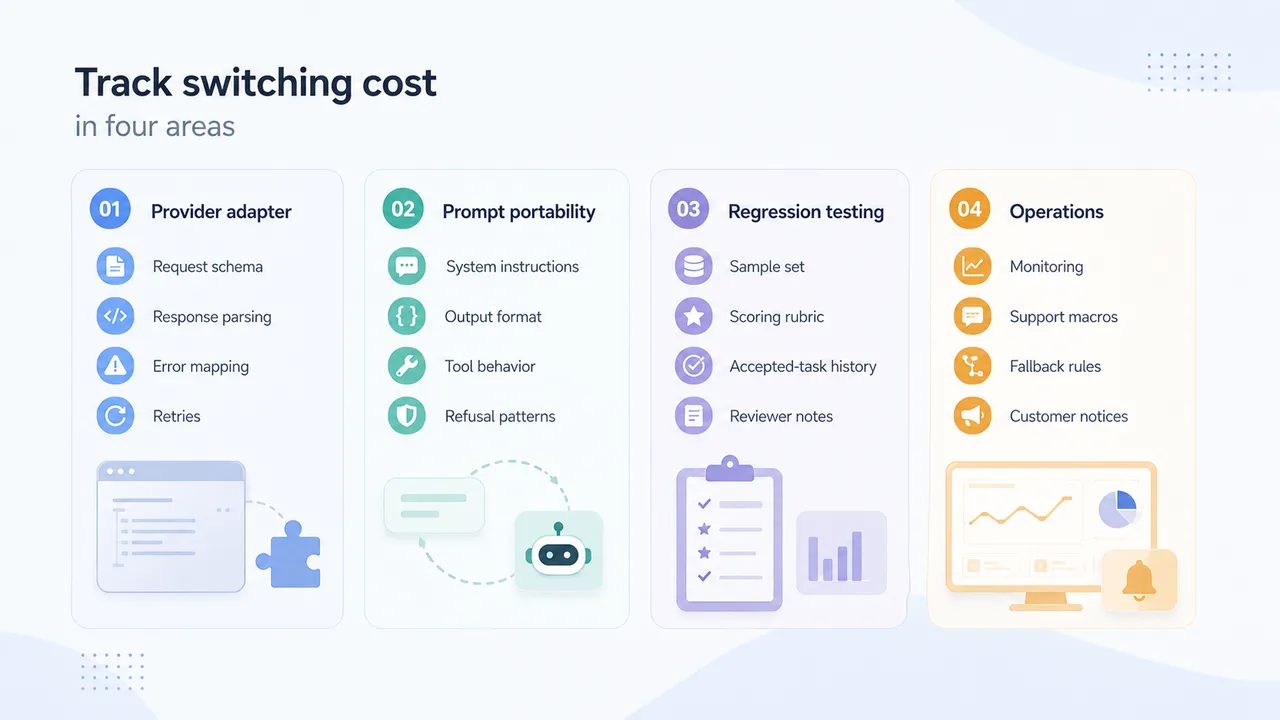
Track switching cost in four areas:
- Provider adapter: request schema, response parsing, error mapping, retries.
- Prompt portability: system instructions, output format, tool behavior, refusal patterns.
- Regression testing: sample set, scoring rubric, accepted-task history, reviewer notes.
- Operations: monitoring, support macros, fallback rules, customer notices.
The goal is not to avoid Agnes or any other provider. The goal is to avoid turning a free-tier experiment into a hard dependency without knowing the exit cost.
Make the Production Decision
Prototype-only, overflow, internal workload, and customer-facing thresholds
Use deployment categories.
- Prototype-only: Good for experiments and demos. No customer promise. No paid fallback required.
- Internal workload: Acceptable when delays are tolerable and users understand capacity limits.
- Overflow route: Useful when free capacity handles low-priority work and paid routes handle urgent work.
- Customer-facing route: Requires verified limits, fallback policy, monitoring, support workflow, and approval from product, platform engineering, and FinOps.
A free tier should earn production traffic through evidence, not optimism.
Required evidence before increasing production traffic
Before increasing traffic, collect:
- Publication-date check of limits, pricing, SLA, and data terms
- Workload definition
- Acceptance rubric
- Peak traffic estimate
- Test results under repeated runs
- Retry and fallback rate
- Cost per successful task
- Incident runbook
- Rollback trigger
- Approval owner
The decision is not “Is the API free?” The decision is “Can this route finish the workload at the quality, timing, and risk level the product promises?”
FAQ
Who approves exceptions to the paid-provider fallback policy?
Product, platform engineering, and FinOps should approve exceptions together. Product owns user impact, platform owns reliability evidence, and FinOps owns budget exposure. Legal or compliance should join when data terms, credits, or customer commitments are involved.
How should support categorize free-tier throttling incidents?
Support should categorize them as capacity or throttling incidents unless the provider confirms a broader outage. The record should include timestamp, workload, error class, retry count, fallback behavior, customer impact, and whether the incident came from free-tier limits.
Which team owns customer credits after provider interruption?
Customer Success should own the customer conversation. Finance and product should own credit approval. Platform engineering should provide the evidence: request logs, provider status, duration, fallback result, and whether the disruption affected a paid customer commitment.
Conclusion
Agnes API cost should be measured at the task level. Count accepted outputs, retries, fallback, repair time, support work, customer impact, and migration risk.
The free tier can be useful for prototypes, internal tools, and controlled overflow. It should not become the default for customer-facing production traffic until the team has verified limits, measured cost per successful task, and agreed on fallback rules.
Previous posts: