
pxpipe for Production AI Cost Optimization
pxpipe cost guide for AI teams deciding when compression reduces input tokens, image tokens, and production LLM spend.
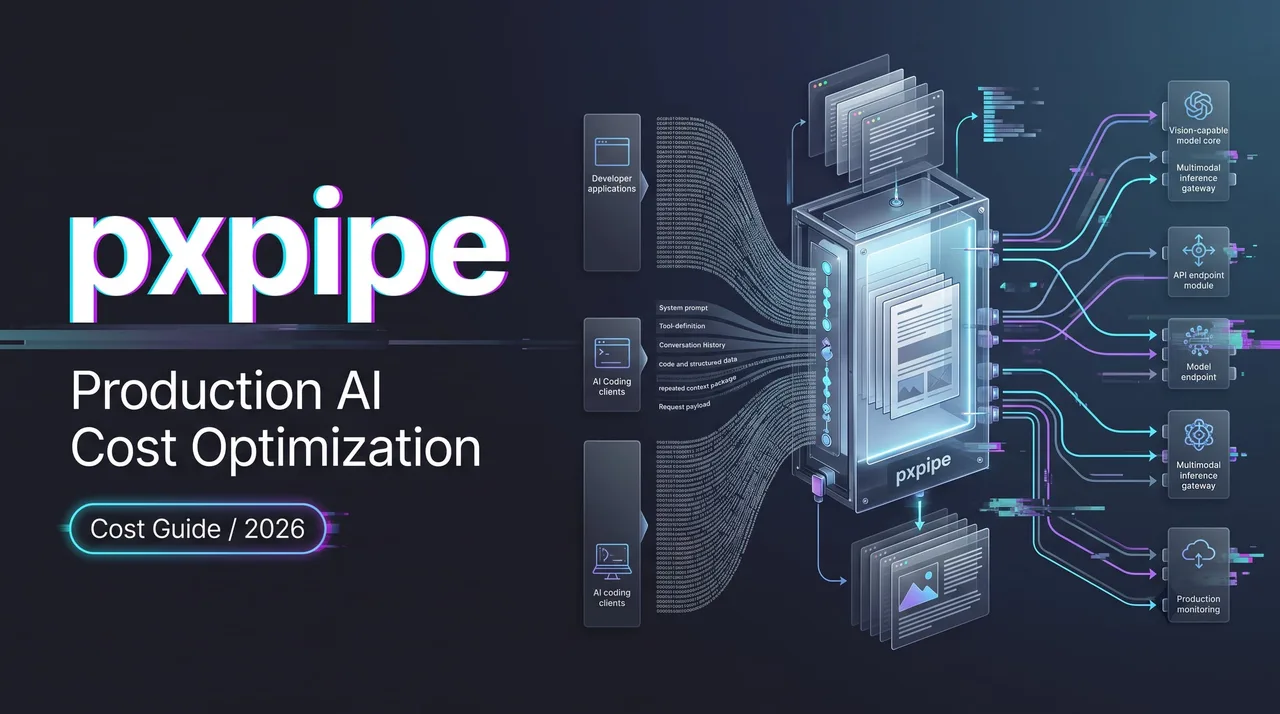
I would not put pxpipe into a paid production path because a demo bill looked smaller. That is the exact kind of shortcut that later turns into a billing incident, a support ticket, or both.
The useful question is narrower: can image-based context compression reduce input token cost for a specific workload without breaking task quality? For dense agent context, maybe. For short prompts, sparse prose, exact identifiers, or customer-facing flows that need auditability, the answer may be no.
This is a cost evaluation note.
What pxpipe Is Trying to Optimize
Input token cost, dense context, and visual text renders
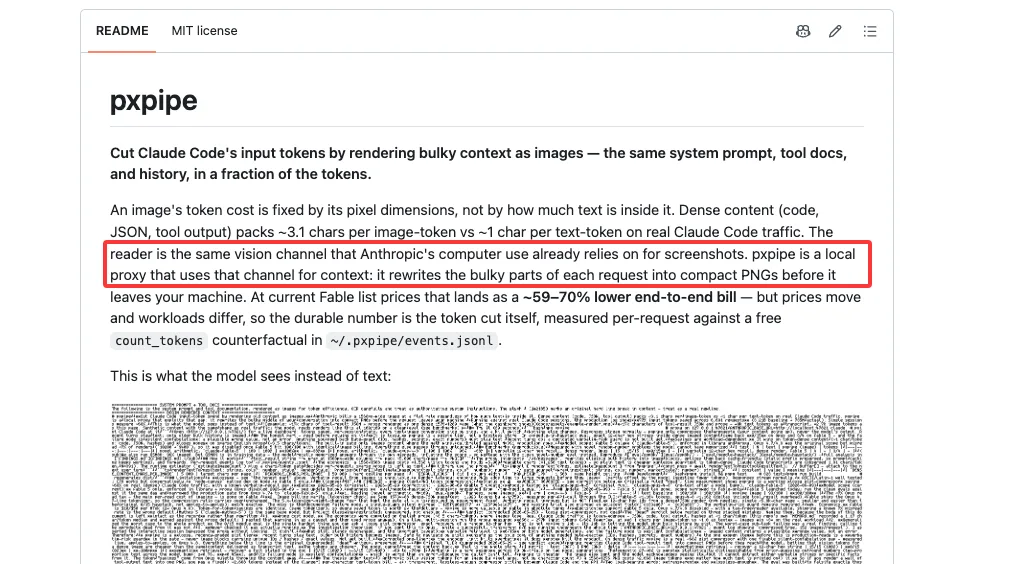
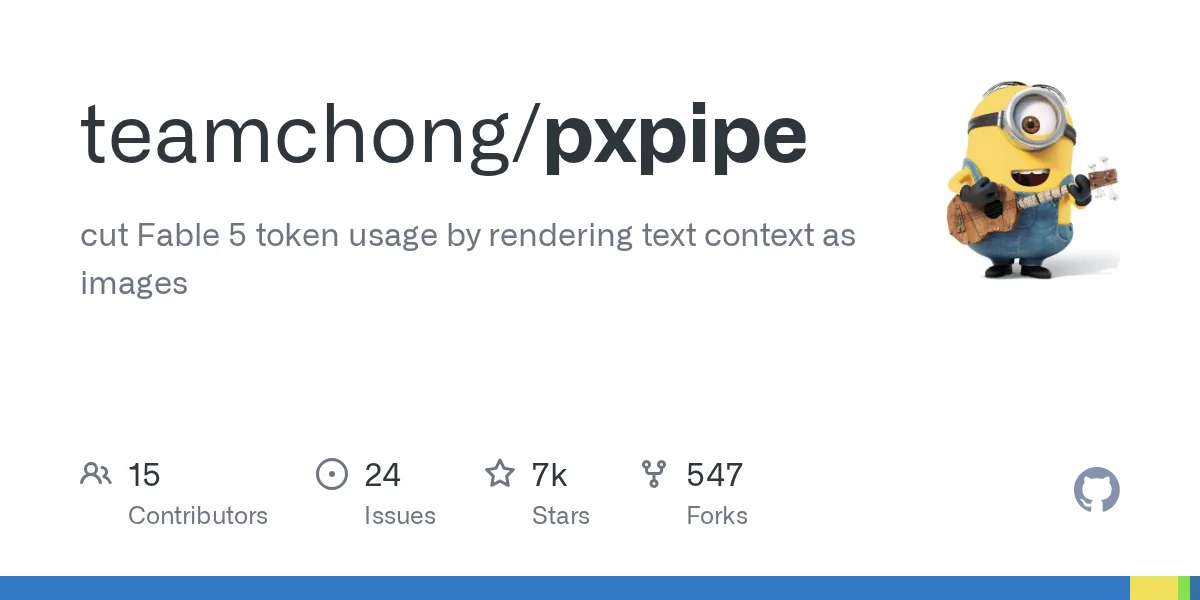
The public pxpipe GitHub repository describes it as a local proxy and library that renders bulky context into PNG image blocks before forwarding the request to supported multimodal models. The project is MIT licensed. Its stated target is not every prompt. It focuses on large, stable, token-dense input: system prompts, tool docs, old history, logs, JSON, command output, and similar context.
The mechanism is simple enough to explain and still risky enough to test carefully.
Text is normally billed as input tokens. Dense code, logs, and machine output can be expensive because they tokenize poorly. An image, by contrast, is charged according to image-token or visual-token rules. If a rendered image can hold a lot of useful text per billed image token, the input side may get cheaper.
That “may” is doing work.
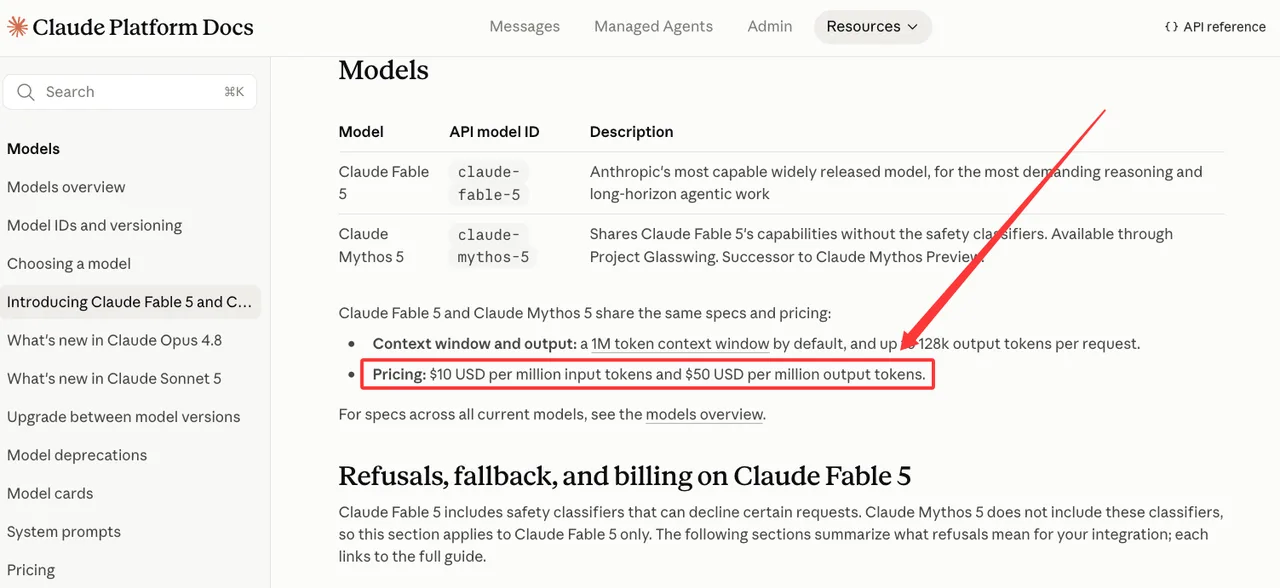
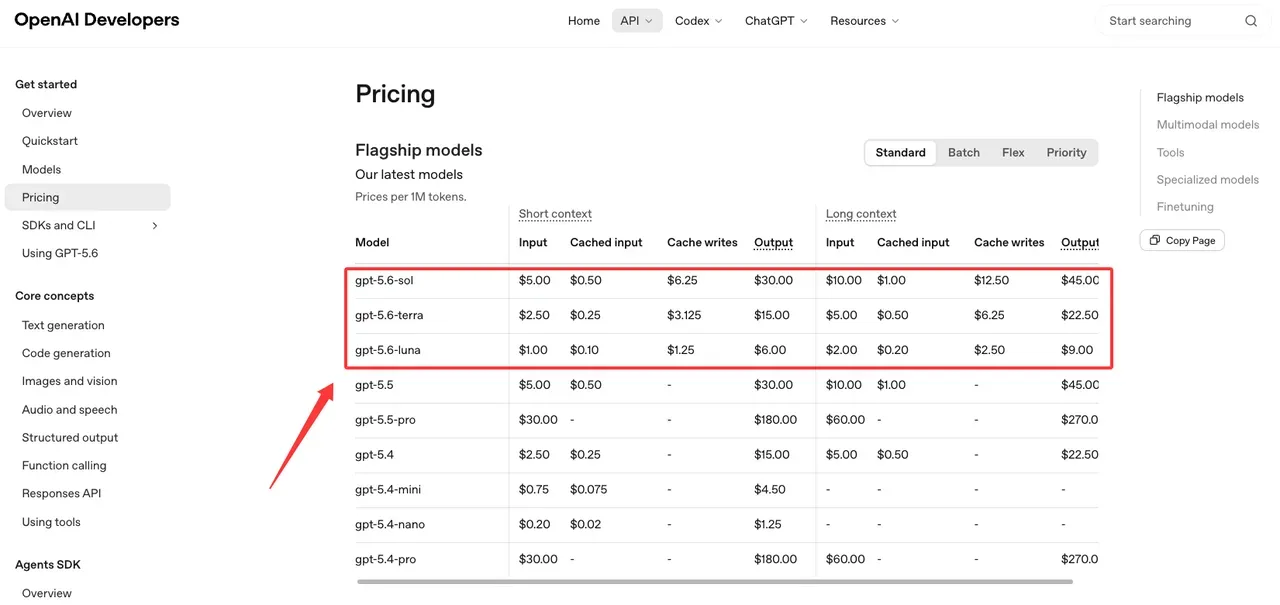
As of July 2026, Anthropic’s Fable documentation lists claude-fable-5 at $10 per million input tokens and $50 per million output tokens, with a 1M context window by default and up to 128k output tokens per request in the Claude Fable 5 docs. OpenAI’s current API pricing page lists GPT-5.6 family rates separately for short and long context. That means the break-even point depends on the model, context length tier, cache behavior, and whether the image representation is actually cheaper after all billable pieces are counted.
I paused here. This is where most “LLM cost optimization” claims get too clean.
Why savings depend on workload shape
The repo itself is cautious about workload dependence. It says wins appear on token-dense material and losses can appear on sparse prose. That matches the basic math.
Compression only helps when the converted block would cost less as image input than as text input. A 20-line customer question is not that. A repeated 60k-character tool schema might be. A large JSON dump with lots of punctuation and repeated keys might be. A short policy paragraph probably is not.
Prompt caching complicates the picture. If stable context is already heavily cached, replacing it with images may save less than expected. If the client keeps resending uncached tool output, the same compression layer may matter more. The baseline has to compare the same request under the same cache state. Otherwise the savings number is decorative.
Good enough. That’s the most honest assessment I can give.
When Compression Can Pay Off
Dense code, JSON, logs, tool output, and repeated context
The best candidate material is bulky and low-precision. Not useless. Low-precision.
Examples include:
- Old conversation history used for orientation.
- Large command output where the model needs the shape of the result.
- File reads that the agent can reopen before editing.
- Tool documentation and schemas repeated across turns.
- Logs where exact reproduction is not required.
- JSON where the model needs structure, not byte-perfect values.
For Anthropic models, image cost is tied to visual-token rules. The Claude vision docs describe image handling with patch-based visual tokens, model-specific limits, supported formats, and resizing behavior. For GPT-5.6, OpenAI’s Images and vision guide says image inputs are metered in token units and explains how detail, patch counts, and model family behavior affect token use.

The provider rules are not interchangeable. A render profile that looks economical on Fable 5 may not work on GPT-5.6. A GPT-5.6 auto detail setting may preserve original dimensions and produce a larger bill than expected if the team does not resize or select a cheaper detail level.
So that’s where the bottleneck is: not rendering text into images. The bottleneck is proving the image meter is cheaper for the exact model and request shape.
Why sparse prose or short prompts may not benefit
Sparse prose is a bad candidate because it already tokenizes reasonably well. There is not enough density to exploit. Turning a normal prompt into an image can add latency, reduce readability, and still cost more.
Short prompts are also poor candidates. The fixed overhead of transformation, logging, request rewriting, and debugging does not disappear just because the bill is small. A system that saves fractions of a cent while making failures harder to diagnose is not cheaper. It only moves cost from the API invoice to engineering time.
Exact values are the sharper boundary. The pxpipe README is direct about lossy behavior. Verbatim recall from dense images can fail, especially for hashes, IDs, secrets, paths, exact numbers, or any value the model must reproduce byte-for-byte. Those blocks should stay as text, or the agent should reopen source truth before acting.
For production, “mostly readable” is not a quality bar.
Production Cost Evaluation
Per-request estimator, baseline runs, and break-even checks
A production evaluation needs a per-request estimator before any rollout. The estimator should answer one question: for this request, with this model, cache state, context length tier, image detail setting, and expected output length, does compression lower total cost?
Total means total. Not just the transformed block.
Count:
- Raw text input cost.
- Compressed image input cost.
- Cached input and cache write behavior.
- Long-context uplifts.
- Output cost.
- Retry cost.
- Additional tool calls caused by misreads.
- Extra latency cost if it affects user experience or infrastructure occupancy.
The pxpipe repo describes an events log and counterfactual measurement approach. That is the right shape: record the original uncompressed estimate beside the actual compressed usage. Keep both. Finance cannot review a savings claim if the baseline disappears.
The baseline set should include real production-shaped fixtures. Not one happy-path demo. Use representative code tasks, log-heavy tasks, JSON-heavy tasks, long-history tasks, and ordinary prompts that should stay uncompressed. The “should stay uncompressed” cases matter because they test the gate. A compression system that only wins when hand-fed dense examples is not ready.
Break-even should be calculated per model. Fable 5 cost, GPT-5.6 input token cost, and image tokens all move under different pricing rules. If the model changes, the conclusion expires.
Latency, quality loss, and debugging overhead
PNG rendering is not free. Encoding large pages adds latency before the request leaves the client. For background coding agents, that may be acceptable. For interactive customer support, it may not be.
Quality loss is quieter. The model may misread a dense render and still respond confidently. That is worse than a hard error. A hard error gets routed. A plausible wrong answer gets shipped.
Debugging also changes. Raw text prompts are searchable. Rendered visual context is inspectable, but slower to review. Support teams need a way to see the original block, the rendered image, the model route, the estimator decision, and the final billing usage. Without that, every incident becomes archaeology.
The minimum evaluation record should include:
| Evaluation item | Why it matters |
|---|---|
| Raw request and compressed request | Shows what changed before the model saw it |
| Estimated raw cost and actual billed cost | Prevents savings claims from becoming vibes |
| Model ID and image settings | Compression behavior is model-specific |
| Cache state | Avoids double-counting prompt caching as compression savings |
| Quality verdict | Cost savings without task success is not savings |
| Fallback path used | Shows whether failures were recoverable |
One table. Enough.
Rollout Risks
Compression artifacts, unreadable renders, and billing surprises
The main artifact risk is unreadable or partially readable text. Dense rendering pushes the model toward its visual reading limit. At profitable density, exact recall gets worse. That is not a bug in a narrow sense. It is the trade.
Billing surprises come from three places.
First, image token rules can change by provider and model family. Second, default image detail behavior may change the number of patches or tokens. Third, long-context thresholds can move a request into a higher price tier. OpenAI’s GPT-5.6 pricing, for example, separates short and long context rates. A team that estimates only short-context input may understate cost once the request crosses the threshold.
There is also data governance. A local proxy does not mean upstream traffic stays local. If the rendered context is forwarded to a provider, it is still provider-bound data. Security review should treat rendered images as equivalent to the source text they contain.
Kill switch, logging, and fallback to raw context
A rollout needs a kill switch before it needs a dashboard. The switch should disable image conversion without changing the rest of the request path. If the compression layer is suspected in an incident, teams need raw-context fallback immediately.
Logging should capture the estimator decision, transformed blocks, skipped blocks, model ID, token usage, and savings counterfactual. It should also record why a block stayed text. “Skipped because sparse prose” and “skipped because exact-token risk” are different operational signals.
Fallback rules need to be boring:
- Unsupported model: pass through as raw text.
- Exact-value task: keep source text or force source re-read.
- Customer-facing answer: require quality gate before enabling.
- Cost anomaly: disable compression for that route.
- Misread incident: preserve artifacts and replay raw.
This is not dramatic. It is just the price of putting compression in the path of paid work.
FAQ
Who should approve compression for paid customer workloads?
Approval should come from the model platform owner, security or data governance, finance, and the product owner for the affected workflow. Engineering can validate the mechanism, but it cannot approve customer risk alone.
For paid workloads, the approval packet should include model IDs, provider pricing source, baseline runs, quality evals, rollback plan, logging fields, and the exact contexts allowed for compression.
What cost anomaly should trigger disabling pxpipe?
Disable it when compressed requests cost more than raw baseline for a meaningful slice of traffic, when retries erase the savings, or when long-context/image-token behavior produces unexplained billing jumps.
A single odd request can be investigated. A repeated pattern should trip the kill switch. Production systems do not get points for being interesting.
How should finance review compression savings claims?
Finance should review net savings against retained baseline evidence. The claim should separate raw input token reduction from total bill reduction. It should also subtract added retries, added output, higher context-tier pricing, and any provider-specific image-token cost.
Unsupported claims should be removed from customer docs, sales decks, and internal ROI pages. Keep the wording narrow: “saved X on these workloads under these model and pricing conditions,” not “cuts LLM costs.”
Conclusion
The practical case for pxpipe is real but narrow. It can make sense for dense, repeated, low-precision agent context where image tokens are cheaper than text tokens and quality holds under eval. It does not make sense as a blanket production switch.
The safest framing is simple: compression is a per-request cost decision, not a product promise. Verify the repo, license, supported models, estimator logic, provider pricing, and image billing rules before citing any savings number.
This conclusion has an expiration date. Models update fast.
Previous posts:
Related Articles
/filters:quality(82)/media/images/1773962750383987480_n3hqzHRZ.webp)
Seedance 2.5 vs WAN 3.0 vs Kling 4.0: Specs, References and Price Compared
/filters:quality(82)/media/images/660b4b48-6351-40cd-ba00-51322b7455f4.webp)
How to Use Kling 4.0 Keyframes for a Product Reveal
/filters:quality(82)/media/images/273bf240-30e3-4e6c-8ae4-e3346b487bc7.webp)
Kling 4.0 Pricing: What Does One Usable Clip Cost?
/filters:quality(82)/media/images/bb7ec772-f694-45f4-9a9a-c0e5fd2e7d60.webp)
Kling 4.0 Reference-to-Video: Keep a Product Consistent
/filters:quality(82)/media/images/444431ee-1387-4a40-81ad-866e095a7c75.webp)
Kling 4.0 Review: Can It Handle Product Video Ads?
/filters:quality(82)/media/images/81212eb5-4b43-4cc4-92f4-38a0c439d258.webp)