
GLM-5.2 Open Weights vs Hosted API: Deployment Tradeoffs
GLM-5.2 ships MIT open weights and hosted access. A builder's guide to deployment tradeoffs, cost, and control.
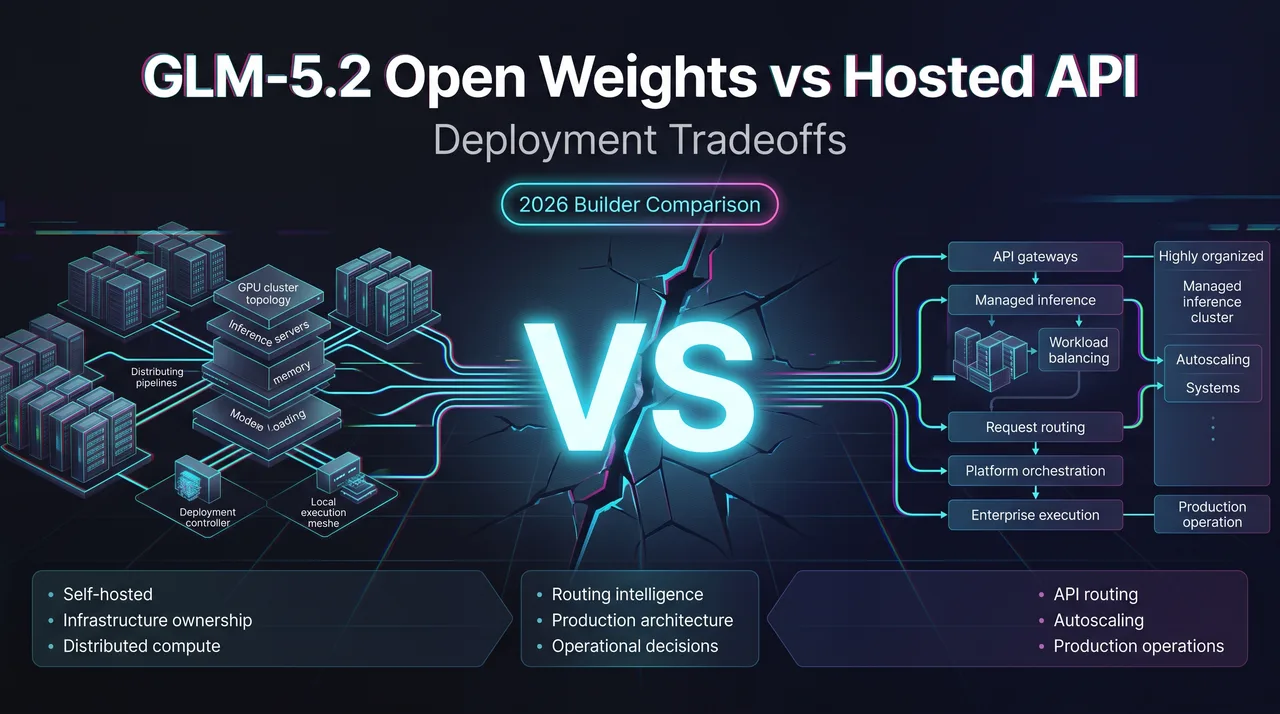
I paused on the phrase GLM-5.2 Open Source because it sounds like a cost decision. It is not. It is an operations decision with a license attached.
As of my July 7, 2026, check, I can verify a live Hugging Face GLM-5.2 model card showing MIT license metadata, a Z.ai developer page for the hosted glm-5.2 API, and local serving notes for vLLM and SGLang. I am not treating “around June 20” release chatter as the canonical date. The useful question is simpler: if you can run it yourself and also call it as a hosted model, which burden do you actually want to own?
Two Ways to Run GLM-5.2
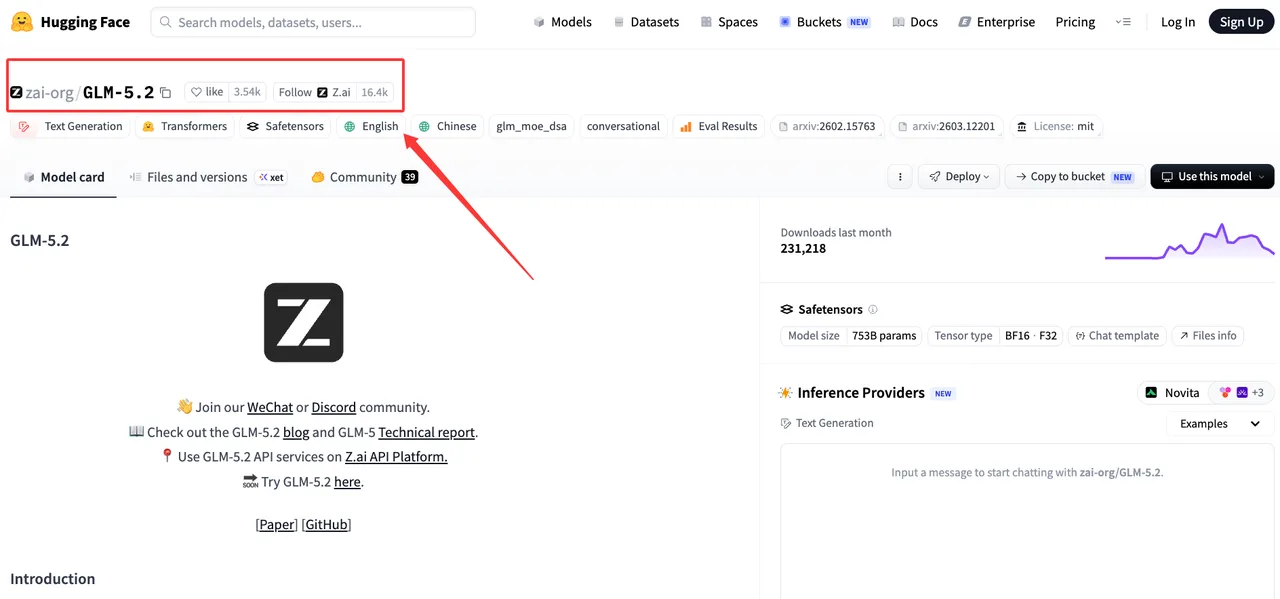
MIT open weights (self-hosted)
The self-hosted path starts with the weights. Z.ai’s model card lists GLM-5.2 with an MIT license, and the project README points to GLM-5.2 and GLM-5.2-FP8 downloads through Hugging Face and ModelScope. The same README describes GLM-5.2 as 744B-A40B in BF16 and FP8 variants, while Hugging Face metadata currently displays 753B. I would mark both as [vendor-reported] and re-check before capacity planning. Don’t average them. That is how bad infra estimates begin.
The upside is control. You choose the serving stack, quantization, routing layer, data boundary, logging policy, and upgrade timing. You can keep prompts inside your own environment. You can patch around model behavior. You can benchmark against your exact workload instead of someone else’s leaderboard.
The catch is obvious once the first deployment ticket opens. Open weights do not remove serving cost. They move it into GPU capacity, storage, networking, observability, incident response, and whoever gets paged when throughput drops.
Hosted Coding Plan / standalone API
Hosted access is the other path. Z.ai’s GLM-5.2 developer docs list the hosted model as text-in/text-out, with 1M context, 128K maximum output, thinking mode, streaming, function calling, context caching, structured output, and MCP-related capability notes. The same page shows direct API examples using the glm-5.2 model ID.
There is also the GLM Coding Plan, which is aimed at coding tools and says its plans support GLM-5.2, GLM-5-Turbo, and GLM-4.7. That is not the same thing as owning the model. It is a managed product surface with quotas, policy, and convenience.
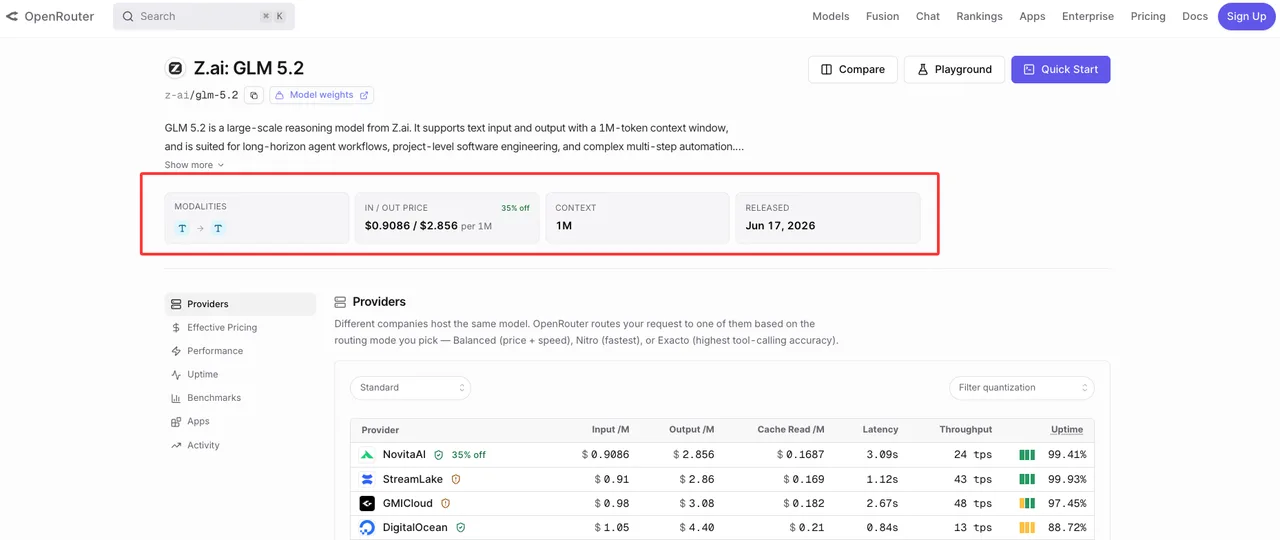
Gateway access is a third hosted flavor. OpenRouter’s GLM 5.2 model page lists context, pricing, provider routing, performance, uptime, and activity dimensions. Useful for testing. Not the same as direct Z.ai control.
Self-Hosting Realities
VRAM, throughput, and serving stacks (vLLM, SGLang)
I would not publish a fixed VRAM number for GLM-5.2 without a current deployment recipe, precision choice, context target, batch shape, and hardware profile. The number depends on too many variables: BF16 vs FP8, tensor and expert parallelism, KV cache size, max context actually used, concurrent sessions, prefill/decode split, and whether you are optimizing for latency or throughput.
Z.ai lists local serving support through SGLang, vLLM, Transformers, KTransformers, Unsloth, and Ascend-oriented stacks. For most platform teams, the first two names matter most. vLLM describes itself as a high-throughput, memory-efficient serving engine with OpenAI-compatible APIs, streaming, tool calling, reasoning parsers, and distributed inference. SGLang emphasizes low-latency and high-throughput serving, RadixAttention, continuous batching, quantization, structured outputs, and broad hardware support.
That does not mean either stack makes local deployment easy. It means you have a plausible serving layer. Different thing.
For a GLM-5.2 Open Source deployment, your first benchmark should not be “tokens per second in a clean demo.” It should be: project-size prompt, tool calls enabled, realistic output length, cache behavior measured, concurrency ramped, retries visible, and failure modes logged. Found the pattern on the third try.
Operational and upgrade overhead
The underestimated work starts after the model returns its first good answer.
You need image builds, framework pinning, driver compatibility, GPU scheduling, autoscaling, queue management, cold-start policy, health checks, model download caching, rollback plans, and monitoring for latency, TTFT, output tokens, cache hit rate, OOM errors, timeout rates, and partial stream failures.
Then comes behavior drift. A hosted API can change underneath you. A self-hosted model can freeze too long. If Z.ai publishes an improved FP8 variant or serving recipe, you decide when to move. That sounds good until you have to re-run regression tests across prompt templates, tool schemas, JSON output, safety filters, and long-context workflows.
Open weights give you control. They also give you chores. Both statements are true.
Hosted Access Realities
Speed of integration and managed scaling
Hosted GLM-5.2 is faster to test. The Z.ai docs provide direct API examples, and the migration guide calls out the model identifier, sampling defaults, thinking mode, reasoning_effort, streaming output, streaming tool calls, max context, and regression checks. That is exactly the checklist a builder needs when moving from an earlier GLM model or another hosted coding model.
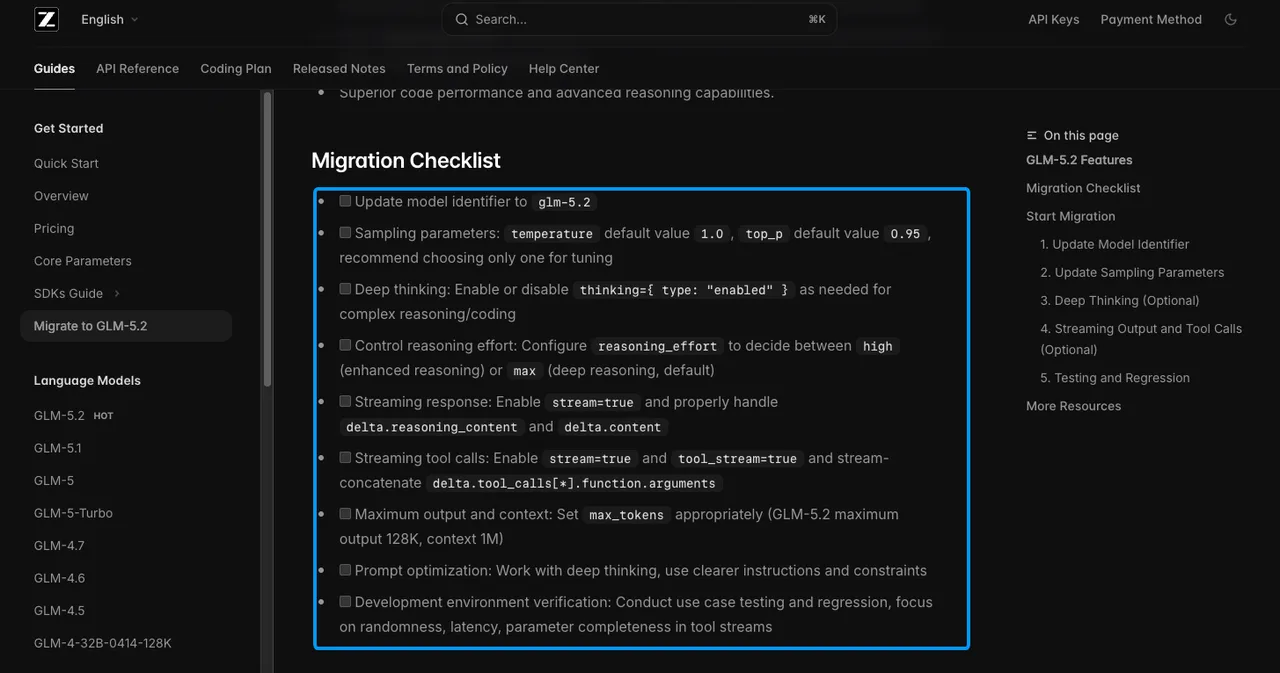
The hosted path makes sense when the question is still “does this model improve the product?” not “can we operate this model better than the provider?” Most teams should answer the first question before pretending they are ready for the second.
Managed scaling also removes a class of distractions. No GPU procurement. No serving framework tuning on day one. No emergency cluster resize because one customer pasted a large repo into the prompt window.
Speed is not the goal. Not breaking flow is.
Cost predictability and vendor dependence
Hosted access turns inference cost into a visible meter. That is helpful. It also means you inherit the provider’s pricing structure, quota system, rate limits, policy changes, and outage profile.
Self-hosting flips the accounting. Token cost may look lower at steady high utilization, but only if the GPUs stay busy, the team can operate them, and performance remains acceptable under real traffic. Idle GPUs are not free. Engineering time is not free. A week lost to unstable serving is not free either, even if the model license says MIT.
The vendor-dependence question is not binary. Hosted API dependence means you rely on someone else’s uptime and policy. Self-hosting dependence means you rely on your own infra maturity, hardware supply, and serving expertise. Pick your dependency. You do not get to pick none.
Deployment Decision Framework
Choose self-hosting when…
Choose self-hosting when data boundary, latency control, fixed workload economics, model customization, or regulatory constraints are stronger than your need for fast integration.
The self-hosting LLM case gets better when traffic is steady, prompts are predictable, the team already runs GPU workloads, and the product depends on model behavior that you want to freeze, audit, or customize. It also makes sense when hosted rate limits or policy boundaries block the use case.
I would require four proofs before moving production traffic: a cost model at expected utilization, a latency/throughput benchmark with real prompts, an operations owner who can maintain the serving stack, and a migration plan that preserves API behavior for the app layer.
No owner, no self-hosting. That rule saves time.
Choose hosted access when…
Choose hosted access when the team is still validating workload fit, when usage is spiky, when the model is one option in a routing layer, or when engineering bandwidth is better spent on product behavior than GPU operations.
Hosted GLM-5.2 API access is also cleaner when you need fast experiments across thinking modes, streaming tool calls, and long-context coding tasks. You can measure quality, latency, and inference cost before committing to a local deployment.
The decision I like is staged: start hosted, instrument everything, collect prompt and cost traces, then decide whether local deployment is worth the transfer. If nobody can show the workload profile, nobody can prove self-hosting will be cheaper.
FAQ

What operational overhead do teams typically underestimate when self-hosting GLM-5.2 open weights?
They underestimate the boring layer: model storage, image builds, framework versions, GPU memory fragmentation, long-context KV cache pressure, autoscaling, queueing, observability, and regression testing.
They also underestimate ownership. When a hosted API gets slow, you file a ticket or route around it. When your self-hosted stack gets slow, it is your profiler, your logs, your CUDA/NPU stack, and your rollout window.
How hard is migrating from hosted GLM-5.2 to self-hosted without breaking existing integrations?
It depends on how disciplined the first integration was. If the app only knows an OpenAI-compatible chat endpoint, strict model IDs, stable tool schemas, and normalized response handling, migration is manageable. If prompts, retries, parsing, logging, and provider-specific fields leaked through the codebase, migration becomes refactoring.
The safe pattern is to put a model gateway inside your own system from day one. Hosted or local becomes a backend choice. The product should not care.
When does the control advantage of open weights stop outweighing the operational burden?
It stops outweighing the burden when the team cannot keep utilization high, cannot staff inference operations, or cannot show that local behavior is materially better for cost, privacy, latency, or customization.
Control has value. Unused control is decoration. Expensive decoration.
What monitoring and maintenance differences should builders expect between self-hosted and hosted versions?
Hosted monitoring focuses on request cost, latency, rate limits, error classes, provider status, retries, and model quality. Self-hosted monitoring adds GPU utilization, memory pressure, queue depth, cache behavior, serving-worker health, model-loading time, framework errors, node failures, and capacity planning.
Maintenance also changes. Hosted means tracking provider docs and migration notices. Self-hosted means testing new weights, new quantization, new serving framework releases, and new hardware drivers. Different dashboards. Different failure stories.
Conclusion
The GLM-5.2 Open Source path is not automatically better than the hosted path. It is better when control, data locality, customization, and long-term utilization justify the operational surface.
Hosted access is not automatically weaker. It is better when speed, managed scaling, and predictable integration matter more than owning every layer.
For most builders, I would start hosted, measure real workload behavior, then decide whether self-hosting earns its keep. Open weights are a serious option. Treat them like infrastructure, not a coupon.
Previous posts:
- GLM-5.2 API Guide: Features, Context, and Integration
- Qwen3.6-35B-A3B Deployment: vLLM, SGLang, and Production Notes
- AI Coding Agents to Inference Platforms: Where the Infrastructure Changes
- Codex AI Media API Stack: Building Production AI Pipelines
- LTX-2 API Local Workflow: Self-Hosting vs Managed Integration
/filters:quality(82)/media/images/6cd1ca63-9e7e-493b-8a68-97bad82fb7b4.webp)
/filters:quality(82)/media/images/567077af-c3bd-4701-ba96-1b981a515d79.webp)
/filters:quality(82)/media/images/1773962750383987480_n3hqzHRZ.webp)
/filters:quality(82)/media/images/1ecd59e5-56e4-434d-ae06-c414860b29b8.webp)
/filters:quality(82)/media/images/b38eb9e7-de41-4a05-8e79-5e280c4a0c36.webp)
/filters:quality(82)/media/images/c347367a-a007-4466-b8f7-d37f5fb52819.webp)