MiniMax H3 Pricing Explained: AI Video Costs
MiniMax H3 pricing is based on generated video duration and reference inputs. Estimate per-job cost, retries, usable output, and monthly budgets.
The number that can break a video budget is not always the largest one. Sometimes it is the smallest one on the page. For MiniMax H3 pricing, “From $0.13/run” looks clean, but production cost starts only after you ask: one run of what, for how many seconds, with which references, and how many usable clips at the end?
All prices below are as of the publication check on August 3, 2026. Recheck every number on the day this article goes live.
Read the Current MiniMax H3 Price Correctly
Why “from $0.13/run” is a starting display, not a complete-video price
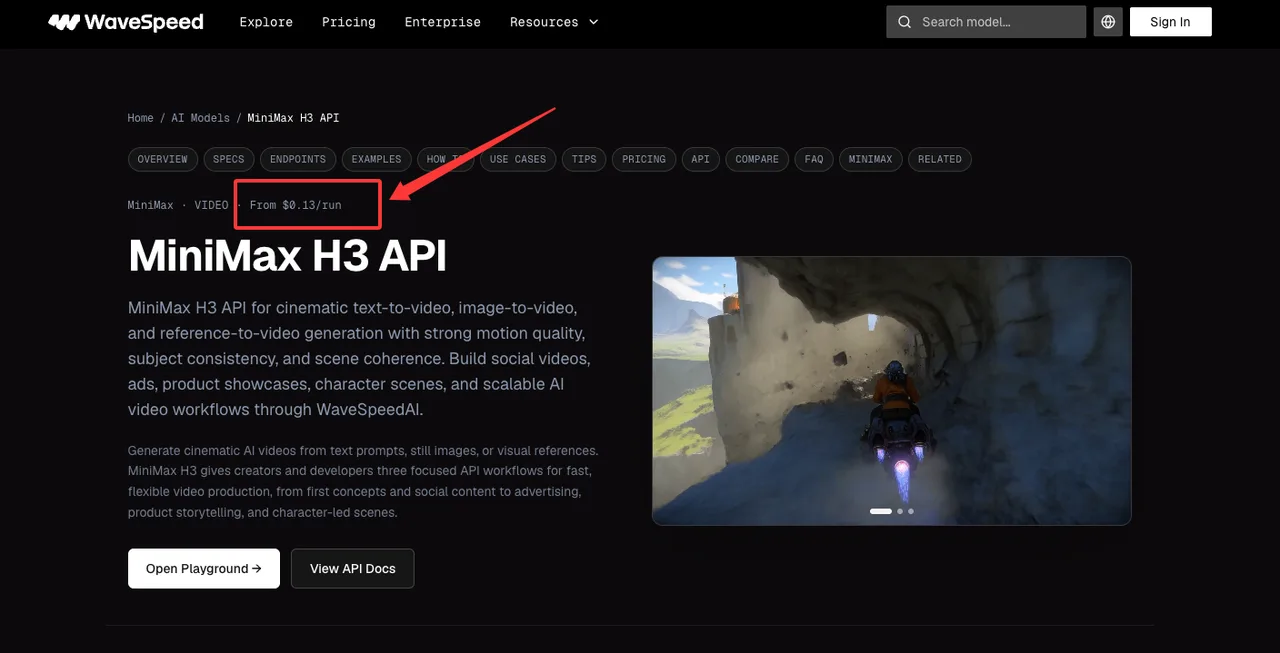
WaveSpeed’s public MiniMax H3 page shows the model starting from $0.13/run as of publication date. That is useful for discovery, but it is not the same as saying every finished video costs $0.13.
For production planning, “run” should be treated as a starting billing display. The final charge depends on the endpoint, duration, output count, resolution, and reference inputs. A product budget that copies only the smallest visible number will understate the real AI video API cost.
The detailed 2K rate of $0.13 per generated second
The detailed WaveSpeed endpoint pages matter more than the model overview card. As of publication date, the H3 text-to-video endpoint prices generated 2K video at $0.13 per second.
That means the basic 2K output examples are:
5 seconds: $0.65 as of publication date
10 seconds: $1.30 as of publication date
15 seconds: $1.95 as of publication date
So the safe wording is not “a full H3 video costs $0.13.” The safe wording is: WaveSpeed starts H3 from $0.13/run, while 2K generated output is billed at $0.13 per generated second as of publication date.
Calculate Base Output Cost
Five-, ten-, and fifteen-second WaveSpeed examples
For a simple 2K text-to-video job, base output cost is:
generated seconds × $0.13 × number of outputs
As of publication date, one 5-second 2K output is $0.65. One 10-second 2K output is $1.30. One 15-second 2K output is $1.95.
If a system requests two 10-second outputs, the base generated-output cost becomes $2.60 as of publication date. If a batch runs 100 single-output, 10-second jobs, the base generated-output line is $130 as of publication date, before rejected clips, retries, storage, review, or editing.
This is the cleaner way to read WaveSpeed MiniMax H3 pricing: start with seconds and outputs, then add the route-specific inputs.
Duration, output count, and route selection assumptions
A useful cost row should not say only “H3 video.” It should record the route and assumptions.
For example:
- H3 text-to-video, 2K, 10 seconds, one output, no paid references, checked August 3, 2026.
That is different from:
- H3 reference-to-video, 2K, 10 seconds, one output, 6 images, 8 seconds of reference video, checked August 3, 2026.
The model name may be the same, but the cost structure is not.
Add Reference-Input Charges
Free image and audio allowances versus paid additional images
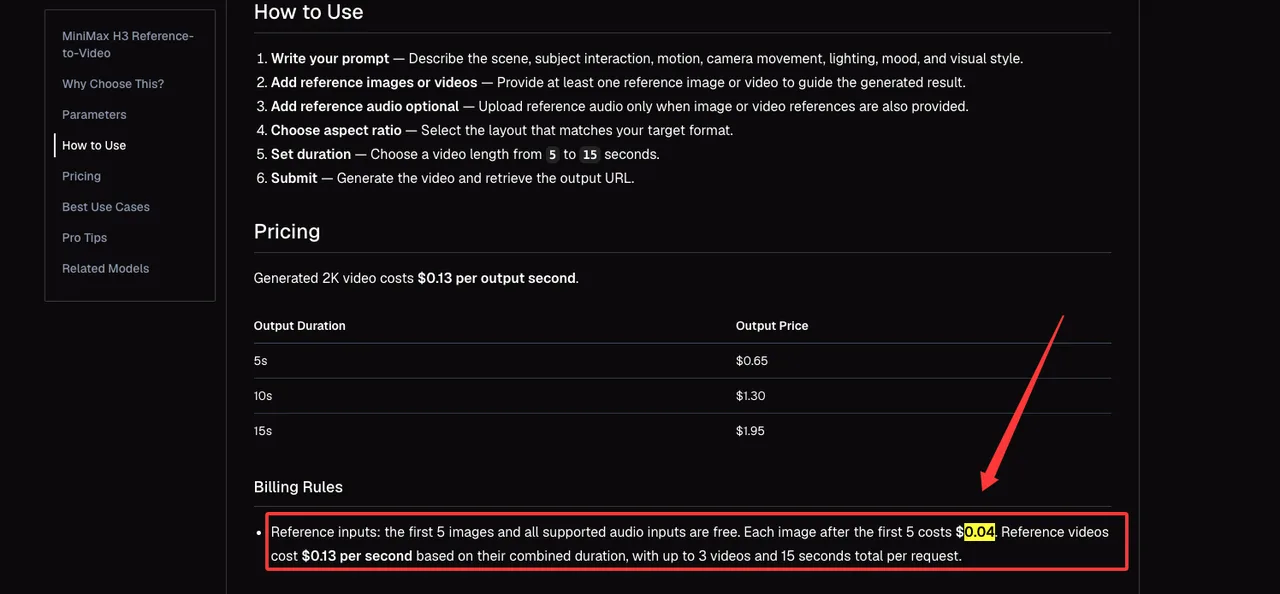
Reference inputs are part of the bill, not just creative settings. As of publication date, the H3 reference-to-video endpoint says the first 5 images are free, supported audio inputs are free, and each image after the first 5 costs $0.04.
For a 10-second 2K reference-to-video job with 6 images:
- Output cost: $1.30 as of publication date
- Extra image charge: $0.04 as of publication date
- Starting total: $1.34 as of publication date
The reference-to-video cost may still look modest in one test. At scale, the habit of uploading extra references can become a measurable budget line.
Reference-video duration charges and combined-input scenarios
Reference video has its own billing rule. As of publication date, WaveSpeed lists reference video input at $0.13 per second, based on combined reference-video duration, with up to 3 videos and 15 seconds total per request.
For a 10-second 2K output using 8 seconds of reference video:
- Output cost: $1.30 as of publication date
- Reference-video input: $1.04 as of publication date
- Starting total: $2.34 as of publication date
This is why combined-input jobs need clear labels. Four free images and no reference video are not the same cost shape as four free images plus reference video.
Calculate Cost per Usable Video
Retries, rejected generations, QA failure, and usable-clip yield
Base price is not the same as usable-clip price. A generation may complete but still fail brand review, miss the intended motion, distort a product, or need another attempt.
A practical formula is:
cost per usable video = total generation spend / approved usable clips
If ten 10-second 2K attempts cost $13 as of publication date, and six clips are usable, the generation cost per usable clip is about $2.17 before review labor and post-processing.
That number is often more useful than the provider’s smallest displayed price because it reflects the workflow, not only the model.
Storage, review labor, post-processing, and delivery overhead
Finished video files usually pass through more steps: storage, preview links, internal review, safety checks, trimming, resizing, captions, compression, delivery, or human editing.
Keep these costs outside the provider rate card. Model billing, labor, infrastructure, and customer margin should each have their own line. When they are mixed together too early, it becomes hard to tell whether a margin problem comes from MiniMax API pricing, review time, or poor usable-clip yield.
Compare Direct and Aggregated API Pricing Carefully
Match resolution, duration, input mode, and billing date
Direct and aggregated routes should be compared under the same conditions: resolution, duration, input type, output count, billing date, account type, and package coverage.
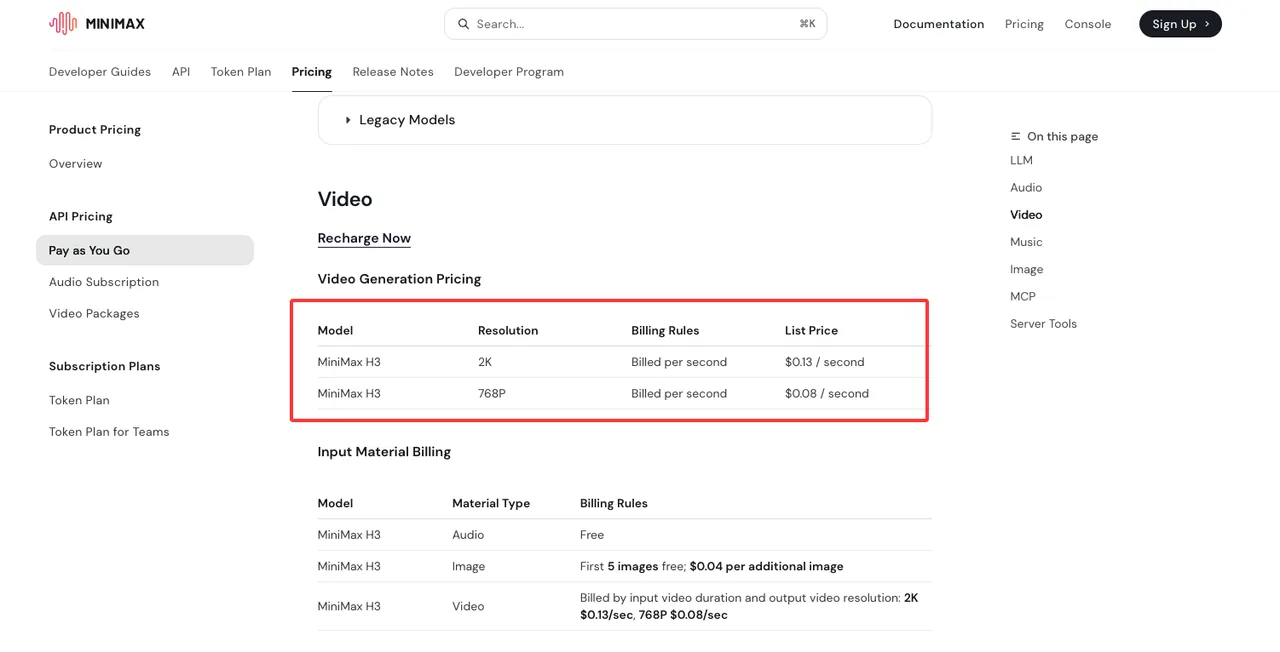
As of publication date, the official MiniMax pay-as-you-go pricing lists MiniMax H3 2K at $0.13 per second and 768P at $0.08 per second. If an internal note still says 768P is $0.09 or closed beta, treat that as stale until it is rechecked against the current official page.
This is especially important for video model pricing because a small per-second difference grows quickly across batches.
Why provider claims about price parity require current evidence
A provider may claim parity with another route at one point in time. That claim still needs dated evidence.
Save the page URL, access date, route, resolution, duration, input mode, package status, and account conditions. Also check whether packages apply. As of publication date, MiniMax’s video packages page says video packages support Hailuo series models and MiniMax H3 is not supported yet.
So a forecast should separate direct pay-as-you-go H3 costs, WaveSpeed endpoint costs, and any package-based assumptions.
Set Production Budget Controls
Per-job caps, alerts, quotas, fallback routes, and customer margins
A production system should limit cost before usage grows. Set caps for duration, output count, paid references, and retries. Add alerts by project, workspace, or customer. Define when a job should stop, when it should retry, and when it needs manual approval.
Customer margins should be based on usable output, not only generated attempts. If customers pay for finished clips, rejected generations are your cost. If customers pay for attempts, the product language needs to make that clear.
Monitor price and package changes without hard-coding assumptions
Do not hard-code public prices into long-term plans without a review process. Store every price assumption with a source and date. Recheck before launch, before changing customer plans, and before large campaigns.
For MiniMax H3 pricing, the healthiest habit is simple: seconds first, references second, usable yield third, overhead last.

FAQ
Which team should own MiniMax H3 budget alerts?
Engineering should own technical enforcement, including caps, alerts, and quota logic. Product and finance should own the policy behind those limits. One accountable owner should review exceptions.
What records should be retained for billing disputes?
Keep request IDs, timestamps, endpoint names, model names, resolution, duration, output count, input counts, reference-video duration, retry history, task status, error codes, project ID, and invoice line items.
How should price changes be reflected in customer plans?
Use dated plan versions. Recalculate margins first, then decide whether to update new-customer pricing, renewals, included credits, or usage caps. Customer-facing changes should follow a clear policy.
Conclusion
MiniMax H3 pricing is manageable when it is read as generated seconds plus route-specific inputs, not as a single “from” number. As of publication date, a 2K 5-second output is $0.65, a 10-second output is $1.30, and a 15-second output is $1.95 before references, retries, and overhead. Recheck every public price on the day the article or pricing logic goes live.
Previous posts:
Related Articles

Best AI Video Platforms for Production Teams in 2027

Best Sora 2 Alternatives for Video Teams in 2027

Lanta AI Review 2027: Best Uses, Pricing, and Limits
Sora 2 Review 2027: API Quality, Cost, and Limits

Build a GPT-6 Astra 3D Workflow With Blender Assets