
Why Real-Time AI Inference Matters for Motion and Robotics
Real-time AI inference turns model outputs into responsive motion and robotics behavior. Learn latency, control-loop, reliability, and safety trade-offs.
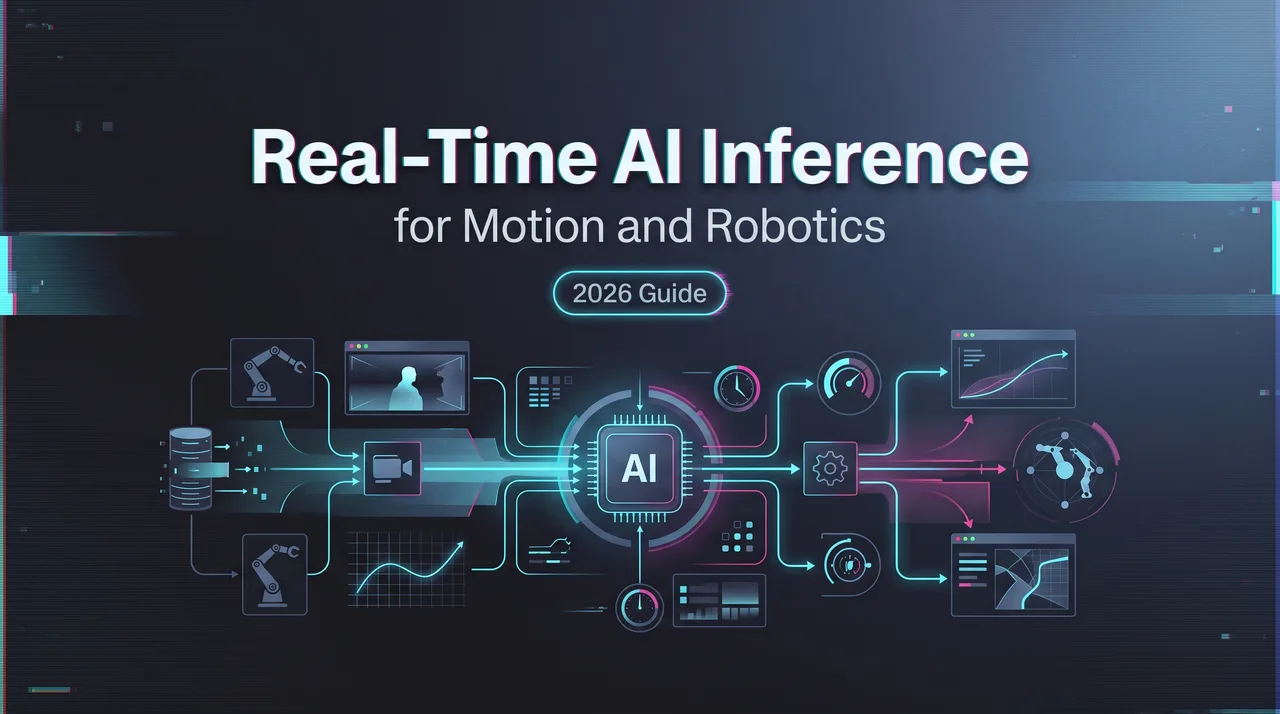
A robot does not care that the model was fast on average. A character controller does not care that 95 frames looked clean if the 96th frame missed the control deadline. That is why real-time AI inference matters for motion systems: the output is not a file waiting in a queue. It is part of a loop that keeps moving.
The production question is simple. Can the system perceive, infer, decide, act, and correct itself before the world changes enough to make the answer stale? If not, the model may still be useful. It just does not belong in the control path yet.
What Real-Time AI Inference Means for Physical Motion
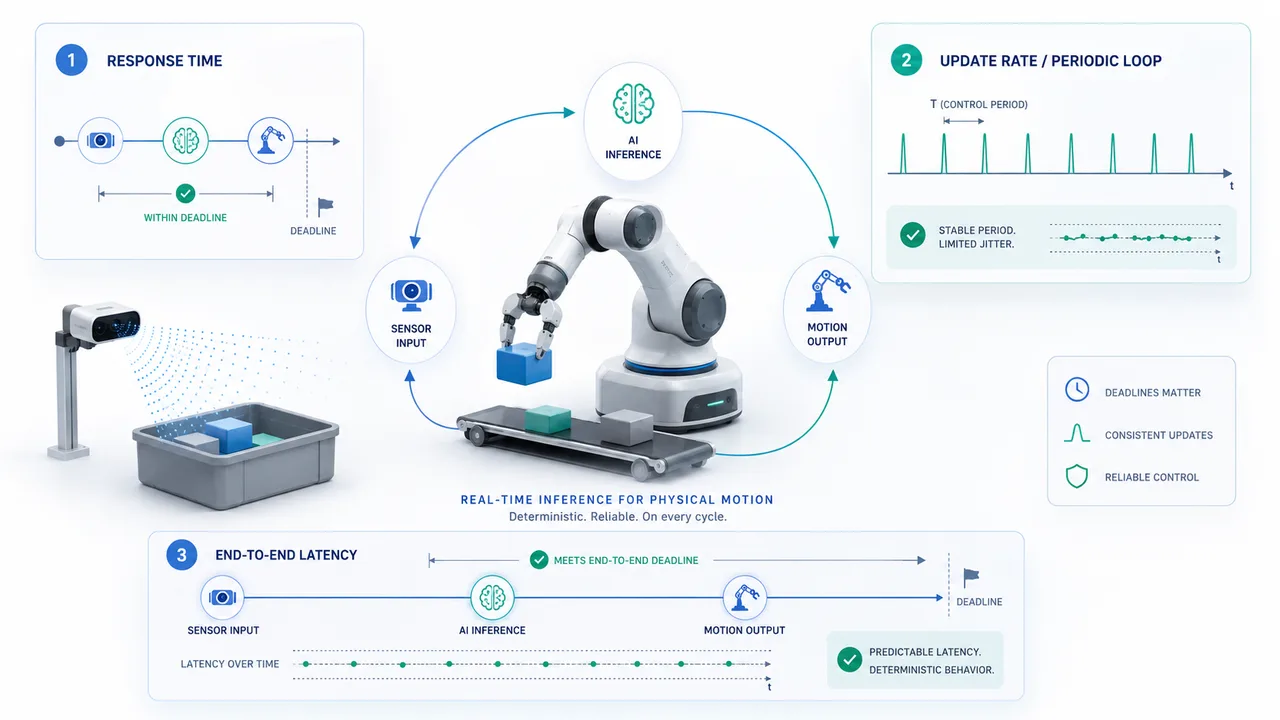
Response Time, Update Rate, and End-to-End Latency
Real-time does not mean “fast” in the marketing sense. It means the system updates within a deadline that the task can tolerate. The ROS 2 real-time material describes this in control-loop terms: periodic updates, deadlines, and limited jitter matter because nondeterministic operations can break timing behavior.
For motion work, I split the measurement into four parts:
| Metric | What It Answers |
|---|---|
| Average latency | How long the normal path takes |
| Tail latency | How bad the slow cases get |
| Jitter | How much timing varies between cycles |
| Deadline miss rate | How often the loop is late |
Motion control latency is usually damaged by the last two. A 20 ms average with 120 ms spikes can look fine in a dashboard and still feel unstable in the body.
Real-Time, Near-Real-Time, and Offline Workloads
Real-time workloads must answer before a control deadline. Near-real-time workloads can tolerate small delays, such as teleoperation assist or interactive animation preview. Offline workloads can wait: video rendering, batch simulation, dataset labeling, asset cleanup.
This distinction matters because the same model can be acceptable in one category and unsafe in another. A planner that takes two seconds may be fine for an offline simulation pass. It is not fine inside a balance controller.
Why Motion and Robotics Need Closed-Loop Inference
Perception, State Estimation, Planning, and Action
A robotics inference pipeline usually looks like this: sensors capture the world, perception extracts useful signals, state estimation decides what the system believes, planning selects the next action, and the actuator layer executes it.
The loop does not end there. Motion systems need feedback. Did the foot land where expected? Did the joint reach the target? Did the object move? Did the user change direction? If the answer arrives late, the next action is based on old state.
A good single output does not mean the production workflow is ready. Closed-loop systems care about repeated correctness under changing state.
Feedback, Drift Correction, and Changing Environments
Drift is where slow inference starts to show. A character slides slightly. A manipulator approaches at the wrong angle. A mobile robot over-corrects after a delayed obstacle update.
The model may not be “wrong.” The loop may be late.
That is the production trap. Teams debug model quality when they should first check sensor timestamps, queue delay, inference time, actuator lag, and feedback frequency.
Where Latency Enters the Control Loop
Sensors, Networks, Queues, Models, and Actuators
Latency enters before the model sees anything. Cameras buffer frames. Lidars scan over time. Network packets wait. Queues build. Preprocessing runs. The model executes. Postprocessing translates output into a command. Actuators respond with their own physical delay.
A clean embodied AI runtime treats these as one budget, not separate teams’ problems. If perception takes too long, planning inherits stale state. If model serving adds queue time, the controller receives yesterday’s answer. In motion, “yesterday” can mean 80 ms ago.
Tail Latency, Jitter, and Missed Control Deadlines

Tail latency is the part that hides in averages. Google’s The Tail at Scale is about large online services, but the lesson transfers cleanly: rare slow paths can dominate the felt behavior of an interactive system.
In robotics, the tail is worse because missed timing does not only annoy the user. It can change the system state. A delayed stop command, delayed obstacle update, or delayed grasp correction can create a different physical situation.
Speed matters, but stable speed matters more.
Balance Speed, Quality, and Compute Cost
Smaller Models, Reduced Precision, and Edge Execution
Low-latency AI inference often starts with model shape. Smaller models, distilled policies, reduced input size, pruning, caching, and reduced precision can all cut runtime. NVIDIA’s TensorRT precision control documentation shows the trade-off directly: lower precision can reduce memory and speed computation, but hardware support and accuracy sensitivity still decide what works.
This is where teams need test data, not hope. A quantized planner that is fast but produces unstable contact behavior did not save time. It moved the cost into recovery.
Cloud Inference, Local Control, and Hybrid Architectures
Cloud inference works well when latency tolerance is wide, connectivity is reliable, and outputs do not need hard control timing. It is weaker for balance, collision response, grasp correction, and emergency behavior.
Local control works better for tight loops. The trade-off is hardware cost, thermal budget, deployment complexity, and update management.
Hybrid architecture is usually the practical middle. Keep fast safety and control local. Send slower perception, semantic planning, analytics, and batch learning to cloud systems.
Design for Failure and Safe Degradation
Timeouts, Stale State, Fallback Policies, and Manual Control
A real-time model serving path needs a failure contract. What happens when inference is late? What happens when output confidence drops? What happens when state is stale?
The fallback should be boring. Hold position. Slow down. Stop. Revert to a classical controller. Hand control back to a human operator. The wrong answer is letting an expired model output continue because the pipeline has no other state.
Robot and industrial system content here is only architecture risk identification. Production systems need review by qualified safety owners, domain engineers, and compliance teams.
Monitoring Motion Quality Alongside System Performance

Infrastructure dashboards can say the service is healthy while motion quality gets worse. That is not good enough.
Track both sides: latency, queue depth, deadline misses, dropped frames, stale-state events, actuator command delay, foot sliding, collision contacts, overshoot, oscillation, and human intervention count.
NIST’s work on robot performance measurement is a useful reminder that robot capability needs repeatable task tests, not just system uptime. The field does not care that your API returned 200.
Choose the Right Architecture by Use Case
Interactive Animation, Simulation, and Teleoperation
Interactive animation can tolerate more recovery than a physical robot. If a generated character motion is late, the system can blend, skip, or fall back to a cached motion. Simulation can also rerun scenarios and compare policies before deployment.
Teleoperation sits in the middle. Human control creates a safety layer, but timing still matters. A delayed assistive model can fight the operator. That is worse than no assist.
Mobile Robots, Humanoids, and Industrial Systems
Mobile robots need dependable perception and planning cycles. Humanoids add balance, whole-body coordination, and contact timing. Industrial systems add process safety, repeatability, and audit requirements.
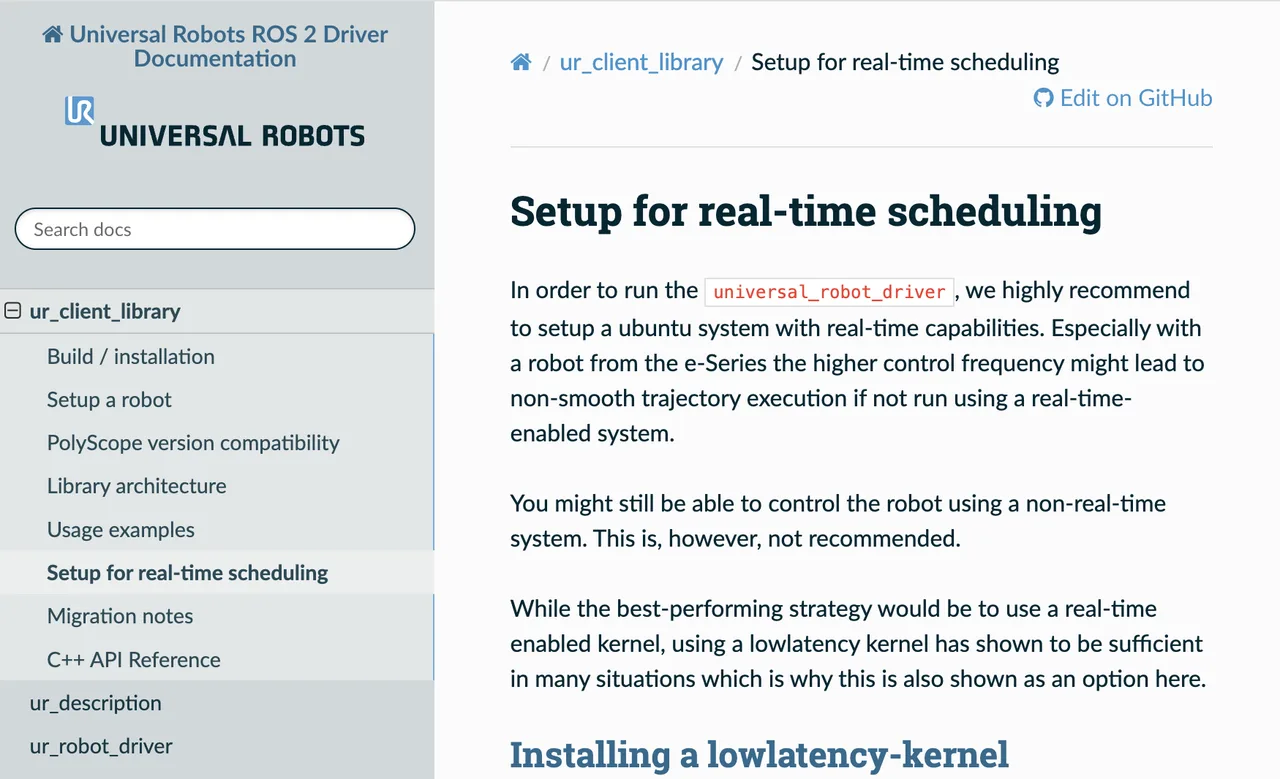
For robot drivers, timing can be strict enough that real-time scheduling becomes part of setup. The Universal Robots ROS documentation on real-time scheduling warns that higher control frequency can affect trajectory smoothness if the system is not real-time capable.
This conclusion only fits the architecture layer. Certification, operating procedures, and safety cases are separate work.
FAQ
Who approves latency targets before robotics pilots begin?
Engineering proposes the targets. The safety owner approves them before the pilot starts. Product should not set motion latency targets alone.
How should teams disclose degraded motion-control service to customers?
Disclose the affected capability, expected behavior, fallback mode, risk boundary, and next update time. Do not describe degraded autonomous behavior as normal operation.
Which logs should customer support collect after timing failures?
Collect timestamps across sensors, queues, model inference, controller output, actuator command, fallback trigger, and operator action. Support needs a timeline, not screenshots.
Who may authorize fallback from autonomous to manual control?
The operating procedure should name that role before deployment. In most robotics pilots, the trained operator or safety owner needs authority to take control immediately.
How often should safety owners rehearse emergency stop procedures?
Often enough that the procedure is not theoretical. The exact cadence depends on system risk, deployment environment, and regulatory requirements.
Conclusion
Real-time AI inference matters because motion is not a static output. It is a contract with time. Average latency tells only part of the story. Tail latency, jitter, update rate, and missed deadlines decide whether a system feels stable, behaves safely, and recovers cleanly.
For motion and robotics, start with the loop: perception, state, planning, action, feedback. Then assign a latency budget to every step. The model is one part of that budget. Not the whole machine.
Previous posts:
/filters:quality(82)/media/images/c347367a-a007-4466-b8f7-d37f5fb52819.webp)
/filters:quality(82)/media/images/cd4db796-7728-45fb-8267-6813ed28e173.webp)
/filters:quality(82)/media/images/1791535252286714222_v4jvJT2a.webp)
/filters:quality(82)/media/images/1791451065663755033_qNqAKS1a.webp)
/filters:quality(82)/media/images/1791359984291066138_tW5eOX6f.webp)
/filters:quality(82)/media/images/1773962750383987480_n3hqzHRZ.webp)