
Infinite TV Review: Live AI Video From Twitch Chat
This Infinite TV AI review examines one Twitch-chat-driven video stream, including responsiveness, continuity, moderation, and deployment limits.
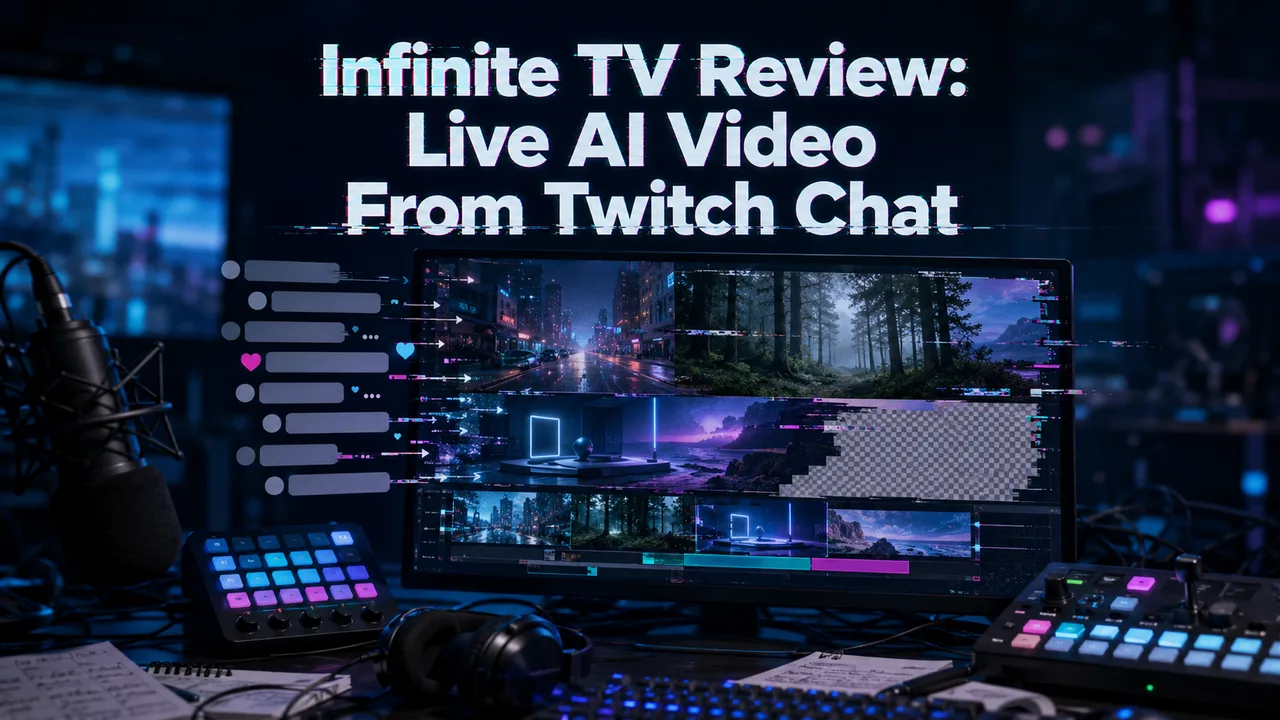
A live AI stream does not fail like a normal video render. It fails in public.
This Infinite TV AI review looks at one narrow job: a Twitch chat-driven stream where comments influence LTX live generation and the output goes to RTMP. I did not run a public audience test, so this is a code-and-docs review, not proof that the demo can survive production traffic.
What Infinite TV Demonstrates
Twitch Chat, LTX Generation, and RTMP Output
The Infinite TV GitHub repository describes a realtime LTX video generation demo. The pipeline listens to Twitch chat, turns selected messages into prompts, produces video through LTX backends, applies text overlays, and sends frames to an RTMP stream. A React dashboard monitors generation metrics, queue state, system health, and chat activity.
The documented setup needs Python 3.11+, Node.js 18+, FFmpeg, a FAL account and API key, an OpenAI key, and a Twitch stream key. This is not a single binary. It is a small live system with chat input, prompt generation, inference, post-processing, streaming, and monitoring.
Open-Source Project Boundaries
The model path matters. The README lists ltxv1 as a local Hugging Face pipeline and ltx-2.3 as a hosted fal.ai backend. The LTX Video model card confirms Lightricks as the model developer and frames LTX as image-to-video diffusion, with limitations around prompt following and factual reliability.
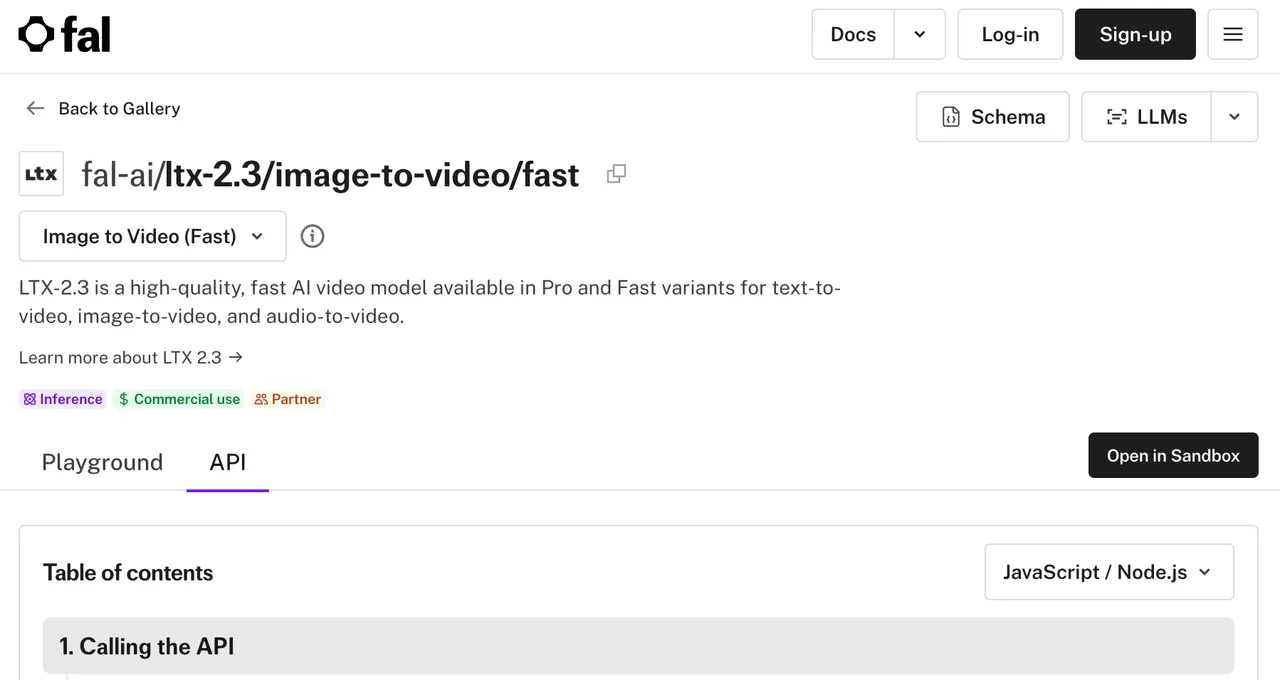
For the hosted path, the fal LTX 2.3 Fast API docs document the fal-ai/ltx-2.3/image-to-video/fast route, API-key authentication, queue behavior, file inputs, and output video objects. Prompts and media may leave your machine on this path. If you need a closed workflow, verify the local model path separately.
Review Scope: One Chat-Driven Live Stream
Prompt Responsiveness and Scene Continuity
For a Twitch AI video prototype, the useful test is not whether one comment makes one funny clip. The test is whether ten comments can influence the stream without turning the scene into fragments.
The code keeps previous prompts and current frame state, then asks an LLM to select or ignore recent comments. That is the right shape for an interactive AI stream because visual continuity needs memory. But memory is not control. A sample run should track which chat message was chosen, what prompt was generated, how long generation took, and whether the next clip still belongs to the scene.
This cannot be judged by feel. It needs a sample run.
Queue Behavior, Moderation, and Loop Stability
The implementation has two queue points to pressure-test. The chat listener stores incoming comments in a bounded queue. The RTMP streamer stores generated frames in another queue and repeats the last frame or shows a placeholder when frames run short. Reasonable for a demo. Risky in public.
Moderation is the larger gap. I did not find a documented moderation layer in the README. Prompt templates ask the LLM to choose visual, actionable comments, but that is not a safety system. Before a public stream, add pre-generation filters, banned terms, per-user throttles, moderator override, and a kill switch. Twitch’s video broadcast docs explain RTMP ingest and stream keys; prompt safety is still your job.
Where Infinite TV Helps AI Video Builders
Useful Prototyping Lessons
Infinite TV is most useful as a map of moving parts. It shows that live generation is not just model latency. The operator has to handle chat ingestion, prompt routing, model selection, frame buffering, encoding, stream health, credentials, and dashboard state.
That is the useful lesson. LTX live generation can look simple when the demo is quiet. Add viewers, repeated commands, offensive prompts, and one slow model response, and the workload changes. Demos show the ceiling. Production shows the floor.
Limits Before a Public Production Stream
Do not treat this as a ready public channel without hardening it. The README has troubleshooting notes for RTMP failure, FFmpeg, generation timeouts, GPU availability, frame rate, resolution, and queue bottlenecks. Those notes are not a support contract.
The code includes FAL deployment details, a GPU-B200 machine type in app configuration, and private FAL endpoints. Useful evidence of the intended path, not a complete support matrix. Lock the model route, GPU type, prompt model, output FPS, moderation policy, log retention, and fallback behavior before opening chat to real viewers.
FAQ
What license governs commercial Infinite TV streaming deployments?
The README says the project is MIT licensed, but I did not find a standalone LICENSE file at the expected path. Treat that as incomplete. The MIT License is permissive, but deployment also depends on LTX, FAL, Twitch, and prompt-model terms. This is general information, not legal advice.
Which GPU configurations does Infinite TV officially support?
The README does not publish a GPU support matrix. It documents FAL and local inference paths, while app code references GPU-B200. Verify GPU availability, VRAM, target FPS, and timeout behavior before calling any configuration supported.
Can Infinite TV run without sending prompts externally?
Not by default. The prompt generator requires FAL, OpenAI, or Groq credentials, and the hosted LTX 2.3 path calls fal.ai. A fully local version would need local video inference plus a local prompt model.
Which RTMP services are officially documented beyond Twitch?
The README claims support for other RTMP endpoints, but the current implementation hard-codes Twitch’s RTMP URL pattern. Treat non-Twitch output as something to verify or extend before relying on it.
How long does Infinite TV retain chat messages?
I did not find a project-level retention policy. The code uses in-memory queues and writes local server, generation, and queue logs. If chat text appears in logs, retention is whatever your deployment keeps. Set deletion rules before a public test.
The Infinite TV AI review verdict is simple: use it as a prototype reference, not as a production streaming service. The next test should measure prompt selection, queue recovery, moderation, GPU behavior, and data retention in one controlled Twitch session.
Previous posts:
/filters:quality(82)/media/images/b73c2438-6bdd-4b80-a229-8d71d8f819cf.webp)
/filters:quality(82)/media/images/427fd9f2-347d-4f86-a2d5-aee110cda01d.webp)
/filters:quality(82)/media/images/1773962750383987480_n3hqzHRZ.webp)
/filters:quality(82)/media/images/43fa0e7f-a0db-48d7-9bab-921d1225db30.webp)
/filters:quality(82)/media/images/5799ff56-3a73-40ca-a666-e4965d878496.webp)
/filters:quality(82)/media/images/7a8850fc-caf6-482f-ac4d-5ddbe64ec47c.webp)