
WeLM Review: 80B and 617B MoE Evidence 2026
This WeLM review examines the reported 80B and 617B MoE evidence, benchmark scope, hidden-decoding gains, and limits for AI builders.
Dora here. I paused before writing this WeLM review because the easy version would be wrong. The public evidence is not a product launch page, not a hands-on API test, and not a license-ready procurement packet. It is a research evidence record around Tencent’s Sequential-Hidden-Decoding repository and the linked paper.
For model engineers and AI platform leads, that distinction matters. The question is not “can I deploy WeLM tomorrow?” The public answer is unknown. The better question is narrower: what do the reported WeLM 80B and 617B MoE results show, what do they not show, and how should a team test the claims before turning them into a decision?
What Evidence This WeLM Review Covers
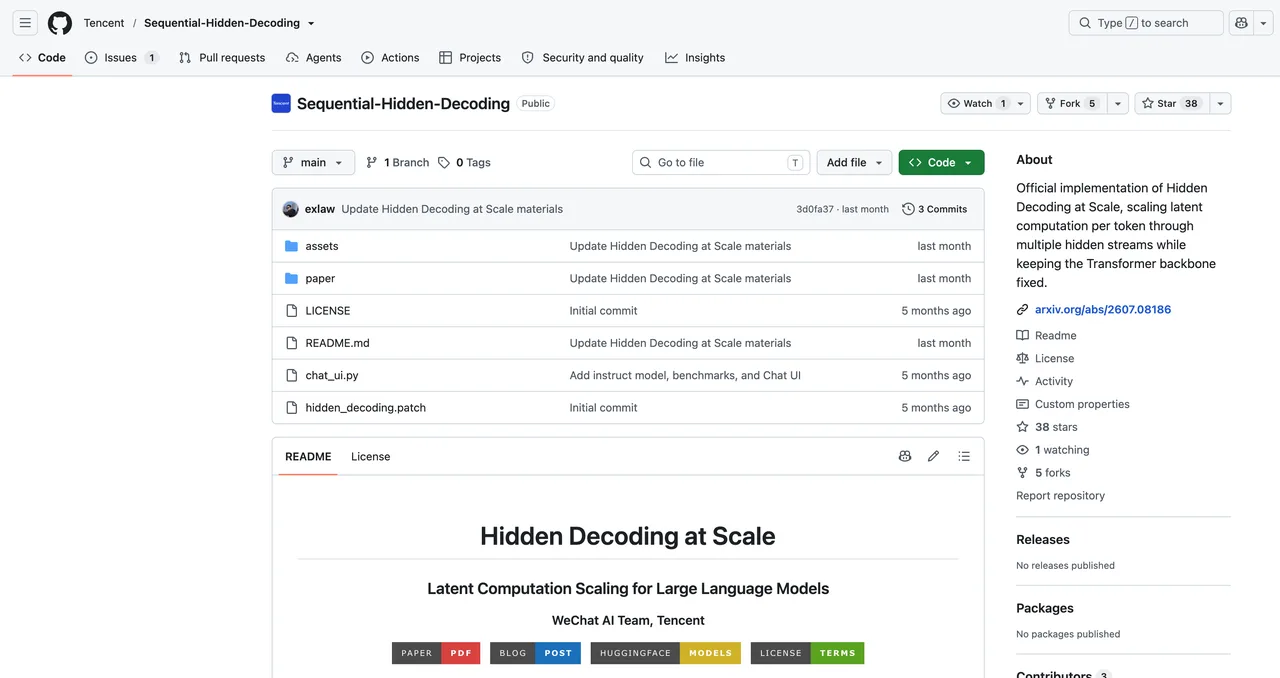
This article covers the WeLM-HD4-80B and WeLM-HD4-617B results reported by Tencent’s WeChat AI Team. It does not cover older WeLM 16B or 32B work. Different evidence set. Different model scale. Mixing them would make the table look fuller and the conclusion worse.
The paper, Hidden Decoding at Scale, was submitted to arXiv on July 9, 2026. The GitHub repository says frontier-scale WeLM-HD4-80B/617B results were added on July 7, 2026.
The 80B and 617B MoE Model Pairs
The core comparison is pairwise. WeLM 80B is compared with WeLM-HD4 80B. WeLM 617B is compared with WeLM-HD4 617B.
That pairing is important. The reported gains are not “617B versus 80B” in the main benchmark table. They are hidden-decoding variants compared against matched autoregressive baselines at the same scale.
Autoregressive and Hidden-Decoding Variants
The autoregressive baseline predicts tokens in the usual single-stream path. The hidden-decoding variant expands each input token into n streams. For HD4, n=4.
Only the final stream predicts the next token. Earlier streams act as latent computation states, and their KV cache is retained for later tokens. The paper’s HTML version describes this as sequence-length scaling with the Transformer backbone fixed.
Good definition. Easy to overstate.
Compare the Reported 80B and 617B Results
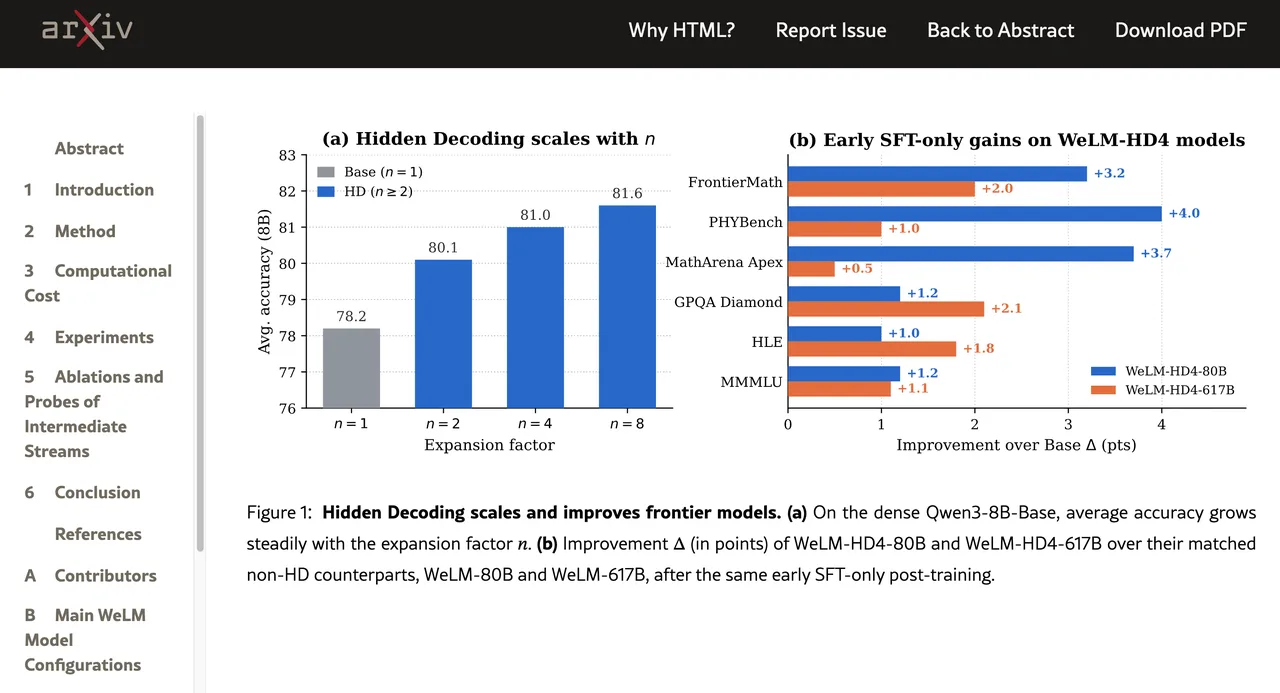
The reported table shows positive deltas for both HD4 models across nine shared benchmarks. For WeLM-HD4-80B, the largest listed gains are SciCode +4.2, PHYBench +4.0, and MathArena Apex +3.7. For WeLM-HD4-617B, the larger gains include GPQA Diamond +2.1, FrontierMath +2.0, and HLE +1.8.
These are author-reported results. Not an independent replication. That sentence has to stay attached to the numbers.
Active Parameters and Evaluation Scope
The repository states that active Transformer parameters per token stay unchanged: 3B for the 80B model and 23B for the 617B model. That means the HD4 setup is not presented as “more active experts per token.” It is more latent computation per token through expanded hidden streams.
The same source also says both matched autoregressive and hidden-decoding models use the same early SFT-only post-training recipe, with no reinforcement learning. That keeps the comparison cleaner than a mixed post-training setup.
Where the Larger Model Shows Reported Gains
The 617B pair shows gains, but not uniformly large gains. HMMT moves from 96.0 to 96.2. MathArena Apex moves from 24.2 to 24.7. SciCode moves from 51.4 to 52.1.
That still matters. It just does not justify scoreboard language. A careful WeLM benchmark read says: gains appear across the listed tasks, but the effect size depends on task and scale.
Interpret the Hidden-Decoding Results
The central hypothesis is simple: keep the backbone fixed, spend more computation per token, and see whether capability improves.
Hypothesis confirmed inside the reported setup. This is where my data ends.
Quality Changes Across Expansion Factors
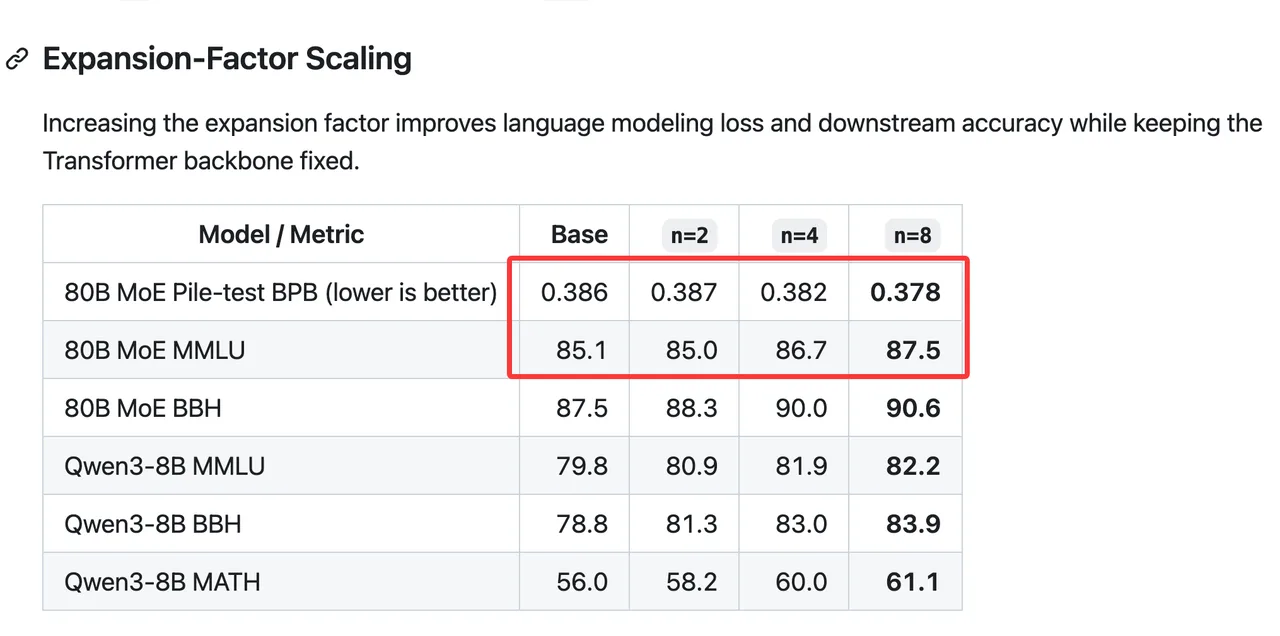
The expansion-factor table is useful because it does not only compare HD4 to a baseline. It shows n=2, n=4, and n=8 trends for an 80B MoE study and Qwen3-8B demonstrations.
For the 80B MoE, Pile-test BPB falls from 0.386 at base to 0.378 at n=8. MMLU moves from 85.1 to 87.5. BBH moves from 87.5 to 90.6. There are intermediate non-monotonic spots, but the reported n=8 model is strongest overall in most rows.
Compute Cost Behind the Additional Hidden Streams
The cost side is not optional. The repository reports that a 4x expanded sequence costs 5.1x in per-batch training time on WeLM-HD4-80B and 4.4x on WeLM-HD4-617B.
That is close to a 4x linear reference and far below a 16x dense-attention baseline. The reason is Stream-Factorized Attention: most layers attend within each stream, while only selected layers mix across streams.
So that’s where the bottleneck was. Not in parameter count. In expanded sequence compute, attention layout, KV cache, and serving behavior. Not in active Transformer parameter count.
Read the Benchmark Tables Carefully
The benchmark table is useful. It is not a procurement answer.
A model engineer should read it as controlled research evidence: same model scale, matched baseline, same early SFT-only recipe, author-reported scores. Anything beyond that needs testing.
Early SFT-Only Post-Training and Matched Comparisons
The early SFT-only condition matters because modern model quality can move a lot after heavier post-training. The paper says mature WeLM release scores are outside scope.
That sentence blocks a common mistake: taking research-table numbers and comparing them to commercial models with different post-training, different inference settings, or undisclosed tool use.
Vendor-Reported Scores and Missing Independent Replication
I found public demonstration checkpoints in the Tencent Hugging Face collection, but those are Qwen3-8B-based Hidden Decoding models. The repository explicitly says they are not the main WeLM 80B/617B paper models.
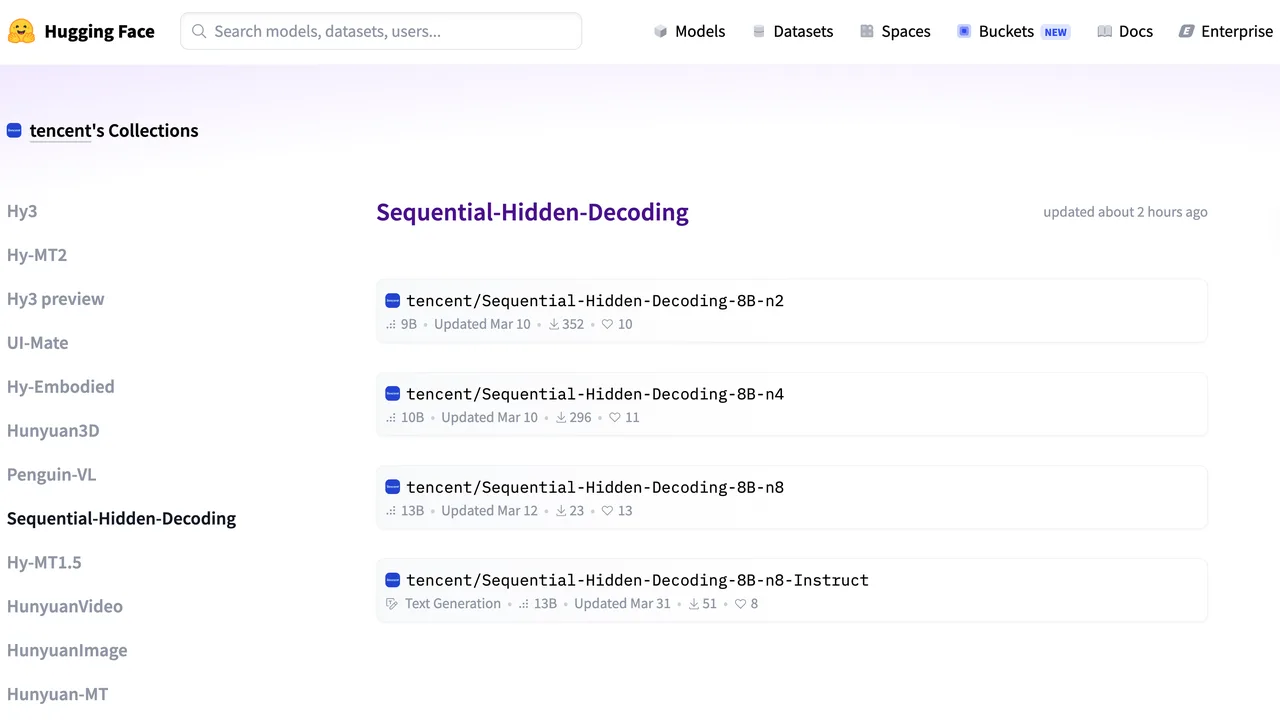
Access to WeLM-HD4-80B or WeLM-HD4-617B weights, API model IDs, pricing, production inference requirements, latency, and tool abilities is not established by the public sources I checked.
Translate the Evidence Into Builder Questions
For builders, the next step is not “rank it.” The next step is to turn each missing public detail into a test or a blocking question.
Access, Serving Requirements, Latency, and Cost
The repository includes an SGLang inference patch and serving notes for released demonstration models, with details such as trust-remote-code, fa3, conservative batch sizing, and expanded internal sequence length. SGLang itself is a high-performance serving framework for large language and multimodal models.
That does not prove WeLM 80B or 617B production access. It only shows the public demonstration path and implementation direction.
Tool Use, Reliability, and Domain-Specific Evaluation
Tool use is unknown from the public WeLM-HD4 evidence. Reliability under long conversations is unknown. Domain behavior is unknown unless your team tests it.
For an AI platform lead, those unknowns are not small print. They decide whether the model belongs in a research watchlist, an internal bakeoff, or a production shortlist.
Build an Independent Evaluation Plan
A clean evaluation plan has fewer moving parts than most teams want. That is the point.
Freeze Tasks, Baselines, Harnesses, and Acceptance Rules
Freeze the task set before seeing model outputs. Include domain tasks, reasoning tasks, coding tasks, refusal/safety cases, latency-sensitive prompts, and long-context prompts.
Freeze baselines too. Compare against models you can actually access under your serving constraints. Record prompt templates, decoding settings, judge rules, sample counts, and failure labels.
Separate Model Quality From Serving and Harness Effects
Run quality evaluation separately from serving evaluation. Then run an integrated test.
A model can score well and still be wrong for your workload if latency, KV cache growth, batching behavior, or cost breaks the product path. Hidden streams are not free. The reported 4.4x and 5.1x per-batch training-time multipliers make the training-side cost plain enough; serving behavior needs to be evaluated separately.
Limits and Trade-Offs
The evidence is interesting because it isolates a fixed-backbone scaling path. It is limited because public research evidence is not the same as deployable availability.
Research Results Do Not Prove Production Availability
I did not find official public evidence for WeLM-HD4-80B/617B API availability, open weights, commercial terms, model IDs, or price. The repository license says the project is under its Hidden-Decoding license terms, while dependent models and software keep their own licenses.
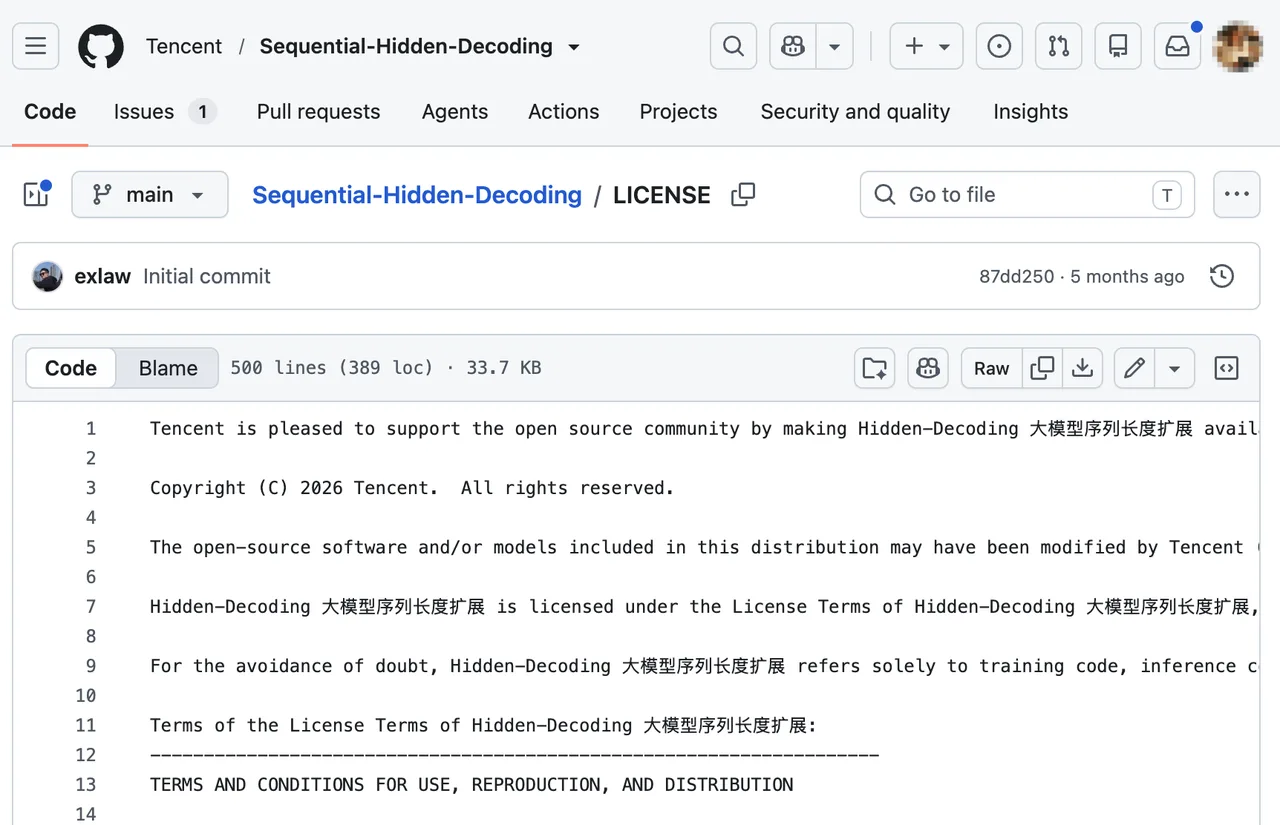
That is general information, not legal advice. Review current official terms before any commercial use.
Aggregate Benchmarks Do Not Predict Every Workload
Aggregate benchmarks hide workload shape. A math-heavy agent, a support chatbot, a code migration assistant, and a scientific QA tool can all read the same table and make different decisions.
Good enough. That’s the most honest assessment I can give.
FAQ
Can research-only models appear in a production procurement shortlist?
Yes, but only as “watchlist” or “pending access” candidates. A production shortlist needs access terms, serving specs, security review, cost estimates, and repeatable internal results.
What license review is required if WeLM weights are later released?
Review the model license, repository license, dependent model licenses, redistribution terms, output-use terms, and any acceptable-use policy current on the publication date. This is not legal advice.
Who should verify citations before benchmark figures enter sales materials?
A technical owner should verify the source table, and a legal or compliance reviewer should check wording. Sales copy tends to delete caveats. That is how benchmark claims become fragile.
How should teams record corrections when a benchmark table changes?
Keep a dated evidence log: source URL, access date, copied metric, later correction, and affected materials. Do not silently edit old claims.
Can internal evaluation scores be shared with external vendors?
Only after checking company policy, dataset confidentiality, and vendor agreements. Internal prompts often contain customer, product, or security-sensitive information.
Conclusion
This WeLM review lands in a narrow place. The reported WeLM 80B and WeLM 617B MoE evidence supports hidden decoding as a serious fixed-backbone scaling result. It does not prove public access, production readiness, price, license fit, or workload fit.
For builders, the useful move is boring: preserve the original definitions, reproduce what can be reproduced, and keep research claims separate from deployment claims. Run it yourself. That’ll tell you more than anything I say.
Previous posts:
/filters:quality(82)/media/images/5f15570a-6a68-432e-a6f1-1dcbf799ba81.webp)
/filters:quality(82)/media/images/b73c2438-6bdd-4b80-a229-8d71d8f819cf.webp)
/filters:quality(82)/media/images/427fd9f2-347d-4f86-a2d5-aee110cda01d.webp)
/filters:quality(82)/media/images/1773962750383987480_n3hqzHRZ.webp)
/filters:quality(82)/media/images/43fa0e7f-a0db-48d7-9bab-921d1225db30.webp)
/filters:quality(82)/media/images/5799ff56-3a73-40ca-a666-e4965d878496.webp)