
Deepseek Engram Explained: Conditional Memory for LLMs
DeepSeek Engram uses conditional memory and scalable lookup to complement MoE computation. Learn the research results, system design, and current limits.
Deepseek Engram is not a new DeepSeek chat model, API tier, or WaveSpeedAI feature. It is a DeepSeek-AI research project for adding conditional memory to LLMs, published through the official Engram repository, paper, and demo code.
For AI engineers and platform teams, the useful question is simple: what does this design change inside a model, and where do the research boundaries stop?
What Deepseek Engram Is
Engram is a memory module that retrieves learned N-gram representations during model execution. Instead of asking the Transformer to reconstruct every local or factual pattern through compute, Engram adds a sparse lookup path.
The official paper frames this as “Conditional Memory via Scalable Lookup,” a second sparsity axis beside MoE-style conditional computation.
Conditional Memory as a Separate Sparsity Axis
MoE sparsity activates selected experts for each token. Engram activates selected memory rows for token sequences. One spends sparse capacity on computation; the other spends it on retrieval.
That distinction matters. If a phrase, entity, or local pattern has a stable representation, a lookup table may carry part of that burden. The model can then reserve more neural capacity for composition, reasoning, and context-dependent transformation.
How Engram Complements MoE Computation
Engram is not presented as a replacement for MoE. It is designed to work alongside attention and MoE layers.
A practical MoE memory architecture reading is this: MoE handles dynamic processing, while Engram supplies static memory signals. The paper tests whether moving some sparse parameters from experts into memory can improve results under fixed parameter and FLOPs budgets.
How the Lookup Path Works
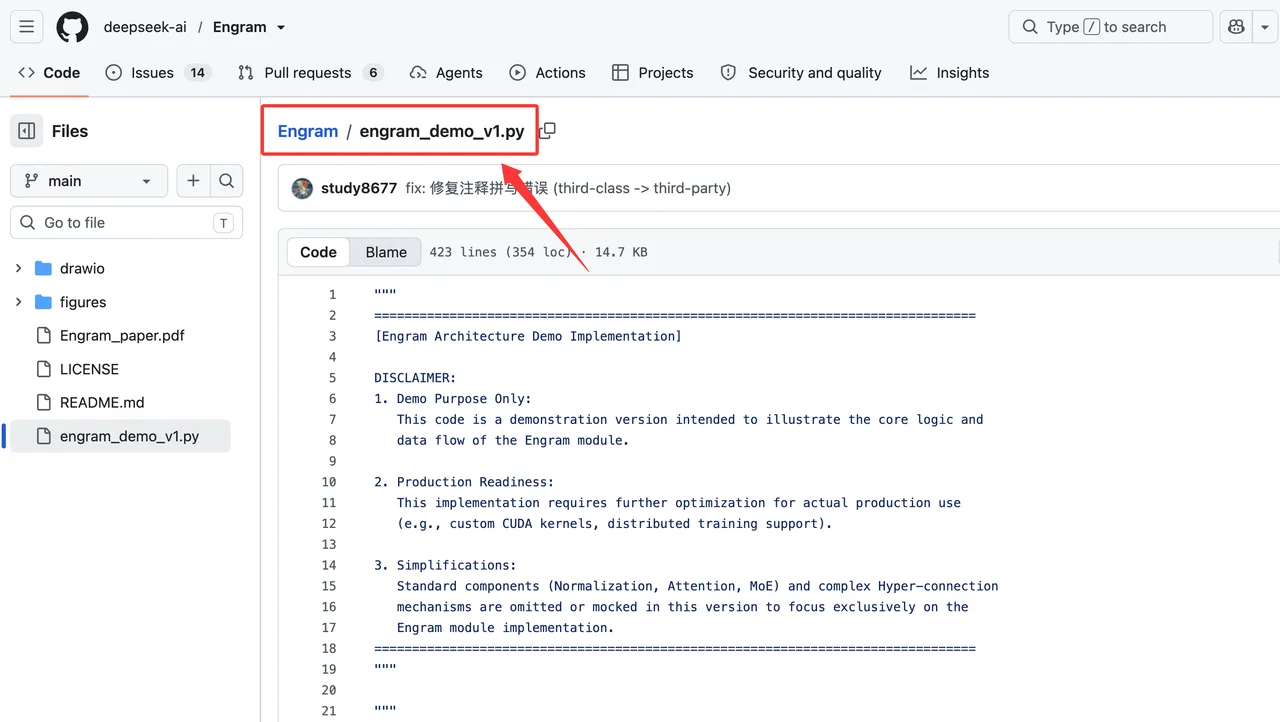
The official demo implementation shows the Engram data path, but it is not a full production stack. It mocks or omits major model components so readers can focus on the memory module.
Normalize and Compress Token Sequences
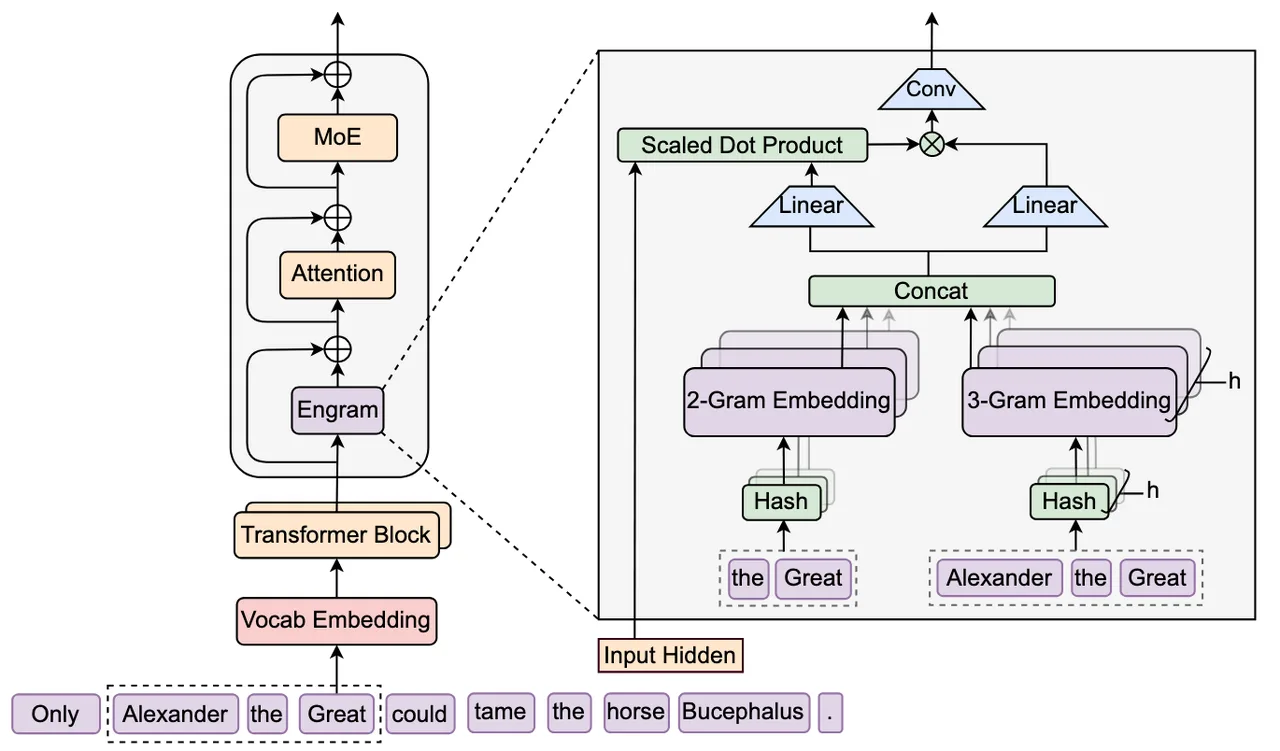
Engram first compresses raw token IDs. The demo uses normalization steps such as Unicode normalization, lowercasing, accent stripping, and whitespace handling.
This reduces duplicate surface forms before lookup. The paper reports about a 23% tokenizer vocabulary reduction in its setup. That number should not be treated as universal; tokenizer design and language mix both matter.
Address N-Gram Memory in Constant Time
After compression, Engram builds suffix N-grams and maps them to memory rows with multi-head hashing. The default demo uses up to 3-grams.
This gives the module a scalable lookup path: recent token patterns can be converted into deterministic memory addresses. The O(1) claim refers to lookup addressing, not to an end-to-end production latency guarantee.
Fuse Retrieved Values With Hidden States
Retrieved N-gram embeddings are not blindly inserted into the model. Engram projects them into key and value spaces, compares them with the current hidden state, and uses a learned gate.
If the memory looks useful, more signal passes through. If it conflicts with the current context, the gate can suppress it. The fused output then enters the model stream before later attention and MoE computation.
What the Research Actually Evaluates
The strongest part of the DeepSeek research is that it does not only compare a larger model with a smaller one. It uses constrained comparisons to ask whether memory is a better use of some sparse capacity.
Iso-Parameter and Iso-FLOPs Comparisons
The paper reports iso-parameter and iso-FLOPs experiments. In one large setup, Engram-27B is compared with a MoE-27B baseline while keeping activated parameters around 3.8B and training on 262B tokens.
To add Engram, the model reduces routed experts and allocates parameters to memory. That is the real trade-off: more static lookup capacity, less dynamic expert capacity.
The paper also describes a U-shaped allocation pattern. Some memory helps in the tested regimes, but too much memory weakens dynamic compute. That is a useful research result because it gives teams a boundary, not just a headline.
Knowledge, Reasoning, Code, and Math Results
The paper reports gains for Engram-27B over the MoE-27B baseline across knowledge, reasoning, code, math, and long-context tasks. Examples include MMLU, CMMLU, BBH, ARC-Challenge, DROP, HumanEval, MATH, GSM8K, and selected RULER evaluations.
Those results should stay attached to the paper’s setup. They do not prove that Engram will improve every model family, tokenizer, dataset, or serving environment. This cannot be judged by feel. It needs a sample run under the target constraints.
Why the Architecture Matters to AI Builders
Engram is interesting because it touches both model design and inference infrastructure. It is not only a benchmark mechanism.
Host-Memory Offloading and Inference Design
Because Engram memory addresses are deterministic from token sequences, the paper argues that active memory rows can be prefetched. It also discusses host-memory offloading as a possible inference design.
That does not mean the demo has production SLA behavior. The repository notes that production use would need more work, including custom kernels and distributed training support.
For platform engineers, the open questions are concrete: where does the table live, how are rows prefetched, what happens under batching, and how does long-context traffic affect memory access patterns?
When Static Lookup May Preserve Neural Capacity
The architectural bet is that some knowledge and local pattern reconstruction should not consume the same compute path as reasoning.
If Engram carries part of that static load, deeper layers may spend more useful capacity on context-dependent work. The paper’s analysis supports this direction, but the claim remains research-bound.
Limits and Trade-Offs

The Demo Is Not a Production Deployment Stack
The demo is an educational implementation. It is useful for reading the module’s flow, not for proving deployment readiness.
It does not provide a complete training system, serving runtime, distributed memory plan, or latency-tested API. Demos show the ceiling. Production shows the floor.
Research Results Do Not Guarantee Gains in Every Model
Engram adds design choices: memory size, N-gram order, hash heads, layer placement, fusion behavior, tokenizer compression, and serving layout.
A setting that helps one model may waste capacity in another. The paper’s findings are serious, but they are not a universal upgrade switch.
FAQ
Is Deepseek Engram available through a public API?
No. The official materials describe a research repository, paper, and demo code. They do not announce a public Engram API or a new DeepSeek chat model.
Can Engram be added to an already trained model?
The published work trains models with Engram as part of the architecture. It does not provide a turnkey method for attaching Engram to an arbitrary already trained model.
What license applies to the official implementation?
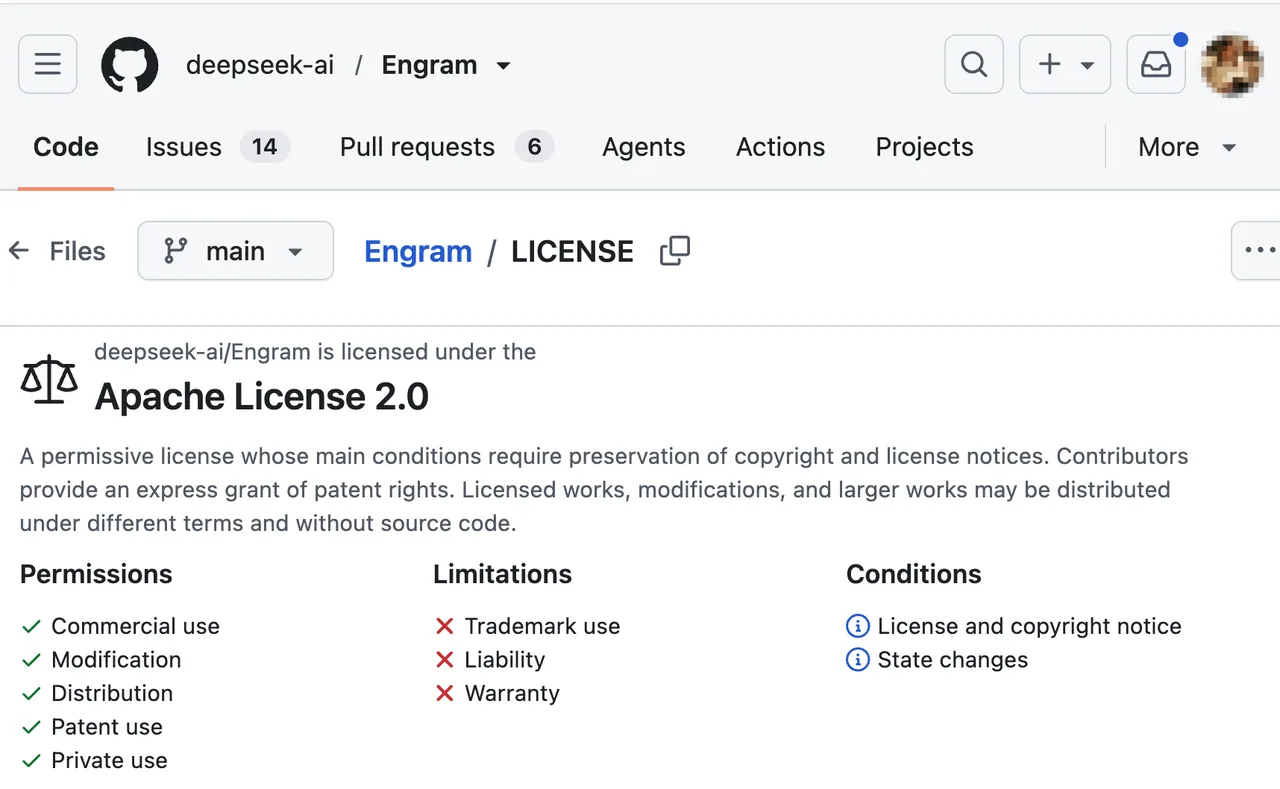
The repository shows an Apache-2.0 license for the published code. The README also says model use is subject to the model license, so future model artifacts should be reviewed separately.
Does Engram store application prompts or user conversations?
No public material describes it as application memory. Engram is presented as trained model memory based on N-gram embedding tables, not a system for storing user prompts or chats.
Who should review architecture research before it influences a model roadmap?
Research, training infrastructure, inference platform, security, privacy, legal, and product owners should review it together. Benchmark gains, serving feasibility, licensing, and privacy risk are separate decisions.
Conclusion
Deepseek Engram is a research architecture for conditional memory in LLMs. It adds compressed N-gram lookup, deterministic addressing, and gated fusion into the model stream.
The useful takeaway is bounded: Engram may influence future model designs that split sparse capacity between computation and memory. It is not a public API feature, not a production serving stack, and not proof that every model will gain from static lookup.
Previous posts:
/filters:quality(82)/media/images/5f15570a-6a68-432e-a6f1-1dcbf799ba81.webp)
/filters:quality(82)/media/images/b73c2438-6bdd-4b80-a229-8d71d8f819cf.webp)
/filters:quality(82)/media/images/427fd9f2-347d-4f86-a2d5-aee110cda01d.webp)
/filters:quality(82)/media/images/1773962750383987480_n3hqzHRZ.webp)
/filters:quality(82)/media/images/43fa0e7f-a0db-48d7-9bab-921d1225db30.webp)
/filters:quality(82)/media/images/5799ff56-3a73-40ca-a666-e4965d878496.webp)