
Breeze TTS 2 Benchmarks: Quality and Speed Claims
Breeze TTS 2 benchmark review explains published quality and speed claims, evaluation limits, and a reproducible listening test for voice products.
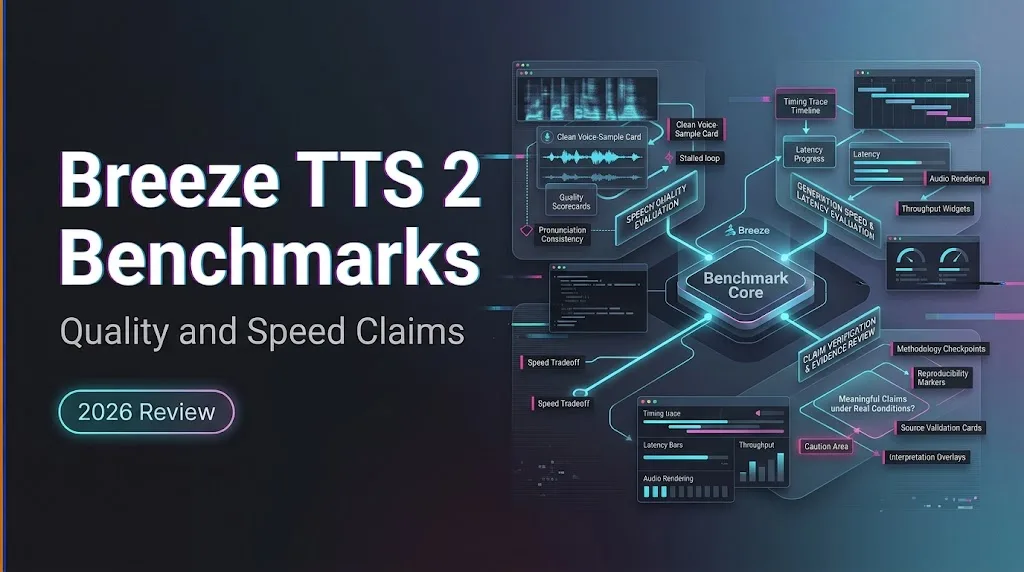
I read the public results twice because the headline number was doing too much work. A Breeze TTS 2 benchmark page can say “first,” but an ML engineer still has to ask: first on which task, language, runtime, and scoring method.
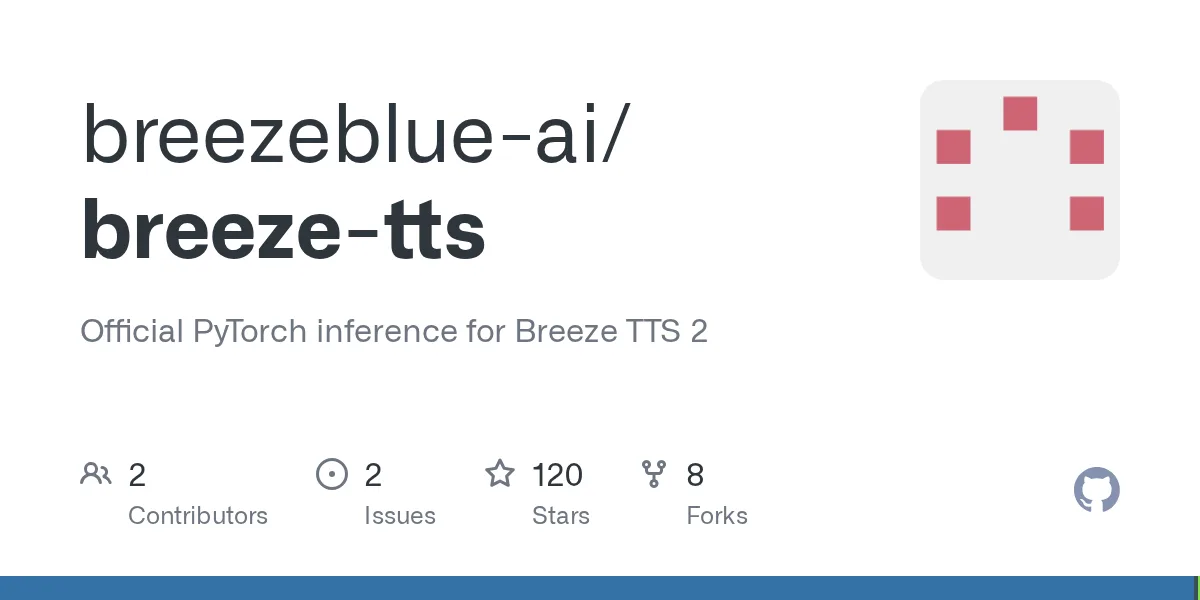
This note audits published quality and speed evidence. I did not run private tests. The first source is the official repository, checked in August, 2026.
What the Published Evaluations Measure
Speech Quality, Similarity, and Language Coverage
The public evidence is not one generic TTS quality evaluation. It is split across voice design, voice direction, transcript accuracy, diversity, and speaker similarity.
The model card lists Breeze TTS 2 as a 3B text-to-speech model with English and Chinese tags. The README also says bilingual English and Chinese support. The product page shows broader multilingual demos, but the voice-design and voice-direction benchmark datasets I could inspect are English. I would not turn English scores into a 50-language quality claim.
The Voice Design Benchmark reports 1,000 English character-voice tasks across seven media categories. Breeze TTS 2 is listed with Role Fit 78.02, Voice Diversity 708, and Transcript Pass 98.5%. Role Fit uses a 1–5 judge rating scaled by 20. Voice Diversity uses WavLM Large plus ECAPA embeddings and clustering.
Voice direction is separate evidence. It reports 700 English cases, 9 steerability axes, and 25 reference voices. Breeze TTS 2 is listed at 4.25 VDS, with 0.67 SPK_SIM. VDS measures direction following. SPK_SIM uses speaker-embedding cosine similarity.
Latency, Throughput, and Hardware Configuration
Speed has two buckets: local TTS inference speed and provider startup latency.
The README says the warmed-up fast path reaches under 40 ms time to first audio on an NVIDIA H100, with 0.32 real-time factor. It lists 7.7 GiB GPU memory for eager inference and 14.4 GiB with --fast-all. Precision for that exact run is not fully specified, while the model card lists F32 and BF16 tensors.
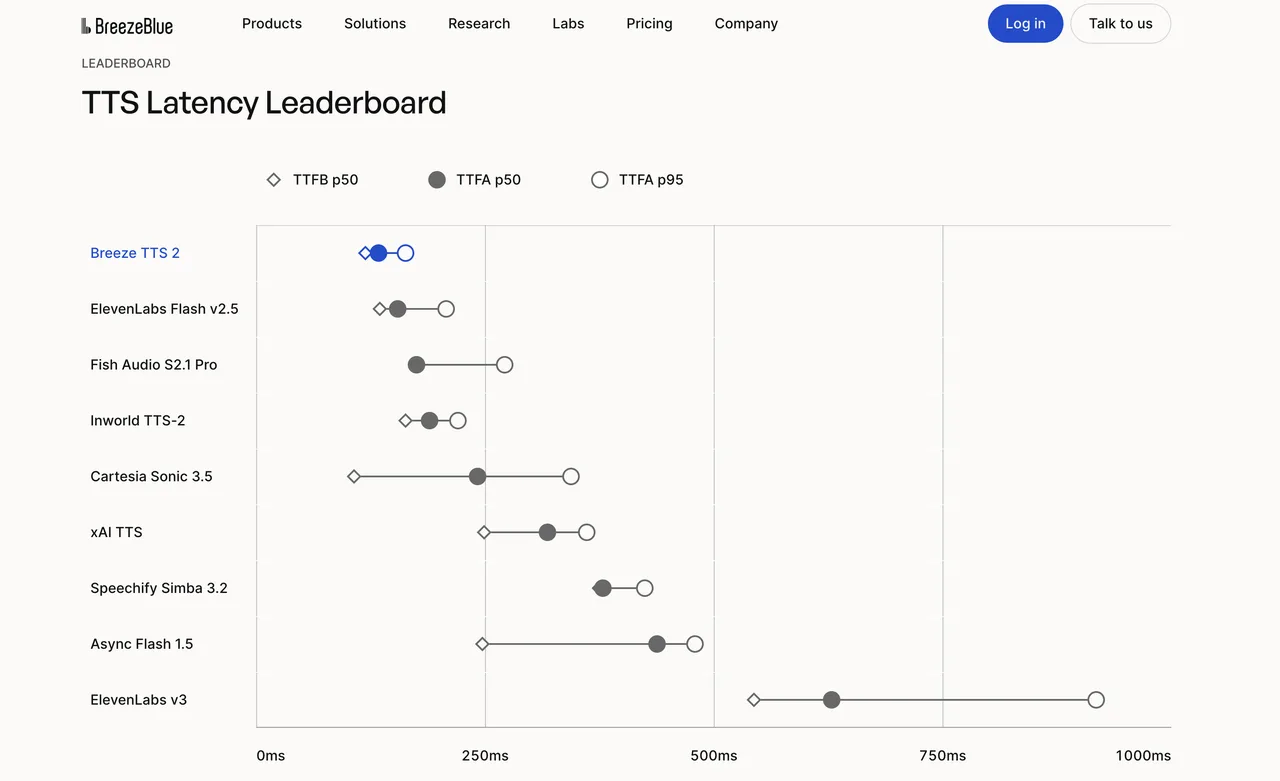
The TTS Latency Benchmark reports persistent WebSocket at TTFB p50 119.4 ms, TTFA p50 133.6 ms, and TTFA p95 163.3 ms. The method uses 40 fixed English prompts, 3 US client regions, 3 warm-ups per regional client, and pooled successful samples. It says Breeze TTS 2 used its highest request priority, while other providers used paid plans. I paused here. That condition belongs next to every chart.
Read the Improvement Claims Carefully
Vendor-Reported Results and Baseline Choices
The benchmark pages publish tasks, metrics, and evaluation paths. They are still vendor-published pages. Baselines, provider settings, voices, prompts, and failure handling need their own audit row.
| Claim | Record before repeating it |
|---|---|
| Quality | model version, language, audio, scorer, judge method |
| Similarity | reference voice, embedding model, distance metric |
| Startup speed | protocol, region, warmup, queue, p50/p95 |
| Throughput | batch size, concurrency, precision, hardware |
| Version gain | old/new model IDs, same scripts, same dataset |
Found the pattern on the third try: speech model latency usually means at least three things. TTFB, TTFA, and RTF are not interchangeable.
Why Audio Samples Need Blind Listening Tests
The public pages include listening widgets and benchmark tasks. That helps. It does not replace a blind MOS listening test for a voice product.
MOS is blunt, but useful. Naturalness, intelligibility, pronunciation, noise, prosody, and fatigue do not always move with Role Fit or VDS. A model can follow direction well and still sound wrong for a short product prompt.
A small blind test hides model names, normalizes loudness, randomizes order, uses one codec path, screens raters for language proficiency, and stores disagreement.
Build a Small Voice-Product Evaluation
Freeze Scripts, Speakers, Languages, and Hardware
For a local Breeze TTS benchmark, I would freeze fewer things and record them harder.
Use 40–100 scripts if the product is early. Include commands, narration, numbers, names, punctuation, emotion, and failure bait. Test English and Chinese if those are in scope. Add more languages only after confirming support in the tested route.
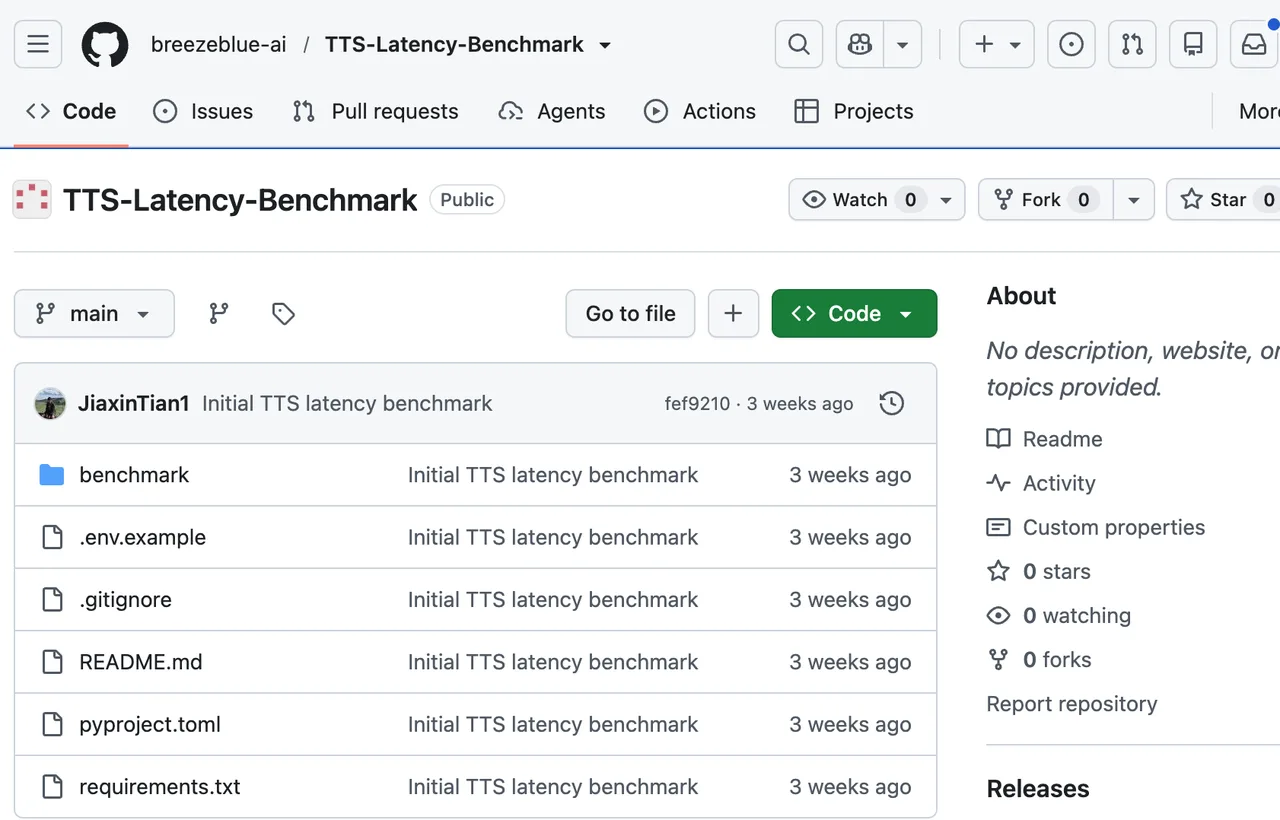
The latency evaluation suite is useful because it records request timing, summary files, percentiles, and optional saved audio. For every run, store model revision, inference-code revision, language, reference ID, dataset row, prompt, seed, codec, hardware, precision, batch size, concurrency, warmup, and queue policy.
Score Naturalness, Errors, Delay, and Reviewer Agreement
Score four buckets: naturalness, transcript errors, delay, and reviewer agreement.
Naturalness can use MOS. Transcript errors can use human review plus ASR checks. Delay should separate TTFB, initial silence, TTFA, total generation time, and RTF. Reviewer agreement needs mean, variance, outlier checks, and language proficiency.
Keep failed generations. Silence, clipped audio, repeated words, wrong language, and early stop matter more than the best sample.
Decide Whether the Evidence Supports a Pilot
Signals Strong Enough to Continue
The published evidence supports an internal pilot when the workload resembles the public tests: English character voices, voice direction, low-startup-latency speech, and streaming interaction.
The useful part is reproducibility. Public datasets and evaluation suites let a team rerun parts of the measurement instead of arguing over a screenshot.
Gaps That Require Independent Testing
Multilingual coverage beyond inspected English benchmark tasks needs separate tests. Codec differences need control. The H100 fast-path number needs local replication if local serving is the claim. Provider latency needs production-like priority, traffic, and region testing.
I did not find a separate paper-style technical report on August 28, 2026. The README, model card, and benchmark docs carry the current technical details. If a technical report appears later, old summaries need revision.
FAQ
Will the project publish raw benchmark audio for download?
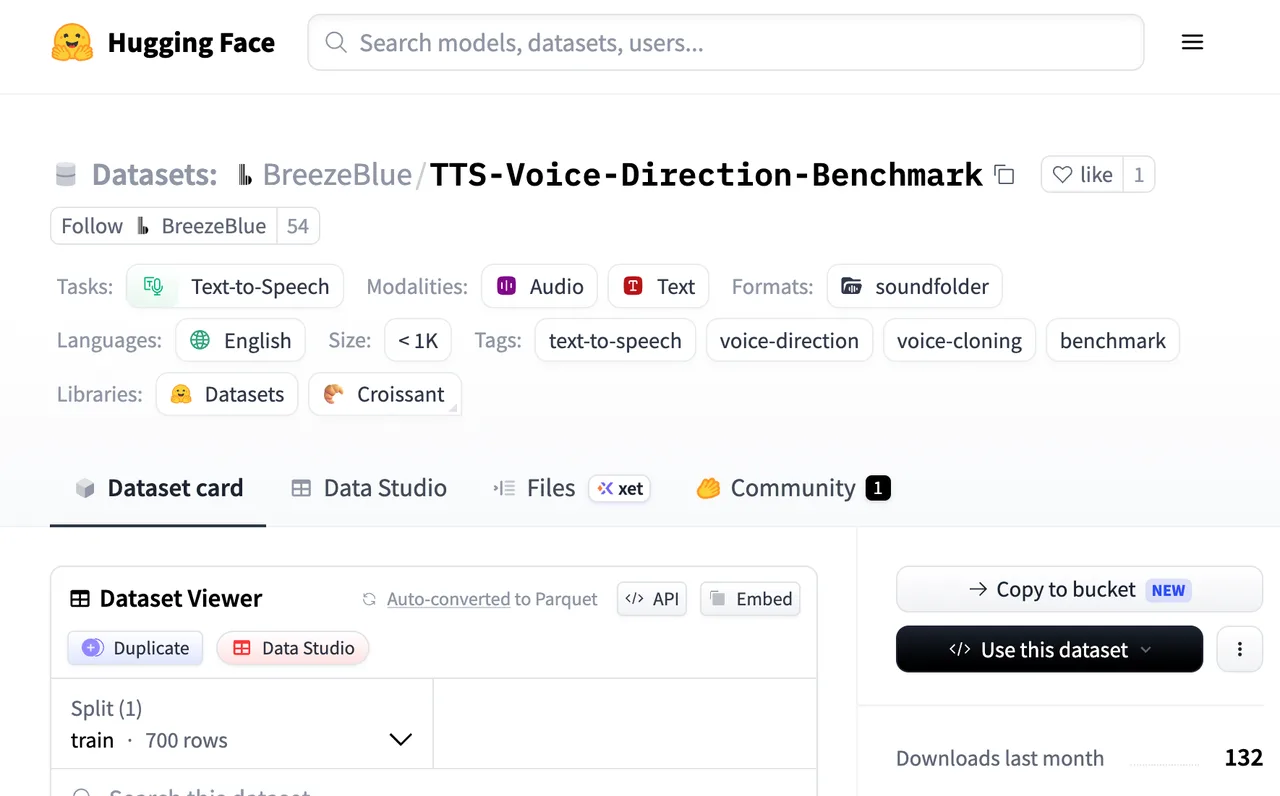
I found benchmark tasks, listening widgets, and reference-audio dataset paths. The voice-direction dataset includes task records and reference-audio paths, but I did not find a full downloadable pack of generated raw benchmark audio for every compared model.
How are human raters screened for language proficiency?
BreezeBlue’s pages expose judge-model details more clearly than human-rater screening details. For independent MOS, store first language or demonstrated proficiency.
Can teams compare scores collected with different audio codecs?
Not cleanly. Codec changes can alter noise, brightness, latency, and perceived quality. Compare within one codec path, or report codec as a separate condition.
Who owns disputes when listener ratings diverge sharply?
The benchmark owner owns the rubric. The product owner owns the launch decision. A sharp split can mean unclear instructions, poor rater fit, or a real audience divide.
What release change should invalidate an old benchmark report?
Mark the report stale after a model revision, inference-code change, precision change, hardware change, codec change, prompt-set change, scorer change, or queue-policy change.
Conclusion
A Breeze TTS 2 benchmark result is useful only when the test shape stays attached to the number. The published evidence supports further evaluation for English voice design, voice direction, and startup latency. It does not replace a frozen product test. Run it yourself. That’ll tell you more than anything I say.
Previous posts:
/filters:quality(82)/media/images/5f15570a-6a68-432e-a6f1-1dcbf799ba81.webp)
/filters:quality(82)/media/images/b73c2438-6bdd-4b80-a229-8d71d8f819cf.webp)
/filters:quality(82)/media/images/427fd9f2-347d-4f86-a2d5-aee110cda01d.webp)
/filters:quality(82)/media/images/1773962750383987480_n3hqzHRZ.webp)
/filters:quality(82)/media/images/43fa0e7f-a0db-48d7-9bab-921d1225db30.webp)
/filters:quality(82)/media/images/5799ff56-3a73-40ca-a666-e4965d878496.webp)