
MotionBricks Explained: The Future of Real-Time Motion AI
MotionBricks AI generates modular motion for animation and robotics. Learn how its architecture works, what the research shows, and what remains unproven.
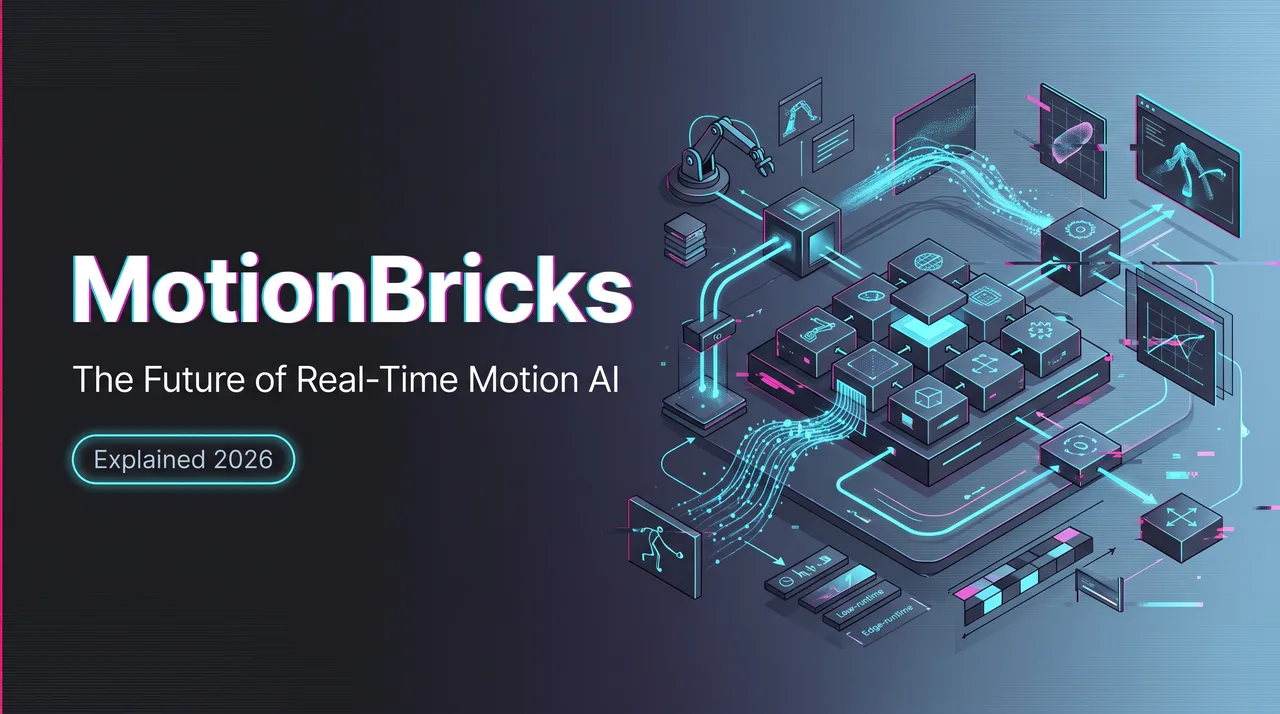
A real-time character system breaks in a different place than an image model. One bad pose is visible. One bad transition can poison the whole interaction loop. That is the operating context for MotionBricks AI: not whether it makes an impressive demo, but whether a motion system can stay controllable when animation, simulation, and robotics start asking for live decisions.
As checked on August 11, 2026, I found strong research evidence, public project assets, and an initial code release. I did not find evidence of a stable hosted API, commercial endpoint, or production support contract in the official MotionBricks sources. That matters. Demos show the ceiling. Production shows the floor.
What MotionBricks AI Is
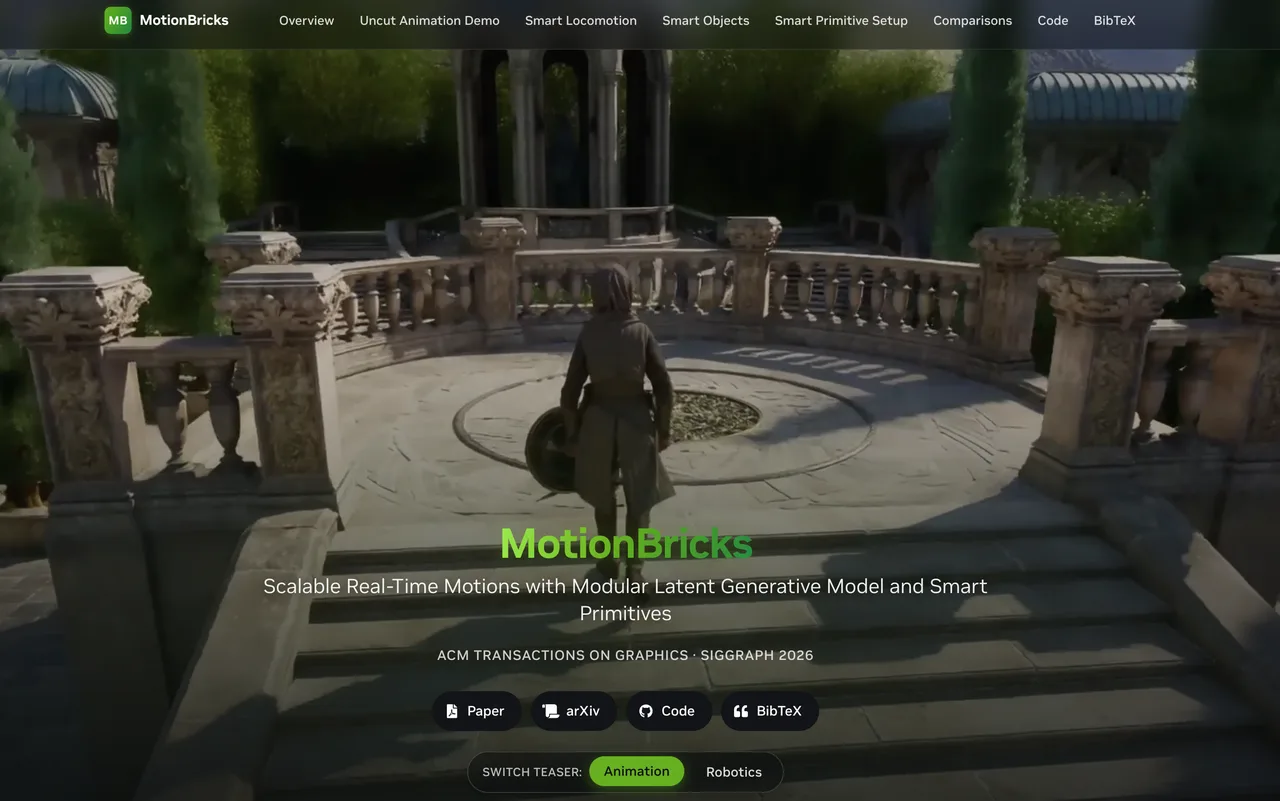
Modular Motion Generation in a Shared Latent Space
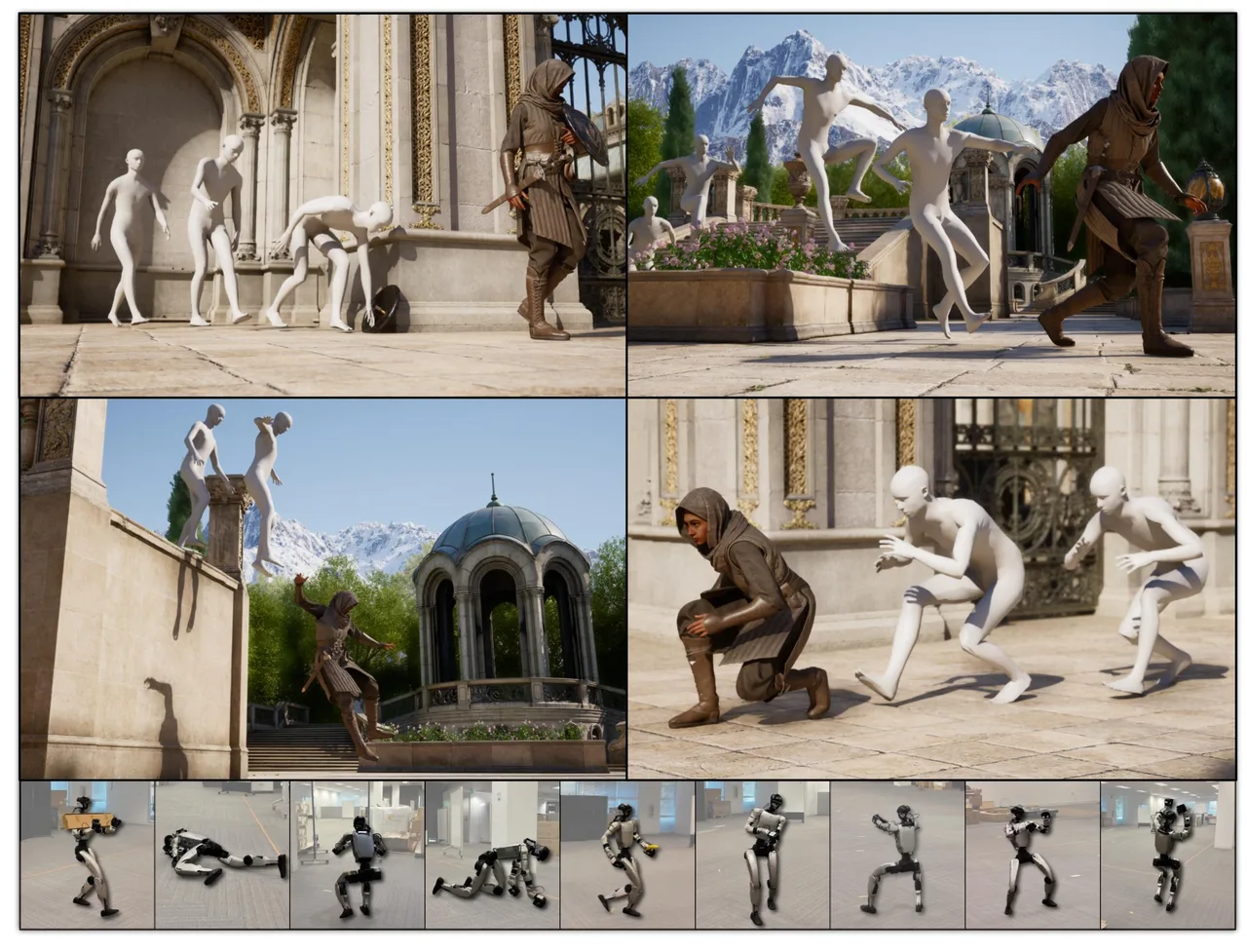
MotionBricks is presented by NVIDIA researchers as a real-time generative framework for motion synthesis. The official MotionBricks project page describes a modular latent generative backbone that models more than 350,000 motion clips with one neural model.
The technical idea is useful because it does not treat motion as a single text-to-animation prompt. The paper frames motion as a runtime control problem. Character state, target keyframes, root trajectory, pose tokens, and decoded continuous motion all sit inside the generation loop.
In production terms: it is a motion intelligence model trying to replace brittle hand-authored behavior graphs with generated transitions that still respond to user commands and scene events.
Smart Primitives for Navigation and Interaction
The second half of the system is the smart primitive layer. Smart locomotion handles navigation commands such as velocity, heading, and style. Smart objects handle interaction through proxy keyframes, letting the backbone fill in approach, contact, and follow-through.
That is the useful part for character motion AI. The system is not only producing a motion clip. It is exposing controllable building blocks for runtime behavior.
For robotics teams, the arXiv paper also reports deployment on a Unitree G1 humanoid robot. Treat that as a research demonstration, not a field safety claim. Unsafe robot motion has consequences outside the renderer.
Can Developers Access MotionBricks Today?
Public Research Assets and Missing API Evidence
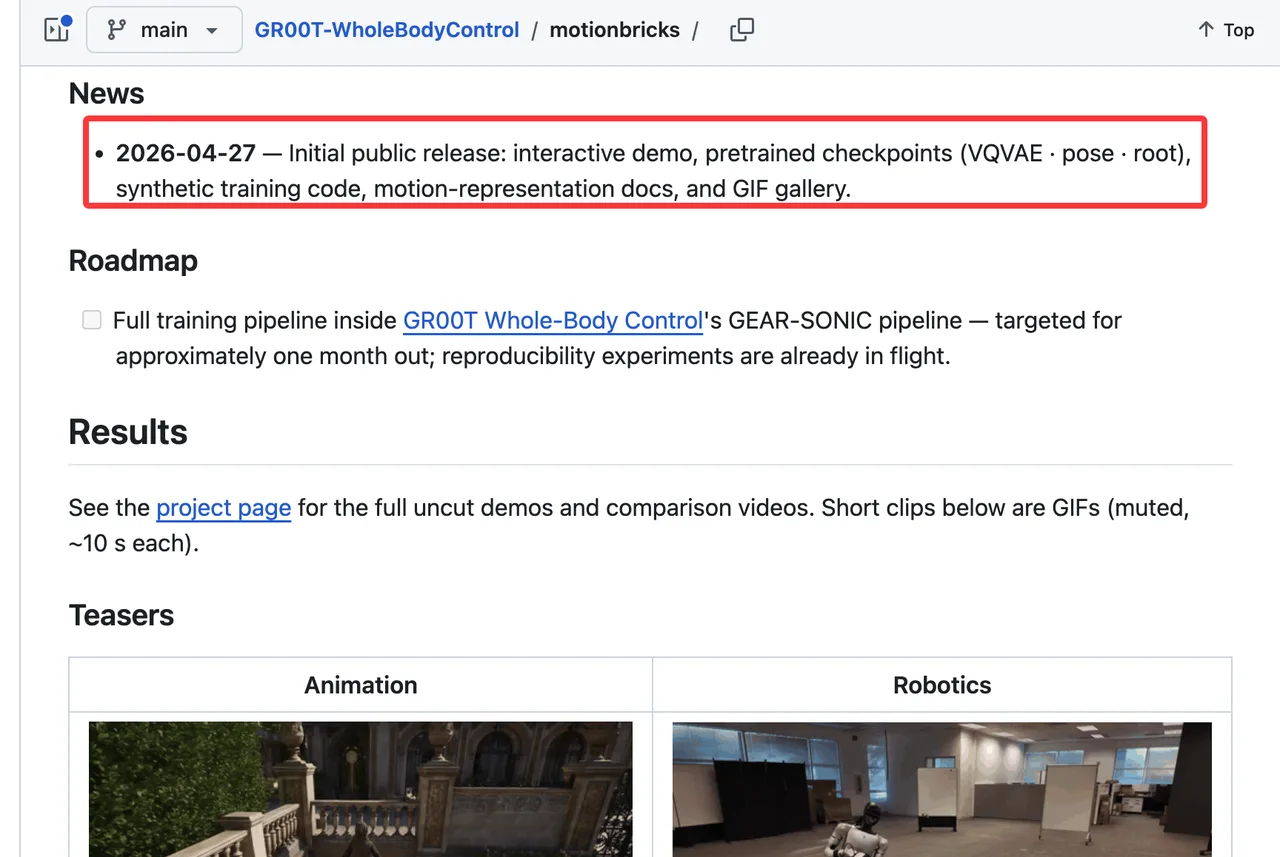
The current official page links to the paper, videos, and code. The MotionBricks code release says the initial public release includes an interactive demo, pretrained checkpoints, synthetic training code, motion-representation docs, and setup notes.
I did not find “API” on the official project page or in the arXiv HTML version. I also did not find public hosted pricing or SLA terms there. That is the boundary.
So the current answer is narrow: developers can study public research assets and preview code paths. I would not describe MotionBricks as an API product today unless a stable endpoint, model ID, pricing page, license, and support policy appear in official documentation.
What Must Be Available Before Production Integration
Before production integration, the missing pieces are not glamorous. They are the pieces that keep customer work from becoming guesswork:
- A stable model interface
- Runtime requirements
- Versioned weights or packages
- License and commercial-use terms
- Supported input and output schemas
- Safety boundaries for animation and robotics use
- Support, incident, and rollback policy
- Benchmark reproduction scripts
This cannot be judged by feel. It needs a sample run, a failure log, and a named owner for every risk.
How MotionBricks Could Fit an API-First Stack
Motion Inputs, Character State, and Output Contracts
An API-first design would need to turn smart motion primitives into explicit request contracts. For example, a navigation request might include character state, velocity command, heading, style, skeleton profile, frame rate, and constraints. An object interaction request might include object pose, contact target, approach path, and allowed motion envelope.
The output contract should be just as strict: pose sequence, root trajectory, contact labels, confidence or validity signals, timing, and failure state. If the output only returns “motion,” downstream systems will invent their own interpretation. That is how teams create five versions of the same bug.
Model Adapters, Runtime Isolation, and Version Control
If a platform later wraps MotionBricks, it should do it through an adapter layer, not direct application coupling. The adapter translates product-level requests into the model’s native primitive format, then normalizes the output into the app contract.
Runtime isolation matters. A motion model can fail through latency spikes, bad pose constraints, unsafe physical action, or skeletal mismatch. Each failure class needs its own fallback.
Versioning is not optional. If the model changes, the same navigation command may produce different movement. For animation teams, that may be a style issue. For a robotics motion model, that can be an incident.
Evaluate MotionBricks for Production Use
Reproduce Benchmarks Under Your Hardware and Workloads
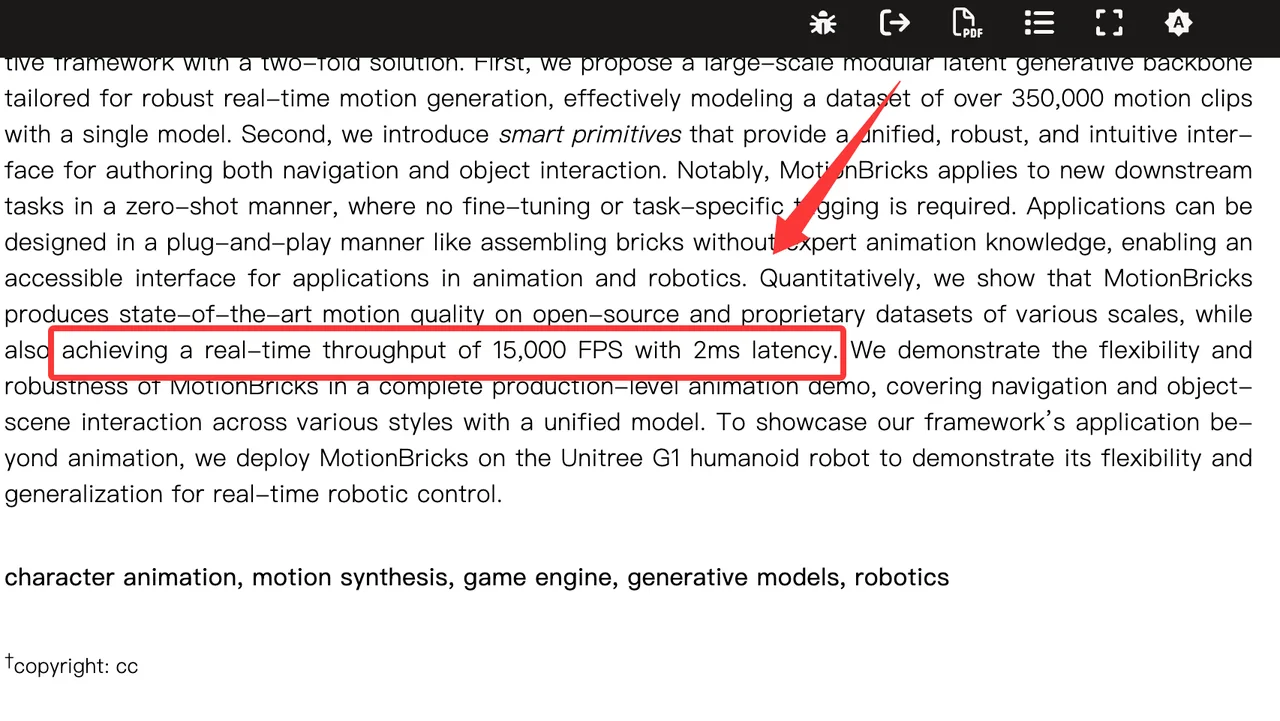
The arXiv HTML paper reports 15,000 FPS throughput and 2 ms latency, and the project page repeats the same headline figures. Those numbers are useful. They are not a production SLA.
A team evaluating MotionBricks AI should reproduce benchmarks on its own hardware, skeletons, scene constraints, and runtime loop. If the real workload is a Unity simulation with networked characters, a UE5 demo number is not enough. If the workload is robot control, simulation success is not physical safety.
Measure Latency, Motion Quality, Reliability, and Cost
The evaluation sheet should separate four things.
Latency measures frame timing, tail behavior, and replanning cost. Motion quality measures foot sliding, penetration, contact, object interaction, and transition smoothness. Reliability measures failures across repeated commands, not only the best generated sequence. Cost measures GPU time, integration work, safety review, and human cleanup.
Cheap motion is not cheap if a designer spends two hours repairing every interaction.
Choose Between Pilot, Internal Wrapper, and Wait
When a Research Pilot Has Clear Learning Value
A research pilot makes sense when the goal is learning, not delivery. Good pilot tasks include character navigation tests, synthetic interaction scenes, skeleton retargeting checks, and benchmark reproduction.
| Route | Use When | Do Not Use When |
|---|---|---|
| Research pilot | The team needs evidence and can tolerate broken edges | Customer delivery depends on stable access |
| Internal wrapper | The interface is stable enough for controlled internal use | License, weights, or runtime are unclear |
| Wait | The team needs support, SLA, and commercial terms | The goal is only early technical learning |
A pilot should produce logs, not promises. Record model version, hardware, skeleton, scene, latency, failure cases, and operator notes.
When Supported API Access Is the Safer Choice
Supported API access is safer when the output touches customer-facing demos, paid products, or robot behavior. A supported service should define uptime expectations, endpoint behavior, pricing, limits, safety guidance, and incident escalation.
Limits and Open Questions
Availability, Licensing, Safety, and Support Boundaries
MotionBricks is also tied to NVIDIA’s GR00T Whole-Body Control effort, which frames it inside a broader humanoid-control stack. That strengthens the robotics relevance. It does not remove the need for deployment review.
The GitHub release states that source code is under Apache 2.0 and pretrained weights use the NVIDIA Open Model License. Paper license, code license, model-weight license, dataset rights, and commercial use are separate questions. Legal needs to read the live terms before customer use.
What Would Change the Build-or-Wait Decision
The build-or-wait decision changes when official materials add stable access evidence: versioned model packages, documented interfaces, runnable weights, supported runtime targets, commercial terms, and production support.
Until then, MotionBricks AI belongs in research evaluation and controlled internal experiments, not customer commitments.
FAQ
Who should approve experimental motion models for customer-facing demonstrations?
Product, engineering, and safety should approve together. For robotics demonstrations, a domain safety owner needs final authority.
How should teams label research benchmarks in external product materials?
Label them as paper-reported or internally reproduced. Include hardware, workload, date, and whether the benchmark came from animation, simulation, or robot tests.
Who owns customer notices after a motion-model access change?
Product owns customer impact. Engineering owns technical accuracy. Support or customer success owns delivery. Legal reviews wording when contracts or rights are involved.
Who owns incident response for unsafe robotic motion outputs?
The robotics safety owner should lead incident response, with engineering supplying logs and reproduction data. Do not route this only through model operations.
When should legal teams review generated-character training data disclosures?
Before any customer-facing demo, commercial deployment, dataset reuse, or claim about training rights. Generated motion can touch likeness, performance, asset licensing, and synthetic data policy.
Conclusion
MotionBricks AI is worth watching because it attacks the production problem directly: real-time motion, smart motion primitives, character interaction, and robot control under one research framework.
I would treat it as research with promising public assets, not a ready API product. Run a pilot if the learning value is clear. Build an internal wrapper only after license, interface, and runtime evidence are stable. Wait for supported access if the output goes in front of customers or into physical motion.
Previous posts:
Related Articles
/filters:quality(82)/media/images/1791535252286714222_v4jvJT2a.webp)
ModelsLab Review 2027: One API for Media Models?
/filters:quality(82)/media/images/1791451065663755033_qNqAKS1a.webp)
Best AI Video Background Removal Tools in 2027
/filters:quality(82)/media/images/1791359984291066138_tW5eOX6f.webp)
Best Comfy Cloud Alternatives in 2027
/filters:quality(82)/media/images/1773962750383987480_n3hqzHRZ.webp)
Qwen Image 2.1 vs Qwen Image 3.0: What Changes and When to Upgrade
What's Next for Wan Video Generation, and What It Means for Creators
/filters:quality(82)/media/images/1791271002496939282_TBLU3cmv.webp)