
Solar Pro 4 Benchmarks: Agent Reliability Signals
Solar Pro 4 benchmark review explaining what its agent, terminal, and long-context scores signal, plus the evidence gaps builders should test themselves.
Hello, guys. I’m Dora. I do not use a Solar Pro 4 benchmark as a ranking shortcut. That is where people get sloppy. For ML engineers and platform leads, the useful question is narrower: do the published scores give enough evidence to start a pilot for document-heavy, tool-using agents?
This page treats benchmark numbers as signals. Not guarantees. Not production proof. The job is to turn them into a small validation plan.
What the Published Benchmarks Measure
Terminal Tasks, Multi-Turn Tools, and Long Documents
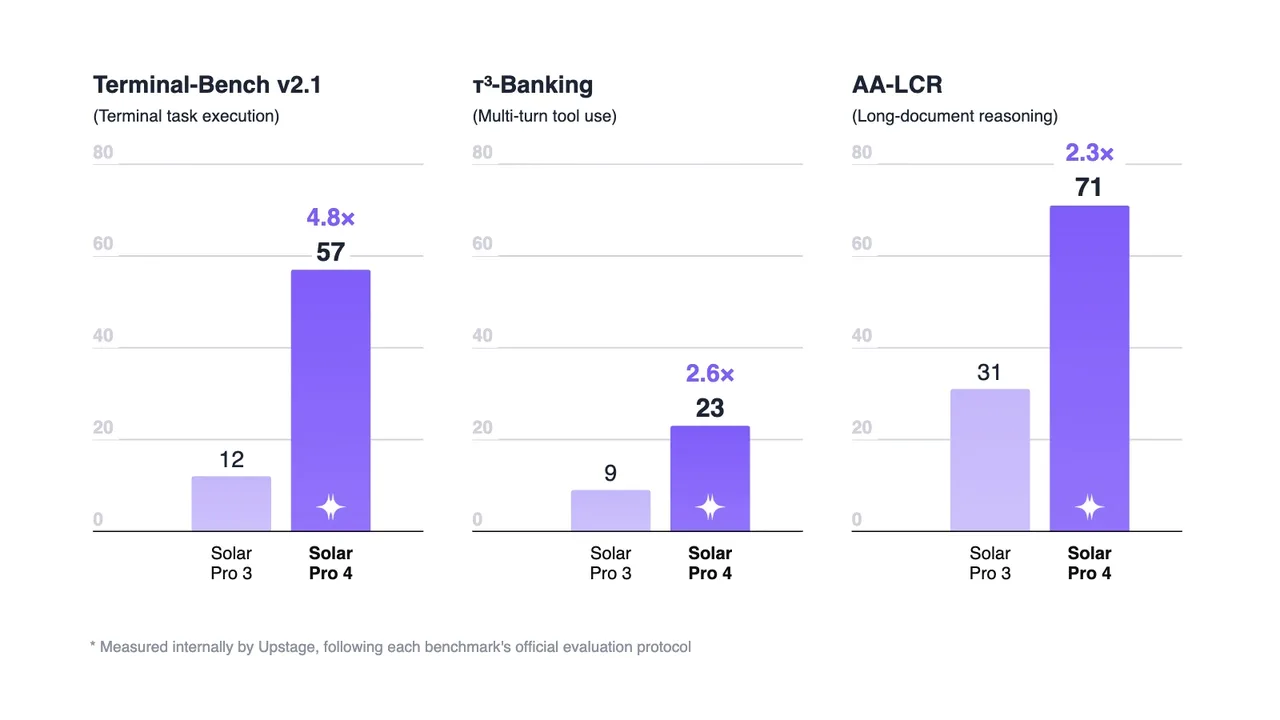
Upstage’s Solar Pro 4 launch post frames the model around long documents, terminal tasks, and multi-turn tool use. It reports three agent-relevant scores, attributed to Artificial Analysis as of August 2026:
| Benchmark | Reported Solar Pro 4 Score | What It Tests |
|---|---|---|
| Terminal-Bench v2.1 | 57 | Shell-based task completion |
| Tau3-Banking | 23 | Multi-turn tool use with policy lookup |
| AA-LCR | 71 | Long-document reasoning over large text sets |
That mix is useful. Terminal-Bench checks whether an agent can operate in a terminal, not just write commands. Tau3-Banking is a tool-use benchmark with conversation state and backend outcomes. AA-LCR is a long-context benchmark for answers scattered across documents.
I paused here. These are closer to work than trivia tests, but they are still harnesses.
Test Harnesses, Baselines, and Reported Configurations
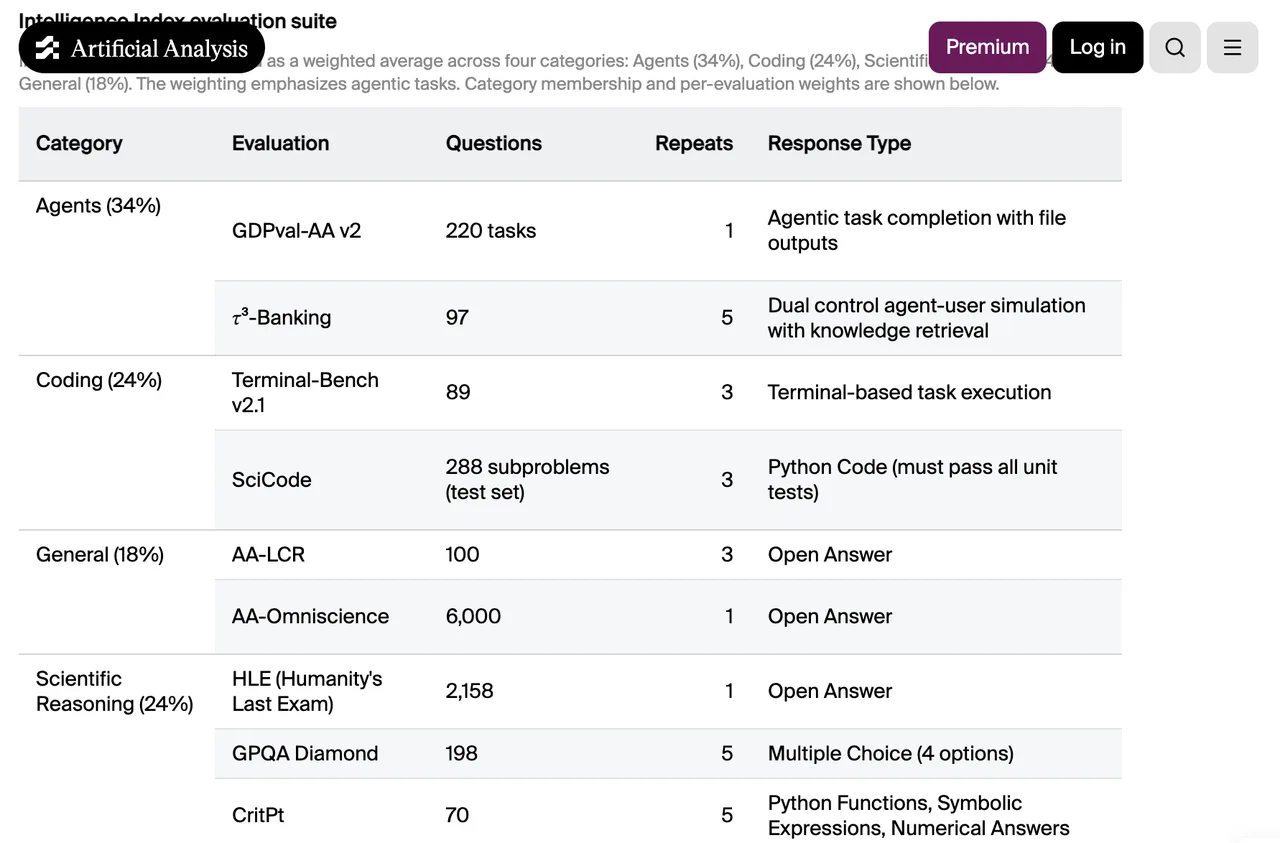
Artificial Analysis says its Intelligence Benchmarking v4.1.1 includes GDPval-AA v2, Tau3-Banking, Terminal-Bench v2.1, SciCode, HLE, GPQA Diamond, CritPt, AA-Omniscience, and AA-LCR. It also states that Terminal-Bench v2.1 uses 89 tasks with 3 repeats and pass@1 scoring through terminal execution.
The public benchmark record needs these fields beside every number:
| Field | Why It Matters |
|---|---|
| Model ID | solar-pro4 is not the same as a routed alias |
| Source date | Results can move after endpoint changes |
| Harness | Agent wrapper changes behavior |
| Configuration | Reasoning level, token budget, tools, timeout |
| Provider | First-party API and routers may differ |
| Cost basis | Retries and reasoning tokens change the bill |
Found the pattern on the third try: a score without its harness is just a number wearing a lab coat.
Read the Scores as Signals, Not Guarantees
What Each Evaluation Suggests About Agent Behavior
The Artificial Analysis report gives the cleaner comparison against Solar Pro 3: Terminal-Bench v2.1 moved from 12% to 57%, AA-LCR from 31% to 71%, and Tau3-Banking from 9% to 23%. It also reports GDPval-AA v2 moving from 498 Elo to 1277 Elo.
That suggests real progress in agent model reliability. The pattern is strongest where the workload has state, tools, documents, and an external completion criterion.
One caution: AA-Omniscience improved from -53 to -1 partly because Solar Pro 4 abstained more. The same report says it attempted 41% of questions, while Solar Pro 3 attempted 92%. Its hallucination rate improved, but accuracy stayed at 19%. Good refusal behavior can help production. It can also create incomplete workflows.
Why a Strong Score May Not Transfer to Another Stack
Terminal-Bench itself changed between versions. The official Terminal-Bench 2.1 release says v2.1 fixed 28 of 89 tasks and added continuous validation for agentic benchmarks. Version matters.
A production stack adds more differences: custom tools, file limits, auth flows, retry policy, timeout ceilings, prompt templates, memory, retrieval, and human approval gates. A model that passes a clean harness can still fail when a real spreadsheet is malformed or a tool returns a partial response.
This is where my data ends. Published scores say “pilot candidate.” They do not say “ship it.”
Build a Small Independent Validation Set
Choose One Real Workload and Completion Criterion
Pick one workload. Not five. A good first Solar Pro 4 evaluation might be: read three policy documents, inspect one CSV, call one internal calculator tool, and produce a pass/fail recommendation with citations.
The completion criterion has to be binary enough to grade:
| Workload Type | Completion Criterion |
|---|---|
| Contract review | Finds specified clauses and flags absent ones |
| Terminal fix | Test suite passes without manual repair |
| Finance packet | Numbers match source files |
| Support policy agent | Tool result and policy answer agree |
| Research memo | Every claim maps to a cited source |
No vibes. Vibes are how bad agents get promoted.
Track Correctness, Retries, Tool Errors, and Total Cost
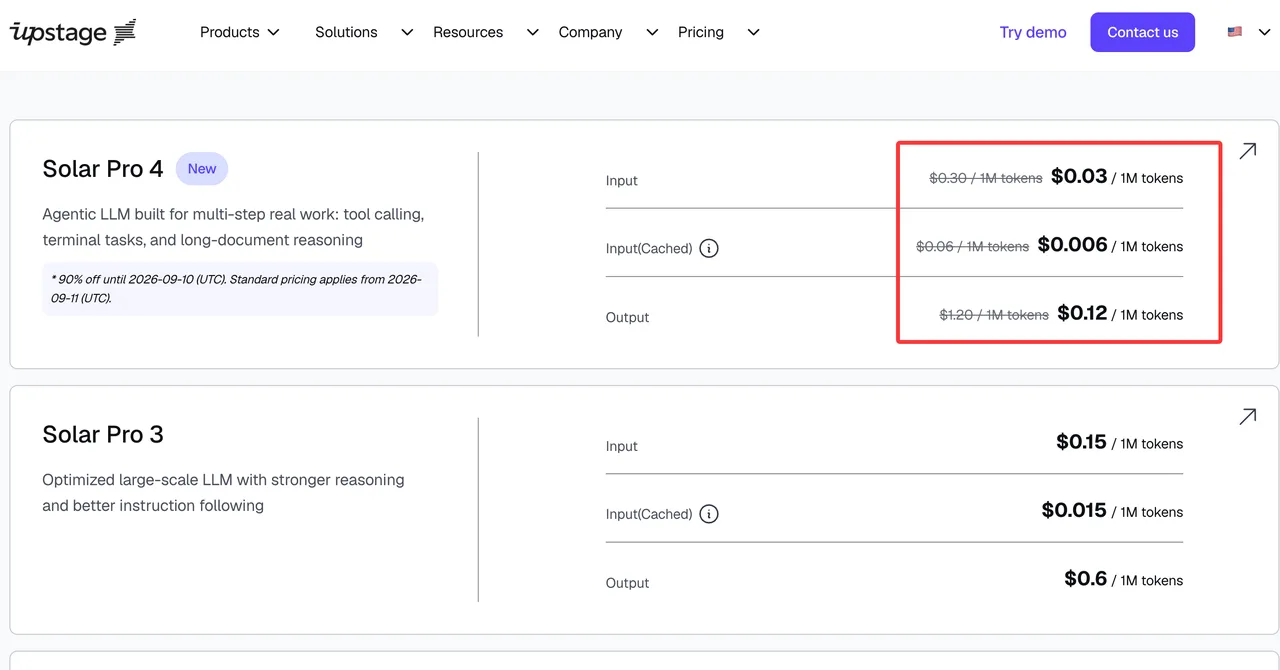
The Upstage API pricing page lists Solar Pro 4 at $0.30 per 1M input tokens, $0.06 per 1M cached input tokens, and $1.20 per 1M output tokens, excluding VAT. For agent workloads, record total task cost, not unit price.
Track these fields per run:
- Final correctness.
- Number of tool calls.
- Tool-call format errors.
- Retry count.
- Prompt tokens, cached tokens, output tokens.
- Wall-clock time.
- Human repair time.
- Failure reason.
A cheap failed run is not cheap. It is a paid interruption.
Decide Whether the Evidence Is Sufficient
Evidence That Supports a Pilot
The evidence supports a pilot when the target workload resembles the measured tasks: long text, multi-step tool use, terminal execution, and final deliverable grading. Solar Pro 4 benchmark data is strongest for those shapes.
I would move to a pilot if the internal test shows at least stable pass rates, low tool-format errors, tolerable retries, and no silent fabrication in document-grounded answers.
Gaps That Require More Testing
More testing is needed when the stack depends on hidden constraints: regional endpoint behavior, private tools, non-English business documents, regulated outputs, or strict latency.
Artificial Analysis also separates model capability from endpoint/provider behavior. Keep that separation. First-party model scores do not automatically describe every routed provider, region, or enterprise deployment.
FAQ

Does Upstage disclose contamination checks for Solar Pro 4 benchmarks?
I did not find a public Solar Pro 4 contamination-check disclosure in the official launch post or the Artificial Analysis pages checked on August 31, 2026. Treat contamination status as unconfirmed unless a newer source documents it.
Can enterprises legally reproduce Solar Pro 4 benchmarks internally?
It depends on benchmark licenses, dataset access, API terms, and internal use rules. Terminal-Bench has public harness materials. Artificial Analysis and Upstage in-house evaluations may not expose everything needed for exact reproduction. This is general information, not legal advice.
Could regional endpoints produce materially different benchmark results?
Possible, but I found no public Solar Pro 4 regional benchmark split. Endpoint behavior can change through provider routing, request defaults, model revision, caching, or token limits. Test the exact endpoint planned for production.
How often does Upstage refresh Solar Pro 4 benchmark reports?
I did not find a fixed refresh schedule. Use publication date, source date, model ID, and provider as part of every record. A launch-post number from August 2026 is not a live monitor.
Do published evaluations include non-English workloads from real business domains?
Upstage reports Korean and Japanese benchmark rows, including law, medicine, office work, Japanese MMLU, and Japanese IFEval. It also describes OfficeVerse as synthetic office tasks from public data across 11 industry domains and 12 task types. That is not the same as private customer-domain validation.
Conclusion
A Solar Pro 4 benchmark is useful when it becomes a pilot filter. Terminal-Bench, Tau3-Banking, AA-LCR, and GDPval-AA point toward stronger agent behavior, especially on long-context and tool-heavy work.
They do not prove production reliability. Pin the model ID, record the harness, run one real workload, count retries and cost, then decide. Good enough. That is the most honest assessment I can give.
Previous posts:
/filters:quality(82)/media/images/b73c2438-6bdd-4b80-a229-8d71d8f819cf.webp)
/filters:quality(82)/media/images/427fd9f2-347d-4f86-a2d5-aee110cda01d.webp)
/filters:quality(82)/media/images/1773962750383987480_n3hqzHRZ.webp)
/filters:quality(82)/media/images/43fa0e7f-a0db-48d7-9bab-921d1225db30.webp)
/filters:quality(82)/media/images/5799ff56-3a73-40ca-a666-e4965d878496.webp)
/filters:quality(82)/media/images/7a8850fc-caf6-482f-ac4d-5ddbe64ec47c.webp)