GPT-5.4 Mini vs Nano vs GPT-5.4: Pick by Workload
Compare GPT-5.4 Mini, Nano, and GPT-5.4 by cost, latency, and capability to route each API workload to the right model.
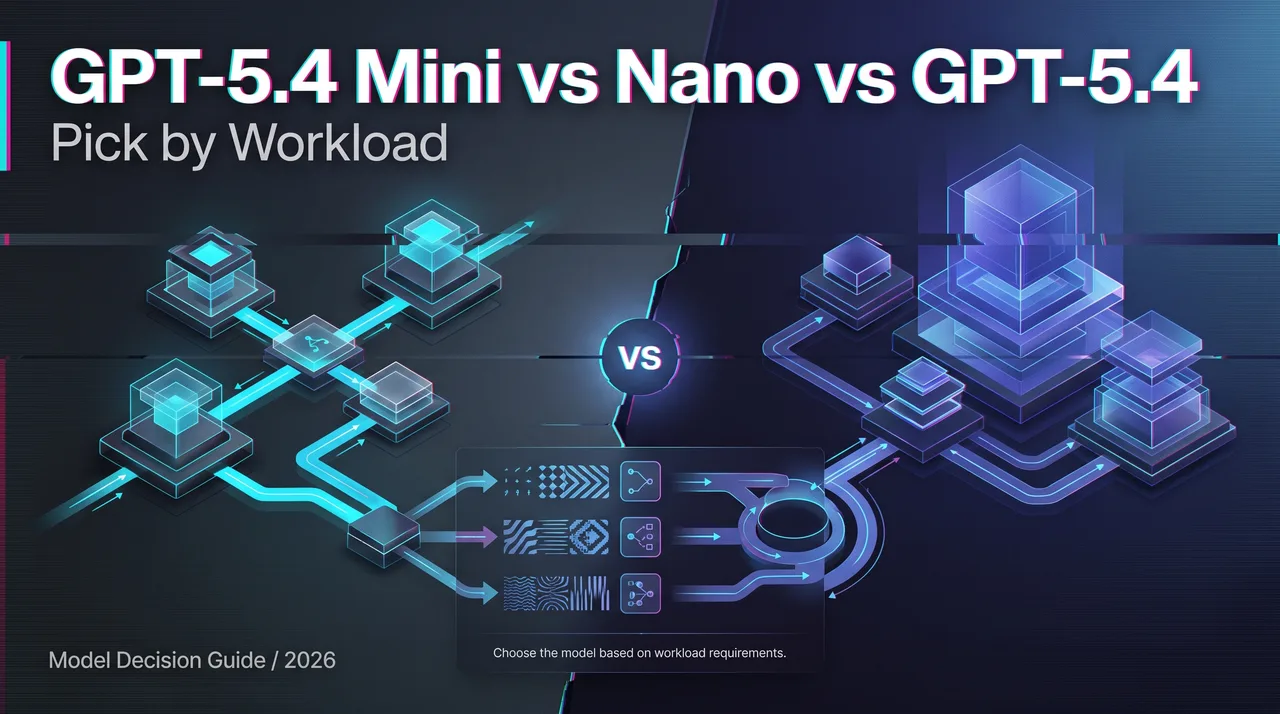
I had three routes open in the same API plan: cheap extraction, high-volume chat, and harder reasoning. That is where the GPT 5.4 mini model actually belongs in the conversation. Not as a cute small model. As the middle route between Nano and the full GPT-5.4.
The short version: Nano is the cheapest route in this three-model comparison and is API-only. Mini is the default efficient route for volume, light coding, and responsive agents. GPT-5.4 is the stronger route when the quality floor matters more than the cost ceiling. GPT-5.5 sits above this family for frontier work; this page is not rewriting the GPT-5.5 vs GPT-5.4 comparison. Different job.
The Three Variants at a Glance
The OpenAI release note for GPT-5.4 mini and Nano is unusually useful because it says the routing quiet part out loud. Smaller models are for workloads where latency and cost shape the product experience.
That is the frame I would use.
Positioning: mini=fast/cheap, Nano=cheapest/edge, 5.4=frontier-lite
Nano is the cheapest GPT-5.4-class model. I would use it for classification, extraction, ranking, tagging, format checks, and small subagents that operate under tight prompts.
Mini is the efficient general route. The GPT 5.4 mini model is not just for throwaway tasks. It supports coding, computer use, tool calling, multimodal inputs, and subagent patterns, while staying much cheaper than the full model.
GPT-5.4 is the quality route inside this family. It has the larger context window, stronger reasoning, and broader fit for professional work. It is not the top of the current stack, but it is the model I would compare against when mini starts failing quality checks.
Comparison Table
The table below uses official model pages where possible. I am keeping it compact because the real decision is not “which row looks best.” It is where the workload breaks.
| Model | Price per 1M tokens | Context / max output | Latency positioning | Modality and access | Best first route |
|---|---|---|---|---|---|
| GPT-5.4 nano | $0.20 input / $1.25 output | 400K / 128K | Fastest cost route | Text in/out, image input; API only | Extraction, classification, ranking |
| GPT-5.4 mini | $0.75 input / $4.50 output | 400K / 128K | Faster than full 5.4 | Text in/out, image input; API, Codex, ChatGPT | High-volume chat, light coding, subagents |
| GPT-5.4 | $2.50 input / $15 output | 1.05M / 128K | Fast, higher capability | Text in/out, image input; API, Codex, ChatGPT | Harder reasoning, long context, quality-sensitive work |
Price, context, latency, modality, access
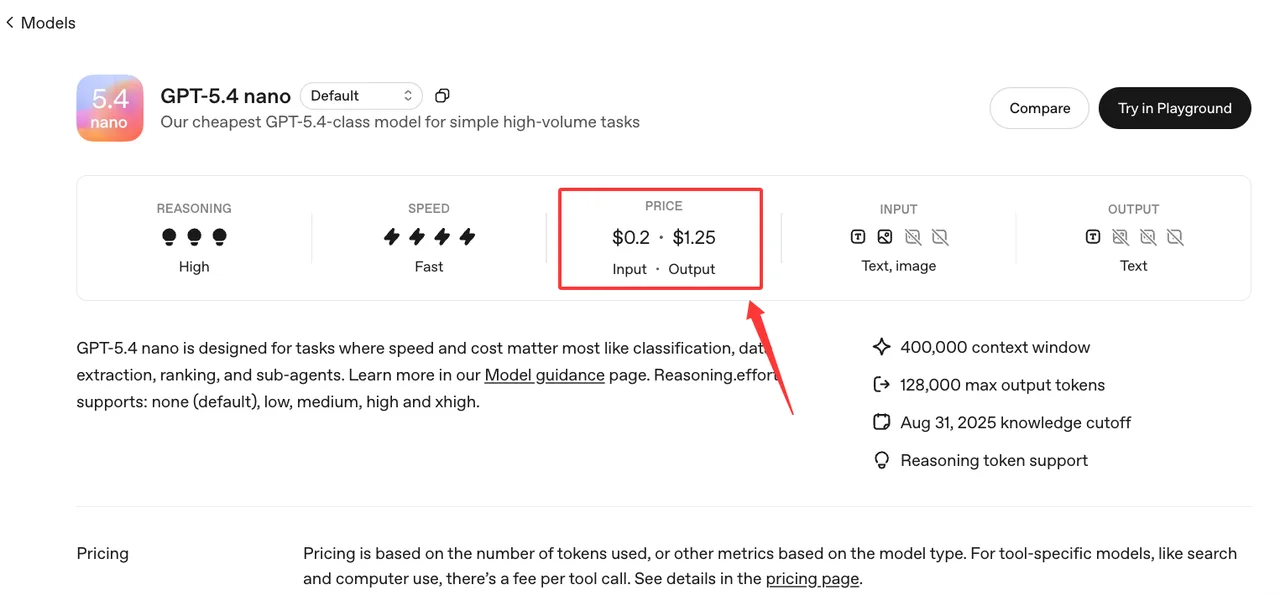
For openai api pricing, the verified numbers are straightforward. The GPT-5.4 Nano model page lists $0.20 input and $1.25 output per million tokens. The GPT-5.4 mini model page lists $0.75 input and $4.50 output. The GPT-5.4 model page lists $2.50 input and $15 output.
Nano is API only. Mini is broader: API, Codex, and ChatGPT. In ChatGPT, the release note says mini is available to Free and Go users via Thinking, while API free-tier rate limits are a separate issue. I would not mix those two availability statements. They answer different questions.
The context split is also clean. Nano and mini use 400K context windows. GPT-5.4 uses 1.05M. That alone can move a workload out of mini when the prompt carries large files, long tool logs, or multi-document state.
When Each Wins
The cleanest routing rule is this: start small when the output is easy to verify, move up when the error is expensive.
That sounds obvious. It is also the rule teams forget when a cheaper model performs well in a demo.
Nano: classification, extraction, predictable output
The GPT 5.4 Nano route wins when the task has a narrow input, a stable schema, and an answer that can be checked cheaply.
Examples: support ticket classification, metadata extraction, short summarization, spam-like ranking, product attribute normalization, routing labels, and simple subagent work. Nano is also useful when the response is short and the product needs a low latency model more than it needs extra reasoning.
The boundary is ambiguity. If the model has to decide which task it is solving, Nano is already in the wrong room.
Mini: high-volume chat, light coding
Mini is where I would start for most builder-facing volume. It has enough capability for lightweight chat, focused coding help, tool calls, screenshot interpretation, structured outputs, and subagents that handle bounded work.
OpenAI’s launch table reports SWE-Bench Pro at 54.4% for mini and 57.7% for GPT-5.4. You may see third-party writeups round that as “mini around 54%, standard around 57.7%.” I would cite the official release table instead. The gap is real, but it is not automatically product-visible.
For single-file edits, code explanation, UI copy generation, extraction with light judgment, and high-volume support chat, mini can be the route that keeps cost down without dropping below the quality floor.
GPT-5.4: harder reasoning at lower cost than 5.5
GPT-5.4 wins when the task is still inside the 5.4 family but mini starts showing cracks.
I would route to full GPT-5.4 for larger codebase changes, long-context document analysis, complex tool workflows, and tasks where the model has to hold several constraints at once. The price is higher, but the failure mode is often cheaper to review.
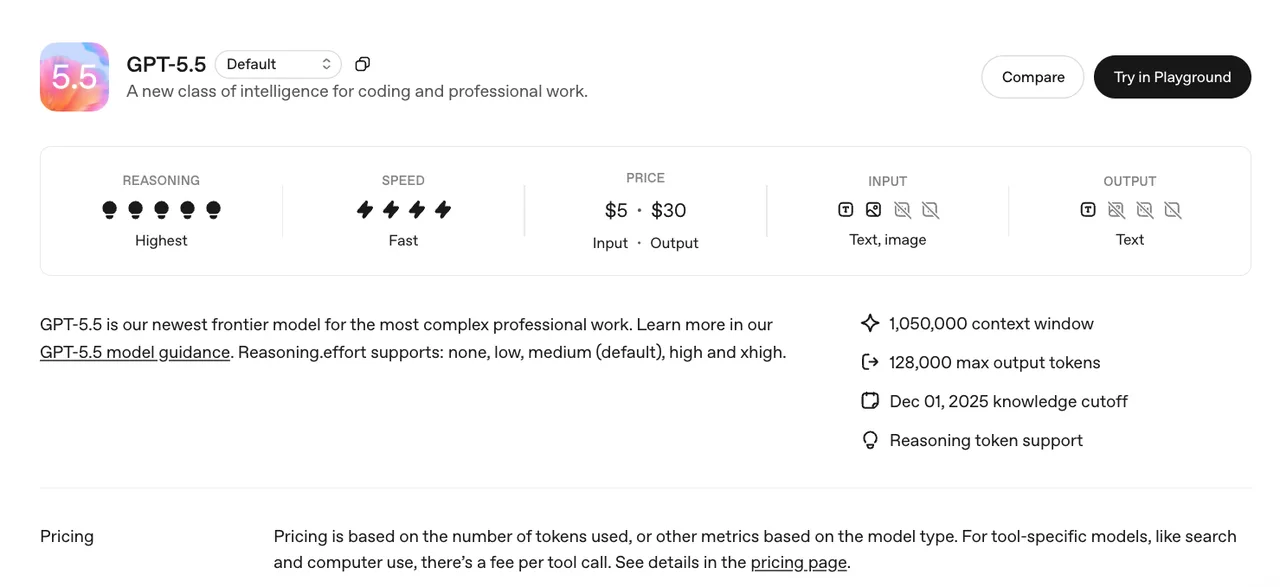
GPT-5.5 sits above it. The GPT-5.5 model page lists a higher price and positions it for the most complex professional work. That is the frontier lane. GPT-5.4 is the lower-cost quality lane under it.
Decision Criteria for Routing
The router needs one question first: what breaks if the model is wrong?
If the answer is “we retry quietly,” use Nano or mini. If the answer is “a user sees a bad decision,” raise the quality floor. If the answer is “an engineer spends 45 minutes repairing a patch,” the cheap call was not cheap.
Cost ceiling vs quality floor
Cost ceiling is the maximum a workload can spend per accepted result. Quality floor is the minimum correctness needed before the output can ship, trigger an action, or reach a user.
Nano wins when the cost ceiling is hard and the quality floor is modest. Mini wins when the cost ceiling matters but the output still needs reasoning, tool use, or conversational quality. GPT-5.4 wins when the quality floor is higher and the task has enough complexity to justify the extra cost.
I paused here the first time I mapped this. “Use the cheapest model that works” is too loose. The better rule is: use the smallest model that stays above the quality floor after retries, validation, and review time.
For a low latency model, also separate first-token latency from end-to-end workload time. A fast model that fails twice may be slower than a larger model that succeeds once.
Limits & Trade-offs
Nano’s trade-off is capability headroom. It is cheap because it is small. It belongs in tight lanes.
Mini’s trade-off is long-horizon judgment. It can handle a lot, especially when prompts and tools are clean. It is not the route I would trust for messy planning, cross-file architectural decisions, or high-stakes reasoning without eval evidence.
GPT-5.4’s trade-off is cost. It gives more context and stronger reasoning, but it can become wasteful when used as the default for every label, extraction, and first-pass draft.
The GPT-5.5 trade-off is simpler: stronger frontier capability, higher cost. Keep it in the comparison as the escape hatch for tasks where GPT-5.4 still misses the quality floor. Do not make this article into that article. The 5.5 vs 5.4 decision deserves its own page.
Good infrastructure makes you forget it is there. A good model router does the same.
FAQ
What’s the capability gap between Mini and Nano in practice?
Mini has more room for reasoning, coding, tool use, and multimodal workflows. Nano is better treated as the predictable-output route. The practical gap shows up when prompts get ambiguous, tool results need interpretation, or the answer requires more than one step.
Which workloads actually fit Nano versus Mini versus the full GPT-5.4?
Use GPT 5.4 Nano for classification, extraction, ranking, and tight subagent work. Use mini for high-volume chat, light coding, structured support, and fast multimodal tasks. Use GPT-5.4 when the task needs longer context, harder reasoning, or a higher quality floor.
Is Nano only available through the API?
Yes. OpenAI’s release note says GPT-5.4 Nano is only available in the API. Mini is different: it is available in the API, Codex, and ChatGPT, including Free and Go users through Thinking in ChatGPT.
Where does GPT-5.5 sit above these three models?
GPT-5.5 is the higher frontier route above this 5.4-family comparison. I would use it when GPT-5.4 misses the quality floor on complex professional work, agentic coding, or long-running tasks. It is not the cost-efficient default.
Can I mix Mini, Nano, and GPT-5.4 in the same application?
Yes. That is the point. Let Nano handle cheap predictable calls, mini handle high-volume interactive work, and GPT-5.4 handle harder escalations. Track accepted-result cost, not request cost. That is where routing decisions stop being guesswork.
Conclusion
The GPT 5.4 mini model is the middle route, not the weak route.
Nano is for cheap predictable work. Mini is for high-volume product traffic where speed and quality both matter. GPT-5.4 is for the harder cases where context, reasoning, and review cost push the task above mini. GPT-5.5 sits above all three when the workload needs frontier capability.
The decision is cost ceiling vs quality floor. Run evals on your own traffic, keep the failures, and route by accepted result. Run it yourself. That will tell you more than a model card.
Previous posts: