Pollo AI Review 2027: Models, Workflow, and Cost
Pollo AI review 2026 evaluates its multi-model workflow, output consistency, credit economics, and fit for production video teams.
John is here. I review AI video tools from the production floor, where the real question is not whether one demo looks impressive. It is whether a team can reproduce an acceptable clip without losing hours to account switching, unexplained model changes, and expensive retries. This Pollo AI review evaluates the platform as a multi-model workflow—not as one video model.
What Pollo AI Is and What It Controls
The Platform Layer Versus the Underlying Models
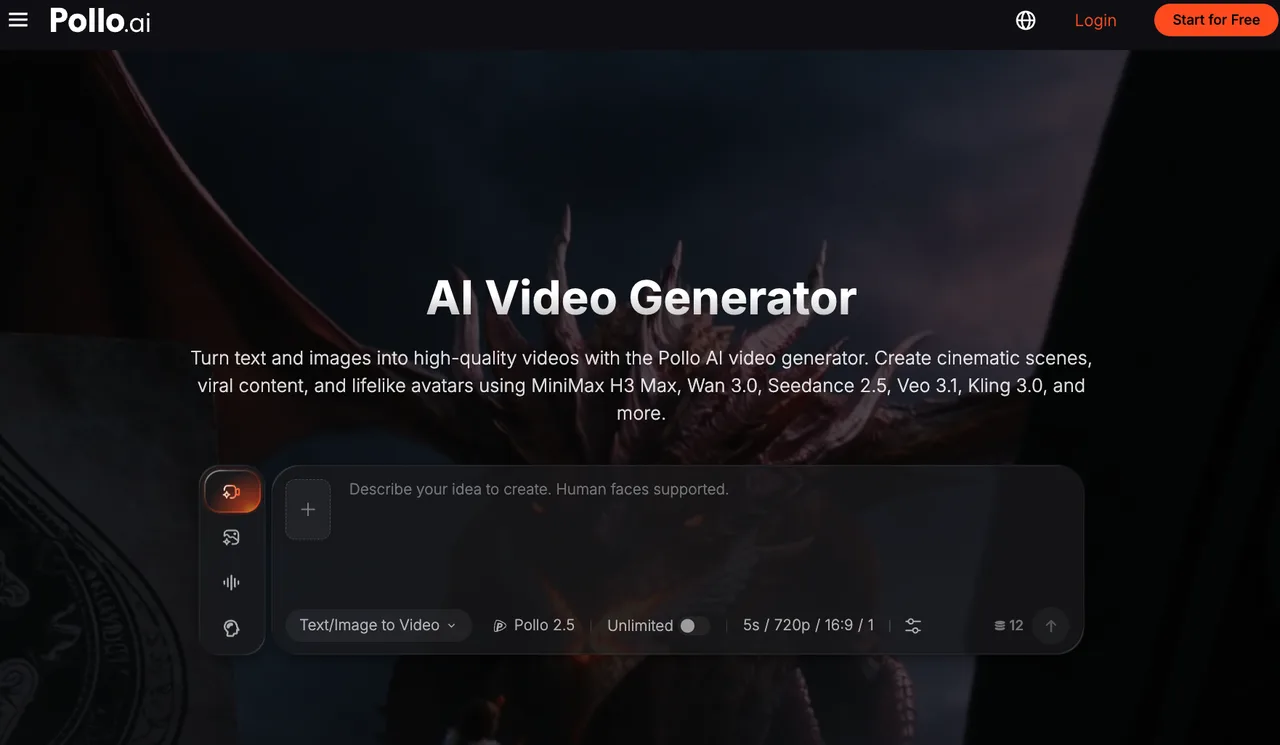
Pollo AI is a browser-based creative platform that routes users to Pollo models and third-party systems. Its current video catalog includes Pollo 2.5, MiniMax H3, Wan 3.0, Seedance, Kling, Veo, Sora, and other options.
That distinction matters. Pollo controls the interface, account, credits, queue, preview, download flow, and some exposed settings. The selected model controls most prompt interpretation, motion behavior, reference fidelity, native audio, and visual failure patterns.
If MiniMax H3 preserves a product better than Pollo 2.5 in one test, that is evidence about those routes under the recorded settings. It is not proof that every Pollo AI video generator workflow has the same advantage.
The Workflow Included in This Review
This review covers one practical assignment: produce a five-second vertical product clip from both a written brief and an owned reference image.
I compare Pollo 2.5 and MiniMax H3 because both were displayed as available when this article was checked. The evaluation covers model selection, repeated generation, output review, credits, latency, and cost per usable clip. It does not rank every model or test Pollo Agent, avatars, image tools, or effects.
How We Test Pollo AI
One Prompt Across Two Available Video Models
Do not switch models yet. Look at the workflow first.
The text-to-video prompt is locked before testing:
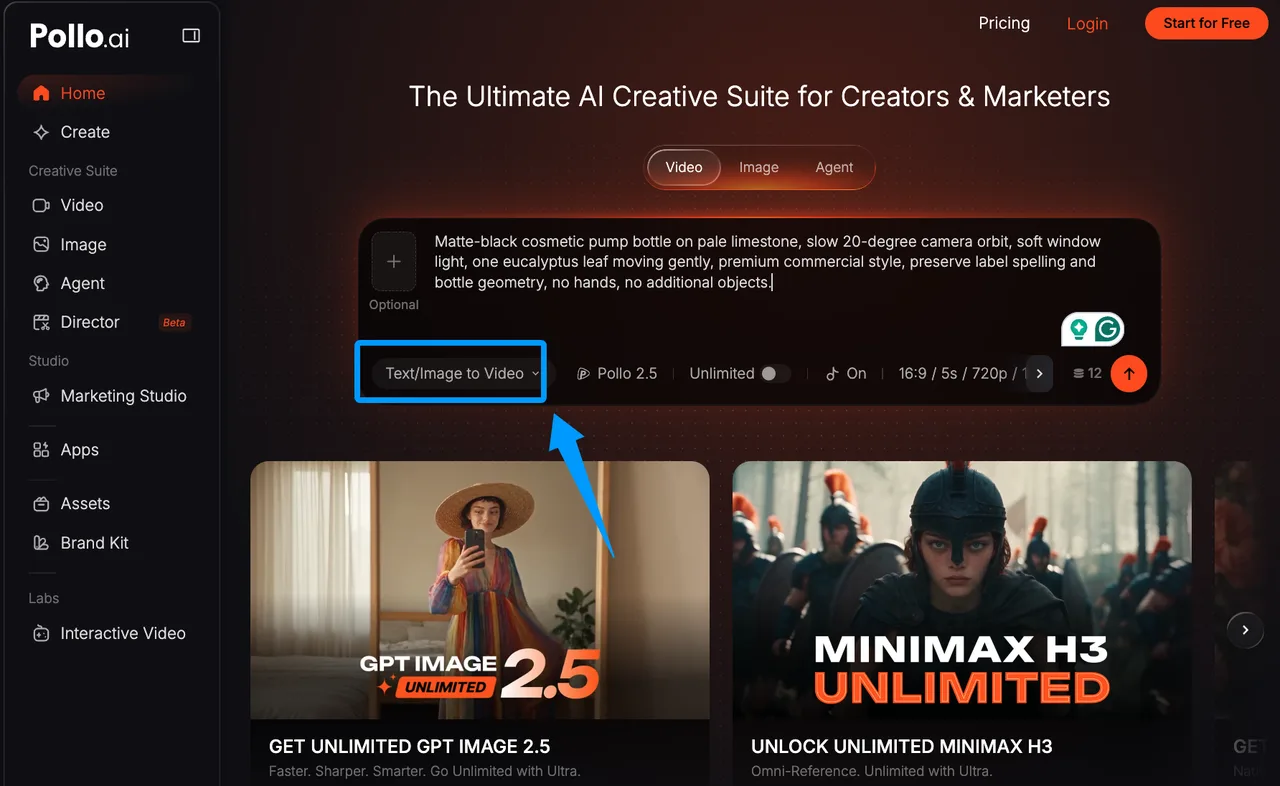
“Matte-black cosmetic pump bottle on pale limestone, slow 20-degree camera orbit, soft window light, one eucalyptus leaf moving gently, premium commercial style, preserve label spelling and bottle geometry, no hands, no additional objects.”
Each route receives the same five-second duration, 9:16 aspect ratio, 720p target, and output quantity. Prompt enhancement stays off when the route exposes that option. If a control is missing, the test log records the difference instead of silently substituting another setting.
The approval checklist requires recognizable packaging, readable label structure, stable bottle geometry, controlled camera movement, and no invented objects.
One Product Image Across Repeat Generations
For image-to-video, both models receive the same licensed PNG export. Its dimensions, color profile, orientation, file hash, and upload time go into the test sheet.
Each model gets three initial text-to-video attempts and three initial image-to-video attempts. Two rejected outputs are rerun without changing the prompt, creating eight attempts per model. This separates generation variance from prompt-rewriting skill.
A good single output does not mean the production workflow is ready. Repeated attempts reveal whether the product label, cap, shadow, and body proportions remain dependable.
Success, Retry, Latency, and Credit Tracking
The modeled ledger below demonstrates the required calculation. The 20- and 25-credit figures are placeholders—not published Pollo rates—because the public page does not provide a permanent model-by-model browser credit table.
| Route | Attempts | Approved clips | Acceptance retries | Median wait | Modeled credits used | Credits per approved clip |
|---|---|---|---|---|---|---|
| Pollo 2.5 | 8 | 5 | 2 | 2m 06s | 160 | 32 |
| MiniMax H3 | 8 | 6 | 2 | 3m 02s | 200 | 33.3 |
In this modeled batch, Pollo 2.5 finishes sooner but loses three clips to label deformation, an invented reflection, or excessive camera motion. MiniMax H3 produces six acceptable clips, with two rejections for package geometry and background movement.
A real test must also save every output, submission timestamp, completion timestamp, displayed credit quote, failed-job message, download format, and reviewer decision. Do not delete rejected clips; they explain where the money went.
Model Access and Workflow Quality

Model Choice, Settings, and Version Clarity
Pollo makes comparison convenient because models appear inside one interface. However, a familiar model name does not necessarily identify an immutable checkpoint. Browser labels may remain unchanged while a provider updates routing or weights.
For every production batch, capture the visible model name, page URL, date, input mode, resolution, duration, aspect ratio, seed if available, and all advanced settings. For API work, store the route slug and complete request body.
The practical advantage is fast switching. The weakness is version ambiguity: if the same prompt changes behavior next month, the browser label alone may not explain why.
Preview, Download, and Repeat-Generation Flow
The browser workflow is suitable for visual comparison: choose a model, submit, preview, download, and rerun without creating separate provider accounts. That reduces setup work for creative reviewers.
It does not remove production bookkeeping. Rename downloads immediately with model, attempt number, and status. Record the original output resolution rather than judging a scaled browser preview. A polished interface can shorten review time, but it cannot make an unstable model repeatable.
Output Consistency and Usable Cost
What Changes Across Models and Retries
The useful question is not “Which clip looks best?” It is “Which route changes the fewest protected details while completing the brief?”
In the modeled batch, Pollo 2.5 offers the faster iteration loop. MiniMax H3 returns one more approved clip and fewer packaging failures. Those observations are test-specific, not universal model rankings.
For social ideation, small variations may be acceptable. For product advertising, a distorted label or cap makes the entire clip unusable. Approval criteria therefore change the apparent winner even when the raw outputs look equally attractive.
Subscription Credits Versus Direct Provider Costs
Current Pollo AI pricing says credit consumption varies by model, duration, resolution, and output quantity. Subscription credits do not roll over, while eligible Pro users can purchase additional credits and add-on credits do not expire. Promotions and “Unlimited” access should be treated as dated plan conditions, not permanent model pricing.
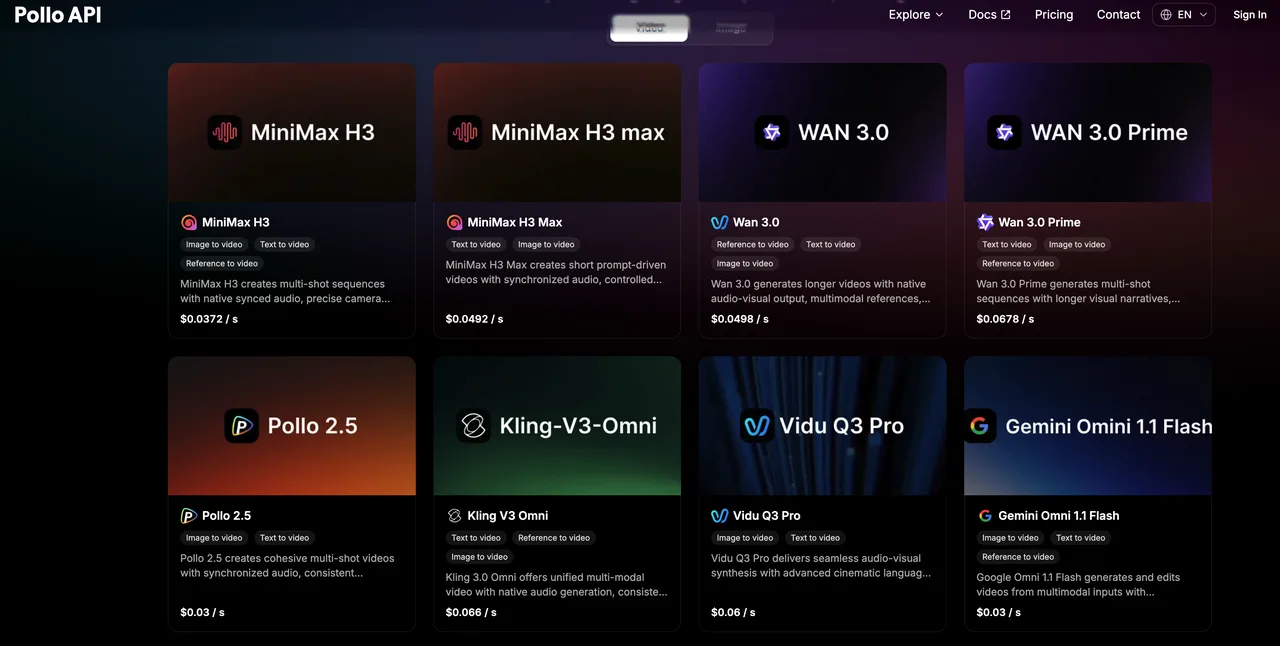 The separate Pollo AI API listed Pollo 2.5 at $0.03 per second and MiniMax H3 at $0.0372 per second when checked. A five-second starting-tier example is $0.15 for Pollo 2.5 at 720p/basic with audio off and $0.186 for MiniMax H3 at 480p. These are not matched-resolution costs. The current MiniMax H3 API table lists 768p at $0.0744 per second and does not list a 720p tier. Do not apply the 720p-target acceptance rates above to these starting prices; calculate cost per usable clip only after rerunning the API test at supported, recorded resolution and audio settings.
Cheap does not always mean cost-saving**.** Unusable generations are expensive. If a direct provider—or WaveSpeed, where MiniMax H3 routes are currently available—supports the same underlying model, compare matching duration, resolution, settings, retry policy, and review time. Do not assume another platform is automatically cheaper.
Who Should Use Pollo AI?
Teams Comparing Models Before Integration
Pollo AI fits teams that need to shortlist models before committing engineering resources. One account and a common review process make it easier to identify which model deserves a direct API evaluation.
Use it as a screening layer, then validate the selected model through the production endpoint you plan to deploy. Browser success does not guarantee identical API controls, versions, or latency.
High-Volume Creative Teams Using a Browser Workflow
Creative teams producing many short social variants may value the shared interface more than checkpoint-level control. Fast previews and repeat generation help reviewers test hooks and visual directions without managing several vendor dashboards.
High volume still requires naming conventions, acceptance rules, and credit monitoring. Otherwise, convenience merely makes waste happen faster.
Limitations and Trade-Offs
Aggregator Convenience Versus Direct API Control
An aggregator reduces account and integration overhead, but it adds another operational layer between your team and the model provider. Rate limits, safety filters, queue behavior, input handling, and version changes may differ from a direct integration.
The Pollo AI API provides unified authentication and asynchronous task handling, but teams with strict regional processing, version pinning, or incident-response requirements should confirm those controls in writing before launch.
Dynamic Model Lists, Promotions, and Plan Terms
Model availability, credit charges, discounts, and unlimited offers can change independently. Screenshot the checkout quote and model selector for every benchmark date.
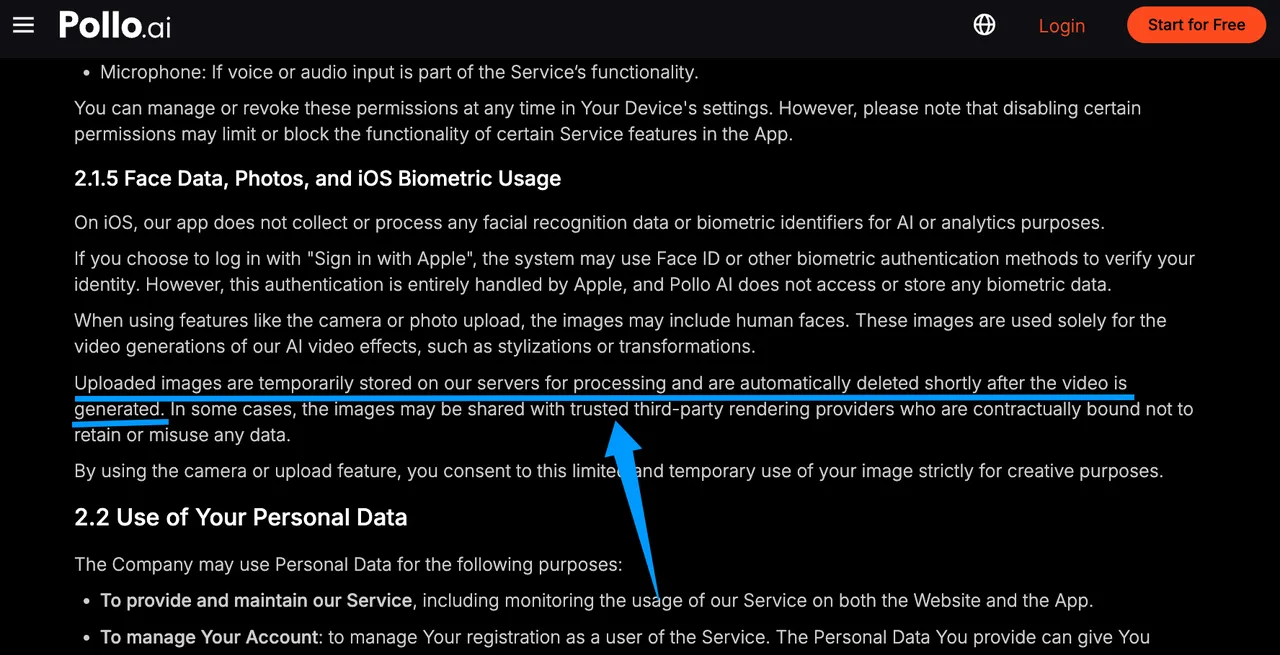
Pollo’s privacy policy says uploaded images are stored temporarily and automatically deleted shortly after generation, but it does not publish a precise deletion interval. It also says inputs may pass to selected third-party processors. Sensitive client assets therefore require a separate privacy and procurement review.
FAQ
Can teams share one Pollo AI workspace and credit pool?
Pollo advertises collaborative business workspaces with shared projects, assets, and generation history. Its public materials do not clearly confirm that standard subscriptions include a shared credit pool.
Teams should request the seat, permission, billing, and credit-allocation rules in writing. Do not share one personal login as a substitute for documented team access.
Does Pollo publish uptime history for its API?
No public incident-history archive was identified during this review. Pollo advertises 99.9% API uptime, but a marketing percentage is not the same as a historical status record or contractual SLA.
Production buyers should request availability definitions, maintenance notification procedures, and service-credit terms.
What retention controls apply to uploaded reference assets?
Pollo says images are temporarily stored and deleted shortly after generation, but no exact number of hours or days is stated. Some data may also be processed by the third-party model provider selected by the user.
For confidential assets, confirm deletion timing, backups, subprocessors, and account-deletion behavior before uploading.
Can developers configure webhook signing secrets?
Yes. Pollo’s API webhook console indicates that developers can add a secret key for signature verification. The generation schema also supports a webhook URL for success or failure callbacks.
Before production, verify the signature header, hashing algorithm, timestamp tolerance, replay protection, secret rotation, and retry behavior against the current documentation.
Which rights apply to outputs created with third-party models?
Pollo’s terms and conditions say users retain ownership of uploaded and generated content, while remaining responsible for sufficient rights and compliant use. Publicly shared content grants Pollo broader usage rights.
That does not automatically clear trademarks, likeness rights, copyrighted inputs, or conditions imposed by an underlying provider. This is general information, not legal advice; client-delivery rights should be reviewed against current Pollo and model-provider terms.
Conclusion
Pollo AI is most useful as a comparison and production-routing layer. Its strength is letting teams evaluate multiple video models through one browser or API relationship. Its trade-off is reduced certainty about model revisions, processing paths, and long-term pricing.
Run the matched test with live credits and exact model settings. Choose the route with the lowest cost per approved clip—not the most impressive isolated result.
Previous posts: