Lyria 3.5 vs Suno for AI Music Builders
Compare Lyria 3.5 vs Suno for one full-song product workflow across musical control, vocals, API access, rights, and task cost.
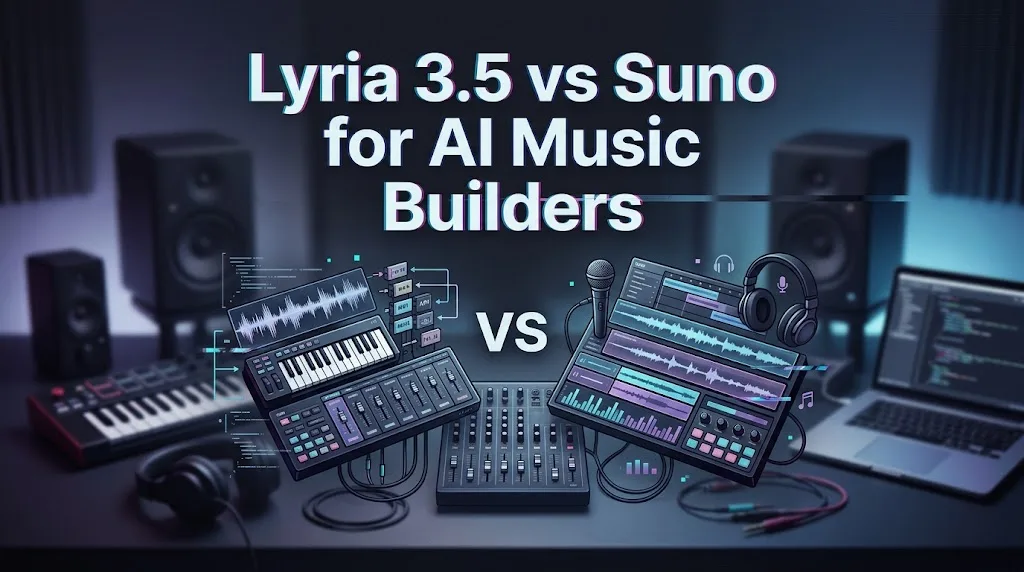
Hi, I’m Dora. This comparison can fail before either platform plays a note. One route begins with an API request; the other continues inside a creator workspace with editing and stems. Comparing only the prettiest export hides that difference.
For this Lyria 3.5 vs Suno decision, ask which route produces an acceptable full song with less engineering and editing work. No matched audio or logs were supplied, so this is a reproducible evaluation plan, not a hands-on result.
Quick Verdict by Music Workflow
Lyria 3.5 for Google’s model and API route
Choose Lyria when an application needs a direct path from text or images to a full song. Google’s lyria-3.5 accepts text plus up to ten images and produces 44.1 kHz stereo audio; MP3 is the default, with text output that can include lyrics and song-structure information. It supports supplied lyrics, instrumentals, section labels, and timing instructions.
Generation is single-turn, so a weak chorus requires regeneration or an external editor. Google’s music-generation guide documents this limit. Lyria is an API-first engine, not a workstation.
Suno for its current creator product workflow
Choose Suno when a creator needs to shape a song after generation. Suno v6 accepts text, audio, image, and video references and supports plain-language edits to sections or lyrics. Premier adds Studio, with MIDI, effects, automation, and multitrack work. The v6 documentation lists v6, v6-wild, and v6-mini.
Suno also offers an official REST API through Suno Platform. Do not assume every creator control exists there. Confirm its account-visible schema, quotas, models, and rights first.
Compare Three Decision Factors
Structure, vocals, and prompt control
Both are full-song generators, but control arrives differently.
| Decision point | Lyria 3.5 | Suno |
|---|---|---|
| Structure | Prompted sections and timing | Prompting plus product editing |
| AI vocals | Generated, supplied lyrics, or instrumental | Generated vocals, custom lyrics, Voices |
| Visual input | Up to ten images | Images and video in v6 |
| Revision | Regenerate or edit elsewhere | Edit sections and lyrics |
| Stems | Not documented | Paid stem separation |
Lyria’s request-response contract is easier to automate. Suno’s tools can reduce DAW reconstruction. That advantage belongs to the product workflow, not automatically to every API call.
API and product integration options
For an AI music API comparison, inspect authentication, job status, retries, retention, limits, and exports. Lyria uses the Gemini Interactions API and returns audio and lyric blocks. It remains Preview, without Batch API support or a documented dated snapshot.
Suno spans web, mobile, Studio, and API. This suits creator-led work but raises a state question: can a Studio project be reproduced through REST? Freeze one surface before measuring.
Rights, cost, and operational fit
Google currently prices Lyria 3.5 at $0.08 per full-song request with no free tier. Paid API content is not used to improve Google’s products, Google does not claim generated content, and tracks carry SynthID. Recheck official pricing at launch.
Suno uses subscriptions, generation credits, and download allowances. Its terms assign qualifying paid-tier outputs to the subscriber and permit commercial use of approved downloads; free outputs are non-commercial. Copyright protection is not guaranteed. Suno adds C2PA Content Credentials. The current terms control the grant.
Use workflow cost:
accepted-song cost = generation + retries + stems/downloads + operator time + mastering
Run One Matched Song Test
Use the same brief and duration target
Use text only so neither route gains an input advantage:
“Create a two-minute indie-pop song at 112 BPM in G major, with acoustic guitar, restrained drums, warm alto vocals, and intro, verse, chorus, second verse, chorus, bridge, and outro. Use supplied original lyrics. Do not imitate a named artist.”
Run five attempts per route. Freeze lyrics, duration, and acceptance rules. Save prompts, settings, model labels, files, latency, billed requests or credits, and retries. For Suno, record whether each output came from Create, Studio, or API.
Score usable output and editing effort
Score 0 to 2 for structure, lyric accuracy, vocal clarity, arrangement continuity, and audible defects. Accept at 8/10 with no rights or safety concern. Record editing minutes through export.
I paused here. A first-pass winner can lose when one broken chorus needs repair. Suno may allow a local edit; Lyria needs regeneration or outside work. Compare acceptance rate, median time, and cost per accepted song.
Limits and Trade-Offs
Product controls may not map to model capability
A stronger Studio result may come from editing tools or operator choices. A cleaner Lyria deployment may reflect API design. Score raw generation and workflow assistance separately.
Music rights and plans change over time
Archive the applicable terms, plan, model label, and pricing page with each release. This conclusion has an expiration date.
FAQ
Do both services support image prompts?
Yes. Lyria accepts up to ten images with text. Suno v6 accepts images alongside text, audio, or video. Conditioning strength may differ.
Can both platforms generate instrumental stems?
No. Lyria documents a mixed MP3 and lyrics, not stems. Suno offers paid post-generation stem separation, including supported modes with up to 12 stems.
Do both outputs include provenance markers?
Yes, differently. Lyria uses imperceptible SynthID. Suno uses C2PA Content Credentials. Verify that the marker survives transcoding and distribution.
Can enterprises request private processing?
Google says paid Gemini API content is not used for product improvement; guaranteed zero data retention points to Vertex AI. Suno’s privacy notice allows ordinary service content to improve products, while separate platform agreements may treat Suno as a processor. Obtain written enterprise terms.
Are model versions selectable on both services?
Not equivalently. Google exposes lyria-3.5 as Preview without a dated snapshot. Suno subscribers can select v6, v6-wild, or v6-mini, but retired models cannot create new iterations. A picker is not version pinning.
Conclusion
Lyria 3.5 vs Suno is a choice between operating models. Lyria fits API-first delivery, per-request accounting, and image-conditioned generation. Suno fits creator-led iteration, section edits, voices, stems, and Studio.
Route the same brief through both. Count accepted songs, retries, and editing minutes. The better route has the lower cost per approved track for this workflow, not the better demo.
Previous posts: