Muse Spark 1.3 Max Pricing and Task Cost
Explain Muse Spark 1.3 pricing through cost per completed agent task, including reasoning usage, retries, cache reads, and failed runs.
A cheap token rate can still produce an expensive agent. Tool loops, retries, failed edits, and human review often matter more than the first API call. This Muse Spark 1.3 pricing analysis focuses on one number: cost per completed agent task. Meta has not published a fixed Max task price, so builders must combine current rates with accepted-output data.
Current Muse Spark 1.3 Price Snapshot
Input, output, cache, and plan charges
Meta’s Muse Spark 1.3 model page lists two API routes. These rates were checked on September 10, 2026:
- Standard
muse-spark-1.3: $1.25 per million input tokens, $0.15 per million cached-input tokens, and $4.25 per million output tokens. - Contributor
muse-spark-1.3-contributor: $0.10 per million input tokens, $0.002 per million cached input tokens, and $0.20 per million output tokens.
Meta labels Contributor traffic as data used to improve its products. Standard traffic is labeled as not used for that purpose. The discount is tied to a different data-use boundary, not just volume. Check eligibility and privacy terms before routing company code through it.
The Meta Model API pricing page does not show a separate platform charge, cache-write fee, free allowance, or minimum commitment for these model rows. Account contracts may differ.
Muse Code pricing now includes monthly subscriptions. Meta’s August 31 plan announcement shows Everyday Usage at $5, High Usage at $15, and Power Usage at $50 per month. It describes request allowances, not token credits, and its graphic still names Muse Spark 1.2. Meta does not publicly convert these plans into a stated quantity of 1.3 Max usage.
What Max reasoning changes in usage
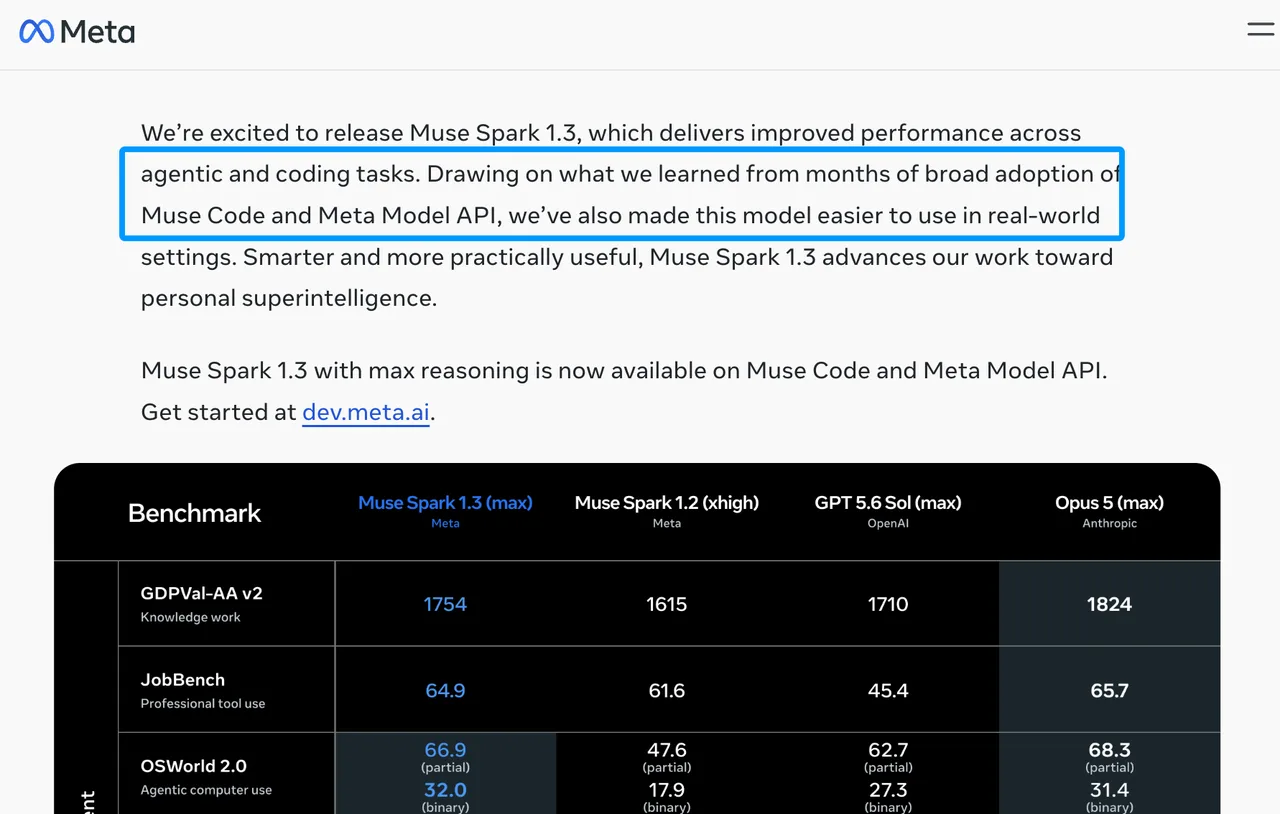
Meta confirms in its Muse Spark 1.3 announcement that Max reasoning is available in Muse Code and Model API. The public pricing row does not assign Max a separate rate, publish a standalone reasoning token cost, or disclose a fixed allowance. It also does not explain whether internal reasoning tokens appear as a separate billed field.
Max can still raise task cost through more output or tool cycles. Use your account’s billed usage and invoice as the source of truth. Same token rates do not guarantee the same task cost.
Calculate Cost per Completed Task
Tokens, tool loops, retries, and failures
Use a replaceable formula:
API attempt cost = (fresh input ÷ 1M × input rate) + (cached input ÷ 1M × cache rate) + (output ÷ 1M × output rate)
Then calculate the real unit:
Cost per completed task = (all attempt costs + tool fees + compute + storage + review labor) ÷ accepted tasks
Count failed attempts whenever they appear in usage records. Include repeated context after cache misses, retries after timeouts, and search or browser services billed outside Meta. A task that succeeds after two paid failures has three attempts.
“Accepted” means the result passed production tests and review. A polished answer that fails validation is still a cost event.
Compare high, xhigh, and Max on one workload
Use one repository task, harness, and stopping rule. Where the same surface exposes each option, run a meaningful sample at high, xhigh, and Max. Keep tool permissions, context construction, tests, and retries fixed.
Capture accepted tasks, fresh input, cache hits, output usage, tool calls, retries, wall time, and reviewer minutes. Meta reports that 1.3 used about 20% fewer tool calls and 25% fewer tokens than 1.2 in its own engineer comparisons. That vendor result does not establish the difference among reasoning levels on your workload.
Move up only when the extra accepted tasks or lower review effort exceed the added spend. This cannot be judged by feel. It needs a sample run.
Set a Practical Cost Guardrail

Cap turns, latency, and retry budget
Set maximum tool calls, wall-clock time, retries, output tokens, and external-tool spend. Stop when the remaining budget cannot fund another complete attempt.
Separate transport retries from model retries. A replay after a connection failure differs from asking the agent to redo a flawed solution. Log the reason so FinOps can distinguish infrastructure waste from model failure.
Escalate only the tasks that need Max
Start routine, reversible work at high or xhigh. Escalate after a defined trigger: repeated test failure, unresolved dependency conflict, long-context reconstruction, or costly review.
Do not automatically escalate a bloated session. Build a clean context, preserve verified evidence, and drop noisy tool output first. Cache savings apply only when reused input qualifies for Meta’s cached rate.
Limits and Trade-Offs
Token price alone does not predict task cost
Muse Spark Max cost depends on completion rate. Tool traces, paid searches, sandbox minutes, and review can dominate the API charge. Contributor pricing may be cheaper while creating an unacceptable data-use trade-off.
Rates and plan allowances can change
Model API remains in public preview. Recheck the official documentation, billing screen, model ID, and contract before each forecast. Date every calculator input; this September 10, 2026 snapshot is not a permanent rate card.
FAQ
Are canceled Muse Spark requests billed?
Meta does not publish a universal rule. Assume processed usage may be billable until account terms say otherwise, then verify with usage exports.
Do unused Muse Code credits expire?
The public plans describe request allowances, not transferable credits. Rollover and expiry terms are not disclosed; check the terms shown at checkout.
Are batch requests priced differently?
No batch-specific 1.3 rate was publicly listed on the verification date. Confirm any account-level batch offer before applying a discount.
Can enterprise customers set project spending limits?
Meta has not publicly documented project-level hard caps. Use application quotas, billing alerts, and an emergency disable path while confirming enterprise controls.
Which currencies appear on Meta Model API invoices?
Public rates use US dollars. Meta does not list every supported invoice or settlement currency; rely on the billing profile and contract.
Conclusion
Muse Spark 1.3 pricing is clear at the token level and unresolved at the Max task level. Standard and Contributor rates are public, but Max has no separate public fee or guaranteed cost per job. Measure a fixed workload, include failed attempts and operating expenses, then reserve Max for tasks whose higher completion rate justifies the spend.
Previous posts:
Related Articles

GPT Image 2.5 Review 2027: Quality, Editing, Speed, and Cost

GPT Image 2.5 vs GPT Image 2: Is It Worth Upgrading?

Grok Imagine Video Pricing and Cost per Clip
H3 Max Benchmark: Speed, Quality, and Prompt Tests
K2 Horizon Review 2027: What the Open Model Family Includes