MiniMax M3 Model: MSA, 1M Context & Multimodality
How MiniMax M3 works: MSA sparse attention, 1M context, native multimodality, and what it means for agent and coding workloads.
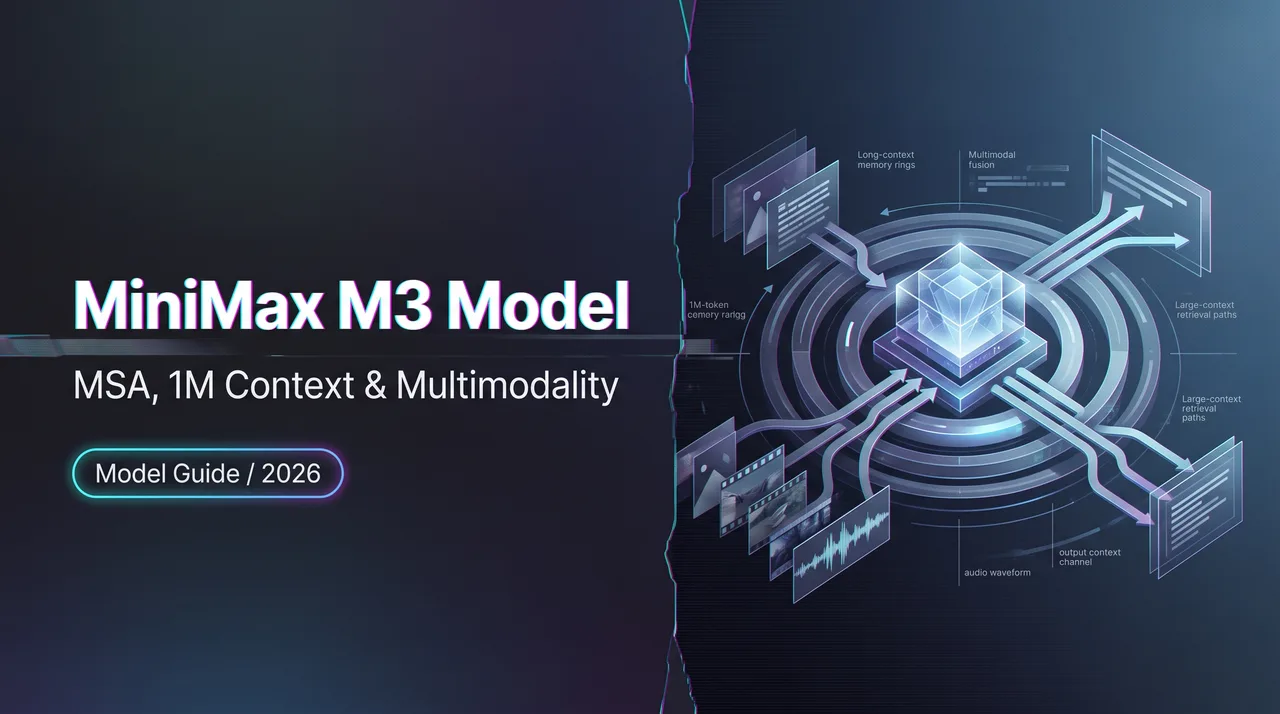
I looked at the MiniMax M3 model because the claim is unusually specific: coding, 1M context, and native multimodality in one open-weight model. That is not the same as “another big model with a longer prompt box.” For builders, the real question is simpler. Does the architecture change what can be built, or does it only make the launch page look heavier.
This note stays on architecture. Not pricing. Not API setup. The useful parts are MSA, long context, multimodal training, and the places where the model still does not look solved.
What Makes M3 Different
The MiniMax M3 release frames the model around three capabilities: coding and agentic work, up to 1M context, and native multimodality. MiniMax says M3 is the first open-weight model to combine those three in one system, according to its official M3 release post.
That is the positioning. The architecture question starts with attention.
MSA (MiniMax Sparse Attention) in plain terms
MSA stands for MiniMax Sparse Attention.
Plain version: instead of making every token attend to every other token in a huge context, MSA first finds the blocks of context that look relevant. Then the main attention computation focuses on those selected blocks.
That matters because full attention gets expensive fast. If context length doubles, full attention does not merely double. The attention cost grows roughly with the square of the sequence length. This is the old long-context wall. Everyone hits it eventually.
The MiniMax Sparse Attention paper describes MSA as blockwise sparse attention built on GQA. It uses a lightweight index branch to score key-value blocks, then a main branch to run exact block-sparse attention over selected blocks. Translation: it tries to avoid looking everywhere while still doing real attention on the parts it chooses.
I paused here. “Sparse” can mean lossy shortcuts. MSA’s pitch is different: sparse selection first, exact attention after selection. The risk moves into retrieval quality. If the index branch misses an important block, the model may not see the thing you expected it to use.
Why sparse attention enables 1M context
A 1M context window is not useful if it is too slow or too expensive to run.
MiniMax reports that, at 1M context, M3 reduces per-token compute to 1/20 of M2 and gets 9x faster prefill plus 15x faster decoding. Those are vendor-reported numbers. Good to know. Not the same as your workload.
The technical paper reports different measured speedups on a 109B research model: 14.2x prefill and 7.6x decoding on H800. This distinction matters. The research-model number validates the attention mechanism. The M3 launch number describes the production model family. Do not merge them into one clean sentence. That is how benchmark soup happens.
For builders, the practical change is this: long context becomes a budgetable design option. Repository-scale code review, long agent traces, multi-document analysis, and long-video understanding can fit into one working window more often.
Still, 1M context is not memory. It is a window. You still need retrieval, state, cache policy, and summarization for long-running systems.
Native Multimodality
The multimodal claim is not just “it accepts images.”
MiniMax says M3 went through mixed-modality training from step 0. That is the part worth noting.
Trained mixed-modality “from step 0”
A model can become multimodal in several ways. One way is to train a strong text model, then attach vision later. That can work. It can also feel like two systems taped together.
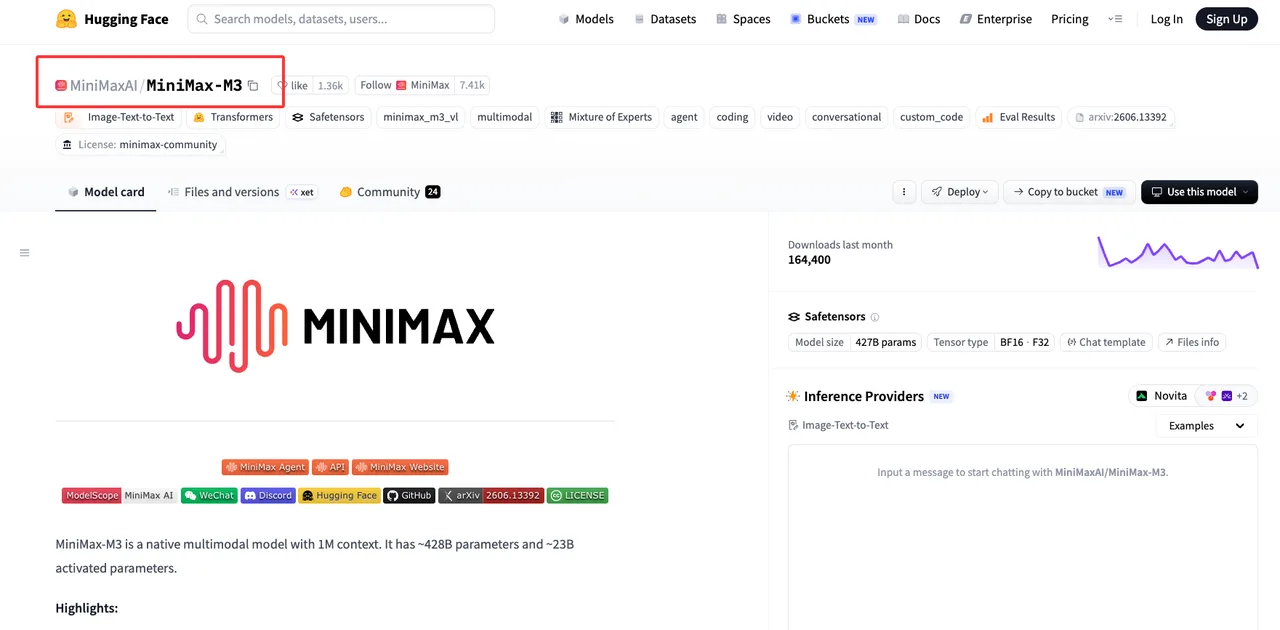
MiniMax describes M3 differently: text, image, and video are trained together from the beginning. The MiniMax-M3 model card says M3 uses mixed-modality training from the first step and lists roughly 428B total parameters with about 23B activated parameters.
So the current public answer to minimax m3 parameters is: about 428B total, about 23B active per token, based on the Hugging Face model card. NVIDIA lists 428B total and 22B active. Small discrepancy. I would write “about 22-23B active” unless MiniMax publishes a stricter number.
This is where my data ends. I found reliable public model-card numbers. I did not find a separate MiniMax blog section that explains every parameter-count detail.
Image/video input & long-video understanding
M3’s input modalities are text, image, and video. The practical implication is not “now it can caption images.” Smaller models already do that.
The useful implication is combined context. A long-video workflow may include frames, subtitles, scene descriptions, task instructions, prior edits, and tool logs. If those can sit in one context window, the model has fewer handoff points.
NVIDIA’s M3 deployment note describes M3 as a 428B MoE with video, image, and text input, 1M context, and native multimodal training across interleaved tokens. It also names long video understanding and extended coding sessions as target workloads.
That is the builder angle. Native multimodality is not only about perception quality. It reduces the glue code between text reasoning, visual grounding, and long-context agent state.
What This Enables for Builders
The best fit is not casual chat.
The best fit is long, messy work where context fragmentation usually hurts.
Long-range agent & coding tasks
M3 is shaped for long-range coding and agent workflows. MiniMax’s own examples include paper reproduction, CUDA kernel optimization, and model post-training loops. The numbers are vendor-reported, so I would not treat them as universal performance guarantees.
The pattern is still useful.
Long agent tasks produce logs. Coding tasks produce diffs, terminal output, test results, traces, and user corrections. A model with long context and sparse attention can keep more of that work visible without forcing every step through a retrieval layer.
That does not remove orchestration. It changes the pressure on orchestration.
A builder can try fewer forced summaries. Fewer “compress the last hour into 800 tokens” steps. Fewer moments where a model forgets a constraint because the working context was chopped too aggressively.
Good infrastructure makes you forget it is there. Long context helps when it makes fewer handoffs visible.
Where it still falls short (abstract reasoning)

The shortfall I would write plainly: I could not confirm a public M3 ARC-AGI-2 score. ARC Prize lists MiniMax M2.5 at 4.9%, while third-party coverage extrapolates this family-level weakness to M3.
Third-party launch coverage flagged MiniMax-family ARC-AGI-2 results as low single digits, and other developer summaries have described M3 as below 12%. I could not confirm a MiniMax-published M3 ARC-AGI-2 score in the official release materials. So I would phrase it carefully: reported below 12%, not vendor-confirmed in the sources I checked.
That is enough to affect decisions.
ARC-AGI-style tasks test novel pattern abstraction. They are not the same as coding with tool feedback. A model can be good at long-horizon engineering work and still lag on pure abstraction. The third-party M3 coverage makes the same basic point: strong agentic coder, not proven as a strong abstract reasoner.
So do not use minimax m3 ai as a generic “frontier reasoning” label. Use it where its architecture matches the job.
M3 in the Model Landscape
M3’s cleanest position is open-weight, long-context, native multimodal, coding-oriented.
That is a narrow sentence. Narrow is good.
Open-weight positioning vs closed frontier
Closed frontier models still matter. They often lead on abstract reasoning, polished instruction following, and managed product behavior. M3 is interesting because it brings more frontier-adjacent capabilities into the open-weight lane.
The minimax m3 benchmark story should not be reduced to a scoreboard. The more useful question is whether the model changes deployment choices. Open weights mean local or private deployment is possible in a way closed APIs do not allow. Long context means fewer external memory compromises. Native multimodality means fewer model switches between visual and text work.
There are tradeoffs.
Self-hosting M3 is not casual. A 428B MoE VLM is still a serious infrastructure object. Not every inference engine will expose the same MSA behavior, quantization path, video input support, or throughput. If the serving stack falls back to less efficient attention, the architectural advantage shrinks.
Run it yourself. That will tell you more than any launch chart.
FAQ
What is MSA (MiniMax Sparse Attention) and why does it matter?
MSA is MiniMax’s sparse attention design for long context. It scores context blocks first, selects relevant blocks, then runs attention over those blocks. It matters because full attention becomes too expensive at million-token scale.
How many parameters does MiniMax M3 actually have?
The public Hugging Face model card lists about 428B total parameters and about 23B activated parameters. NVIDIA lists 428B total and 22B active. I would write “428B total, about 22-23B active” unless a newer official MiniMax spec says otherwise.
Is MiniMax M3 truly native multimodal or just added later?
Based on MiniMax’s release materials and model card, M3 is described as mixed-modality trained from step 0. That means text, image, and video are part of the training design, not just a later connector bolted onto a text model.
What are MiniMax M3’s biggest weaknesses right now?
Abstract reasoning is the one I would name first. Reported ARC-AGI-2 performance is not publicly confirmed for M3 in the sources checked, and I did not find an official MiniMax-published score to replace that. Also, 1M context does not remove the need for memory architecture, retrieval, and evaluation.
How does MSA’s sparse attention differ from standard full attention?
Full attention compares every token against every other token. MSA narrows the work first by selecting relevant key-value blocks, then attends over that smaller set. The upside is lower compute at long context. The risk is selection quality.
Conclusion
The MiniMax M3 Model is interesting because its architecture matches a real builder problem: long, multimodal, agentic work is expensive to keep in one coherent state.
MSA makes 1M context more plausible. Native multimodal training makes image, video, and text feel less like separate pipelines. The open-weight positioning changes deployment conversations.
The boundary is just as important. M3 is not automatically the best abstract reasoner. It is not a memory system. It is not a pricing story or an API tutorial. This piece is only the architecture note.
Good enough. That is the most honest assessment I can give.
Previous posts:
Related Articles
Best AI Video Platforms for Production Teams in 2027

Best Sora 2 Alternatives for Video Teams in 2027
Lanta AI Review 2027: Best Uses, Pricing, and Limits
Sora 2 Review 2027: API Quality, Cost, and Limits
Build a GPT-6 Astra 3D Workflow With Blender Assets