Tripo AI Review 2027: 3D Quality, API, and Cost
Tripo AI review 2026 evaluates mesh quality, texture and export usability, API workflow, and cost per production-ready 3D asset.

A 3D asset can look convincing in a turntable preview and still fall apart when I open it in Blender. The front looks clean; the hidden side contains holes, the origin floats above the floor, and five materials point to the same baked texture. That is the production problem behind this Tripo AI review.
I’m John. I am testing whether two different inputs—a multi-view product reference and a text-defined character—can become editable, billable assets that an application can deliver through an API. This review does not revisit splats versus meshes.
What Tripo AI Is Built to Generate
Text, Image, and Multi-View Inputs
Tripo can start from a text prompt, one reference image, or several views of the same object. These inputs solve different problems.
Text-to-model is useful when the design can tolerate interpretation. A single image gives the model stronger information about one visible side, but hidden geometry still has to be inferred. Multi-view input reduces that uncertainty when the views agree on proportions and details.
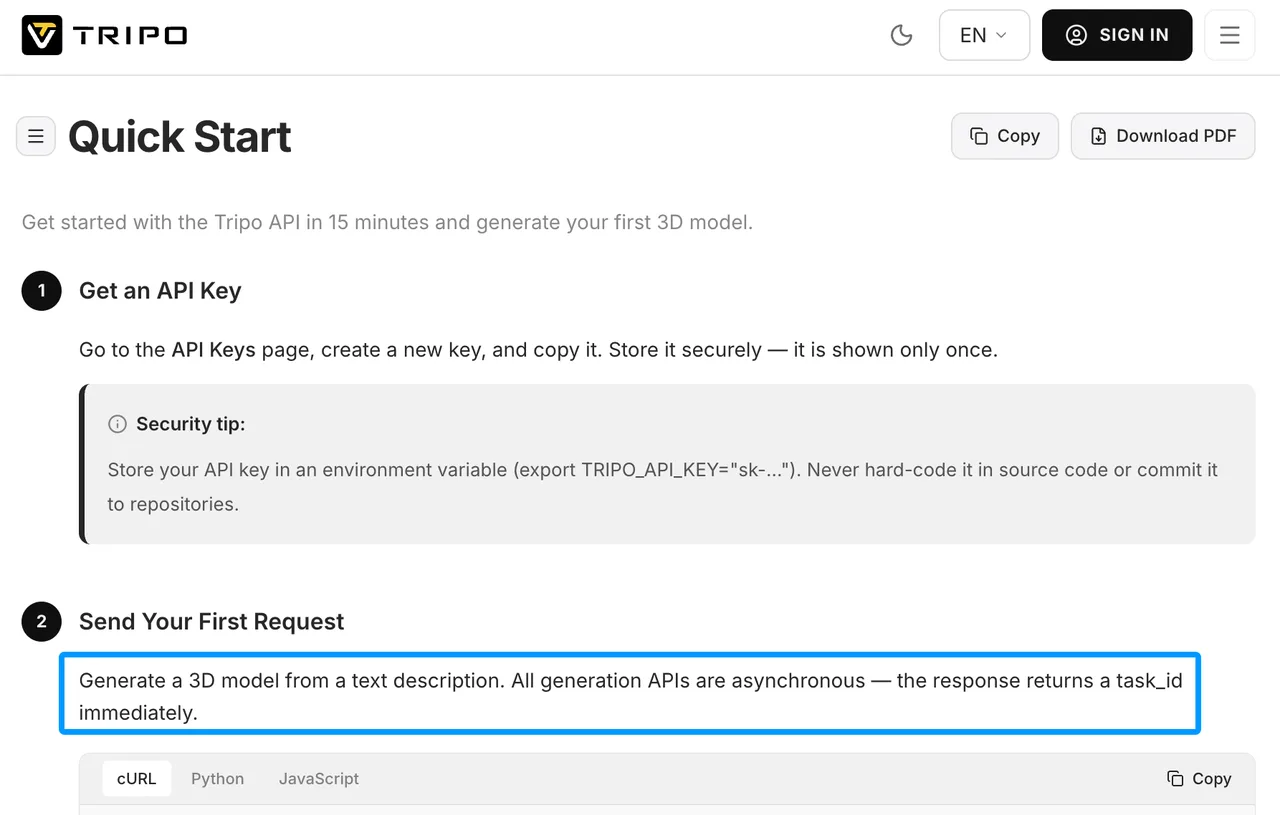
The current Tripo API quick start uses asynchronous generation. A request returns a task_id, which the client polls until the task succeeds, fails, is cancelled, or is banned. Its example pins v3.1-20260211, while production recipes also reference P1-20260311. Record the complete version string rather than writing “latest.”
The Difference Between a Draft and a Production Asset
A draft needs to look recognizable. A production asset must survive inspection.
For a web viewer, that means predictable orientation, acceptable file size, packed textures, and a sensible pivot. A game asset may also need controlled topology, UVs, separated parts, a riggable pose, and a polygon budget. A product configurator needs accurate proportions and material boundaries.
A good single output does not mean the production workflow is ready. The real acceptance point comes after import into Blender, Unity, Unreal, Three.js, or the application that will actually use the file.
How We Test Tripo AI
A Product Object With Clear Hard Surfaces
The first input is an original four-view reference set for a compact desktop speaker. The object measures 160 × 90 × 75 mm and includes a rectangular enclosure, circular dial, two ports, a recessed rear panel, and four feet.
I would run three multi-view generations with the same files and settings:
- Model:
v3.1-20260211 - Texture and PBR: enabled
- Texture quality: detailed
- Geometry target: hard-surface product visualization
- Export: GLB and Blender-compatible FBX
- Pivot: bottom center
- Reference dimensions: saved with the test record
The acceptance checklist covers silhouette, port placement, dial symmetry, rear-panel completion, flat contact surfaces, material separation, and scale after Blender import.
A Character With Texture and Topology Requirements
The second task is a text-defined stylized courier in a neutral pose. The prompt specifies separate boots, gloves, jacket, backpack, and helmet. It also sets a 10,000-face target and asks for clean deformation areas around the shoulders, elbows, hips, and knees.
This route uses P1-20260311, texture generation, and the same three-attempt policy. The asset passes only if the limbs remain separate, the pose is riggable, the texture does not paint missing geometry, and the mesh can be edited without rebuilding the whole character.
I also check whether the material slots describe useful regions or merely divide one baked appearance into arbitrary chunks. A detailed texture can hide poor topology during preview. Blender removes that disguise quickly.
Generation, Cleanup, Export, and Cost Measurements
This cannot be judged by feel. It needs a sample run.
For every attempt, retain the original files, prompt, request JSON, exact model version, task ID, timestamps, terminal status, reported credits, raw GLB, converted export, Blender inspection notes, and rejected-output reason. Internal task IDs should remain unredacted even if the published article hides them.
The following modeled ledger shows how the review should be calculated:
| Test asset | Attempts | Usable after inspection | Median generation | Credits used | Cleanup per usable asset |
|---|---|---|---|---|---|
| Multi-view speaker | 3 | 2 | 78 sec | 150 | 24 min |
| Text-defined character | 3 | 1 | 46 sec | 150 | 46 min |
In the modeled speaker batch, one output is rejected for softened ports and incomplete rear geometry. The other two need pivot, scale, normal, and material cleanup. For the character, two attempts fail the topology checklist because clothing and body regions merge in deformation areas.
These are workflow assumptions, not measured Tripo performance claims.
Geometry, Texture, and Editability
Shape Completeness and Hidden Surfaces
The front render is the least informative inspection angle. I rotate underneath the object, isolate every part, enable face orientation, and run Blender’s non-manifold selection.
For the speaker, the failure points are the rear recess, port interiors, feet, and the surface touching the floor. Multi-view references should reduce invention, but contradictory crops or lighting can still create false edges.
The character receives a similar inspection around the armpits, fingers, backpack straps, inner legs, and helmet opening. If the texture creates the appearance of a gap where no geometric separation exists, the asset is not ready for animation.
Topology, Materials, and Downstream Editing
Editability is not the same as polygon count. Ten thousand poorly distributed triangles can be harder to modify than a larger mesh with sensible loops and separate components.
I check:
- Non-manifold edges, internal faces, holes, and flipped normals
- Object origin, transforms, forward direction, and imported dimensions
- UV overlaps and texture resolution
- Number and naming of materials
- Edge flow around joints and hard-surface boundaries
- Whether small changes require local editing or full remeshing
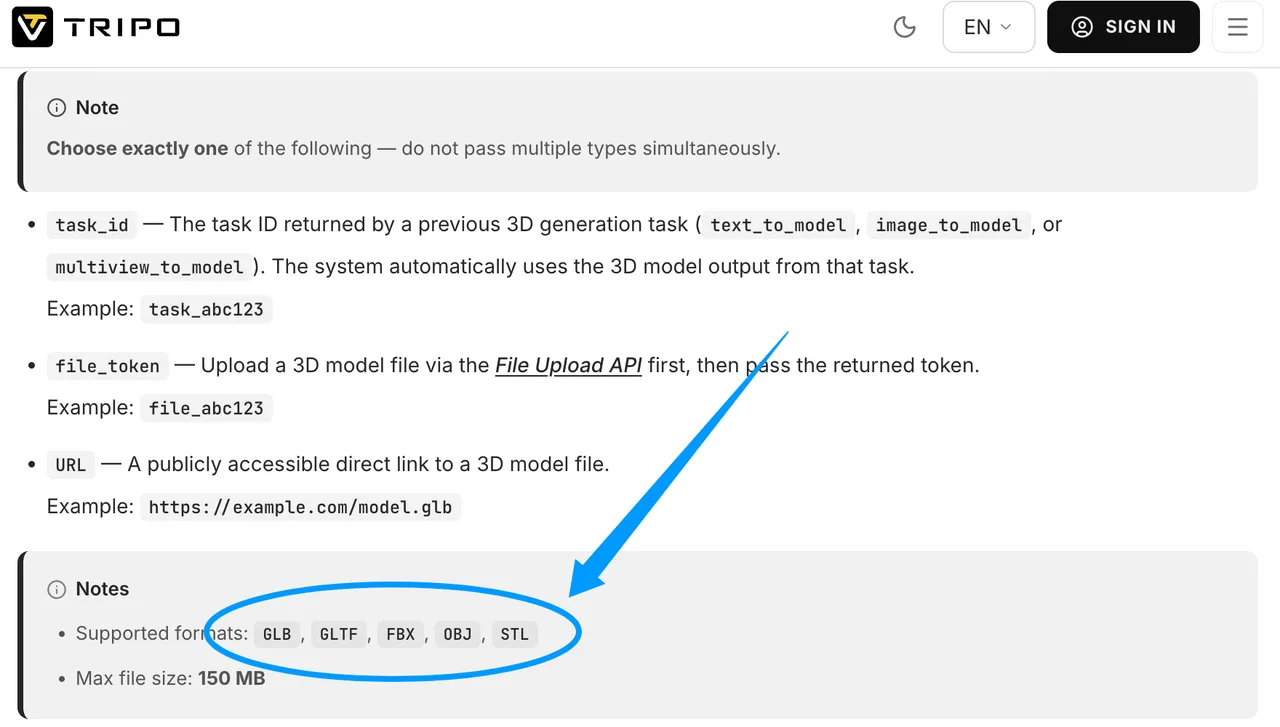
Tripo’s model conversion documentation lists GLTF, FBX, USDZ, OBJ, STL, and 3MF targets. It also exposes face limits, quad conversion, texture size and format, bottom flattening, pivot placement, scale factor, and export orientation. Those controls help, but conversion does not repair every structural error.
API Workflow and Operational Fit
Task Submission, Polling, Post-Processing, and Export
The Tripo AI API follows a job-based workflow:
- Upload or reference the source assets.
- Submit a text, image, or multi-view generation task.
- Store the returned
task_id. - Poll the task every one to two seconds.
- Stop on a terminal status.
- Download the output immediately.
- Submit separate conversion or post-processing tasks when required.
The quick start warns that generated model URLs expire after five minutes. Store the actual asset in your own controlled storage, not the temporary URL.
Post-processing also creates new tasks. Generation, conversion, rigging, mesh completion, and retargeting should therefore be represented as separate ledger entries connected by parent and child task IDs.
Failure Handling, Throughput, and Credit Reconciliation
Set a polling timeout and preserve the final error code. Do not create a duplicate job merely because one poll request timed out.
Current documentation describes a freeze-then-deduct model: credits are reserved when the task starts, consumed after success, and released after a failed or cancelled task. Your reconciliation process should still compare the pre-task balance, frozen balance, terminal status, and reported credit consumption.
Concurrency limits also matter. A prototype that submits two models manually tells you little about a catalog job containing 500 products. Queue time, rate-limit responses, retry backoff, and expired download links must be tested separately.
Cost per Usable 3D Asset
Generation Credits and Post-Processing Charges
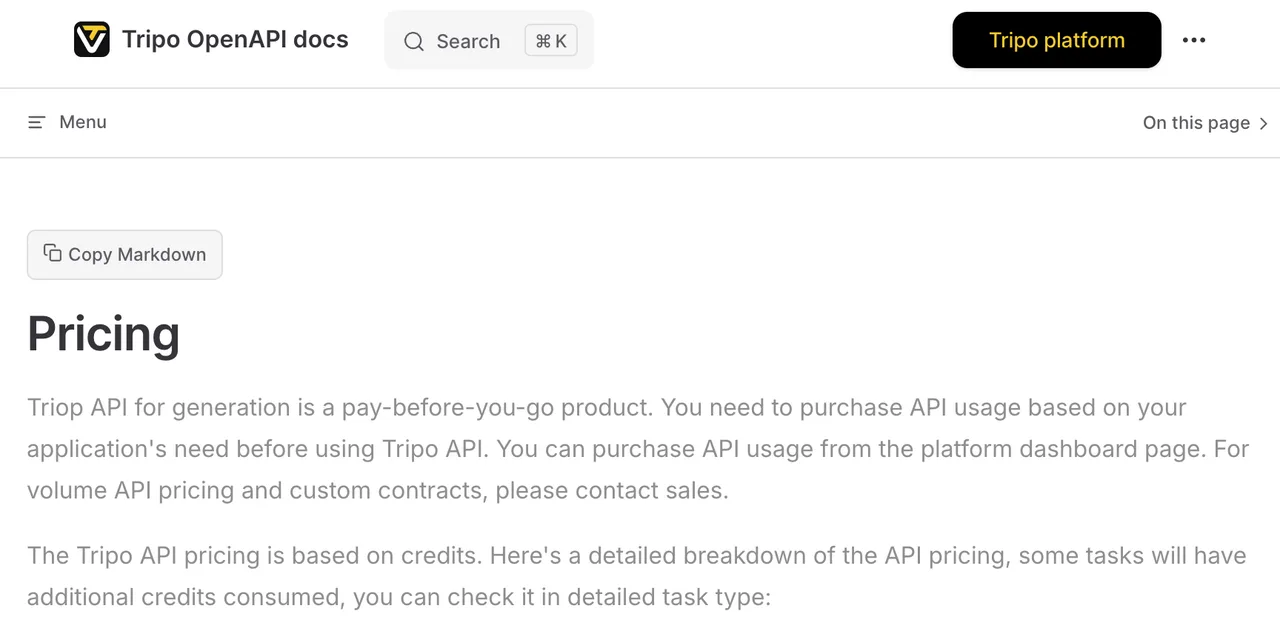
Current Tripo AI pricing uses credits, with a listed conversion of $1 per 100 credits.
The published table lists H2/H3 text-to-model at 10 credits without texture or 20 with texture. Image and multi-view generation cost 20 without texture or 30 with it. Detailed textures add 10 credits. The linked pricing table lists P1 generation at 30–50 credits for its shown configurations; the current P1 model page lists 30–60 credits when detailed texture is included, so verify the live P1 price before publication.
Format conversion starts at five credits. Options such as face limits, quad output, texture settings, pivot placement, or scale adjustment can add another five.
In the modeled test, each generation-plus-export path consumes 50 credits. Three attempts cost 150 credits, or $1.50. Two approved speaker assets produce an API cost of $0.75 each. One approved character makes the API cost $1.50.
The Cost of Manual Cleanup and Regeneration
The API charge is the small number in this workflow. Labor is the one that moves the budget.
At a $45 hourly production rate, 24 minutes of cleanup adds $18 to each accepted speaker. Forty-six minutes adds $34.50 to the character. Review time for rejected generations raises the total again.
The longer the rework path, the worse the cost looks. Track this formula:
Usable asset cost = all task charges + review labor + cleanup labor + export validation + failed handoff work
If every generated character requires manual retopology, regeneration may not be the main problem. The chosen task has crossed into traditional modeling work.
Limitations and Trade-Offs
When Tripo Speeds Up Prototyping
Tripo can shorten the first-draft stage for background props, concept objects, level blockouts, web previews, and early product visualization. It is especially useful when a developer needs a recognizable asset faster than a modeling queue can supply one.
The gain is larger when imperfections are cheap to fix and the asset is not responsible for precise mechanical fit, close-up deformation, or regulated product representation.
When Manual Modeling Remains Necessary
Manual work remains necessary for manufacturing dimensions, CAD-like assemblies, hero characters, facial animation, tightly controlled game topology, collision-sensitive objects, and assets that must match an approved product exactly.
Generated geometry can provide a starting shape. It should not be treated as engineering truth. For those jobs, a skilled modeler is still responsible for measurements, topology, UV strategy, materials, rigging, and final validation.
FAQ
Can Tripo outputs be redistributed inside paid products?
Paid users generally may use, modify, distribute, license, and commercially exploit their inputs and outputs under Tripo’s current terms. That can include embedding an asset in a paid game or application.
The permission does not clear third-party copyrights, trademarks, or likeness rights. It also does not permit exposing Tripo’s foundation-model service to third parties without authorization. This is general information, not legal advice.
Does Tripo retain uploaded references after task completion?
Yes, references may remain beyond task completion. Tripo’s data privacy guidance says assets remain in the user library while the account is active. Private data is removed after account deletion, while previously public inputs and outputs may be retained indefinitely.
An expiring download URL is not proof that the underlying reference or result has been deleted. Obtain written retention commitments for confidential client assets.
Are task IDs portable between different API accounts?
No public documentation confirms cross-account task portability. Task queries require authentication, so production systems should treat each ID as belonging to the account and region that created it.
To transfer work, download the completed file, preserve its metadata, and upload the artifact under the destination account. Do not use another account’s task ID as a storage strategy.
Does Tripo publish an API uptime SLA?
No public uptime SLA or historical status guarantee was identified in the reviewed documentation. Enterprise customers should request availability targets, maintenance notice periods, support response times, and service-credit terms in their contract.
A documented rate limit or concurrency allowance is not an uptime commitment.
Which coordinate system and unit scale do Tripo exports use?
The conversion API defaults to +X as the forward direction and allows +X, -X, +Y, or -Y. Its default scale_factor is 1, while pivot_to_center_bottom is optional.
The documentation does not establish one universal physical unit for every generated asset and export format. Import the file into Blender or the target engine, verify its dimensions and up axis, then apply a project-specific scale before delivery.
Conclusion
Tripo AI is useful when the required result is an editable starting asset, not an automatically finished model. Its API provides clear task IDs, versioned routes, post-processing, export controls, and credit reporting. Geometry acceptance still happens downstream.
For the next test, lock one model version and run three copies of each input. Save every task, open every export in Blender, and calculate cost only after the asset passes. That number—not the preview render—is the production answer.
Previous posts: