Hyper3D WorldGen Review 2027: From One Image to an Editable Scene
A hands-on Hyper3D WorldGen review testing scene geometry, object separation, editable exports, and where one-image 3D generation still fails.
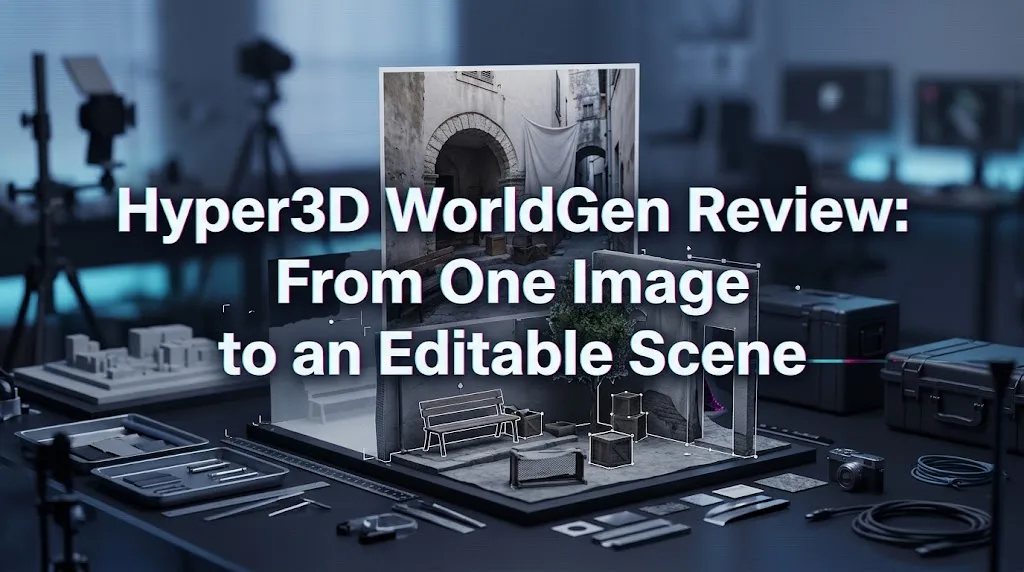
A generated room can look convincing until it opens in Blender. Then the chair is fused to the floor, the table has no back, and the “scene” is one mesh with excellent lighting. For this hyper3d worldgen review, the useful question is structural: can one image become a scene whose objects remain separate, positioned correctly, and editable downstream?
I could not access a complete WorldGen export package or repeatable production account. This is therefore a review of confirmed design claims plus a reproducible three-image evaluation, not a hands-on scorecard.
What Hyper3D WorldGen Is Built to Do
A Scene Workflow Rather Than a Single-Object Generator
According to the WorldGen launch announcement, users can upload one scene image, accept automatic object detection, or draw bounding boxes around selected objects. The system generates independent assets that can be moved, replaced, and edited.
That is the main distinction. Hyper3D WorldGen is intended to recover a composition, not merely produce one isolated model. Hyper3D says it estimates object position, scale, orientation, collision geometry, mass, friction, and relationships such as contact or support.
Its representation is hybrid. Editable objects become separate Rodin mesh assets, while background environments use 3D Gaussian splatting. This division may preserve visual context without turning every wall, tree, or distant facade into a production mesh. It also means “editable 3D scene” does not necessarily mean every visible pixel becomes editable geometry.
The Indoor, Street, and Multi-Object Test Set
Use three inputs with known dimensions and clear rights:
| Input | Objects to inspect | Primary failure risk |
|---|---|---|
| Indoor room | Sofa, table, lamp, wall, floor | Occluded backs and fused furniture |
| Street view | Bicycle, bollards, storefront, pavement | Depth compression and background mixing |
| Tabletop scene | Mug, books, bowl, small props | Incorrect count and object separation |
Save each original image, resolution, selection boxes, generation settings, completion time, retries, and exported files. Use the same rubric for all three. A polished preview is evidence of appearance, not scene structure. I paused here because those two are easy to confuse.
From One Image to an Editable Scene

Geometry Completeness and Hidden Surfaces
A single image contains no direct evidence for an object’s hidden side. WorldGen must infer it. “Complete geometry” therefore means plausible completion, not recovered ground truth.
The underlying CAST research paper describes object segmentation, relative-depth estimation, occlusion-aware geometry generation, pose alignment, and physics-aware correction. Its own examples acknowledge intersections and floating objects before correction. The published product may differ from the research system, so paper results cannot serve as WorldGen production measurements.
Rotate every generated object through 360 degrees. Inspect backs, undersides, thin structures, and contact surfaces. Record missing faces, sealed openings, duplicate geometry, non-manifold edges, and invented asymmetry. For the indoor scene, check whether the concealed side table remains a table rather than becoming a rounded block.
Object Separation and Spatial Relationships
Count source objects before generation, then compare that list with the exported scene hierarchy. A mug and its handle may become separate assets. A stack of books may collapse into one shape. Both results can look acceptable from the original camera.
Check each object’s origin, bounding box, scale, rotation, and parent relationship. Move the chair, bicycle, and mug independently. The surrounding scene must remain intact. Then disable one object at a time and inspect what was hidden beneath it.
CAST uses a relationship graph and Signed Distance Fields to reduce penetration and unsupported objects. That is a useful design direction, not proof of accurate physics. Estimated mass, friction, and collision geometry still need validation inside the target engine.
Export Structure and Downstream Editability
Hyper3D says WorldGen assets can enter Blender, Unity, PlayCanvas, Unreal Engine, and Tuanjie Engine. Public launch material does not specify a complete WorldGen export-format matrix, naming convention, hierarchy contract, or material packaging scheme.
Do not borrow Rodin’s single-object format list and present it as a WorldGen guarantee. After export, record:
- Number of mesh and splat nodes
- Object names and transform pivots
- Shared versus independent materials
- Texture paths and missing dependencies
- Collision objects and physical properties
- Import warnings in the chosen editor
Editability is demonstrated when a developer can select, transform, replace, and re-export one object without rebuilding the scene.
Where WorldGen Works and Where It Breaks
Input Conditions That Produce Usable Scenes
The strongest candidates have clear silhouettes, moderate occlusion, familiar objects, visible floor contact, and enough perspective cues to estimate depth. Scene blocking does not require perfect topology. It requires a composition that survives camera movement and remains easy to revise.
The indoor test is likely the fairest starting point. Furniture provides familiar scale and support relationships. The tabletop test stresses object count. The street scene is harder because distant geometry, reflections, vehicles, signs, and pedestrians compete for segmentation.
Common Failures in Crowded or Ambiguous Images
Expect trouble when objects overlap heavily, share similar colors, or have uncertain boundaries. Glass, reflective metal, fabric, foliage, cables, and thin furniture legs deserve separate inspection. SIGGRAPH’s CAST research summary identified textiles, glass, lighting, and background modeling as difficult areas. WorldGen may have improved them, but no matched public test establishes how much.
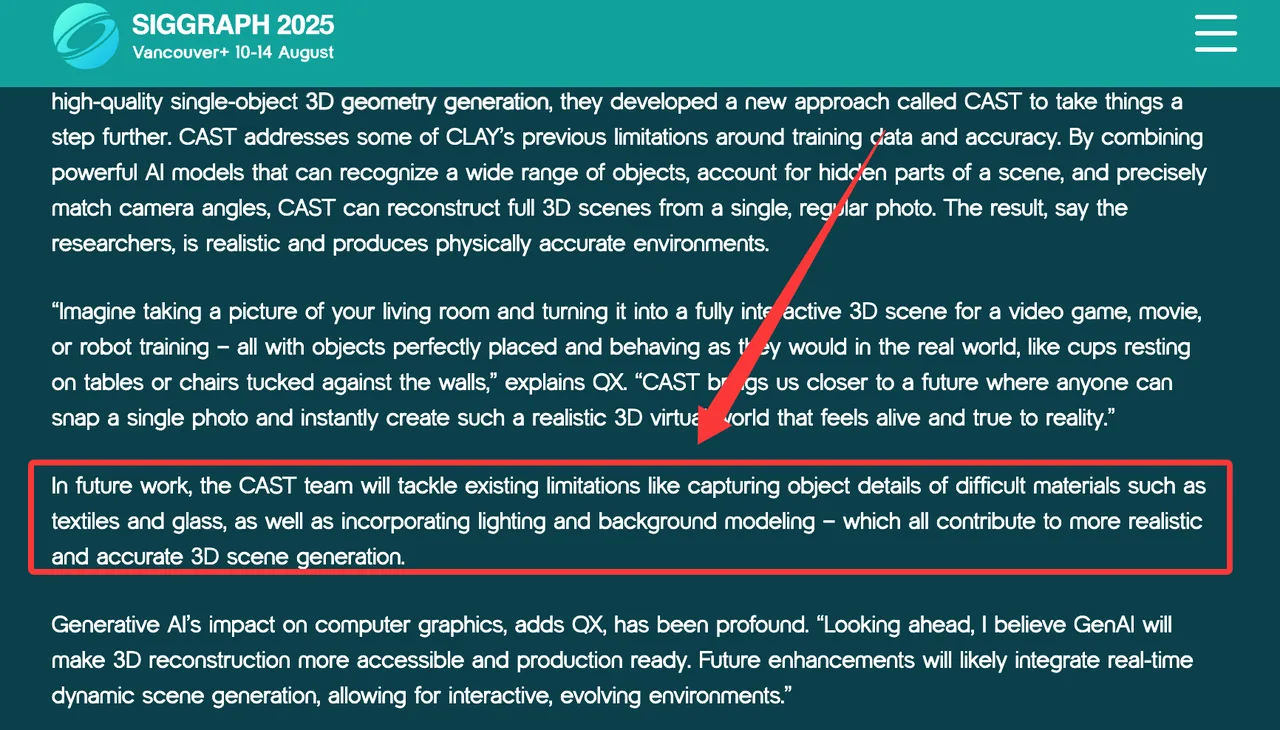
Other likely failures include incorrect scale, merged props, floating objects, mesh-background disagreement, and invented hidden surfaces. These are evaluation hypotheses until the three exports are inspected.
Is WorldGen Ready for a Production 3D Workflow?
Strong Fits for Prototyping and Scene Blocking
WorldGen fits previsualization, level blocking, camera planning, spatial mockups, and early simulation setup. Its value is reaching an editable arrangement faster than modeling every prop manually.
For an AI 3D workflow, measure time to a corrected scene, not generation time alone. Include retries, object cleanup, hierarchy repair, collision changes, and material replacement.
When Manual Modeling or Asset-by-Asset Generation Is Safer
Keep manual modeling for dimension-critical environments, hero assets, deformation-ready characters, certified simulation geometry, and scenes requiring controlled topology or UVs. Asset-by-asset generation is also safer when one object needs repeated art direction without disturbing the surrounding layout.
WorldGen is promising scene infrastructure. The official materials reviewed here do not yet establish a documented production contract for formats, batch operation, or partial regeneration.
FAQ
Can WorldGen preserve camera metadata from the source image?
In the public WorldGen materials reviewed for this article, I found no confirmation of preservation of EXIF data, focal length, sensor parameters, or an exported source-camera object. Verify camera intrinsics and transforms in the actual scene package.
Does WorldGen support batch processing for multiple scene images?
I found no public WorldGen batch API in the Hyper3D documentation reviewed for this article. Hyper3D’s available API documentation concerns Rodin asset generation and cannot confirm scene-level batching.
Can one failed object be regenerated without rebuilding the whole scene?
The launch states that objects can be edited and replaced, and bounding boxes can select objects. It does not document isolated regeneration that preserves every transform, relation, and scene identifier.
Which coordinate system is used in exported WorldGen scenes?
The public materials reviewed do not specify axis orientation, handedness, world units, or origin placement. Inspect these values after import before automating an engine pipeline.
Can generated WorldGen scenes be distributed commercially?

Hyper3D’s current terms tie export and commercial use to the applicable service, plan, source-image rights, and other restrictions. WorldGen is not separately named in the relevant output clause. Confirm the active plan and any WorldGen-specific conditions before distribution. This is general information, not legal advice.
Conclusion
My hyper3d worldgen review stops at a conditional verdict. The design addresses the right problem: object-aware image to 3D scene generation with editable foreground assets and preserved environmental context. Production readiness remains unproven until the exported hierarchy, hidden geometry, transforms, and licensing survive a real three-scene evaluation. Pretty renders are the beginning of that test, not the result.
Previous posts:
Related Articles

H3 Max Pricing: Cost per Usable Video Clip
H3 Max vs MiniMax H3: Speed, Output, and Access

Mercury Agent Review 2027: Provider-Agnostic Runtime Trade-Offs
FLUX 3 Video vs Seedance 2.5 for Production Workflows
Gemini Omni 1.1 vs Seedance 2.5 for Video Control