GPT Image 2.5 Review 2027: Quality, Editing, Speed, and Cost
GPT Image 2.5 review covering quality, editing, speed, cost, API access, and where Flare or Sunburst fits real image workflows.
Dora here. I started this GPT Image 2.5 review with four empty test folders: product image, text poster, transparent asset, and local edit. They stayed empty. The brief requires matched Flare and Sunburst runs with raw images, failures, timing, and API usage. I do not have an authorized run log containing those records.
Filling in a scoreboard anyway would make a cleaner article and a worse production decision. This review therefore covers what OpenAI currently documents, what the API exposes, and the test required before either model enters a real media pipeline.
Quick Verdict: Who Should Use GPT Image 2.5
GPT Image 2.5 is relevant to teams that generate enough images for latency, editing precision, and rejection rates to affect delivery. OpenAI splits the API family into Flare and Sunburst instead of presenting one universal model.
The choice is workload-specific:
| Workflow | Starting route | Reason |
|---|---|---|
| High-volume drafts and routine assets | Flare | OpenAI positions it as the faster everyday model |
| Precise edits and premium campaign assets | Sunburst | OpenAI positions it around editing precision |
| Interactive exploration | ChatGPT Images 2.5 | Easier visual iteration without building an API workflow |
| Production automation | Direct API or verified platform | Request-level controls, usage records, and routing |
| Sensitive brand consistency | Controlled three-model test | Vendor positioning is not an acceptance result |
Flare for fast, repeatable production work
The Flare model page calls it OpenAI’s fastest GPT Image model for high-quality everyday generation. That makes Flare the logical first candidate for catalog variants, social assets, concept drafts, and other repeated jobs.
“Fastest” is an OpenAI claim. It does not establish median or tail latency for a particular prompt, region, quality setting, or reference-image load. I would keep the claim in the shortlist and require measured latency before setting a production timeout.
Sunburst for precise edits and premium assets
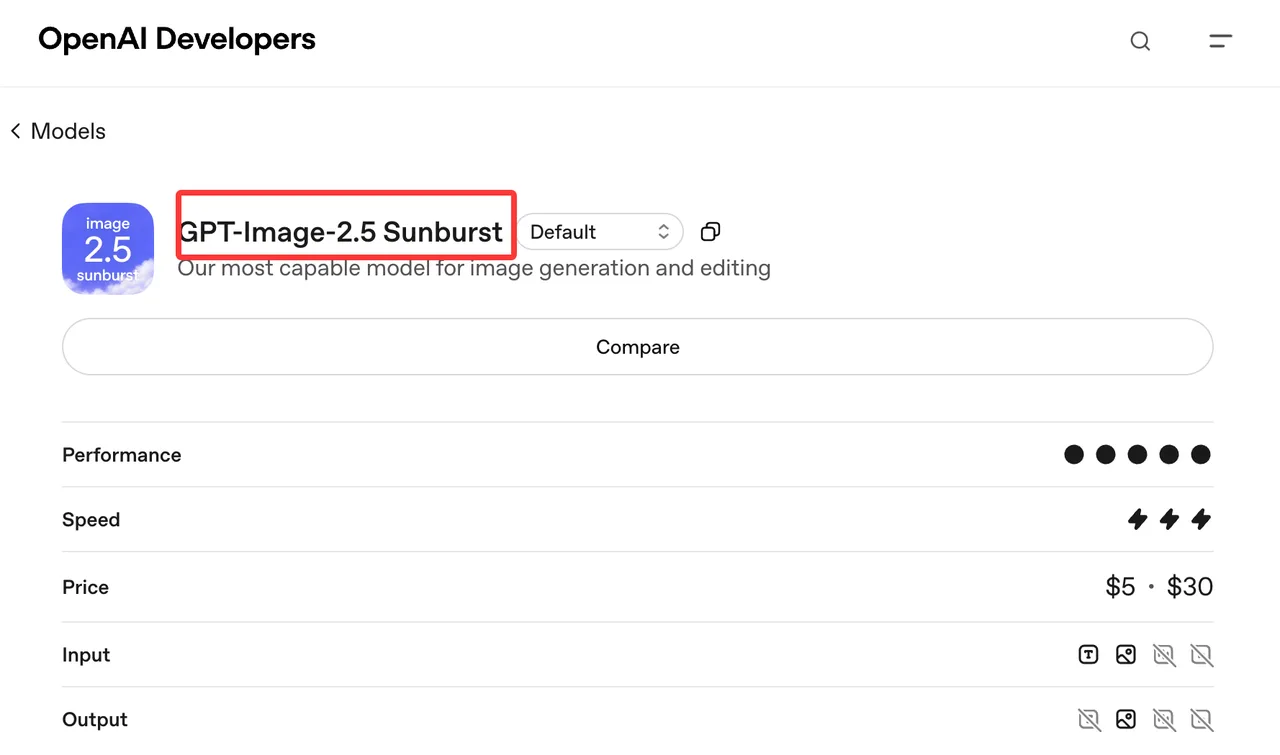
The Sunburst model page recommends it where editing precision matters most. That points toward product retouching, packaging preservation, local replacements, and final campaign assets.
A premium route only pays off when fewer rejected images or fewer editing rounds offset its processing time and token consumption. Without matched outputs, Sunburst has a positioning advantage, not a verified workflow advantage.
What GPT Image 2.5 Includes
ChatGPT Images 2.5 and the two API models
ChatGPT Images 2.5 is the interactive product surface. It fits conversational generation and visual revision. Its plan allowances are separate from API billing and API rate limits.
The API exposes two explicit model IDs:
gpt-image-2.5-flaregpt-image-2.5-sunburst
Both accept text and image inputs and return images. They can be called through the Image API or selected as the image-generation model inside a Responses API workflow.
This naming matters. “GPT Image 2.5” is the family. Flare and Sunburst are the production choices. Treating the family name as one fixed runtime hides the routing decision.
The practical difference between Flare and Sunburst
OpenAI describes Flare around speed and repeatable everyday work. Sunburst is described around capability and precise editing. Both support low, medium, high, xhigh, max, and auto quality settings.
The official image-generation guide also permits custom dimensions. Each edge must be a multiple of 16, neither edge can exceed 3,840 pixels, and total area is capped at 8,294,400 pixels. Resolutions above 2560 × 1440 are experimental. A “GPT Image 2.5 4K” workflow therefore needs its own failure and compatibility checks.
How GPT Image 2.5 Should Be Tested
Choose ChatGPT, the direct API, or a verified model platform
Use ChatGPT for interactive art direction. Use the direct GPT Image 2.5 API when exact model IDs, usage fields, snapshots, and data controls matter.
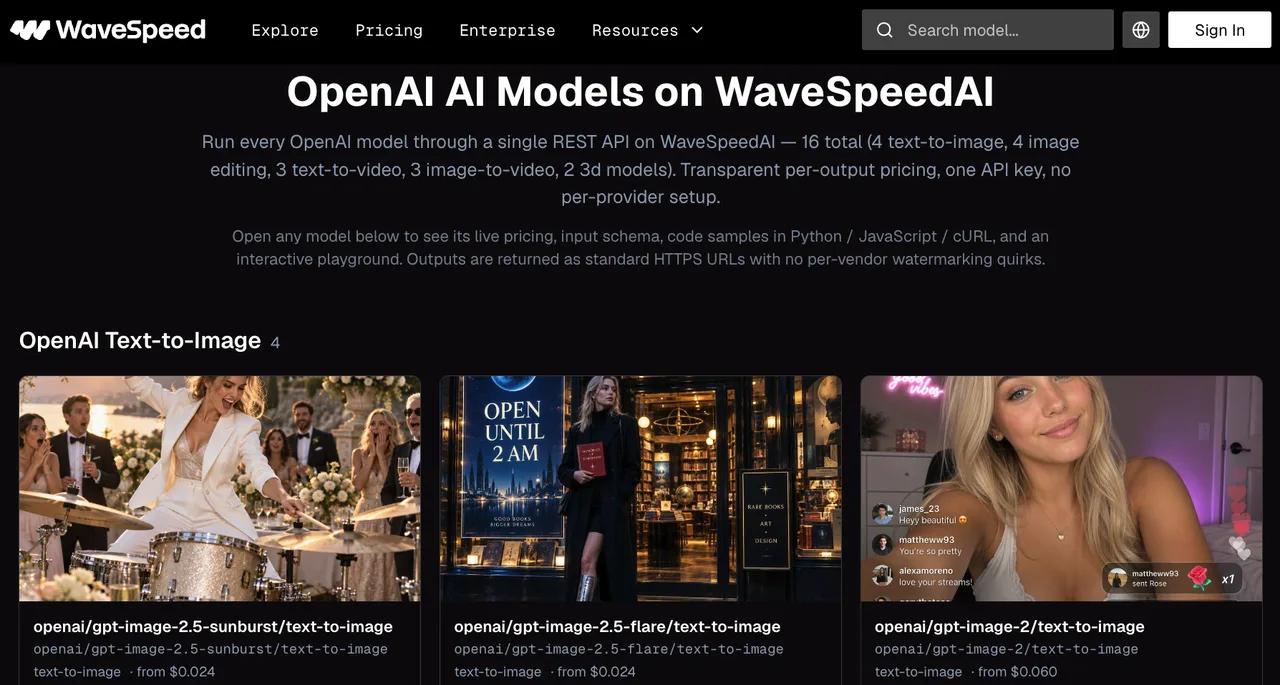
A model platform can provide one API surface across several image engines. The WaveSpeed model directory listed Flare and Sunburst generation and editing endpoints when checked on September 10, 2026. That confirms platform availability, not an OpenAI-native integration or an independent quality result. Platform pricing, schemas, retention, and failure handling need separate verification.
Understand free access and paid production use
Consumer access inside ChatGPT must not be converted into an assumed API allowance. The API model pages mark the Free tier as unsupported.
Paid API work is token-based. Inputs include prompt text and reference-image tokens. Outputs consume image tokens. Streaming partial images add another 100 output tokens each. The invoice is attached to API usage, not to the number of PNG files a reviewer accepts.
How We Tested GPT Image 2.5
No completed test is reported here. The material available for this article does not contain raw outputs or request logs. The method below is the minimum test pack I would accept.
Fixed prompts, references, settings, and repeat counts
Run four tasks on both models:
- A fixed product photograph with background replacement and transparent output.
- A poster containing an exact headline, price, date, and call to action.
- A multi-reference composition with one product reference and one style reference.
- Five consecutive local edits where each turn changes one named region.
Freeze the prompt, references, dimensions, output format, background mode, quality, and partial_images setting. Run each task five times per model. Do not compare Flare at medium against Sunburst at max. That tests settings, not models.
Store the request body, model ID, region, timestamps, response usage, output hash, error code, and moderation stage. Keep rejected images. Deleting the bad ones makes the model look oddly competent.
Usable-output criteria, failures, latency, and cost tracking
Define acceptance before opening the outputs:
- Required text is character-perfect.
- Product geometry, logo, and color stay within approved tolerances.
- Transparent files contain a usable alpha channel.
- Unrequested areas remain materially unchanged.
- The fifth edit still matches the original subject and composition.
- The asset needs no more than the allowed manual repair time.
Measure submission-to-first-partial latency and submission-to-final latency separately. Label moderation blocks, invalid requests, timeouts, malformed files, and creative rejection as different failure classes. One retry counter is too blunt.
Image Quality and Editing Capabilities

There are no defensible head-to-head results without the test pack above. The sections below describe what to inspect, not what Flare or Sunburst “won.”
Product images and transparent backgrounds
Set background: "transparent" and return PNG or WebP. Check the alpha channel rather than trusting a checkerboard preview.
For product work, inspect silhouette edges, reflective surfaces, printed labels, proportions, and untouched regions. A visually attractive bottle with altered label spacing is still a failed product asset.
Posters with embedded text
Use a fixed poster containing mixed font sizes, punctuation, a date, and a price. Score exact characters, placement, hierarchy, and repeated text.
OpenAI says text rendering has improved but can still struggle with placement and clarity. “Looks readable” is not enough when a legal line, discount, or event date changes meaning after one character error.
Reference fidelity and visual consistency
The API supports one or more reference images. Give each reference one role: subject, material, layout, or style. Mixing all roles into one instruction makes failure attribution difficult.
Record identity changes, missing accessories, color drift, altered logos, and composition movement. Compare all five repeats together. A single strong GPT Image 2.5 example says little about production variance.
Multi-turn local edits and accumulated drift
Change one element per turn. Preserve everything else explicitly. Save every intermediate image.
Measure drift from the original, not only from the previous turn. Small changes can accumulate until the fifth output no longer matches the initial product, person, or layout. If drift crosses the acceptance threshold, restart from the last approved image rather than continuing the conversation.
Speed and Cost per Usable Image
Generation latency across Flare and Sunburst
OpenAI positions Flare as the speed route, but the guide warns that complex prompts may take up to two minutes. Record p50, p95, and timeout rate for each task and quality tier.
Partial images improve perceived responsiveness. They do not shorten final completion automatically, and they are not free. Two streamed partials add 200 output tokens to that request.
Token usage, retries, and accepted-asset cost
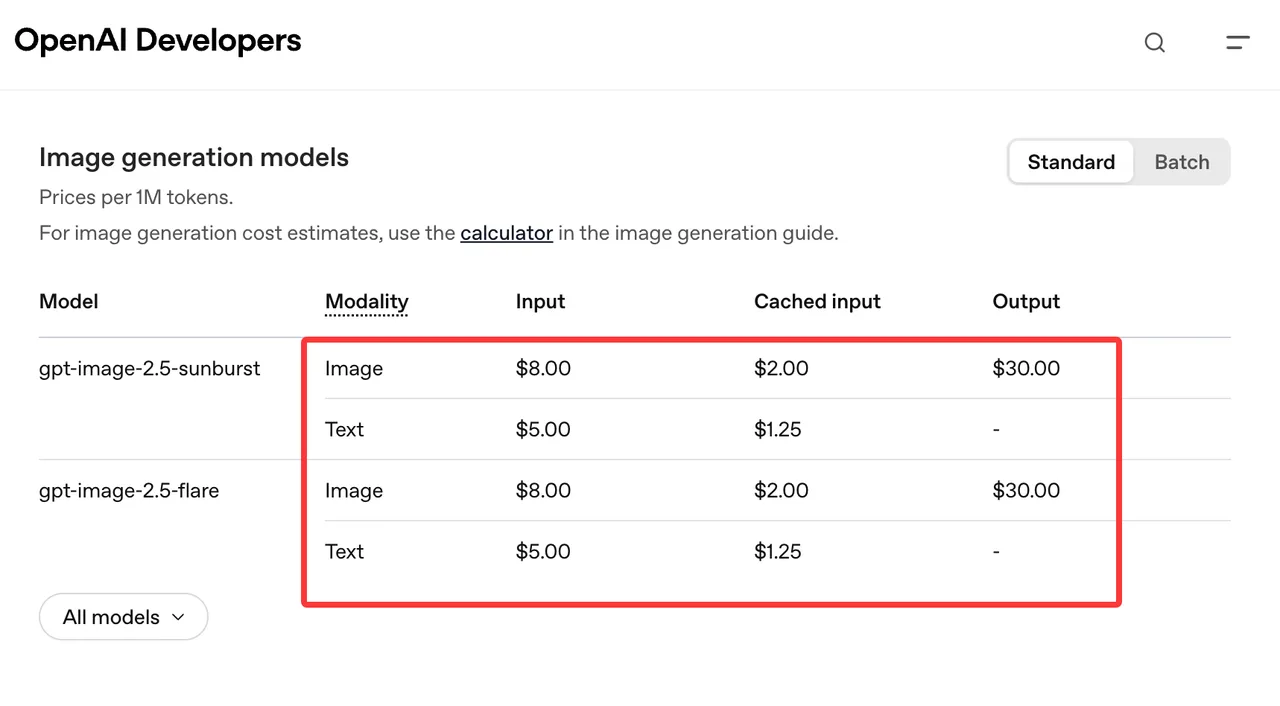
The current API pricing page lists Flare and Sunburst at $5 per million text-input tokens, $1.25 cached, $8 per million image-input tokens, $2 cached, and $30 per million image-output tokens.
Calculate:
Accepted-asset cost = total input, output, partial-image, retry, and rejected-output charges ÷ accepted assets
Flare and Sunburst share listed token rates, but may consume different token counts. Equal rates do not mean equal per-image cost.
I found one documentation inconsistency. The model pages say their rates match GPT Image 2, while the dated pricing table currently lists lower GPT Image 2 rates. This didn’t match the documentation. Use invoice-visible usage and the current pricing table for budget approval.
Limits and Production Trade-Offs
Rate limits, model snapshots, and fallback planning
Both model pages list 100,000 TPM and five images per minute at Tier 1, rising by usage tier. Actual organization limits remain the controlling value.
Pin gpt-image-2.5-flare-2026-09-08 or gpt-image-2.5-sunburst-2026-09-08 during evaluation. Keep the undated alias out of a controlled comparison. A silent model update ruins the baseline.
Where a second image model still reduces risk
A second model helps when the primary route fails repeatedly on typography, a specific visual style, transparent edges, or reference preservation. It also covers quota exhaustion and provider incidents.
Fallback output still needs the same acceptance checks. Availability without comparable quality is only partial recovery.
Final Recommendation by Workflow
Use Flare as the first production candidate for high-volume, latency-sensitive work. Route precision edits and premium final assets to Sunburst only after it proves a higher usable rate on the same inputs.
Keep another image model for known weak cases and operational fallback. Use ChatGPT for interactive direction, the direct API for controlled production, and a verified platform when cross-model routing reduces operational work.
No unconditional winner. The accepted-asset ledger decides.
FAQ
Does GPT Image 2.5 support zero data retention for API inputs?
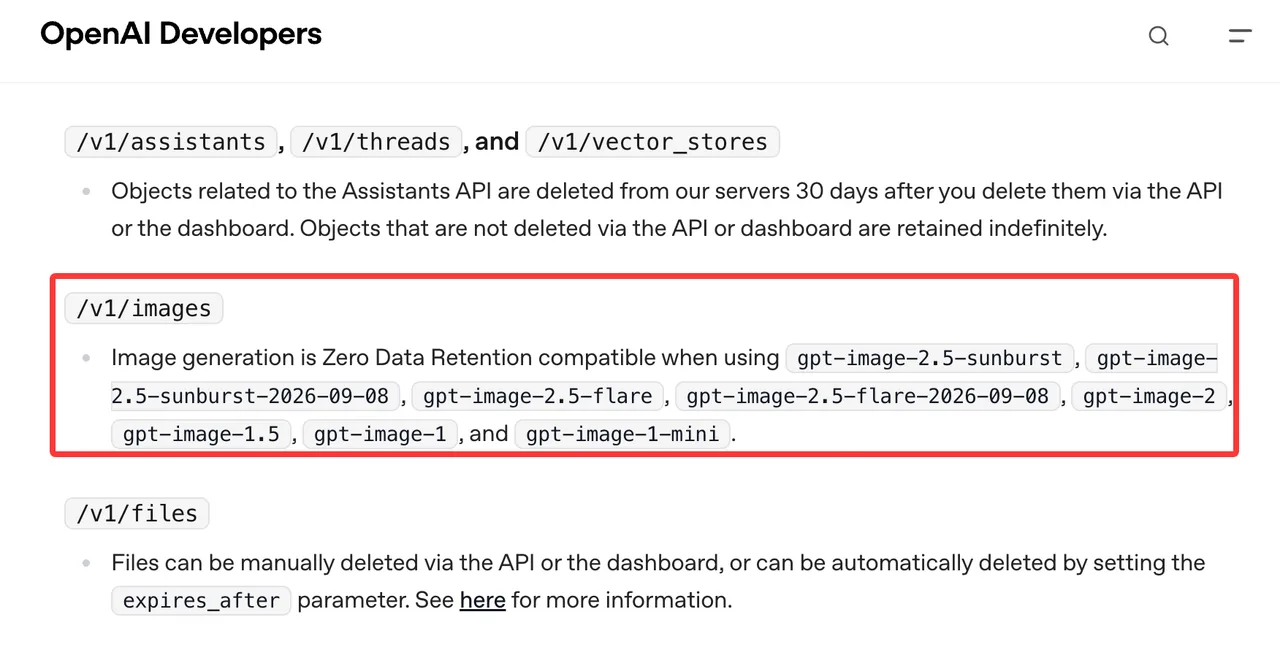
Yes, for approved customers using eligible configurations. OpenAI’s data-controls documentation lists both Flare and Sunburst, including their September 8 snapshots, as Zero Data Retention compatible on /v1/images. Image inputs may still be retained for manual review when safety classifiers detect potential CSAM content.
How are moderated or failed GPT Image 2.5 requests billed?
OpenAI documents input-stage and output-stage moderation blocks but does not publish one rule saying every blocked or failed request is free. An output-stage block may occur after generation work. Record returned usage and reconcile it with the Costs API. Do not infer billing from the HTTP status alone.
Can one GPT Image 2.5 request include multiple reference images?
Yes. The image guide supports one or more reference images and demonstrates four in one request. Published limits can differ by endpoint and platform, so validate the current schema before fixing an application-level maximum.
Are Flare and Sunburst available through the Batch API?
Their model pages list the Batch endpoint as supported. Confirm the accepted Image or Responses endpoint, completion window, file format, and current Batch pricing before moving production traffic. Endpoint support does not prove that every interactive feature behaves identically in Batch.
What commercial-use terms apply to GPT Image 2.5 outputs?
Commercial rights come from the applicable OpenAI services agreement, not from the model card. Teams remain responsible for rights in prompts and reference images, plus trademarks, publicity rights, and other third-party claims. Generated output may not be unique. Legal review still applies to campaign and product assets.
Conclusion
This GPT Image 2.5 review supports a conditional rollout, not a blanket switch. Start with Flare for repeated work. Promote selected precision tasks to Sunburst. Keep a fallback model and judge both by accepted-asset cost, drift, failures, and measured latency. This is where my data ends. The missing run pack is also the next piece that matters.
Previous posts:
Related Articles
GPT Image 2.5 vs GPT Image 2: Is It Worth Upgrading?

Grok Imagine Video Pricing and Cost per Clip
H3 Max Benchmark: Speed, Quality, and Prompt Tests
K2 Horizon Review 2027: What the Open Model Family Includes
Muse Spark 1.3 Max Pricing and Task Cost