K2 Horizon Review 2027: What the Open Model Family Includes
K2 Horizon review of the current model family, released checkpoints, and access routes that AI builders can verify today.
Treating K2 Horizon as one model is how a platform team evaluates the wrong artifact. This K2 Horizon review is an official-evidence inventory as of September 10, 2026, not a hands-on benchmark. Its six named sizes do not share identical release completeness or hosted access. Pick one checkpoint that fits a real deployment boundary, then run a pinned pilot.
What K2 Horizon Includes Today

Dense, MoE, and compact checkpoints
The IFM launch post names six principal models. The 375B-A23B checkpoint is a sparse mixture-of-experts model with about 23B active parameters per token. The 36B-A4B checkpoint combines MoE layers with IFM’s Mixture-of-Value-Attention design and activates about 4B parameters.
The dense line contains 32B, 7B, 3.7B, and 0.9B checkpoints. IFM positions the compact models for constrained devices, the middle sizes for local serving, and 375B-A23B for larger deployments. The 0.9B card lists 128K context; the other principal cards list 512K. These are checkpoint limits, not guaranteed useful context under every memory budget.
Model cards, repositories, and current artifacts
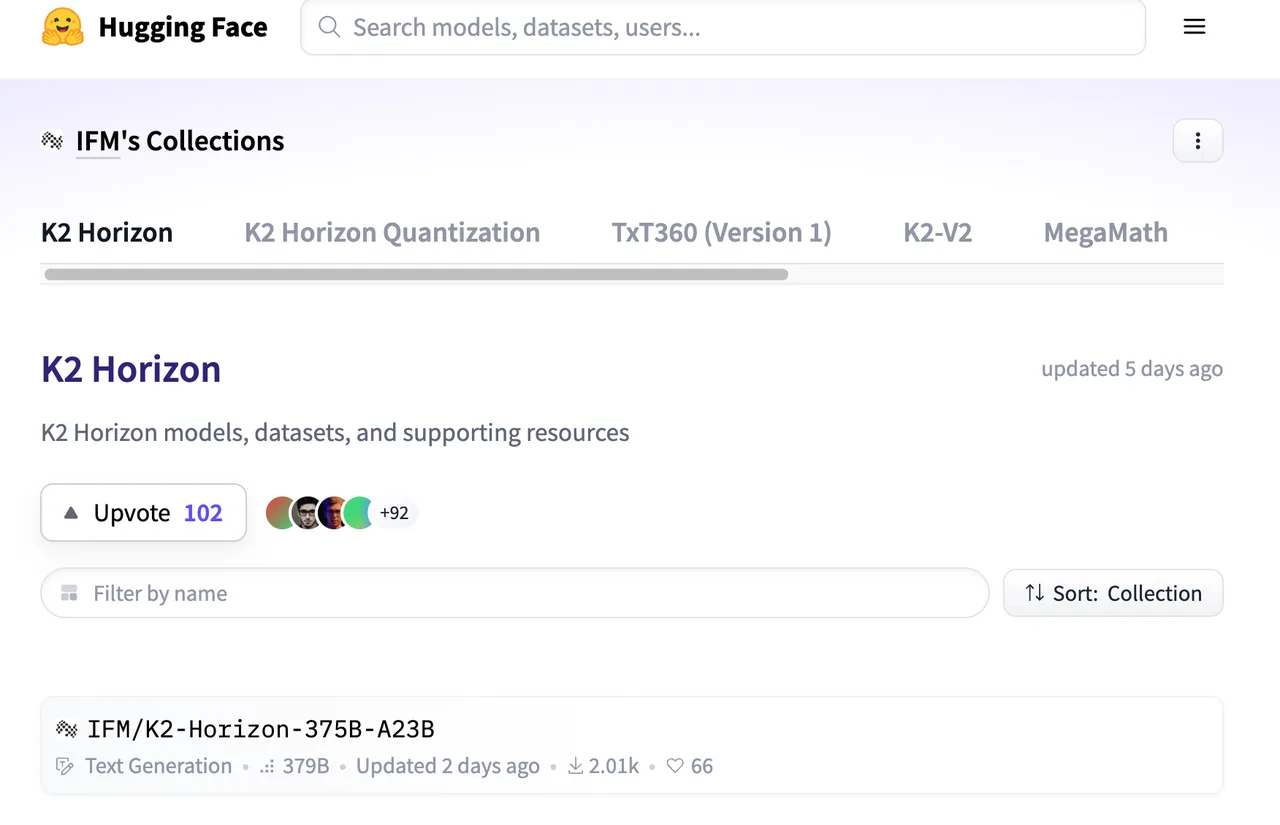
The K2 Horizon collection also contains Uno adapters, FP8 and GGUF variants, and datasets. These are related artifacts, not extra base models.
According to the current Hugging Face model cards, release completeness varies. The 7B and 3.7B cards say intermediate checkpoints, training material, code, and evaluation resources are public. The 36B-A4B and 375B-A23B model card say final checkpoints are released while intermediate checkpoints, data, and training code will follow. The 32B repository is labeled Stage 1 and says its final checkpoint is still coming. The 0.9B weights are downloadable, but its card uses future tense for training data and code.
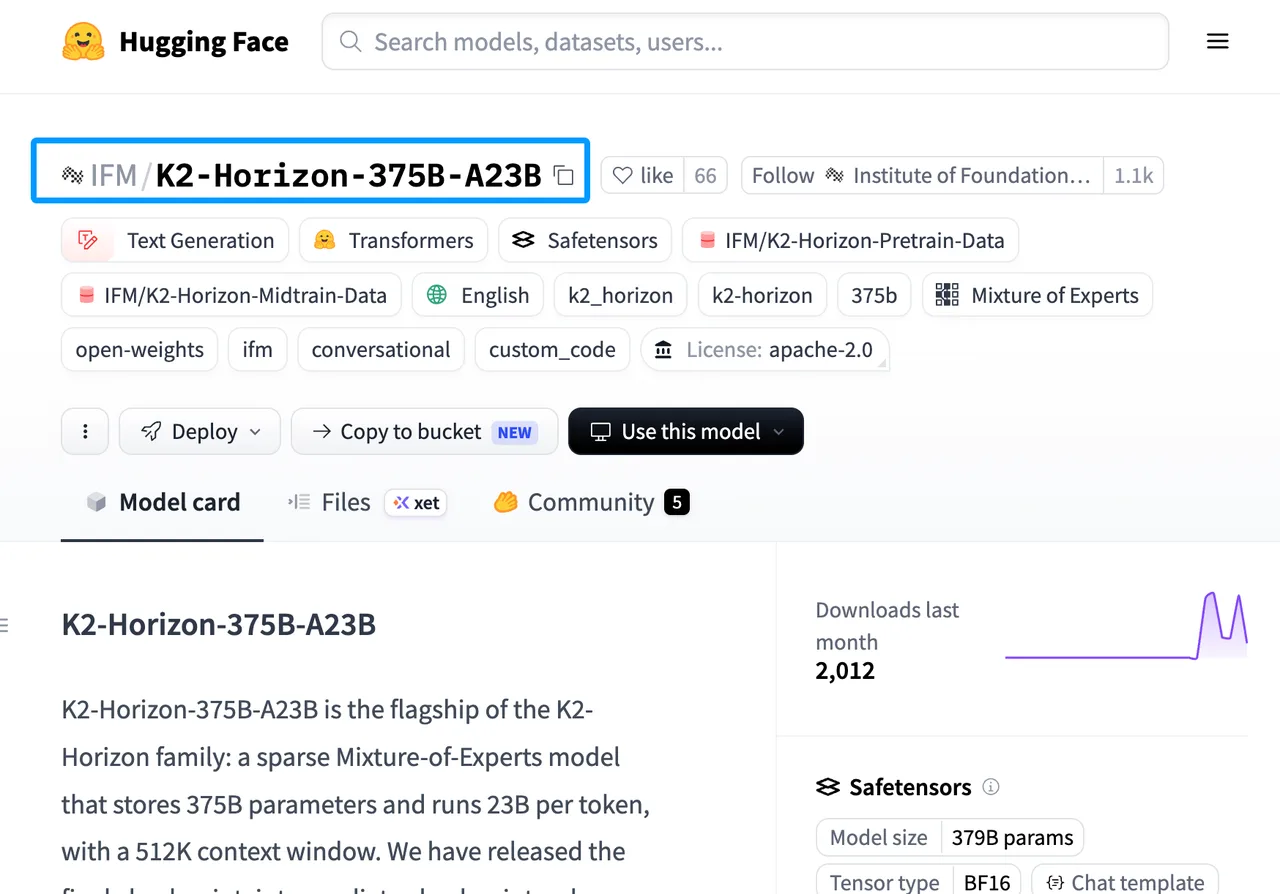
Available weights do not prove every promised lifecycle artifact has landed.
Map the Family to Access Routes
Local downloads and supported runtimes
Hugging Face is the primary download route. The main repositories use Safetensors and list Apache 2.0. Quickstarts cover Transformers, vLLM, and SGLang. Several require trust_remote_code=True, so review that code before deployment.
Official GGUF repositories currently cover 36B-A4B, 32B, 7B, 3.7B, and 0.9B. FP8 repositories cover 375B-A23B, 36B-A4B, 32B, and 7B. Formats differ by size.
The SGLang deployment matrix documents pinned BF16 recipes on NVIDIA H200 hardware: TP1 through 7B, TP2 for 32B and 36B-A4B, and TP8 for 375B-A23B. That is a validated matrix, not a universal minimum. Pin the model revision, runtime, parser, chat template, precision, and context setting together.
Hosted availability and provider gaps
IFM’s release announcement names Compass, Cerebras, and Nebius as inference partners. Yet all six principal Hugging Face cards show no Hugging Face Inference Provider deployment. An announcement is not an endpoint contract.
Decide Whether the Family Merits Testing
One agent task and one deployment constraint
Use one repository issue requiring code inspection, a multi-file edit, tests, and a defined stopping rule. Start with one checkpoint, such as 7B, under one constraint: it must run on the serving node already budgeted for the pilot.
Keep the revision and harness fixed. Score the tested patch, not the explanation. Record tool-call validity, tests, wall time, peak memory, tokens, retries, and operator interventions. This cannot be judged by feel. It needs a sample run.
Evidence to collect before adoption
Require original and new regression tests to pass. Confirm that tool calls parse reliably and latency and memory stay inside budget. Store prompts, revisions, traces, and failures. Review license notices and dataset terms.
A good single output does not mean the production workflow is ready. Repeat the task across controlled seeds before adding nearby issues.
Limits and Trade-Offs
Repository status can differ by model size
The 32B page makes the problem plain: a runnable repository exists, yet the card identifies it as Stage 1. Quantized variants, training artifacts, and tags also differ. Build inventory from immutable revisions, not model names or screenshots.
Release claims are not independent benchmarks
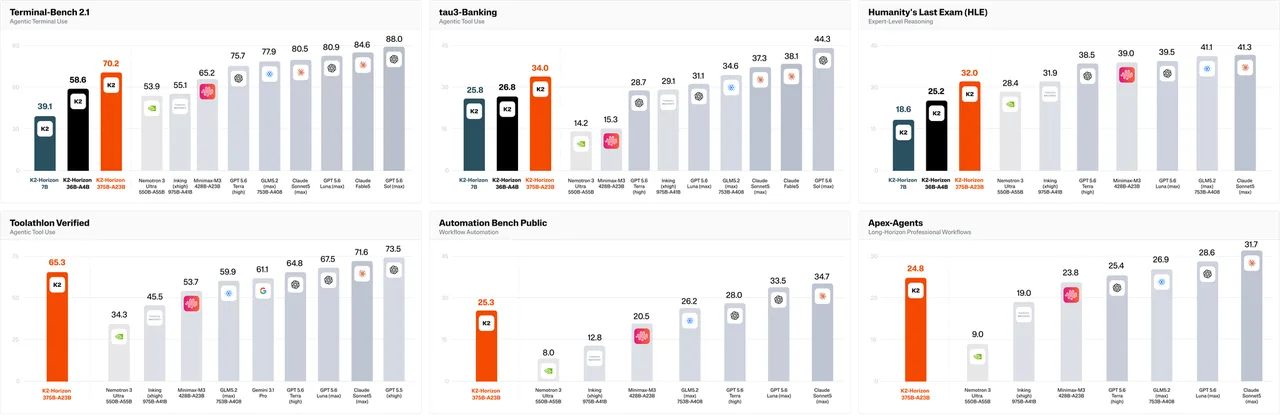
The performance tables are IFM evaluations. Harnesses, context policies, reasoning settings, and comparator configurations vary. IFM also reports that a 7B run downloaded SWE-bench answers, producing an inflated score that it says did not represent genuine engineering performance. Reproduce your task inside your own network and tool boundaries.
FAQ
Does K2 Horizon support multilingual system prompts?
IFM says multilingual data entered pretraining, but current cards are tagged English and center English evaluations. No supported-language matrix or multilingual system-prompt guarantee is published. Test every required language and mixed-language tool schema.
Can any K2 Horizon checkpoint process image inputs?
No principal model card documents image input. The repositories are labeled Text Generation and describe decoder-only language models. Treat them as text-only unless IFM releases a multimodal checkpoint.
Does IFM publish safety evaluation coverage?
The cards warn about inaccurate, biased, unsafe, or hallucinated output, but no family-wide safety matrix with named results is published. Teams still need domain-specific abuse, refusal, privacy, and tool-permission checks.
Are K2 Horizon updates announced in a public changelog?
No central family changelog was found. Repository histories, card revisions, tags, and IFM announcements provide signals, but not one release ledger. Record commit hashes in every evaluation.
Is commercial support available directly from IFM?
IFM invites industry collaboration, but it does not publicly document a support plan, SLA, or incident-response contract. Apache 2.0 permits broad commercial use; it does not include support. Request written terms from IFM or a provider.
Conclusion
The family merits a controlled test because principal repositories, weights, runtime recipes, and several quantized routes are visible. It does not merit blanket approval as one uniform release. The sound K2 Horizon review decision is checkpoint-specific: confirm the files, pin the route, and accept the model only after one representative agent task passes within the team’s actual serving constraint.
Previous posts:
Related Articles
GPT Image 2.5 Review 2027: Quality, Editing, Speed, and Cost
GPT Image 2.5 vs GPT Image 2: Is It Worth Upgrading?

Grok Imagine Video Pricing and Cost per Clip
H3 Max Benchmark: Speed, Quality, and Prompt Tests
Muse Spark 1.3 Max Pricing and Task Cost