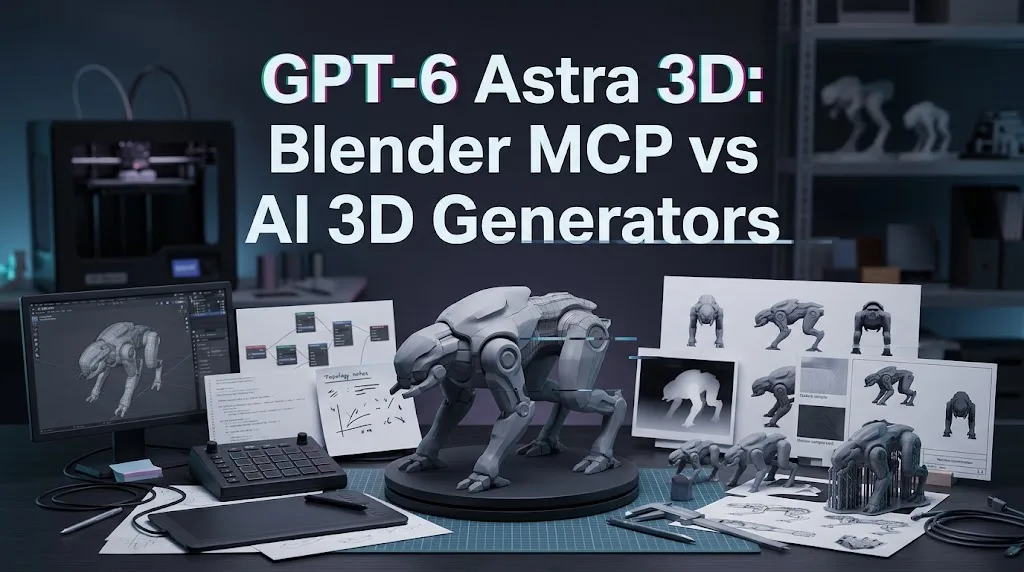
GPT-6 Astra 3D: Blender MCP vs AI 3D Generators
Compare GPT-6 Astra with Blender MCP against AI 3D generators for one production decision: editable scene creation or rapid asset output.
A chair can look finished in a render and still be a bad 3D asset. Rotate it, inspect the underside, or move one leg. The gap between attractive and editable becomes obvious.
That is the real gpt-6 astra 3d decision. Astra can operate tools and write Blender Python, but OpenAI does not describe it as a native 3D model. This comparison uses the community Blender MCP project and Hyper3D Rodin Gen-2.5. No matched files or logs were supplied, so this is an evaluation protocol, not claimed testing.
Quick Verdict by 3D Production Need
Astra with Blender for editable scene work
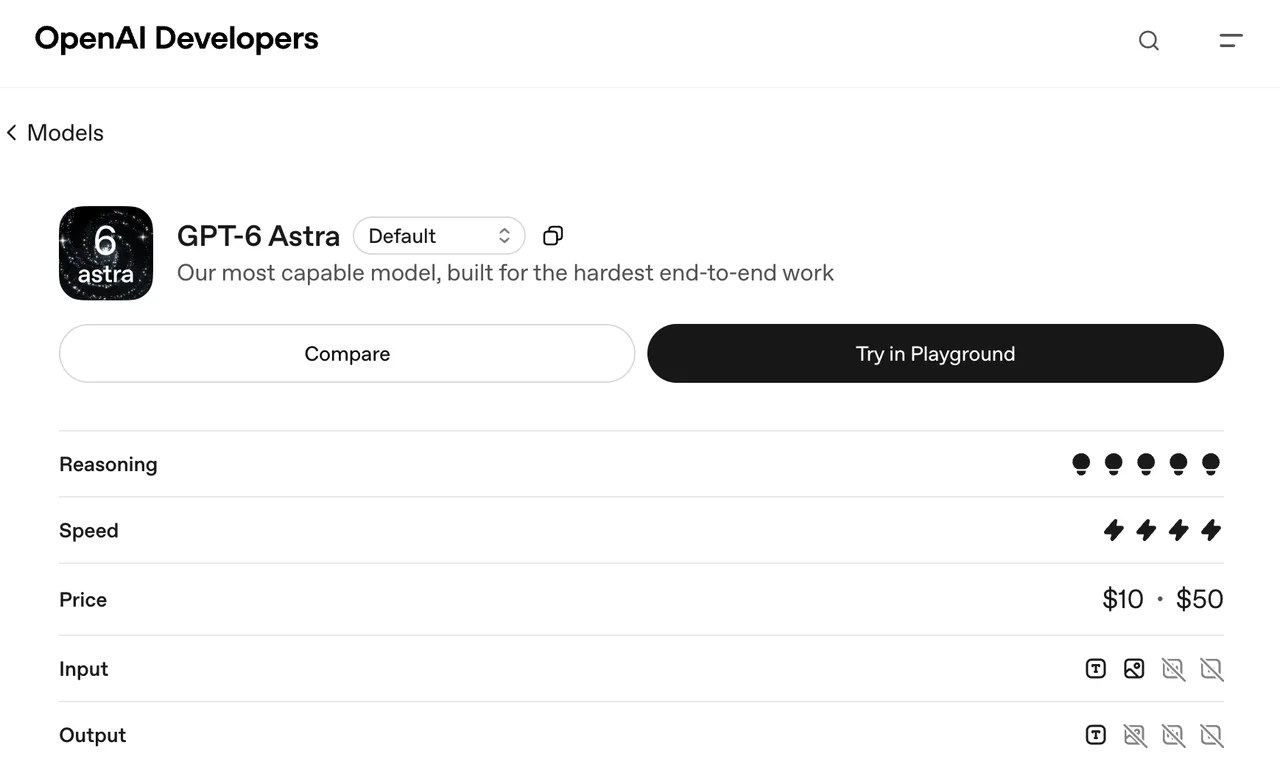
Use the GPT-6 Astra Blender route when the deliverable must remain a structured Blender scene. OpenAI lists MCP, computer use, shell, and image input among Astra’s tools, but not 3D geometry output. The Astra model page confirms that boundary.
OpenAI’s architectural visualization case study used Codex, bpy, background scripts, preview renders, and computer use to build editable architecture, furniture, materials, lights, and cameras. It did not use a native “Astra 3D” endpoint or establish a production benchmark.
AI 3D generators for faster asset starting points
Choose Rodin when the immediate need is a generated prop. Rodin Gen-2.5 accepts text or up to five images and returns GLB, USDZ, FBX, OBJ, or STL with PBR options. Its API specification exposes mesh, texture, tier, and quality controls.
It may reach a downloadable asset faster. Topology, separated parts, scale, pivots, UVs, and visual consistency still need inspection.
Compare Three Workflow Factors
Geometry control and editability
| Factor | Astra with Blender MCP | Rodin Gen-2.5 |
|---|---|---|
| Primary output | Editable .blend scene | Generated mesh package |
| Construction | Objects, modifiers, scripts | Model inference |
| Revision | Direct scene edits | Regenerate or repair |
| Best fit | Scene assembly | Asset starting point |
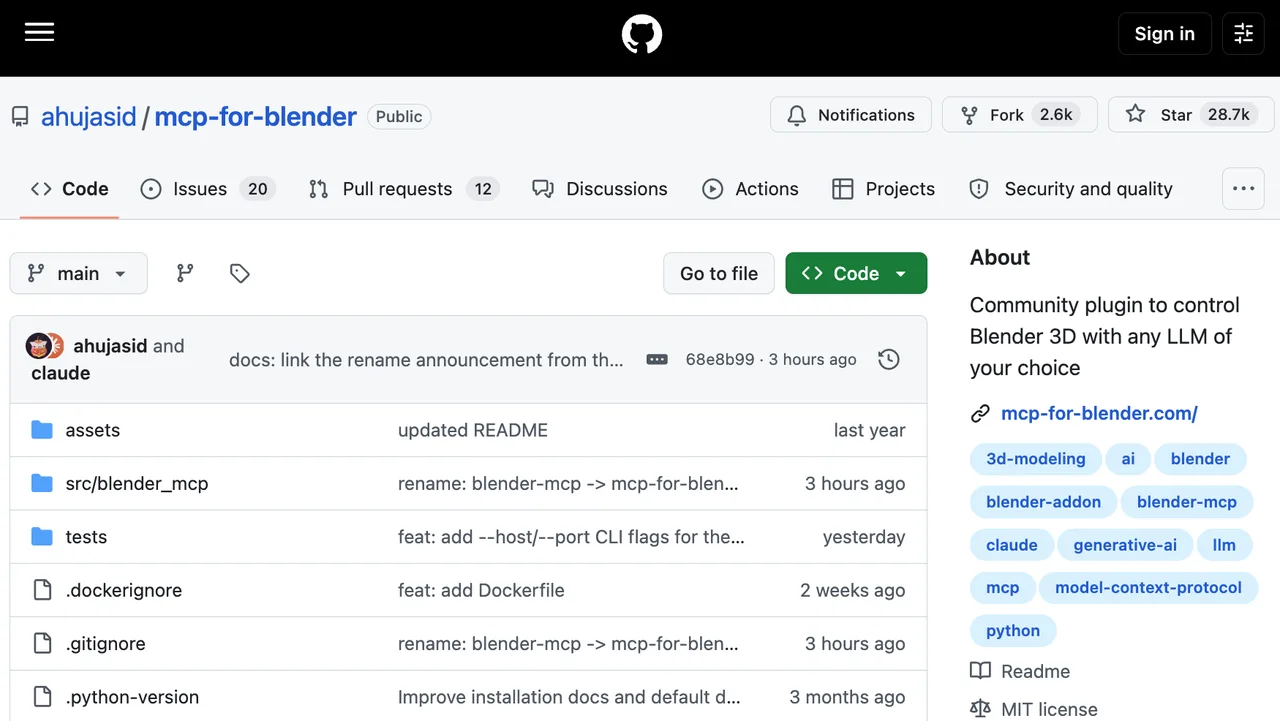
The community Blender MCP repository lets Codex inspect scenes, execute Python, change objects and materials, and export named objects. Arbitrary code is powerful and risky. Save versioned files, enable safe mode where possible, and review scripts.
Non-destructive editing is possible, not guaranteed. The agent must create modifiers and leave them unapplied. A careless script can apply a Boolean, join parts, or overwrite the scene rather efficiently.
Texture, material, and scene continuity
Blender can maintain shared materials, collection names, scale, lighting, and camera relationships across many objects.
Rodin can provide PBR maps quickly, but separate outputs may arrive with different texel density, naming, orientation, or material assumptions. Place three assets under one neutral light, normalize scale, then compare roughness, color response, and geometric detail.
Setup time and operator effort
Blender MCP needs local Blender, the add-on, uvx, MCP registration, a socket connection, and permission controls. It then needs prompt iterations and geometry checks.
Rodin needs credentials, a request, status polling, and download handling. Setup is smaller for one prop. Cleanup may erase that lead. I paused here: generation time is easy to quote. Operator minutes usually decide the route.
Run One Matched 3D Task

Use the same visual brief and acceptance criteria
Use one owned image and one brief:
“Create a stylized walnut bedside table, 60 cm high, with two drawers, rounded edges, four separate tapered legs, brass handles, clean PBR materials, and modeled back and underside.”
Run Blender and the MCP at pinned versions. Run Rodin with a named tier, format, texture mode, and seed where supported. Record the date, Astra model ID, Blender version, add-on commit, Rodin tier, prompts, retries, elapsed time, and failed outputs.
Accept only assets with correct dimensions and origin, separately editable parts, valid normals and UVs, connected textures, and successful export.
Record cleanup time and export success
Measure time to first output and accepted output. Count script corrections, regenerations, modifier loss, texture relinking, and export warnings. Reimport the final GLB or FBX into a clean file and compare hierarchy, dimensions, normals, and materials.
Use accepted asset / operator minute. Polygon count alone says little. A dense mesh with fused drawers is still a fused-drawer problem.
Limits and Trade-Offs
A model-assisted Blender workflow is not a native 3D generator
Astra supplies planning, code, inspection, and tool decisions. Blender performs modeling and rendering. The selected Blender MCP is a third-party bridge, not an OpenAI or Blender integration. Connected services add their own terms.
One demonstration does not establish broad quality
A successful table does not predict characters, vehicles, interiors, rigging, or CAD tolerances. Repeat the evaluation by asset class before changing production. This is where my data ends.
FAQ
Which Blender versions work with the MCP setup?
The selected community project lists Blender 3.0 or newer, Python 3.10+, and uv. Pin an exact Blender release and MCP commit because compatibility can change independently.
Can the workflow preserve non-destructive modifiers?
Yes, if generated bpy operations create modifiers and do not apply them. The Astra 3D workflow must verify this. GLB or FBX may bake unsupported results, so retain the source .blend.
Which 3D file formats can be exported reliably?
Blender MCP documents GLB and FBX. Rodin documents GLB, USDZ, FBX, OBJ, and STL. Reliability still requires reimport tests for hierarchy, materials, scale, animation, and normals.
Does the workflow require a local Blender installation?
It requires a Blender instance with the add-on. Blender commonly runs locally, but the MCP server can also target a remote Blender host. A hosted AI 3D generator such as Rodin works without Blender, though Blender remains useful for validation.
Who owns assets created through connected services?
There is no single answer. The MCP’s MIT license covers its code, not generated 3D assets. Model terms, source-image rights, and library licenses apply. Hyper3D’s terms do not limit Rodin output use, subject to its agreements, law, plan, and third-party rights. Record provenance per object.
Conclusion
The gpt-6 astra 3d route fits editable scenes and deliberate continuity. Rodin fits faster asset starting points. Run both against the same object, then keep the route that reaches a valid export with fewer operator minutes, not the better first render.
Previous posts:
Related Articles
Gemini 3.8 Live vs Extended Thinking: Which Should You Use?
H3 Max API Review 2027: Choose the Right Video Endpoint

K2 Horizon 36B Review 2027 for Local Agent Workloads
H3 Max Pricing: Cost per Usable Video Clip
H3 Max vs MiniMax H3: Speed, Output, and Access