
GPT-Live vs GPT-Realtime-2
GPT-Live vs GPT-Realtime-2 clarifies ChatGPT voice experience versus developer realtime API for production voice teams.
Hello, guys. Dora here. I saw the confusion coming from one sentence in a planning doc: “Use GPT-Live through the ChatGPT voice API.” That sounds plausible. It is also the kind of sentence that sends a voice product team down the wrong path for two weeks.
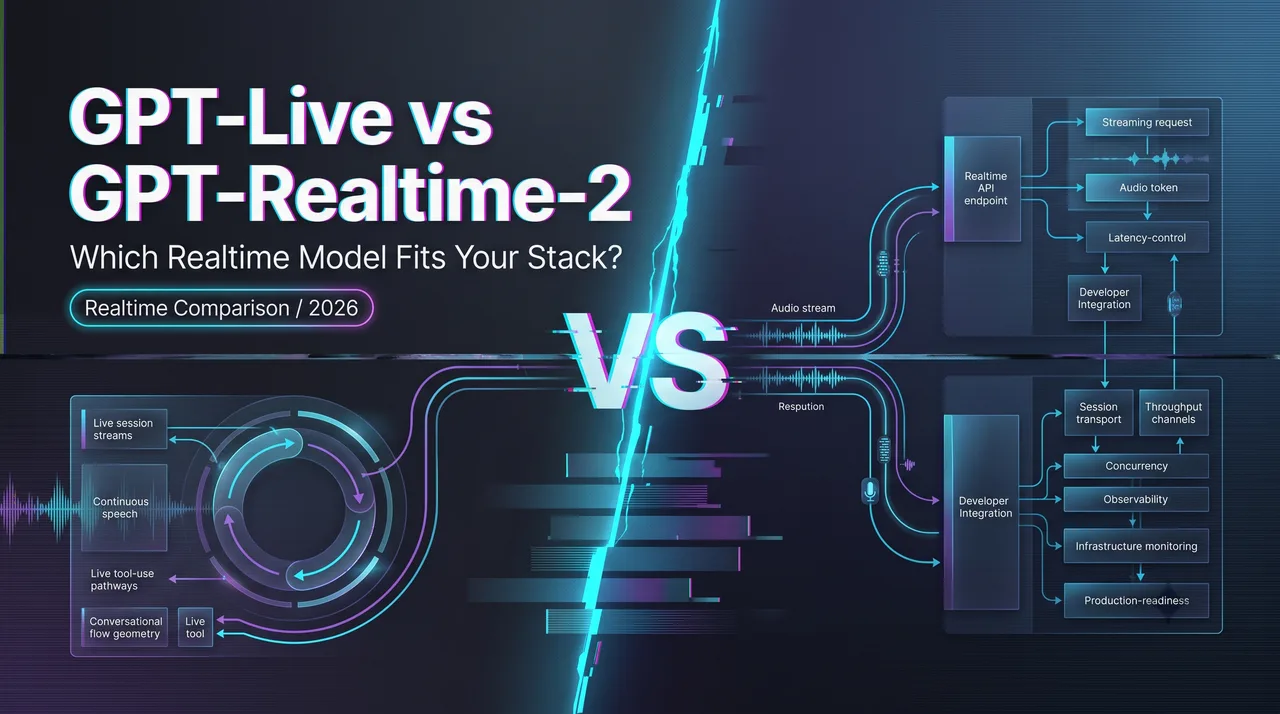
This GPT-Live vs GPT-Realtime-2 note is not a model-quality ranking. It is a naming correction. GPT-Live is currently a ChatGPT Voice product model. GPT-Realtime-2 is a documented API model for realtime voice applications. Different surfaces. Different control. Different support path.
The Core Difference
ChatGPT product model versus developer API product
GPT-Live is the model family powering the newer C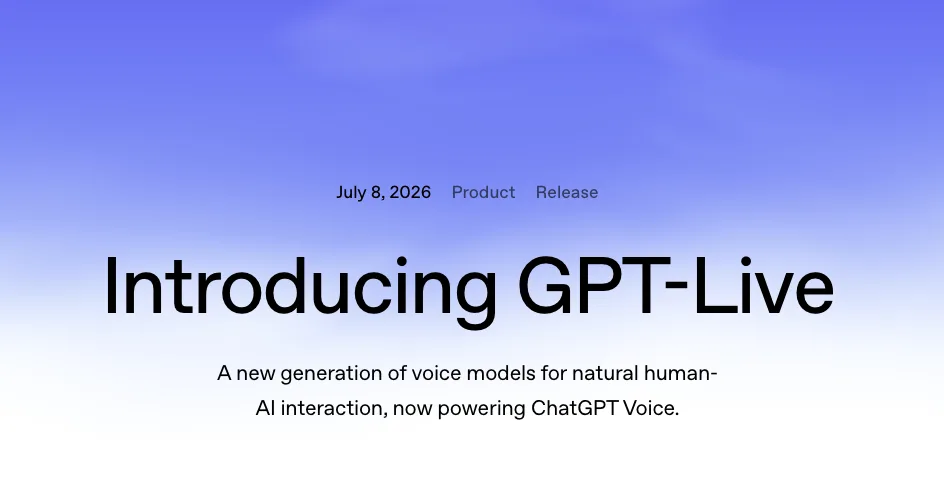 hatGPT Voice experience. OpenAI’s GPT-Live announcement describes GPT-Live-1 and GPT-Live-1 mini as rolling out to ChatGPT users, with GPT-Live-1 for Go, Plus, and Pro users and GPT-Live-1 mini for Free users. The same announcement says OpenAI plans to bring GPT-Live models to the API soon.
That last word matters. Soon is not an API contract.
GPT-Realtime-2 is different. OpenAI’s GPT-Realtime-2 model page lists it as a realtime voice model with the model ID gpt-realtime-2. It documents pricing, modalities, context window, endpoints, function calling support, rate limits, and API availability.
So the split is simple:
| Question | GPT-Live | GPT-Realtime-2 |
|---|---|---|
| Current surface | ChatGPT Voice | OpenAI API |
| Developer model ID | Not documented as a public API model in the model catalog I checked | gpt-realtime-2 |
| Main route | ChatGPT app and web voice experience | Realtime API |
| Builder control | Product-level behavior, limited app settings | Session config, events, tools, logging, transport choices |
| Best use today | End-user ChatGPT voice experience | Production voice agents and custom realtime apps |
That is the difference I would write into the architecture decision record.
Why naming confusion can lead to wrong architecture choices
The problem is not that GPT-Live is unclear as a product. The problem is that “Live” sounds like an API feature.
A buyer hears “GPT-Live” and assumes it is the next OpenAI realtime voice API model. A product manager hears “ChatGPT Voice” and asks whether the team can embed it. An engineer searches for gpt-live-1 and starts planning around a model ID that official API docs do not currently expose.
That creates bad decisions:
- planning API latency and pricing from a ChatGPT product announcement
- promising a model ID before it exists in developer docs
- assuming ChatGPT memory, widgets, or visual cards are API features
- designing observability around a product experience the team cannot instrument
- telling customers “GPT-Live integration” when the actual build uses GPT-Realtime-2
I paused here. This is where naming turns into architecture debt.
Compare Availability and Integration Paths
ChatGPT access, API access, SDKs, and deployment control
The ChatGPT Voice help article describes Live as a ChatGPT Voice option. It says Live is powered by GPT-Live-1 on paid plans and GPT-Live-1 mini on Free, and that availability depends on plan, region, and app version. It also says Live is not available in ChatGPT Business, Enterprise, or Edu workspaces at launch.
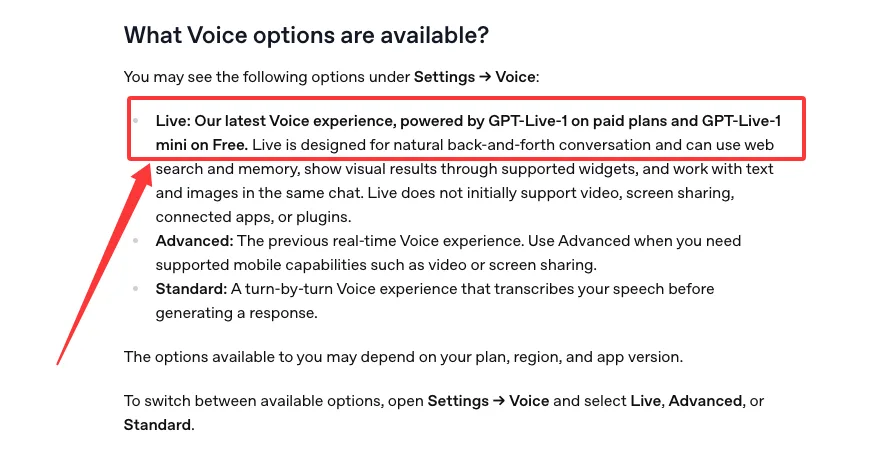
That is product availability. Useful for end users. Not enough for a developer integration.
GPT-Realtime-2 sits on the API side. OpenAI’s May 2026 voice API announcement says GPT-Realtime-2 is available in the Realtime API, alongside GPT-Realtime-Translate and GPT-Realtime-Whisper, and gives audio pricing for GPT-Realtime-2: $32 per 1M audio input tokens, $0.40 per 1M cached input tokens, and $64 per 1M audio output tokens. The model page also lists text pricing at $4 input and $24 output per 1M tokens, plus image input pricing at $5 per 1M tokens.
For integration, the Realtime API supports low-latency connections over WebRTC, WebSocket, and SIP. The API reference describes realtime calls, session configuration, model selection, audio settings, and follow-up call control through the documented Realtime endpoints.
The practical read:
GPT-Live is what a user experiences inside ChatGPT.
GPT-Realtime-2 is what a developer can put into a voice product.
Session events, tools, logging, and production observability
Production voice agents need more than a good voice model. They need events.
The Realtime API reference describes realtime communication over WebRTC, WebSocket, and SIP. The client and server event docs expose the machinery that product teams need: session.update, response.create, response.cancel, conversation.item.*, input audio buffer events, output audio buffer events, and function-call argument deltas.
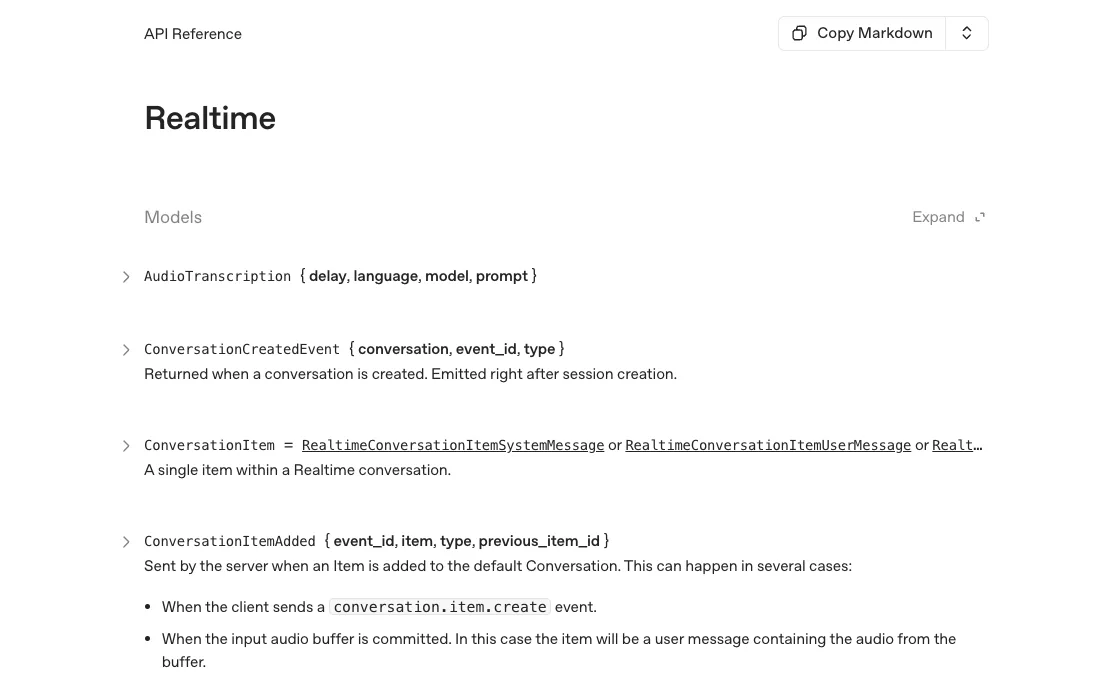
That is not decorative. It is how teams handle interruptions, tool calls, failed turns, call handoff, audit logs, and post-incident review.
With GPT-Realtime-2, the team can design around:
- session configuration
- tool definitions and tool choice
- response lifecycle events
- audio interruption behavior
- SIP call events
- metadata for disambiguating simultaneous responses
- logs tied to API calls and product telemetry
With GPT-Live in ChatGPT, the user may get a more natural experience. The product team does not get the same integration surface. You cannot assume access to the internal full-duplex orchestration, background delegation, ChatGPT memory behavior, or visual answer cards as API primitives.
This is the main architectural line. Not voice quality. Control.
Compare Product Fit
Internal assistants, consumer voice apps, customer support, and education
For internal assistants, GPT-Live may be useful as a user-facing ChatGPT experience. A team can use it to understand what natural voice interaction should feel like. It can help with product research. It should not be listed as the backend model for an internal API-built assistant unless OpenAI exposes that exact API route.
For consumer voice apps, GPT-Realtime-2 is the safer build target today. The team can wire WebRTC in a browser or app, use WebSocket for server-side control, or evaluate SIP for telephony. They can test interruption handling, latency, token use, tool calls, and fallback behavior in their own environment.
For customer support, the gap gets wider. A support voice agent needs call routing, tool calls, CRM lookups, escalation, transcripts, retention rules, and measurable failure modes. ChatGPT Voice is not a contact-center integration layer. GPT Realtime voice is closer to the shape of that problem because the API exposes session and response events.
For education, the answer depends on the product. If the goal is language practice inside ChatGPT, GPT-Live may be the right experience for users. If the goal is a school-owned tutoring app with district logging, student data handling, teacher dashboards, and curriculum tools, the OpenAI realtime voice API is the more controllable route.
Having many voice options is not the problem. Having to pretend they are the same product is.
When GPT-Realtime-2 remains the safer production baseline
GPT-Realtime-2 remains the safer production baseline when the team needs a documented API model ID, predictable pricing, event-level control, and supportable architecture.
That does not mean it is always the newest or best voice experience. OpenAI’s model catalog now also lists newer realtime models such as GPT-Realtime-2.1 and GPT-Realtime-2.1 mini. A team should evaluate those separately if the question is “which realtime API model should we use now?”
But for this comparison, GPT-Realtime-2 has the important thing GPT-Live currently does not have in official API docs: a documented developer surface.
Use GPT-Realtime-2 when the product needs:
- a model ID engineers can put in code
- API pricing the buyer can model
- WebRTC, WebSocket, or SIP architecture choices
- tool calls inside voice sessions
- logs and event traces
- a support path through API documentation and platform support
- a migration record if the model changes later
Use GPT-Live language only when referring to ChatGPT Voice, user-facing ChatGPT behavior, or future API intent clearly marked as not yet implemented.
Risk Checklist for Builders
Pricing uncertainty, model substitution, policy changes, and support burden
The first risk is pricing mismatch. GPT-Live in ChatGPT is tied to ChatGPT plan behavior and usage limits. GPT-Realtime-2 is priced through API token usage. Those are not comparable billing systems. If a buyer asks for a forecast, use API pricing only for the API build.
The second risk is model substitution. GPT-Live delegates deeper work to a frontier model behind the scenes, and OpenAI says that background model can update over time. That is useful in ChatGPT. It is also exactly why it should not be described as a fixed API backend.
The third risk is policy and availability drift. ChatGPT Voice availability can vary by plan, region, workspace type, and app version. API availability varies by model access, organization tier, endpoint support, and rate limits. Similar names. Different gates.
The fourth risk is support burden. If customer documentation says “GPT-Live API” and customers cannot find that in developer docs, support will inherit the confusion. So will sales engineering. So will the customer’s procurement team. Nobody enjoys that meeting.
A clean internal checklist:
- Is the model name present in OpenAI API model docs?
- Is there a callable model ID?
- Is pricing documented for the intended modality?
- Is the endpoint documented?
- Are session events and tool behavior documented?
- Does the customer-facing doc distinguish ChatGPT product features from API features?
- Is any future GPT-Live API assumption marked as unapproved?
If any answer is no, keep the claim out of production docs.

FAQ
Who signs off on model naming in customer documentation?
Product marketing can draft the wording, but final approval should include the solution architect, API buyer or product owner, and developer relations or support owner. If the doc names a model ID, engineering must verify it against official API docs.
For this topic, “GPT-Live powers ChatGPT Voice” and “GPT-Realtime-2 is available through the Realtime API” are different claims. They need different approvals.
What support path should handle ChatGPT-versus-API confusion?
Route ChatGPT Voice questions through ChatGPT product support or the customer’s ChatGPT account owner. Route API implementation questions through API support, solution architecture, or the developer platform team.
Do not let a ChatGPT feature question become an API incident. Also do not let an API integration issue get answered with ChatGPT availability notes. That is how the same confusion repeats.
How should teams record rejected GPT-Live integration assumptions?
Record the rejected assumption, the source that caused it, the official source that disproved or limited it, the date checked, and the replacement decision.
Example: “Rejected assumption: use gpt-live-1 as an API model. Reason: official API model docs did not list gpt-live-1; GPT-Live was documented as ChatGPT Voice rollout, with API availability planned for later. Replacement: build against gpt-realtime-2 unless a documented GPT-Live API model becomes available.”
That record is not bureaucracy. It prevents the same debate from restarting next sprint.
Conclusion
GPT-Live vs GPT-Realtime-2 is mostly a surface-area decision, not a taste test.
GPT-Live is the ChatGPT Voice experience OpenAI is rolling out to users. It is built for natural, full-duplex conversation inside ChatGPT, with product-level features such as memory, search, visual cards, and plan-based availability. It may come to the API later, but future intent is not an integration path.
GPT-Realtime-2 is the developer model teams can plan around today. It has a documented model ID, API pricing, Realtime endpoint support, session events, function calling, and production observability hooks.
The clean wording is boring and correct: use GPT-Live when talking about ChatGPT Voice. Use GPT-Realtime-2 when talking about an API-built realtime voice agent. That distinction saves more time than it looks like.
Previous posts:
/filters:quality(82)/media/images/b73c2438-6bdd-4b80-a229-8d71d8f819cf.webp)
/filters:quality(82)/media/images/427fd9f2-347d-4f86-a2d5-aee110cda01d.webp)
/filters:quality(82)/media/images/1773962750383987480_n3hqzHRZ.webp)
/filters:quality(82)/media/images/43fa0e7f-a0db-48d7-9bab-921d1225db30.webp)
/filters:quality(82)/media/images/5799ff56-3a73-40ca-a666-e4965d878496.webp)
/filters:quality(82)/media/images/7a8850fc-caf6-482f-ac4d-5ddbe64ec47c.webp)