
ViiTorVoice-NAR Deployment Guide
ViiTorVoice-NAR deployment guide for builders evaluating voice cloning, local editing, ONNX models, latency, privacy, and license risk.
I would not start a production review of ViiTorVoice-NAR by listening to the demo. I would start by asking who is allowed to upload reference audio, where that audio is stored, which tenant can enable voice cloning, and what support does when a customer disputes the generated voice.
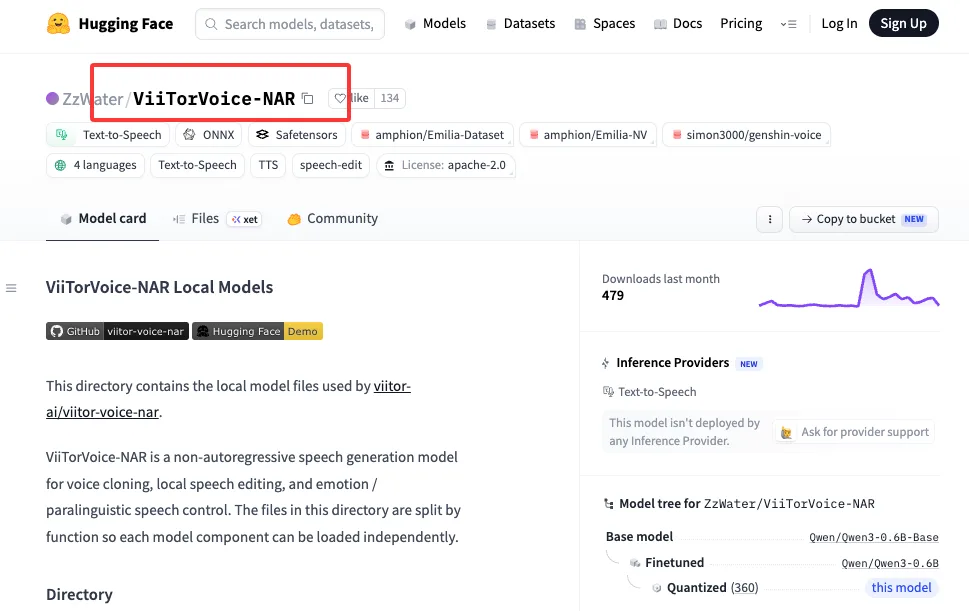
The model exists. The public artifacts are there. As of July 15, 2026, the main Hugging Face model page lists Apache-2.0, onnx, safetensors, Text-to-Speech, speech editing, and language tags for Chinese, English, Japanese, and Korean. The linked GitHub repository describes a local deployment path with split gRPC v2 services and an HTTP gateway.
That is enough to investigate. Not enough to ship blindly.
What ViiTorVoice-NAR Enables
ViiTorVoice is positioned as a non-autoregressive speech generation system for voice cloning and local speech editing. The repo also describes emotion and paralinguistic control.
That puts it in a sensitive category. A speech generation API is not just another media endpoint. It can create output that users experience as a person speaking. That changes product review, support readiness, and release risk.
Non-autoregressive speech generation for builders
The official technical notes say ViiTorVoice uses a non-autoregressive discrete masked language model. Instead of generating audio tokens one by one, it completes masked codebooks in discrete audio-token space.
The audio representation uses DualCodec 25 Hz, 12-layer codebooks. The same notes say these layers carry semantic and acoustic information, supporting cloning, local editing, and conditional control.
For a product team, the interesting part is not the model label. It is the deployment shape.
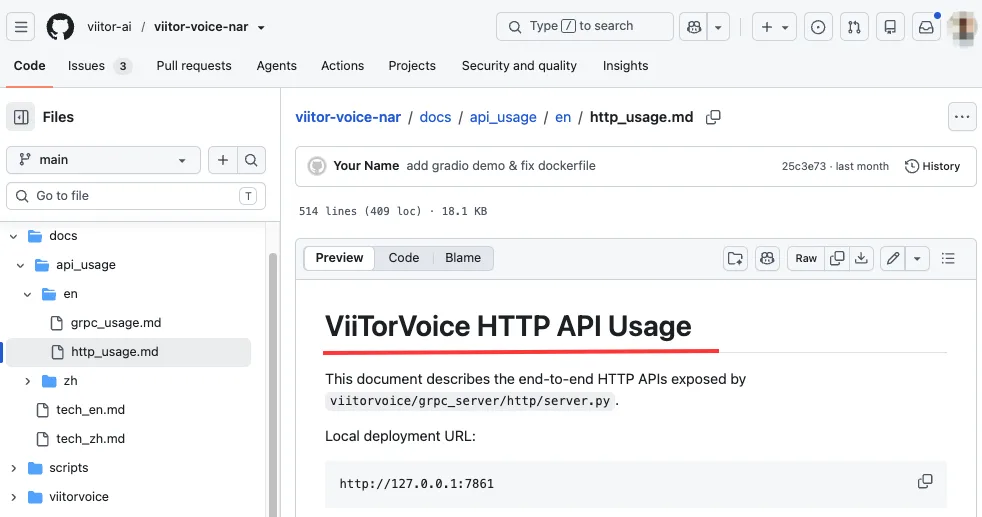
The repo describes separate encoder, LLM, decoder, orchestrator, and HTTP services. The default HTTP service listens on 0.0.0.0:7861, with local access through 127.0.0.1:7861. That makes it a service deployment candidate, not just a notebook artifact.
I paused here. A model that can run locally is easier to test. It is not automatically easier to govern.
Voice cloning, local speech editing, and controllable speech
The model card says the local model files are used for voice cloning, local speech editing, and emotion or paralinguistic control. The Hugging Face README breaks the local assets into components: the ViiTorVoice-NAR LLM, DualCodec, W2V-BERT 2.0, Qwen3 Forced Aligner, and runtime assets.
The public HTTP docs list two main POST APIs: /v1/voice-clone and /v1/text-local-edit, plus /health for service checks in the HTTP API usage. They also document audio input through uploaded files, server-local paths, base64 audio, and codebook input for voice cloning.
Local editing is the more production-interesting feature. The system takes source audio, original text, and edited text. It uses text diff and alignment to locate the region to replace, then regenerates only that span. That can be useful for correction workflows where the rest of the approved recording should stay stable.
The same capability is also why release gates matter. Editing one phrase in a real-sounding voice is not a casual feature.
Production Fit Checklist
I would treat ViiTorVoice-NAR as a candidate only after four reviews are complete: model asset review, runtime review, audio quality review, and abuse review.
Skipping any one of them creates a production surprise. Usually the expensive kind.
Model components, local assets, and runtime assumptions
The Hugging Face repository is not a single small checkpoint. The repository contains multiple large model assets; verify the current total repository size through the Hugging Face API before fixing deployment storage requirements. The model files include safetensors, ONNX files, PyTorch assets, tokenizer files, configs, and component directories.
The model card says the directory structure should remain unchanged unless the loading code is updated. That matters for deployment packaging. If your build system repacks models, strips unused files, or rewrites paths, this model needs a deliberate artifact process.
The GitHub README also says model files should be downloaded into local_models/ under the repository root and should not be symlinked. That is a runtime assumption, not a suggestion. If production deploys immutable containers with mounted model volumes, test that path exactly.
The model page lists Apache-2.0. The GitHub repo also exposes an Apache-2.0 license. Good. Still not the end of license review.
The Hugging Face model card names upstream datasets and submodels, including Emilia datasets, Genshin voice data, Qwen3-0.6B, DualCodec, W2V-BERT 2.0, and Qwen3 Forced Aligner assets. The card itself says to check the upstream project and each submodel for license and usage terms. That sentence belongs in the release checklist.
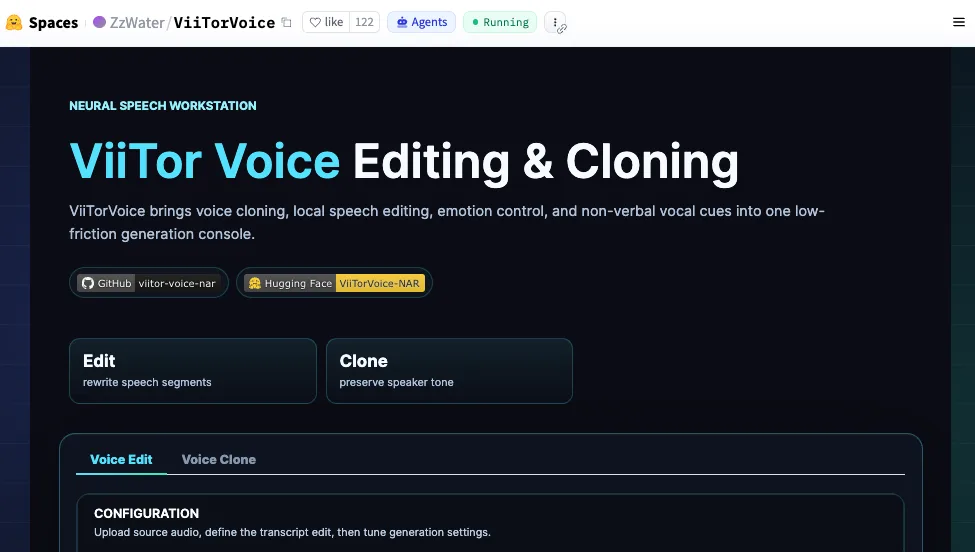
For ONNX TTS deployment, I would also verify runtime compatibility, provider selection, memory use, and whether ONNX execution falls back to CPU in any path. The public Hugging Face demo Space is running on cpu-basic according to the Space API metadata, but that does not prove your latency profile. It only proves the demo status at verification time.
Latency, concurrency, audio quality, and infrastructure cost
The GitHub README claims first block inference with end-to-end first-frame latency around 60 ms. The technical notes explain this as first-block generation, where the model generates an initial audio block before completing later blocks.
That claim is worth testing, not repeating as a production promise.
Measure it with your own payloads:
- first-frame latency
- full-response latency
- GPU memory at idle and under load
- concurrent request behavior
- queue time under burst traffic
- failure rate by input duration
- output duration accuracy
- voice similarity drift
- edit-boundary artifacts
- noisy reference audio behavior
The HTTP docs list timeouts of 600 seconds for voice cloning and 900 seconds for local editing examples. That does not mean typical calls take that long. It does mean the service design allows long-running work. Product teams need to decide whether calls are synchronous, queued, streamed, or converted into jobs.
Audio quality review should include more than “sounds good.” Use fixed test sets. Include short prompts, long prompts, multilingual text, punctuation-heavy text, numbers, names, pauses, and local edits at the beginning, middle, and end of a clip.
Found the pattern on the third try: local editing failures often hide at the boundary. The replaced words sound fine. The join does not.
Release Risks for Voice Features
Voice features need stricter release rules than normal TTS.
A plain TTS voice can still create risk. A voice cloning model raises it. The product question is not “can this synthesize speech?” The question is “can we safely expose this capability to tenants, customers, and support teams?”
Consent capture, privacy review, license review, and abuse controls
Consent has to be captured before reference audio is accepted. Not later. Not in a separate support article. At the upload point.
The system should record who provided the audio, what permission they granted, which tenant owns the voice asset, where the consent record lives, and when it expires. If the product allows team members to upload voices for other people, the review should stop there until the consent model is explicit.
Privacy review should cover reference audio, generated audio, prompt text, codebooks, logs, trace IDs, temporary files, and retention windows. The HTTP docs expose trace IDs in response headers. Useful for debugging. Also a reminder that voice workflows create logs, and logs often outlive the feature decision that created them.
License review needs two layers. First, the project license: Hugging Face and GitHub both show Apache-2.0 for the main artifacts. Second, dependency and data lineage: upstream models, datasets, pretrained components, and any hosted demo code. Do not collapse those into one green check.
Abuse controls should be product-level, not only model-level. Rate limits, tenant allowlists, watermark or provenance policy, reporting paths, sample review, and high-risk content filters all belong in the launch plan.
That is not bureaucracy. That is the cost of making voices.
When voice cloning should be blocked or limited
Block or limit voice cloning when consent is missing, disputed, expired, or not specific enough for the intended use.
Also block it when the requested output impersonates a real person in a context where the listener could reasonably believe the person actually said it. Do not provide tooling paths for bypassing consent, avoiding detection, or making generated speech harder to identify. That line should be in policy and in support training.
Limit the feature for minors, public figures, regulated advice, financial instructions, political persuasion, harassment, fraud-sensitive workflows, and any tenant with unresolved abuse reports.
For commercial use, I would start with tenant-level access, low default quotas, mandatory audit logs, and reviewable voice assets. Open access can come later if the incident data supports it.
Better than expected, but only slightly: the deployment story is real. The governance story is still yours to build.
FAQ
Who owns customer escalation after generated voice output is disputed?
Customer support owns the intake. Trust and safety owns the risk review. Product owns the policy decision if the dispute exposes a feature gap. Engineering owns trace retrieval, route reconstruction, and artifact preservation.
The escalation record should include tenant ID, request ID, generated audio, reference asset ID, consent record, model version, prompt text, output timestamp, and support outcome. If any of those fields cannot be retrieved, the feature is not ready for broad production use.
How should tenant-level voice feature settings be documented for support teams?
Document them in support-readable language, not only config names.
Support should see whether voice cloning is enabled, which users can upload reference audio, whether local speech editing is enabled, what quota applies, what review state the tenant is in, and where consent records are stored. They also need the disable path.
A tenant setting that only engineering can interpret is not a support setting. It is a future incident note.
What third-party model update should trigger a fresh release review?
Trigger a fresh review when the Hugging Face model files change, the GitHub repo changes deployment behavior, the license changes, a dependency model changes, a new dataset is declared, the demo behavior changes, or the API adds new voice-generation controls.
Also review again when latency or quality changes after an infrastructure update. Voice output is user-facing. Small model changes can become support tickets fast.
For ViiTorVoice-NAR, my production answer is conditional: investigate it seriously, test it with your own traffic, and do not ship voice cloning until consent, logging, tenant controls, and escalation paths are already working. That is where my data ends.
Previous posts:
/filters:quality(82)/media/images/6cd1ca63-9e7e-493b-8a68-97bad82fb7b4.webp)
/filters:quality(82)/media/images/567077af-c3bd-4701-ba96-1b981a515d79.webp)
/filters:quality(82)/media/images/1773962750383987480_n3hqzHRZ.webp)
/filters:quality(82)/media/images/1ecd59e5-56e4-434d-ae06-c414860b29b8.webp)
/filters:quality(82)/media/images/b38eb9e7-de41-4a05-8e79-5e280c4a0c36.webp)
/filters:quality(82)/media/images/c347367a-a007-4466-b8f7-d37f5fb52819.webp)