What Is Wan-Dancer? Music-to-Dance Video Explained
Wan-Dancer generates long music-driven dance videos from audio, text, and reference images. Understand its hierarchy, controls, and current limits.
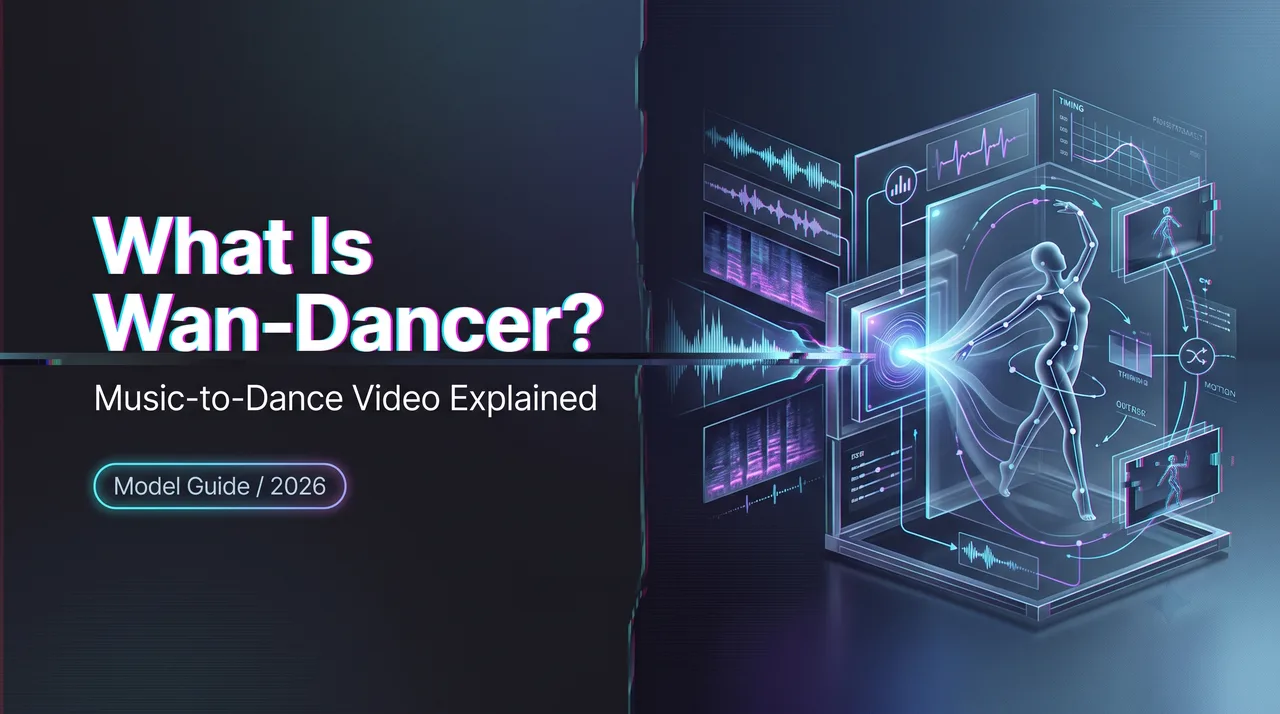
I checked Wan-Dancer because the claim is not vague: minute-scale dance video from music, with a reference identity and long-range choreography structure. That is not the same job as making a five-second animation loop. Longer dance video breaks slowly. Rhythm drifts. Identity shifts. Motion repeats because the model has no plan left.
As of July 15, 2026, the public Wan-Dancer project and arXiv paper confirm a research release from Tongyi Lab, Alibaba Group. The project frames it as a hierarchical framework for minute-scale coherent music-to-dance generation.
That is enough to evaluate. It is not proof that an official hosted API is live.
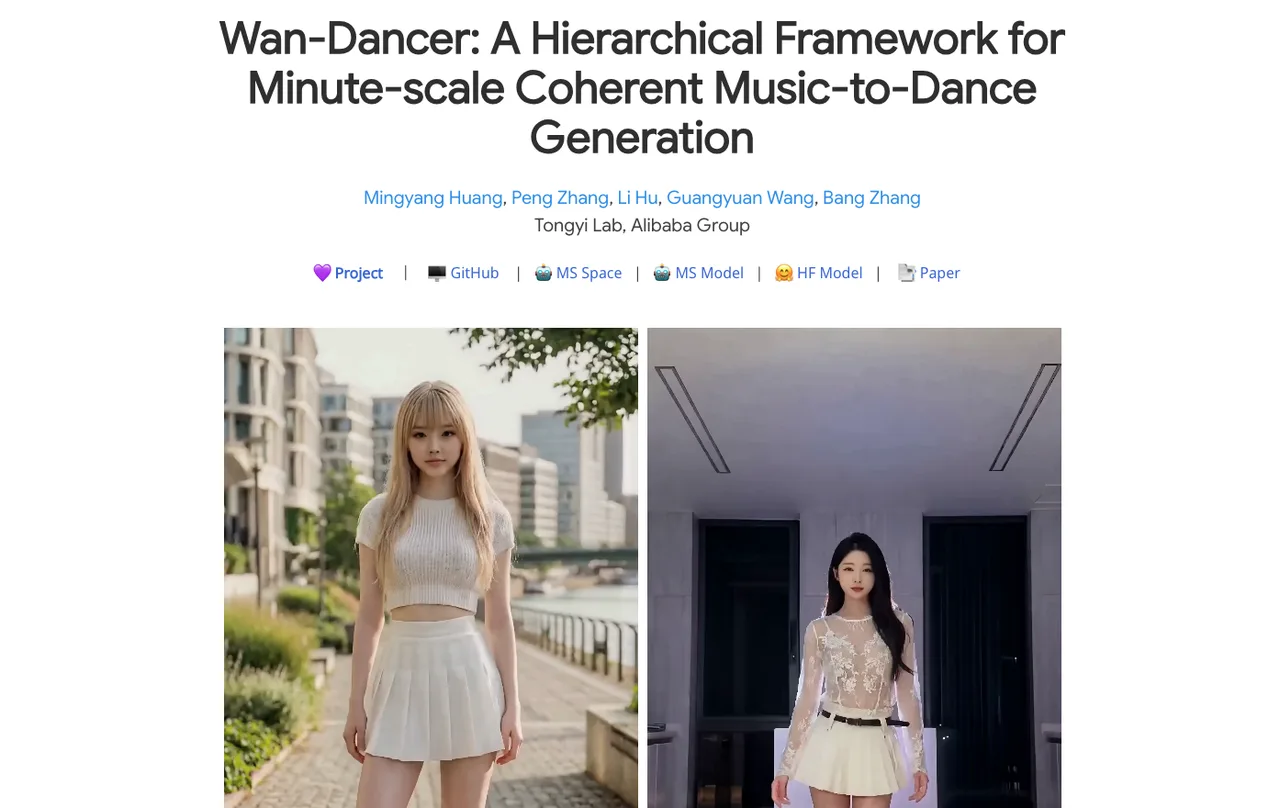
What Wan-Dancer Is
Wan-Dancer is a music-to-dance AI video model. It uses music as the main condition, then generates dance video that follows the rhythm over a longer duration than common short video workflows.
The paper says current diffusion video models often struggle beyond about 20 seconds, with temporal drift, identity inconsistency, and repetitive motion. The proposed fix is a two-stage hierarchy: global keyframe planning first, local temporal refinement after.
That structure is the point.
A short clip can survive on local motion. A one-minute dance needs choreography memory. Otherwise the dancer keeps moving, but the video stops feeling directed.
Inputs, outputs, and the music-to-dance problem
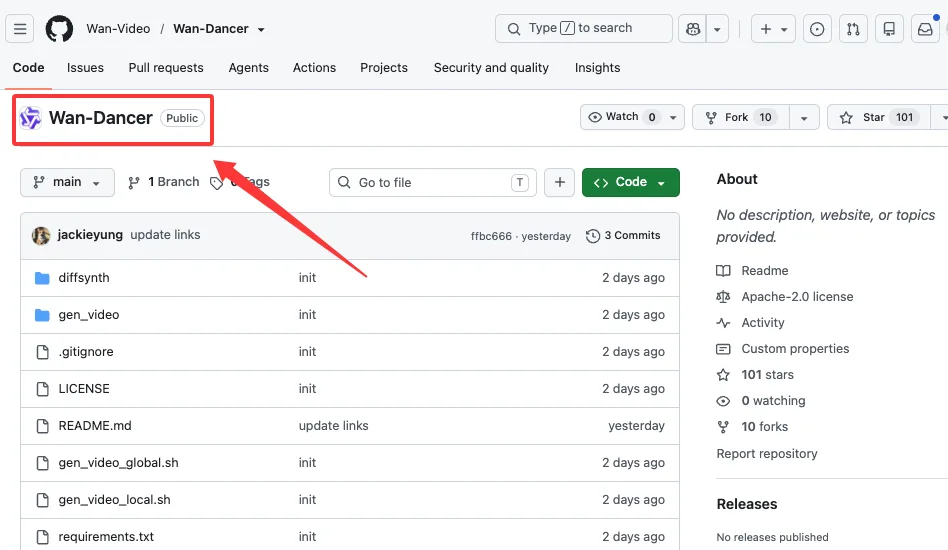
The confirmed inputs include music, a reference image, and text prompts. The public GitHub repo shows inference scripts using image_path, prompt_path, and music_path. The prompt files define the dance style. The reference image anchors the dancer’s appearance.
The output is a generated dance video. The project page shows Chinese classical dance, K-pop, street dance, tap dance, and Latin dance. It also shows minute-scale examples.
I paused here. “Long dance video generation” is not only about duration. It is duration plus rhythm, subject consistency, motion variation, and visual continuity.
Confirmed project status and available resources
The public resources are enough for a builder evaluation.
The project page links to the paper, code, and model pages. The Hugging Face model lists Wan-AI/Wan-Dancer-14B, Apache-2.0, Image-to-Video, Diffusers, Safetensors, and music-to-dance tags. The ModelScope model provides another official model distribution page.
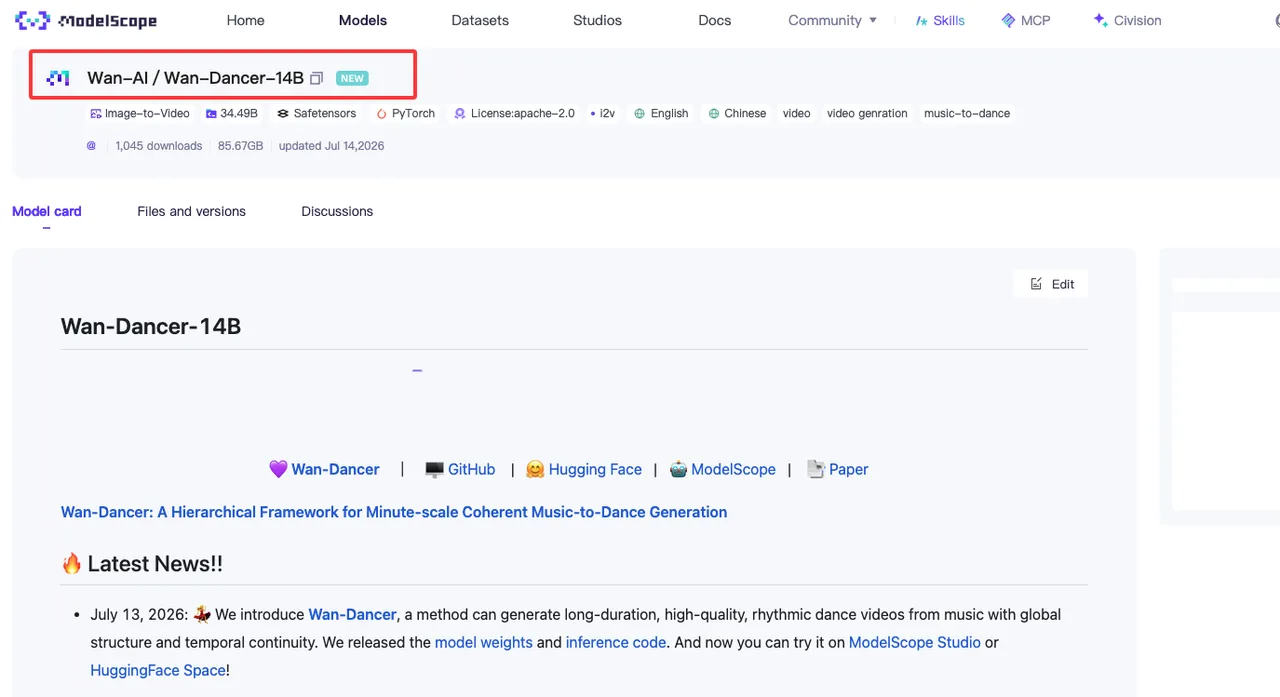
The Hugging Face page says model weights and inference code were released on July 13, 2026. It also says the model is not deployed by any Hugging Face Inference Provider at verification time.
So the status is clear: public research artifacts exist. Production hosting is a separate question.
How the Hierarchical Framework Works
Wan-Dancer separates long-range planning from local detail.
The global stage uses full-track musical context to plan keyframes. The local stage refines the video over time. For builders, this matters more than the model name. It shows where control, failure, and compute cost may enter the pipeline.
Global keyframe planning for long-range structure
The global stage creates the rough choreography structure. It gives the video a long-range plan before final refinement begins.
In the repo, the global generation script takes inputs such as seed, reference image path, prompt path, music path, output directory, timestamp, and diffusion steps. That means the first stage is already a reproducible artifact if the team records the inputs.
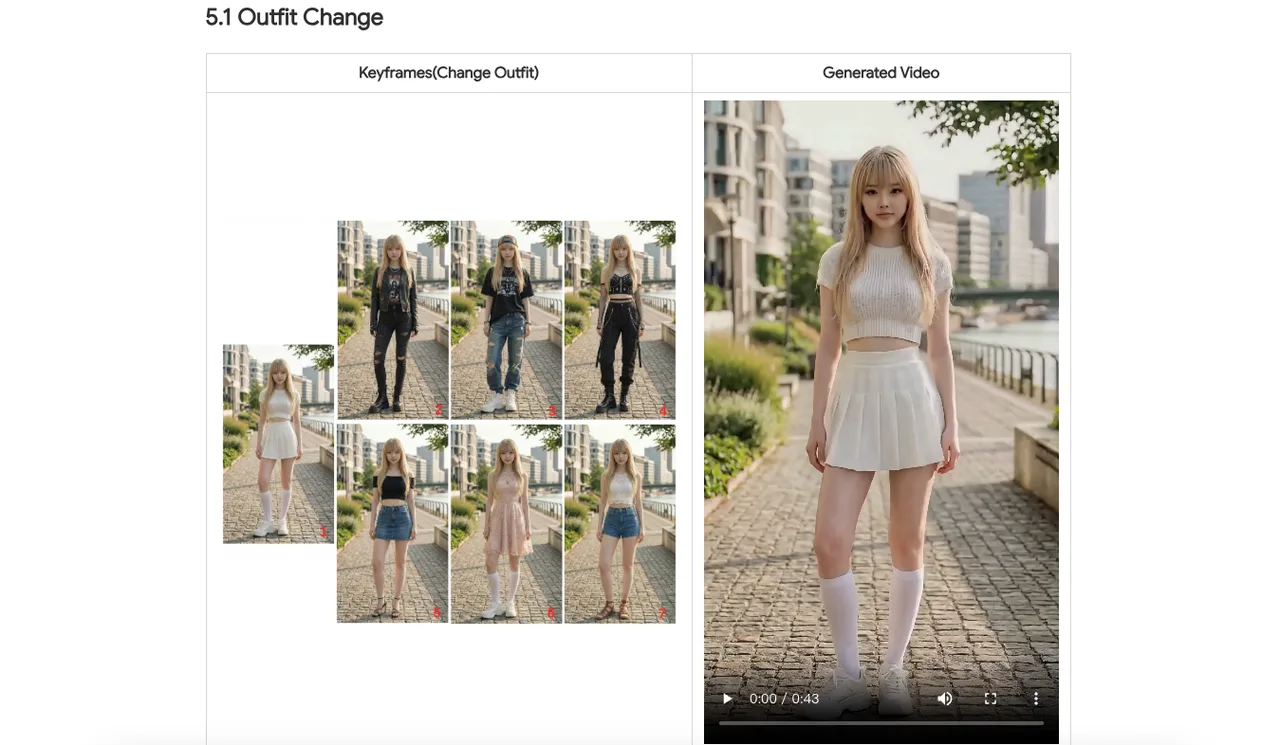
The project page also shows keyframe-based control, including outfit change and movement control. Useful. Also operationally annoying. Keyframes become source assets, and source assets need versioning.
Found the pattern on the third try: control features always create bookkeeping.
Local temporal refinement for motion and visual continuity
The local stage takes the global output and turns it into the final refined video. The repo shows a separate local refinement script using global_video_path, plus the reference image, prompt, and music.
The paper says the framework uses time-mapped RoPE embeddings, optical-flow-based loss, and motion-speed control. These are vendor/project-reported technical claims, checked on July 15, 2026.
The practical reading is simple: local refinement tries to keep motion smooth, identity stable, and fast dance details from turning into visual noise.
Better than expected, but only slightly. The project page still mentions post-processing on showcased videos.
What Wan-Dancer Can Control
Wan-Dancer is not just text-to-video with a music file attached. The public demos show several control surfaces.
The model can condition on music, reference identity, text prompts, keyframes, seed, and motion speed. The project page also shows one music track with different reference images, one reference with different music, and varied outputs from different seeds.
That is exactly the kind of control set a builder wants to test.
Music, reference identity, text, keyframes, and motion speed
Music is the core signal. The model is designed for rhythmic dance video, not generic video motion.
Reference identity comes from the image. Text provides style and dance instruction. Keyframes give higher-level control. Motion speed is called out in the paper because fast movement is where generated video often loses detail.
The limitation is obvious. Every control input becomes a rights and provenance input. Music has rights. Reference images have rights. Prompts can encode style imitation. Keyframes can encode choreographic choices. Architecture does not solve that.
Dance genres and minute-scale generation
The project page demonstrates five dance genres: Chinese classical, K-pop, street, tap, and Latin. It also shows minute-scale examples.
The 720p/30fps and “exceeding one minute” claims are vendor/project-reported. I would not convert them into a general performance promise without local reproduction. Hardware, post-processing, input quality, and prompt setup all matter.
For the Alibaba Wan-Dancer project, the right takeaway is narrower: the research release demonstrates a plausible framework for minute-scale dance generation. It does not remove the need for evaluation.
How It Differs From Other Video Models
Wan-Dancer differs from generic video generation because the main challenge is timed choreography.
A normal text-to-video prompt can describe “a dancer performing on stage.” That may work for a short clip. Wan-Dancer starts from music and tries to maintain structure over a longer track. The evaluation shifts from single-shot aesthetics to continuity.
Text-to-video, motion transfer, and short animation workflows
Text-to-video is useful when the prompt defines scene and action. It is weaker when rhythm, long-range structure, and identity continuity are the main task.
Motion transfer can be more precise when a driving pose or source motion is available. But it needs motion assets. Wan-Dancer is positioned differently: music drives the dance, while text and reference image shape the result.
Short animation workflows are easier to judge. A five-second clip can be selected from many attempts. A two-minute dance video has to survive the whole track. One bad transition can break the asset.
That is why the Wan AI dance model is interesting. It aims at a longer creative unit.
Limits, Risks, and Evidence Gaps
The evidence is promising, but it is still project evidence.
Confirmed: project page, paper, code repo, public model resources, five dance genres, hierarchical framework, and project-reported minute-scale examples.
Not confirmed: official hosted API availability, general latency, commercial deployment cost, safety review process, or stable quality across arbitrary music and references.
That is where my data ends.
Post-processing, compute, identity consistency, and source rights
Post-processing is explicitly mentioned on the project page. Treat demos as showcased outputs, not raw production outputs.
Compute is also non-trivial. The repo says the tested environment used Ubuntu 22.04, Python 3.10.14, and 8 NVIDIA A800 80GB GPUs. That does not prove every run needs the same setup. It does warn against casual deployment assumptions.
Identity consistency needs local testing. Use difficult references: complex outfits, side views, occluded faces, long hair, busy backgrounds, and fast turns.
Source rights need a workflow. The project page says demo images and music were gathered from public sources or generated by AI models, and asks rights holders to contact them for removal. That is a project-page statement, not legal advice for your product.
FAQ
Who owns rights review for reference images and music?
Product should define allowed use cases. Legal or rights operations should review policy. Engineering should make sure music, reference images, prompts, seeds, keyframes, and outputs can be traced. Trust and safety should own escalation rules.
This is a risk map, not a legal conclusion.
How should teams process a source-asset removal request?
Preserve the request, identify the source asset, find related generated outputs, and pause reuse while review runs. If the asset is removed, downstream outputs may also need quarantine or removal depending on policy.
The key requirement is lineage. Without lineage, removal handling becomes guesswork.
What evidence should be retained when source assets change?
Retain asset ID, upload time, source URL if available, license or permission record, prompt file, music hash, reference image hash, model version, seed, keyframes, output ID, and reviewer notes.
When a source asset changes, keep both old and new records. The audit trail matters more than the edit.
Conclusion
Wan-Dancer is a real research release for music-to-dance AI. Its core idea is clear: global keyframe planning for long-range structure, followed by local temporal refinement for motion and visual continuity.
For builders, the next step is evaluation, not API assumptions. Test Wan-Dancer 14B against your own music, references, dance styles, post-processing tolerance, compute budget, and rights workflow.
The model is interesting because it takes long dance video seriously. The deployment question is serious for the same reason. Longer videos carry more motion, more assets, more drift, and more accountability.
Previous posts:
Related Articles
Best AI Video Platforms for Production Teams in 2027

Best Sora 2 Alternatives for Video Teams in 2027
Lanta AI Review 2027: Best Uses, Pricing, and Limits
Sora 2 Review 2027: API Quality, Cost, and Limits
Build a GPT-6 Astra 3D Workflow With Blender Assets