Mercury Agent Review 2027: Provider-Agnostic Runtime Trade-Offs
This Mercury Agent review tests the fit of its tools, skills, memory, and provider abstraction for one persistent AI agent workload.
A persistent agent is easy to demo for ten minutes. The harder test begins after a restart, a failed provider request, or a tool call that needs approval while nobody is watching. This Mercury Agent review examines that operational gap through one reproducible, long-running repository task.
Dora here~ I did not run Mercury Agent with production credentials or infrastructure. The conclusions below separate documented behavior from a proposed evaluation workflow and from architectural inference. Repository details were checked on September 15, 2026.
What Mercury Agent Is Built to Run
Runtime, Tools, Skills, and Memory Boundaries
Mercury Agent is a TypeScript agent runtime for continuous execution through a CLI, local web interface, or messaging channels. It combines tool permissions, schedules, token budgets, skills, provider routing, and SQLite-backed persistent agent memory.
The README advertises 31 built-in tools. Its visible tool table totals fewer, while the current source conditionally registers extra GitHub, subagent, and Spotify tools. Treat 31 as a release-specific headline, not a permanent interface contract. Run /tools after installation and record the loaded set for the actual configuration.
Core Mercury Agent tools cover files, shell commands, Git, web retrieval, scheduling, messaging, and skill management. Shell execution can use an approval queue, folder scopes, and a command blocklist. “Ask Me” is the sensible starting mode for evaluation. “Allow All” materially changes the security boundary.
Memory is local by default and stored under ~/.mercury, including a Second Brain SQLite database. Mercury retrieves a small set of relevant memories for each message and periodically consolidates stored facts. This is structured working memory rather than a guaranteed replay of every conversation. The architecture notes document pause, inspect, and clear controls, and state that there is no review queue or manual editing; however, the current Web Dashboard documentation describes editing, promoting, and pruning memory items.
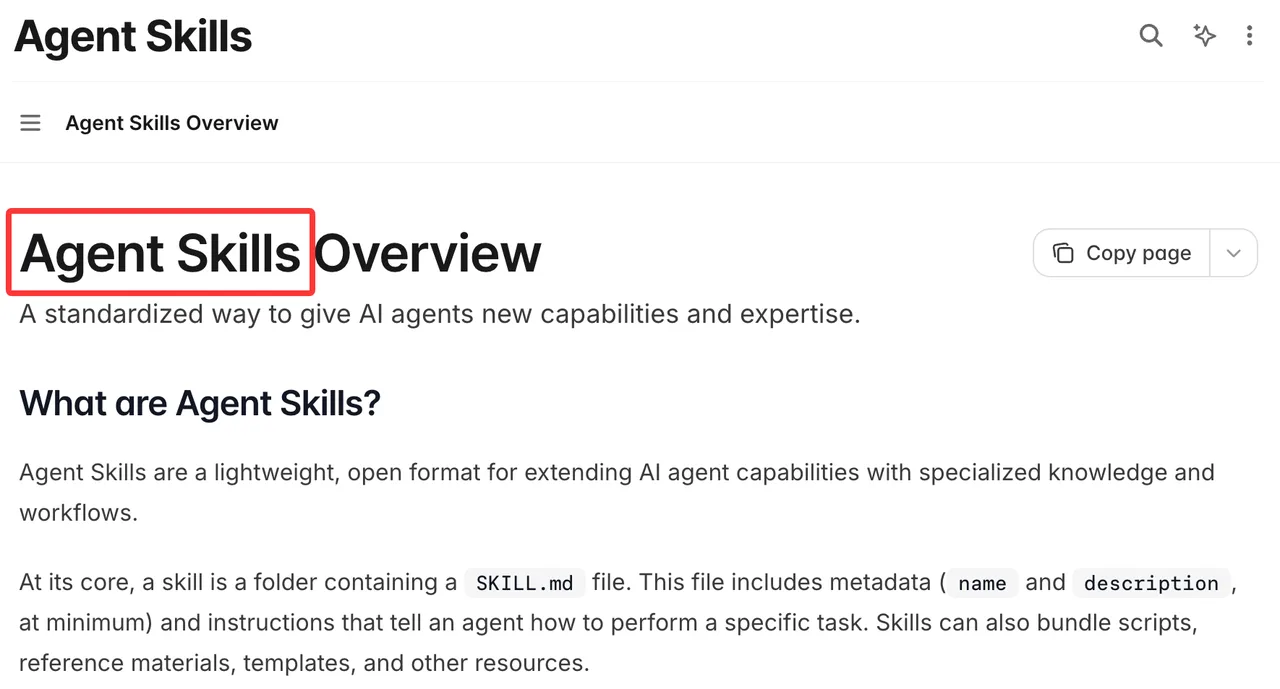
Mercury skills follow the external Agent Skills specification, yet community skills remain unaudited content that may include executable scripts. Pin each skill source and review its scripts before granting shell or filesystem access.
Provider Choice Without a Bundled Model
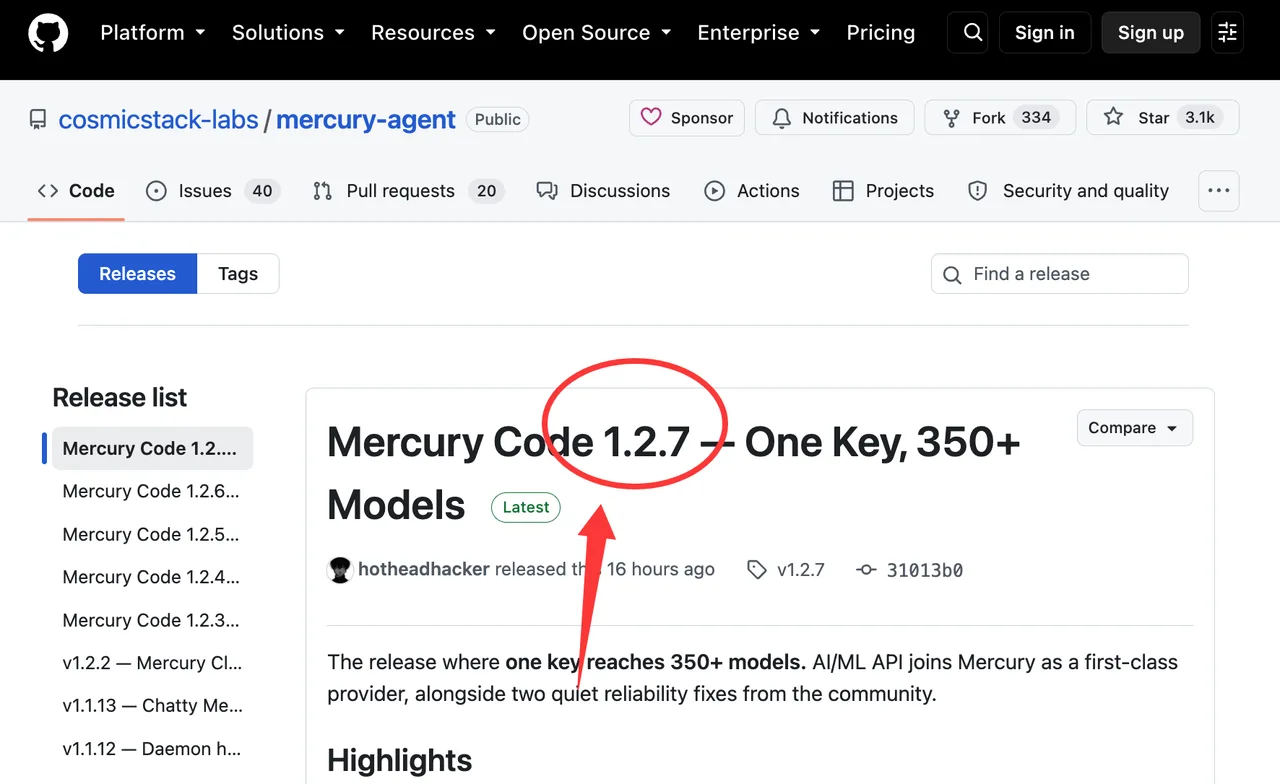
Mercury supplies orchestration, not model weights. Its documented routes include Anthropic, OpenAI, DeepSeek, Grok, Ollama, and OpenAI-compatible endpoints. Release 1.2.7 added AI/ML API support. Local Ollama can keep inference on the device; hosted routes send prompts and relevant context to their respective providers.
Provider fallback moves to another configured route after a failure and remembers the last successful provider. That supports provider-agnostic agents at the routing layer, but it does not establish behavioral parity. Models may interpret tools differently, reject different content, or expose incompatible context and multimodal limits.
I paused here. The README labels 1.2.3 as stable, while the package manifest and release page show 1.2.7. Pin an exact release instead of installing an unspecified latest build.
Review Scope: One Persistent Agent Workload
Setup, Tool Execution, and State Continuity
Use one bounded task: maintain a test repository for eight hours, diagnose a known failing test, propose a patch, run the acceptance suite, and preserve the decision trail across a deliberate runtime restart.
Start from a clean repository commit and an isolated Mercury home directory. Record:
| Evidence | What to capture |
|---|---|
| Runtime | Mercury version, Node version, OS, installation route |
| Agent surface | /tools output, installed skills, permission mode |
| Model route | Provider, model ID, fallback order, context limits |
| Task state | Board item, memory entries, files changed, Git diff |
| Execution | Tool approvals, command output, retries, token usage |
| Recovery | State before shutdown and state after restart |
The acceptance test is not “the agent sounded confident.” Require a passing test suite, a reviewable diff, no writes outside the permitted repository, and enough persisted state to continue without repeating completed destructive actions.
This is a reproducible experiment design, not a reported benchmark. Without raw logs, database snapshots, provider responses, and the final patch, any success rate would be invented.
Provider Switching and Failure Behavior
After the first verified checkpoint, make the primary provider return a controlled failure such as a revoked test key or rate-limit response. Confirm whether Mercury selects the configured fallback, preserves the task state, and reports the route change clearly.
Inspect the next tool call carefully. Runtime state may survive while model intent changes. A replacement model could repeat a command, reinterpret the plan, or produce a tool argument unsupported by the previous route. Place a human approval gate before writes during this stage.
Also restart the daemon once. Mercury documents service integration through macOS LaunchAgent, Linux systemd user services, and Windows Task Scheduler, plus bounded crash recovery. Recovery is only successful if the agent resumes from verified state rather than reconstructing the task from vague memory.
Where Mercury Agent Fits and Falls Short
Strong Fits for Long-Running Tasks
Mercury fits personal or small-team experiments where a local runtime must keep schedules, repository context, budgets, and durable memories while retaining model choice. It is especially interesting when local Ollama and hosted providers need one operational surface.
The permission model and evidence-gated completion contract are useful foundations for coding, research, and maintenance tasks. The runtime also exposes enough local artifacts to make an evaluation inspectable.
Operational Limits Before Production Use
The project is moving quickly. Releases 1.2.4 through 1.2.7 arrived within days, and 1.2.5 restored features lost during a prior merge. Documentation and package versions have already drifted. Pin the runtime, lock skills, test migrations, and preserve database backups.
The changelog records SSRF checks, log redaction, restrictive credential-file permissions, and randomized initial web passwords. These are useful controls, but they are not an enterprise security certification. Public documentation does not establish a formal support SLA, coordinated disclosure policy, encrypted secret-store integration, or multi-node memory consistency model.
FAQ
What license governs commercial Mercury Agent runtime deployments?
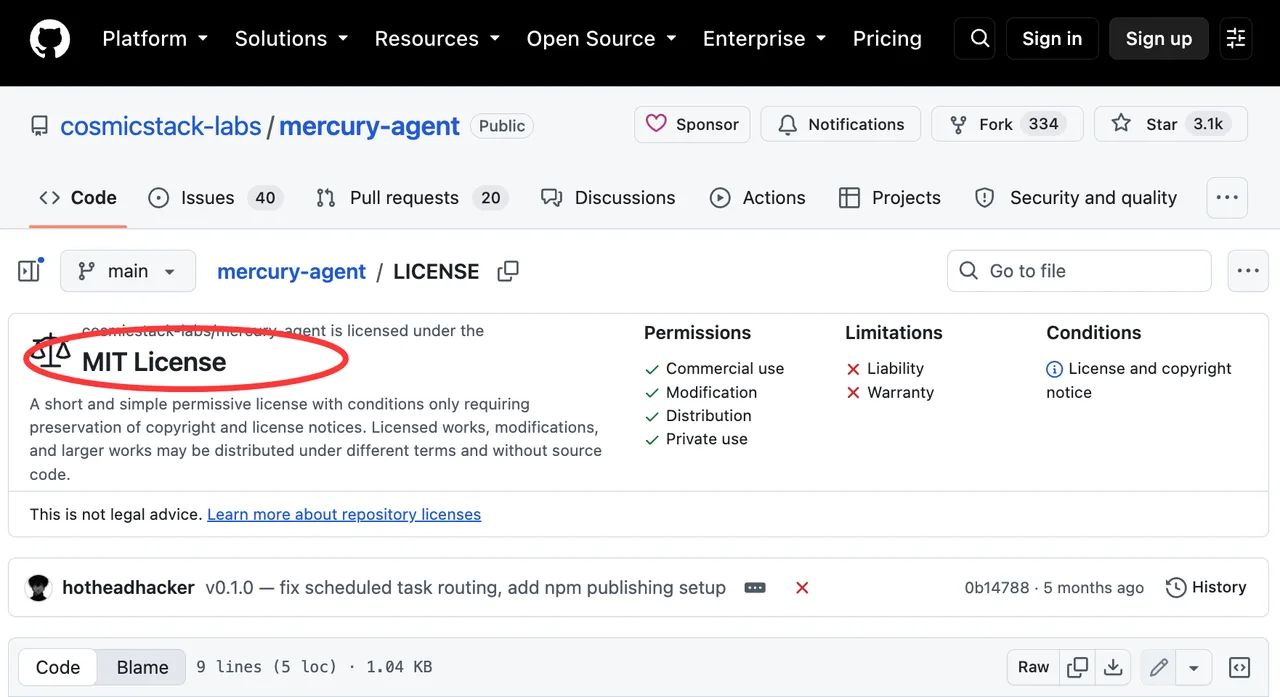
Mercury Agent uses the MIT License. Commercial use, modification, distribution, and sublicensing are permitted, provided the copyright and permission notice remain in substantial copies. The software is supplied without warranty.
Which operating systems have official Mercury Agent support?
Published standalone targets cover macOS on Apple Silicon and Intel, Linux on x64 and ARM64, and Windows x64. Android is also officially documented via Termux, although it uses the npm installation path rather than a prebuilt Android binary and has background-service limitations.
Can Mercury Agent use encrypted external credential stores?
No first-class vault, Keychain, or encrypted credential-store adapter is publicly documented. Mercury supports environment-based credentials and protects some local credential files with restrictive permissions. A deployment wrapper could inject secrets from an external manager, but that would be an integration owned by the operator.
Can existing agent memories be imported into Mercury Agent?
The repository does not document a general memory-import command or a stable interchange schema. Copying SQLite or JSONL data may work between identical versions, but it is not a supported migration contract. Test against a disposable profile before moving valuable state.
How often do releases change skill compatibility requirements?
No fixed compatibility interval is published. The skills system arrived in 1.1.11, while later patch releases continued changing runtime behavior. Pin the Mercury version and skill commit, run the skill diagnostic command, and repeat the single-workload test before every upgrade.
Previous posts:
Related Articles

H3 Max Pricing: Cost per Usable Video Clip
H3 Max vs MiniMax H3: Speed, Output, and Access

Hyper3D WorldGen Review 2027: From One Image to an Editable Scene
FLUX 3 Video vs Seedance 2.5 for Production Workflows
Gemini Omni 1.1 vs Seedance 2.5 for Video Control