
How Do I Handle MiniMax H3 API Timeout Errors?
How to handle MiniMax H3 API timeouts using async polling and status checks so a timeout never means lost work.
Overview
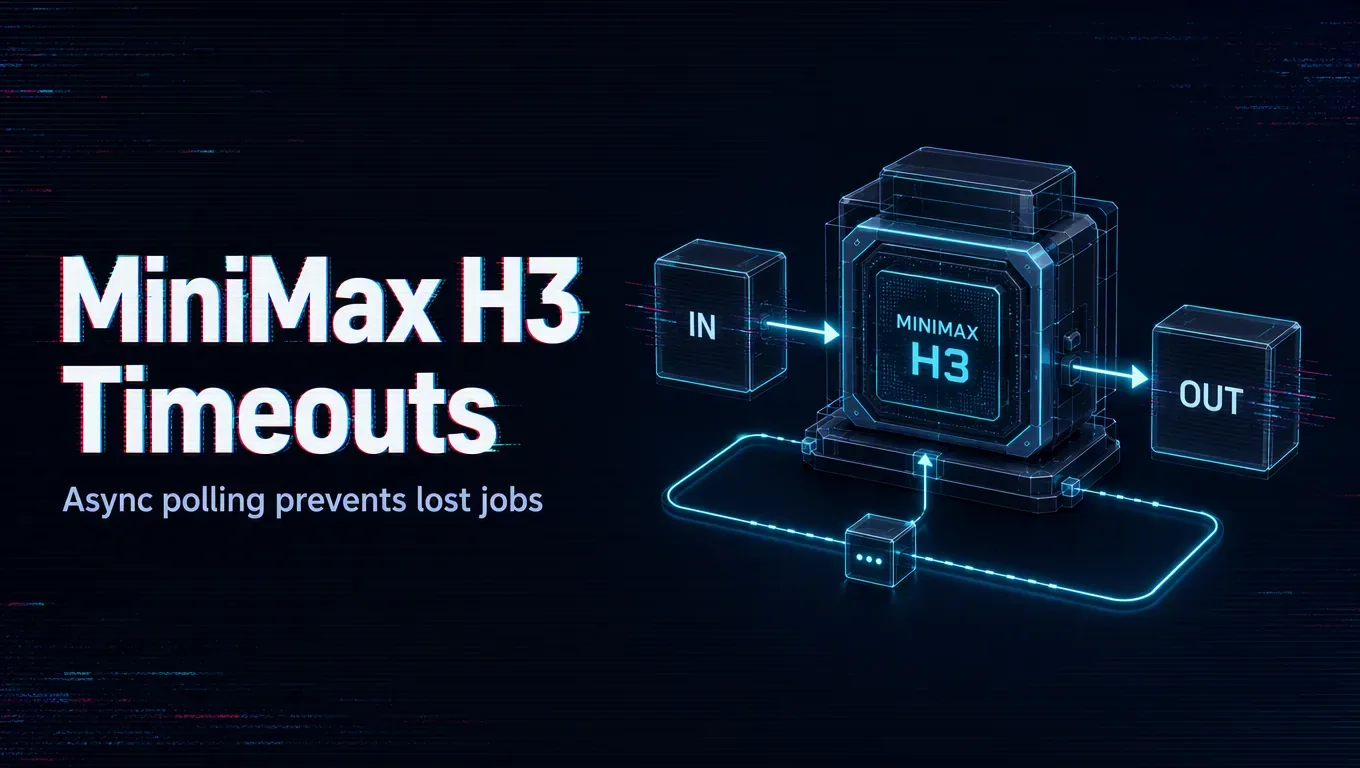
Most timeouts come from treating an asynchronous job like a synchronous one. Video generation takes time, so a request that waits for the finished clip can time out even when the job is fine on the provider’s side. The fix is structural: submit the task, get a task ID back immediately, and check status separately rather than holding one long connection open.
Source note: Verified 2026-08-06 against the MiniMax official H3 blog, MiniMax Video Generation API docs, and Hugging Face MiniMax-H3 model page.
Handle the remaining timeouts deliberately. A timeout on the submit call is ambiguous — the job may or may not have been created — so before blindly resubmitting, query by any identifier you have or use an idempotency key so you do not spawn a duplicate billed job. A timeout while polling is usually harmless; just retry the status check with backoff, since the task keeps running regardless of whether one status request completed. Set sensible client timeouts on each call and log which stage timed out so you can tell a transient network blip from a real provider problem.
The safe default is: never assume a timeout means the work failed. Confirm the actual task status before deciding to retry, cancel, or move on.
Building on the async submit-poll-retrieve pattern from the start makes timeouts a minor, recoverable event rather than a source of lost jobs and mysterious double charges.
/filters:quality(82)/media/images/c347367a-a007-4466-b8f7-d37f5fb52819.webp)
/filters:quality(82)/media/images/cd4db796-7728-45fb-8267-6813ed28e173.webp)
/filters:quality(82)/media/images/1791535252286714222_v4jvJT2a.webp)
/filters:quality(82)/media/images/1791451065663755033_qNqAKS1a.webp)
/filters:quality(82)/media/images/1791359984291066138_tW5eOX6f.webp)
/filters:quality(82)/media/images/1773962750383987480_n3hqzHRZ.webp)