What Are Best Practices for AI Video Generation Error Handling?
Best practices for AI video generation error handling: a failure taxonomy, retry rules per error class, and weekly reviews that catch regressions.
Overview
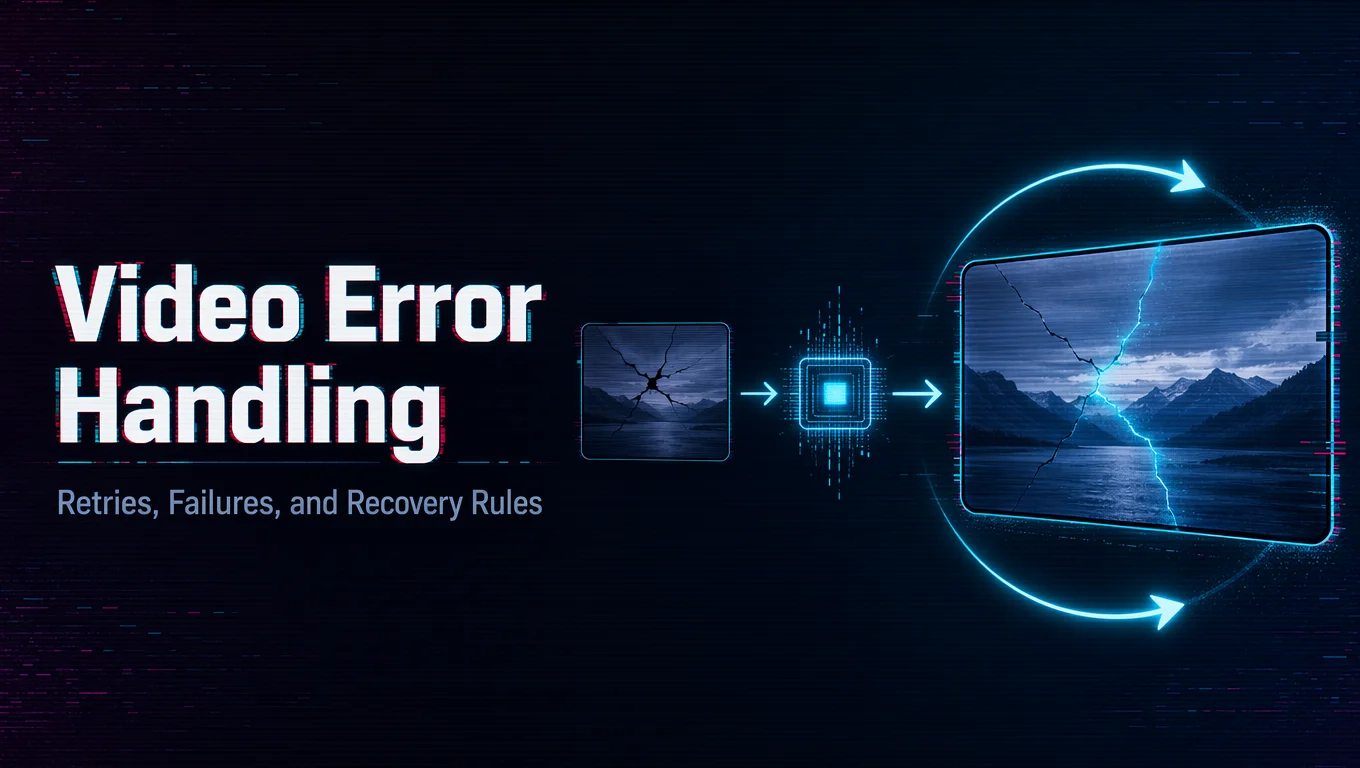
Best practices for AI video generation error handling include validating inputs, classifying error types, retrying safely, storing job IDs, showing user-friendly status messages, and tracking whether failed jobs are billable. Good error handling protects both user experience and budget.
- Validate prompt length, media format, resolution, duration, and unsafe inputs before submission.
- Separate validation errors, provider errors, timeouts, rate limits, and content-policy failures.
- Log request IDs, model, cost, status, and retry history for support review.
Video generation errors can be expensive because each job may consume time and compute. A product should not blindly retry every failure. Some errors require user correction. Some require waiting. Some require switching models or contacting support.
For WaveSpeedAI users, error handling is part of production architecture. Teams using multimodal APIs need clear status codes, webhook events, retry guidance, and billing behavior. The practical workflow is to prevent avoidable errors first, retry only safe cases, notify users clearly, and measure failed-job cost. That turns errors into manageable operations instead of unpredictable support problems. Build the error taxonomy before scaling: classify failures into retryable, input-fix, and escalate buckets, wire each to a distinct response, and review the distribution weekly to catch provider regressions early.
Related reading
Related Articles

Best AI Video Platforms for Production Teams in 2027

Best Sora 2 Alternatives for Video Teams in 2027
Lanta AI Review 2027: Best Uses, Pricing, and Limits
Sora 2 Review 2027: API Quality, Cost, and Limits

Build a GPT-6 Astra 3D Workflow With Blender Assets