
Qwen3.8-27B Review: Performance, Deployment, Efficiency
This Qwen3.8-27B review examines quality, local deployment, memory use, and efficiency so AI builders can judge where the model fits.
John’s back. I have not started a Qwen3.8-27B review from the benchmark table. I start with the deployment ticket: who is going to run it, on what hardware, with which revision, at what context length, and who owns the failure logs when it breaks during a shared test run.
The primary source for this article is the official Qwen/Qwen3.8-27B model card. I did not run a private local benchmark for this article, so I will not invent tokens-per-second, startup time, VRAM, or three-run ranges. Where the official page does not say something, I say that directly.
Review Method and Test Environment
Hardware, Runtime, Precision, and Model Revision
For a real production review, I would not accept “tested locally” as a result. I would require the run sheet first.
The official repository shows Apache-2.0 licensing, Safetensors files, BF16 tensor type, and a visible file tree around 55.6 GB. The official files tree also shows the current main-branch file set and recent commit activity. When I checked it, the visible latest README commit was 1d4bf0f.
My required review record would look like this:
| Field | What I would record before trusting results |
|---|---|
| Model source | Qwen/Qwen3.8-27B, exact commit hash, file checksum if mirrored |
| Hardware | GPU model, GPU count, VRAM, CPU, system RAM, storage type |
| Runtime | Transformers, vLLM, SGLang, TokenSpeed, or other engine version |
| Precision | BF16, FP16, INT8, AWQ, GPTQ, GGUF, or mixed setup |
| Context | 8K, 64K, 256K, and any YaRN extension setting |
| Sampling | temperature, top_p, top_k, reasoning mode, max output |
| Runs | three runs per workload, with min / median / max and failure notes |
This cannot be judged by feeling. It needs a sample run.
Workloads, Prompts, and Acceptance Criteria
I would split the test into five workloads: reasoning, coding, tool use, image understanding, and video understanding. Each workload needs fixed prompts and pass criteria before the first run starts.
For a small team, I would start with 20 to 40 prompts, not 400. The point of the first pass is not to crown a winner. The point is to find whether the model breaks the workflow: bad tool arguments, repeated reasoning, missed visual details, context overflow, slow startup, or unusable refusals.
A good single output does not mean the production workflow is ready.
What Qwen3.8-27B Includes
Architecture, Modalities, Context, and License
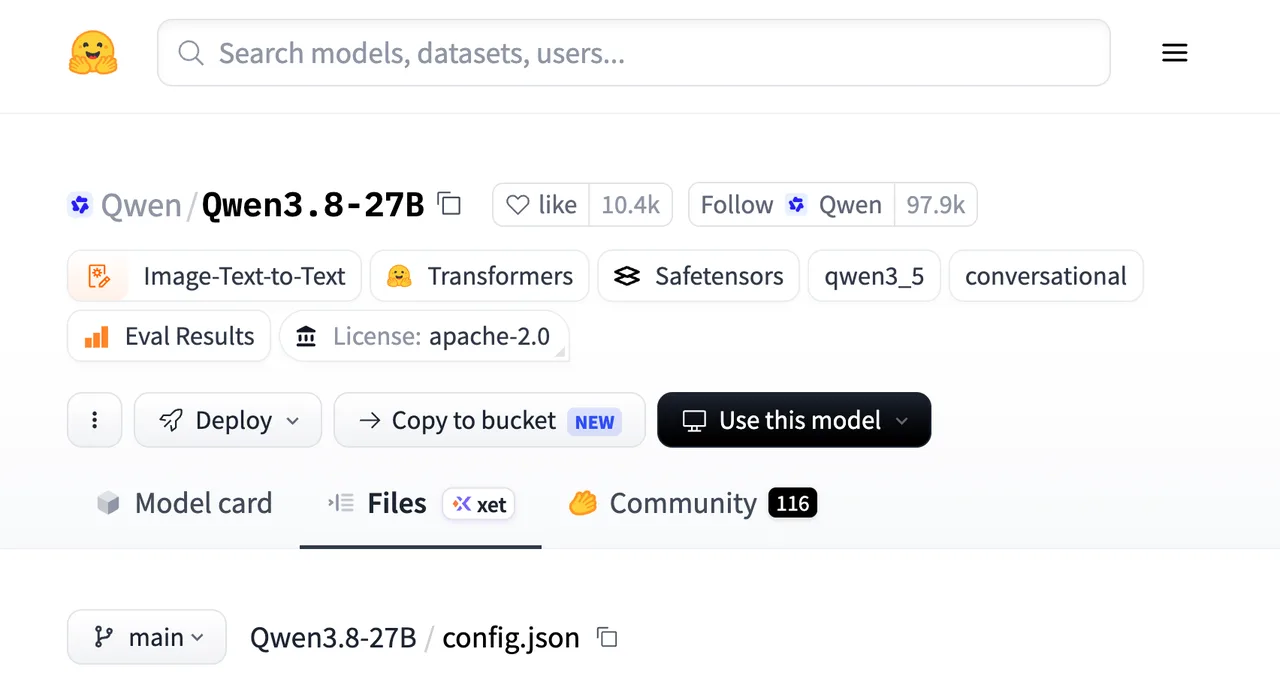
The official card describes Qwen3.8-27B as a causal language model with a vision encoder. It supports text, image, and video input. The config.json lists 64 text layers, hidden size 5120, vocabulary size 248,320, native max position embeddings of 262,144, and a vision configuration with patch size 16.
The model card says the model has 27B parameters. Hugging Face’s file summary shows “28B params.” I would record both, then use the official model name when writing procurement or deployment notes.
The license is Apache-2.0, visible both on the model page and in the LICENSE file. That is useful for many teams, but legal still needs to review downstream use, customer data handling, and any redistribution plan.
Official Checkpoints and Community Builds
Official checkpoints and community quantizations should never sit in the same row.
The Qwen-published BF16 Safetensors checkpoint is the official build I would use as the baseline. Hugging Face also lists community adapters, finetunes, and hundreds of quantizations in the model tree. Those can be useful, but they are not Qwen’s official checkpoint.
If I test a community GGUF, AWQ, FP8, or NVFP4 build, I label it as community unless Qwen publishes it. I do not attribute its latency, quality, or failure pattern back to Qwen.
Evaluate Model Quality
Reasoning, Coding, Tool Use, and Multimodal Tasks
The official Qwen3.8 27B benchmark table reports strong results across coding, agentic tasks, general reasoning, and visual-language tasks. Examples include Terminal Bench 2.1, SWE-bench Pro, LiveCodeBench, GPQA Diamond, OSWorld-Verified, WebArena-Verified, MathVision, OmniDocBench, and RealWorldQA.
I treat those as official benchmark claims, not my local result. That distinction matters. Benchmark conditions include harness choices, context windows, judging models, corrected annotations, and in-house benchmarks. If a team cannot reproduce the task shape, the number is still useful, but it is not deployment proof.
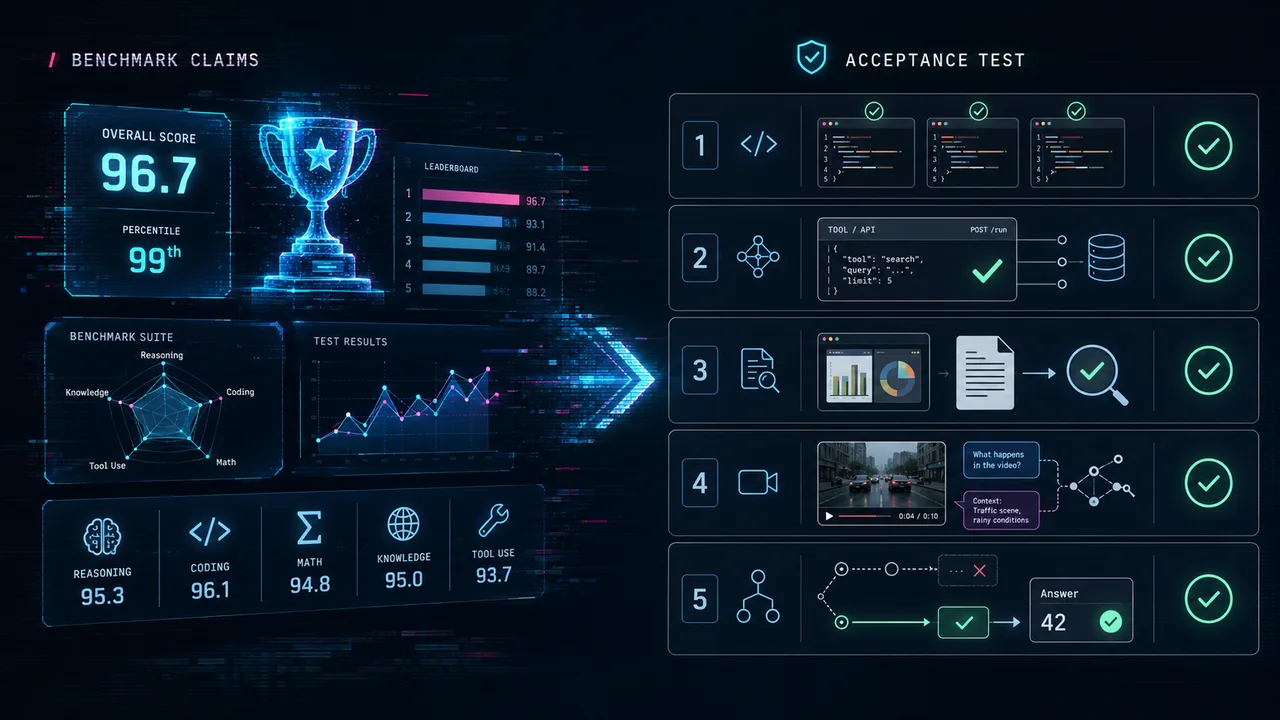
For my own acceptance test, I would ask:
- Can it solve the same coding task three times without format drift?
- Can it call tools with valid structured arguments?
- Can it read screenshots and documents accurately enough for review work?
- Can it handle video prompts without forcing the operator to re-explain obvious context?
- Can it stop reasoning when a direct answer is better?
Reliability, Refusals, and Failure Patterns
I would watch failures more closely than peak answers.
The official card says thinking mode is on by default, supports reasoning_effort, and preserves thinking across history unless disabled. That can help long tasks, but it can also change cost, latency, and review behavior.
For agent work, I would log refusal style, tool-call loops, language mixing, repeated reasoning, broken JSON, lost visual references, and cases where lower reasoning effort increases retries. The card itself warns that lower reasoning effort may not always reduce total completion time in multi-turn agentic tasks.
That is the kind of warning I like. It sounds like something found in production.
Measure Local Performance
Startup Time, Memory Use, and Generation Speed
The official page does not provide a universal minimum VRAM number for Qwen3.8 memory requirements. It shows BF16 weights and a large file footprint. That means a local BF16 deployment is not a casual laptop test unless the runtime shards or offloads it; a smaller community quantization is a separate deployment path.
For a Qwen3.8 local model evaluation, I would measure:
Startup time from process launch to first ready response.
Peak VRAM after load.
Peak VRAM during 8K, 64K, and 256K contexts.
Prefill speed.
Decode speed.
First-token latency.
Throughput under one user and shared users.
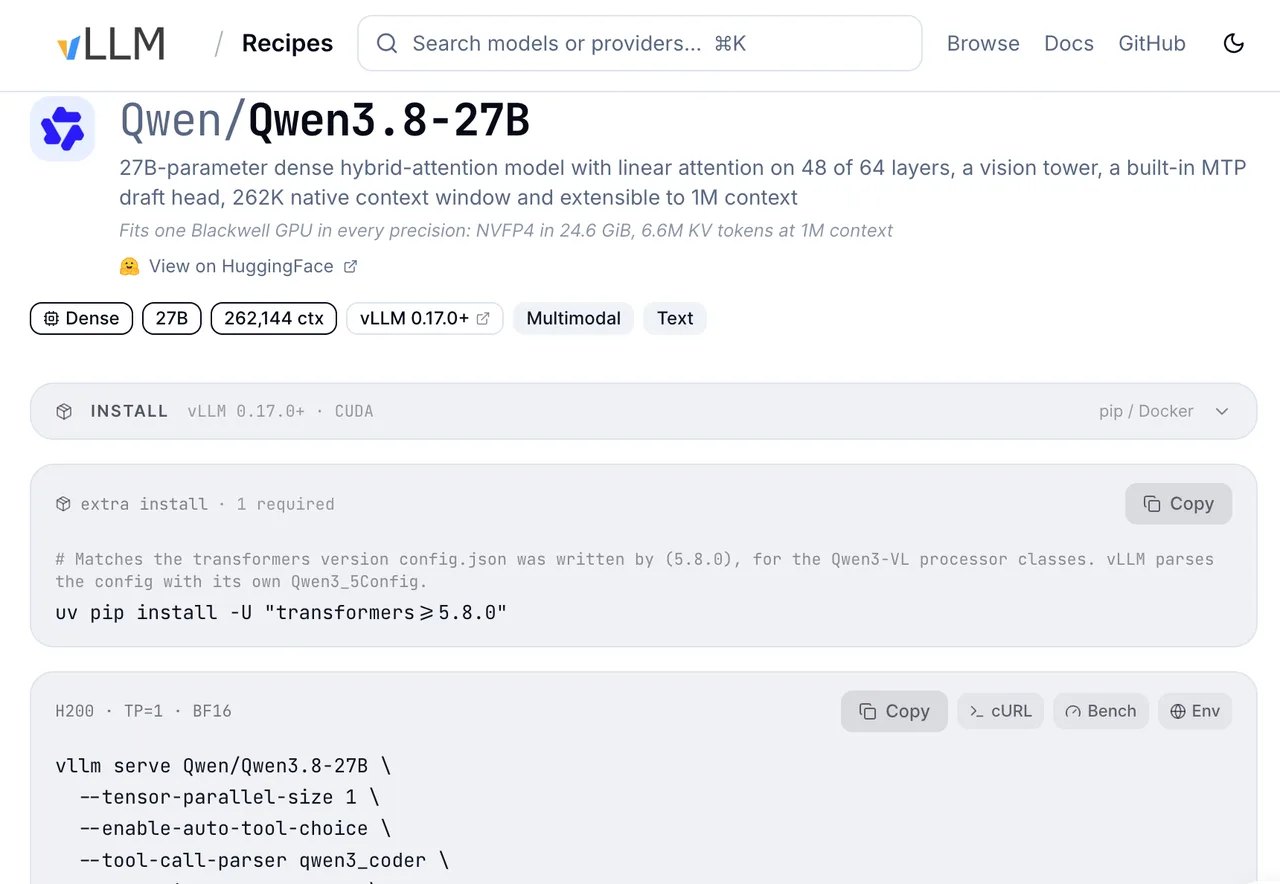
For serving-specific work, I would check engine guidance instead of guessing. The vLLM Qwen3.8-27B recipe gives a concrete serving view, including precision paths, context notes, MTP usage, and troubleshooting around quantized variants. I would still treat those as runtime guidance, not as a substitute for my own three-run measurements.
Context Growth and Out-of-Memory Behavior
Native context is listed as 262,144 tokens, with extension up to 1,000,000 tokens using RoPE scaling techniques such as YaRN. That does not mean every runtime, GPU, or quantization path will survive a 1M-token workload.
I would test context growth in steps. I would also record what happens when it fails: clean error, process crash, CUDA out-of-memory, silent truncation, broken image processing, or unusable latency.
Qwen3.8 inference is interesting because the model is designed for long-horizon tasks. But long context is not free. KV cache, image tokens, video sampling, and preserved thinking all affect the floor.
Decide Where the Model Fits
Local Prototypes, Private Workloads, and Batch Jobs
I would consider Qwen3.8-27B for local prototypes, private document workflows, internal coding agents, batch multimodal review, and teams that need open-weight control without jumping to a much larger model.
The Qwen3.8 model efficiency question is not only “*Can it run?*” It is “Can it finish the task with fewer retries, fewer handoffs, and fewer failed reviews?” If a 27B model reduces operator rework, it may beat a smaller faster model in total workflow time.
One person can remember parameters. A team cannot. Pin the revision, store prompts, log runtime flags, and keep model outputs tied to the exact checkpoint.
When a Hosted or Different-Sized Model Is Safer
I would choose hosted inference or a different model size when the team lacks GPU capacity, needs strict uptime, needs multi-user concurrency, or cannot support long-context memory pressure.
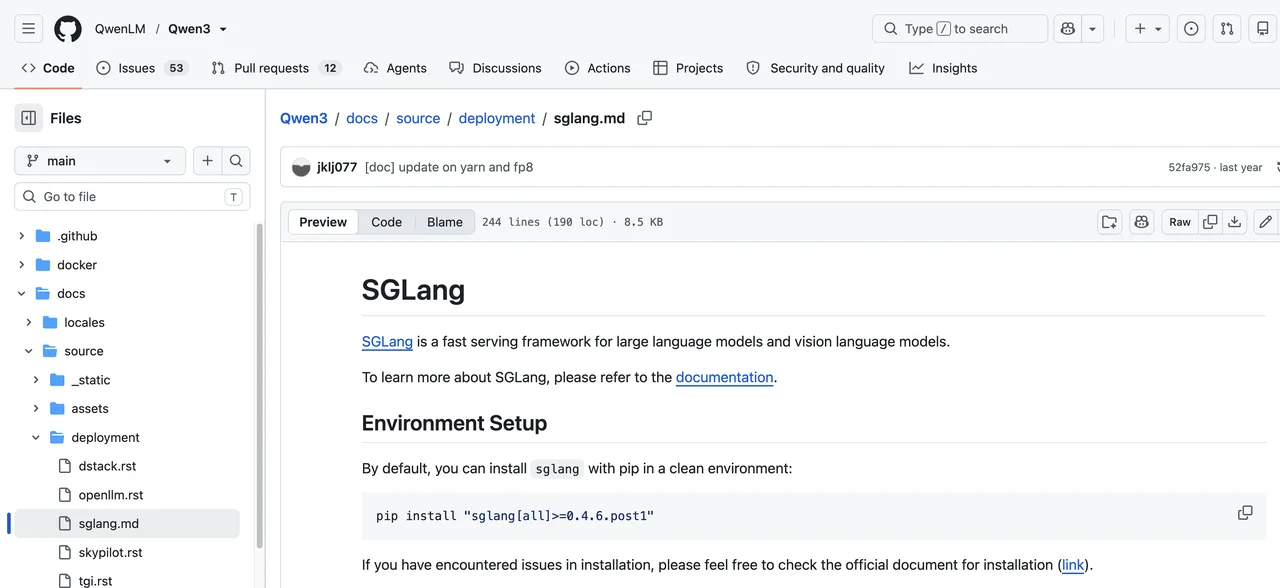
The official card lists vLLM, SGLang, and TokenSpeed as serving paths. For general Qwen deployment mechanics, the Qwen SGLang deployment docs show OpenAI-compatible serving, tensor parallelism, reasoning parsing, tool-call parsing, JSON output, quantized deployment, and long-context configuration patterns. That page is not a Qwen3.8-27B benchmark. I would use it as a deployment reference, then test the actual model and revision myself.
Do not switch models yet. Look at the workflow first.
Limits and Trade-Offs
One Hardware Result Does Not Generalize to Every Runtime
A result from one H100 box does not describe an RTX 4090 workstation. A single-user Transformers run does not describe a shared vLLM endpoint. A short text-only prompt does not describe a video-heavy agent workflow.
If someone sends me one screenshot of tokens per second, I ask for the run sheet.
Quantization Can Change Quality and Compatibility
Community quantization can make deployment possible, but it can also change quality, memory behavior, multimodal compatibility, context stability, and tool-use reliability.
I would not approve a quantized build for shared production until it passes the same prompts as the official checkpoint. If the quantized model is used, the article, dashboard, and release note should name it directly.
FAQ
Can several developers share one Qwen3.8-27B endpoint?
Yes, if the serving stack supports concurrency and the team has access control, rate limits, and per-user logs. I would not let several developers share an endpoint without request attribution. Debugging becomes guesswork.
How should teams pin a model revision for production?
Pin the Hugging Face commit hash, config files, tokenizer files, runtime version, and quantization build if used. Store the exact revision in deployment metadata, not only in a wiki page.
What logs should be retained after a failed evaluation run?
Keep prompt ID, model revision, runtime, hardware, precision, context length, sampling settings, error message, memory peak, output text, and reviewer decision. Do not keep sensitive customer data unless policy allows it.
Can local inference be isolated between customer projects?
Yes, but it requires design. Use separate storage, logs, cache paths, access controls, and network rules. If customer data matters, do not let shared prompts, generated outputs, or cached media bleed across projects.
Who should approve a checkpoint change in a shared environment?
The platform owner, product owner, and evaluation owner should approve it. Security or legal may need review if the model affects customer data, licensing, or regulated workflows.
Conclusion
This Qwen3.8-27B review lands in a cautious place: the official checkpoint looks serious, multimodal, long-context, and deployment-oriented, but production fit still depends on your runtime, hardware, context length, precision, and failure tolerance.
I would test it as a workflow component, not as a benchmark trophy. Start with a pinned revision, run three passes per workload, separate official checkpoints from community builds, and measure the rework path. The conclusion is valid at this scale.
Previous posts:
Related Articles
/filters:quality(82)/media/images/1791192288445452271_ToxGQZ8i.webp)
Holo4 27B vs 35B-A3B: Which Fits Your Agent?
/filters:quality(82)/media/images/1791194933461111356_WeoxGPY8.webp)
Holo4 API vs Local Deployment: Which Fits Your Agent?
/filters:quality(82)/media/images/1790934318687045151_6DhqzIS1.webp)
Best AI Video APIs for High-Volume Workflows in 2027
/filters:quality(82)/media/images/1790879706333726948_TmjHVhrF.webp)
Introducing AI Cinema Studio on WaveSpeedAI: Direct Cinematic AI Video Shots
/filters:quality(82)/media/images/1790934887466368319_r2GQZ8hr.webp)
LTX Studio Review 2027: Does the Video Workflow Hold Up?
/filters:quality(82)/media/images/1790935090456133598_u9CLU4dm.webp)