
Replicate Just Got Acquired by Cloudflare — Should You Still Use It Over WaveSpeedAI?
Replicate was acquired by Cloudflare in 2026. We compare Replicate's cold starts, pricing, and model quality to WaveSpeedAI's optimized inference API.
Replicate made headlines when Cloudflare announced its acquisition in November 2025. For developers who already use Replicate, the question is practical: does the deal change where you should run your models?
Replicate still has a compelling community marketplace and a straightforward way to publish custom models. WaveSpeedAI offers a different draw: one API for a broad range of ready-to-use generation models. The choice depends on the model, deployment setup, latency you can tolerate, and what a completed output costs.
What Is Replicate?

Replicate is a cloud platform for running machine learning models through an API. Developers can use public models or package and publish their own with Cog.
Replicate announced the Cloudflare deal on November 17, 2025. Cloudflare said Replicate had officially joined it on December 1, 2025. Replicate said its brand and API would continue. That describes the acquisition at the time; it is not a promise that every future model, price, or integration will stay the same.
The Cold Start Problem
Cold starts are a real consideration on Replicate, but they do not affect every request equally. According to Replicate’s explanation of cold boots, a model that has been idle may need to start before processing a prediction. Popular public models are less likely to be cold. Demand spikes can also start new workers.
| Setup | What to expect |
|---|---|
| Popular public model | Often already warm; check the specific model |
| Less-used public model | Greater chance of a cold boot |
| Deployment with minimum instances set to zero | Can scale down and require startup later |
| Deployment with minimum instances set to one or more | Keeps capacity running, with an ongoing cost |
A cold boot can take several minutes in some cases. That makes latency worth testing for a user-facing feature, but it does not support one fixed “Replicate cold start time.” WaveSpeedAI also should not be assigned a universal response time without testing the same model and inputs. Queueing, generation, and download time all matter to the user waiting for a result.
Head-to-Head Comparison
| Feature | Replicate | WaveSpeedAI |
|---|---|---|
| Model selection | Large community catalog, official models, and custom models | Broad catalog accessed through one platform |
| Custom model publishing | Cog and private deployments | Check the required deployment path for your model |
| Cold starts | Depend on model activity and deployment settings | Check the selected endpoint’s observed response time |
| Pricing | Depends on the model: hardware time or input/output units | Usage-based, with model-specific pricing |
| Cost to keep a model warm | Relevant for dedicated Replicate deployments | Depends on the service arrangement |
| Output quality | Depends on the model and implementation | Depends on the model and implementation |
| Production decision | Check model maintenance, deployment, and measured latency | Check endpoint availability, measured latency, and final charges |
Neither catalog size nor a platform-wide speed claim tells you how your model will perform. Start with a model both platforms offer, then compare the finished outputs and the full request lifecycle.
A Same-Model Check: FLUX.1 Schnell on Both Platforms
FLUX.1 Schnell makes the comparison concrete. As checked in November 2026, Replicate lists black-forest-labs/flux-schnell at **$3 per 1,000 output images, or $0.003 per image. WaveSpeedAI’s FLUX Schnell documentation also lists $0.003 per image**. Those are published base prices, not a measured cost or speed result for a batch of requests.
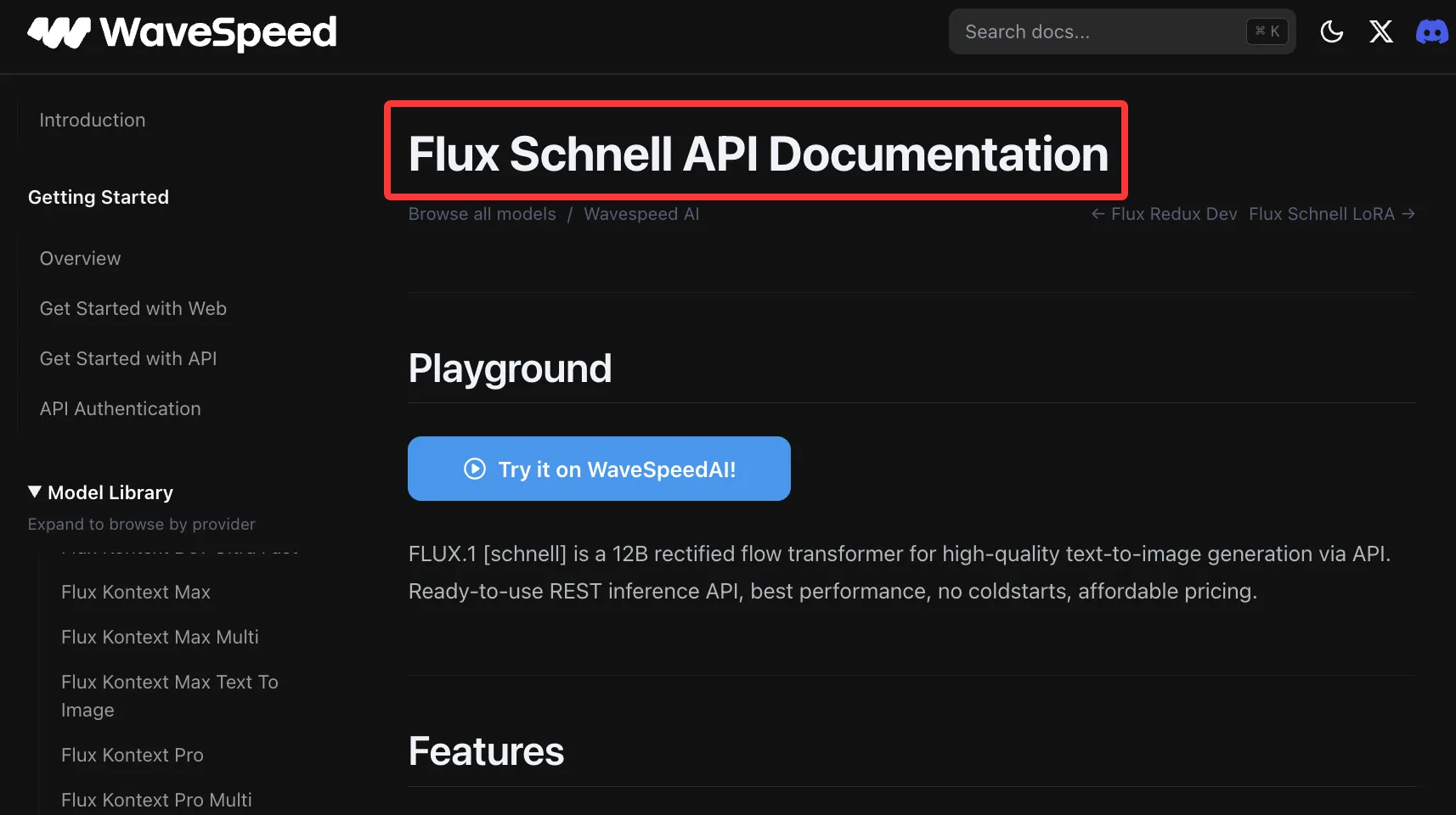
For a first comparison, request one square PNG with the same prompt on each platform:
| Replicate | WaveSpeedAI | |
|---|---|---|
| Model ID | black-forest-labs/flux-schnell | wavespeed-ai/flux-schnell |
| Prompt | A red ceramic mug on a white table | Same prompt |
| Size setting | aspect_ratio: “1:1”, megapixels: “1” | size: “1024*1024” |
| Output count | num_outputs: 1 | num_images: 1 |
| File format | output_format: “png” | output_format: “png” |
| Successful result | status: “succeeded”; read output | data.status: “completed”; read data.outputs |
The fields differ, so migrating takes more than replacing a model string. Record the time from submission until the image is downloadable, the final charge, failures, and whether the output meets your brief. Repeat at the volume and time of day your product actually uses. A matching base price does not establish matching latency or image quality; different implementations may also produce different images from the same prompt and seed.
Where Replicate Falls Short
-
Pricing Takes Model-by-Model Work
Replicate does not bill every model by GPU second. Its pricing explanation says some models are billed by hardware and time, while others are billed by input or output. That means you need to check the model page before estimating a batch.
Public-model billing generally covers active processing time, while most private models on dedicated instances can incur setup, idle, and active time. Keeping an instance warm can improve responsiveness, but it changes the cost calculation. WaveSpeedAI also prices models individually; check the estimate and the recorded charge for your exact inputs before declaring either platform cheaper.
-
Community Models Require More Checking
Replicate’s community catalog is useful precisely because people can publish specialized models. Before putting one into a product, check who maintains it, which version your calls use, whether its inputs have changed, and what its license permits.
This concern does not apply equally to every Replicate model. Its official and popular models deserve their own evaluation. WaveSpeedAI models also need output and reliability checks for the workflow you intend to ship.
-
Model Availability Changes
Do not assume a model family is exclusive to either platform. Compare the specific version and task you need: text-to-image, image-to-video, editing, or another endpoint. A shared model name does not guarantee matching inputs, features, or output behavior.
WaveSpeedAI’s unified access is useful when your application switches among several providers. Replicate may be the better fit when a niche community model or a custom Cog model is central to the product.
-
The Cloudflare Integration Is Still a Product Question
Cloudflare ownership gives Replicate more infrastructure behind it, but the acquisition alone does not prove a latency improvement or an API regression. If you already run Replicate in production, watch the documentation and your own prediction logs for changes that affect your application. Judge the service you can use now, rather than a presumed future integration.
Where Replicate Wins
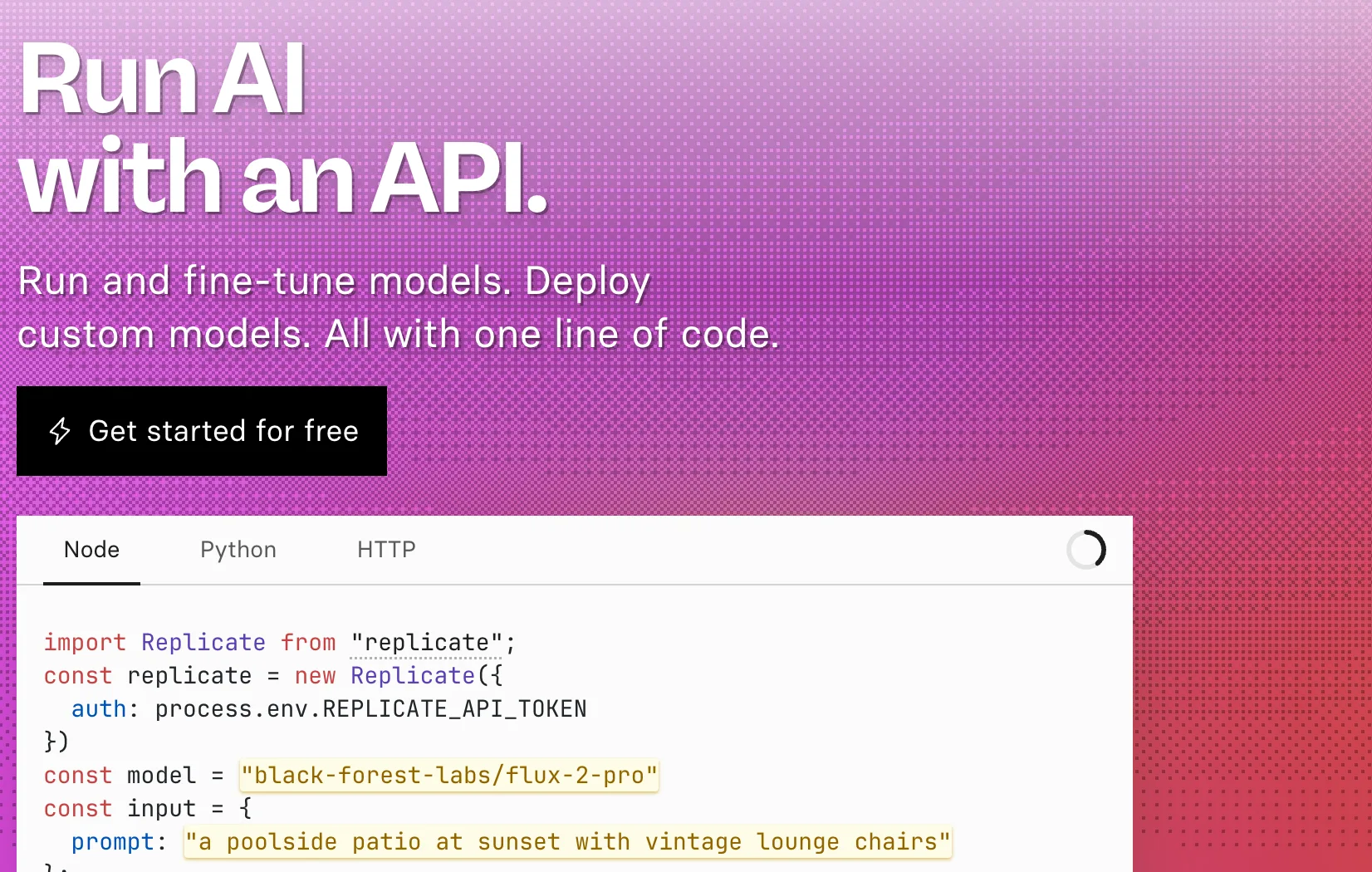
- Community marketplace: A niche or experimental model may already be available.
- Cog packaging: Developers can package and publish their own models.
- Deployment control: Minimum instances let a team trade ongoing spend for a model that stays ready.
- Existing integrations: If your current Replicate model meets its latency and cost targets, migration needs a reason.
Frequently Asked Questions
Is Replicate still independent after the Cloudflare acquisition?
Replicate continues as a distinct brand within Cloudflare. Its November 2025 announcement said the API was not changing as part of the deal. Check current documentation before planning a long-term integration around that statement.
Why do some Replicate requests have cold starts?
An idle model may have been stopped, or a demand spike may require a new worker. Popular public models are less likely to encounter this. A deployment with minimum instances of at least one can keep capacity running at an ongoing cost.
Is Replicate cheaper than WaveSpeedAI?
It depends on the model, settings, and billing arrangement. The published FLUX.1 Schnell base prices above are the same. For your workload, compare total charges divided by usable outputs, including failed runs and any dedicated-instance costs.
Can I use Replicate’s community models on WaveSpeedAI?
Do not assume a community model has a matching WaveSpeedAI endpoint. Check the exact model and version, then compare its input schema and outputs before migrating.
Which platform has better uptime?
This article has no measured uptime comparison or evidence for a platform-wide SLA on both sides. If uptime is a purchase requirement, get the applicable service terms and compare your own incident records.
Bottom Line
Replicate remains a strong choice for community models, custom packaging, and teams that already know the deployment behavior they need. WaveSpeedAI is worth evaluating when access to several generation models through one API would simplify your workflow.
Cloudflare’s acquisition is a reason to revisit the comparison, not a verdict. Pick one model your product actually uses, send equivalent requests, and record completed-output time, usable results, and final cost. That will tell you more than a platform-wide speed or savings claim.
Previous posts:
Related Articles

GPT Image 2.6: What Is Confirmed, What Is Rumor, and What to Build On Today
Seedream 5.5: What to Expect, and How to Get Ready
Connect WaveSpeed to Claude, ChatGPT and Cursor with One URL
Nano Banana 3 Pro Spotted: What the Gempix 3 Pro Leak Tells Us

GPT Image 2.5 API Guide: Flare & Sunburst on WaveSpeedAI