
How Should Developers Handle Failed AI Generation Jobs and Retries?
Separate confirmed failures from uncertain submissions, persist task IDs, apply bounded backoff and retry only operations proven safe.
Overview
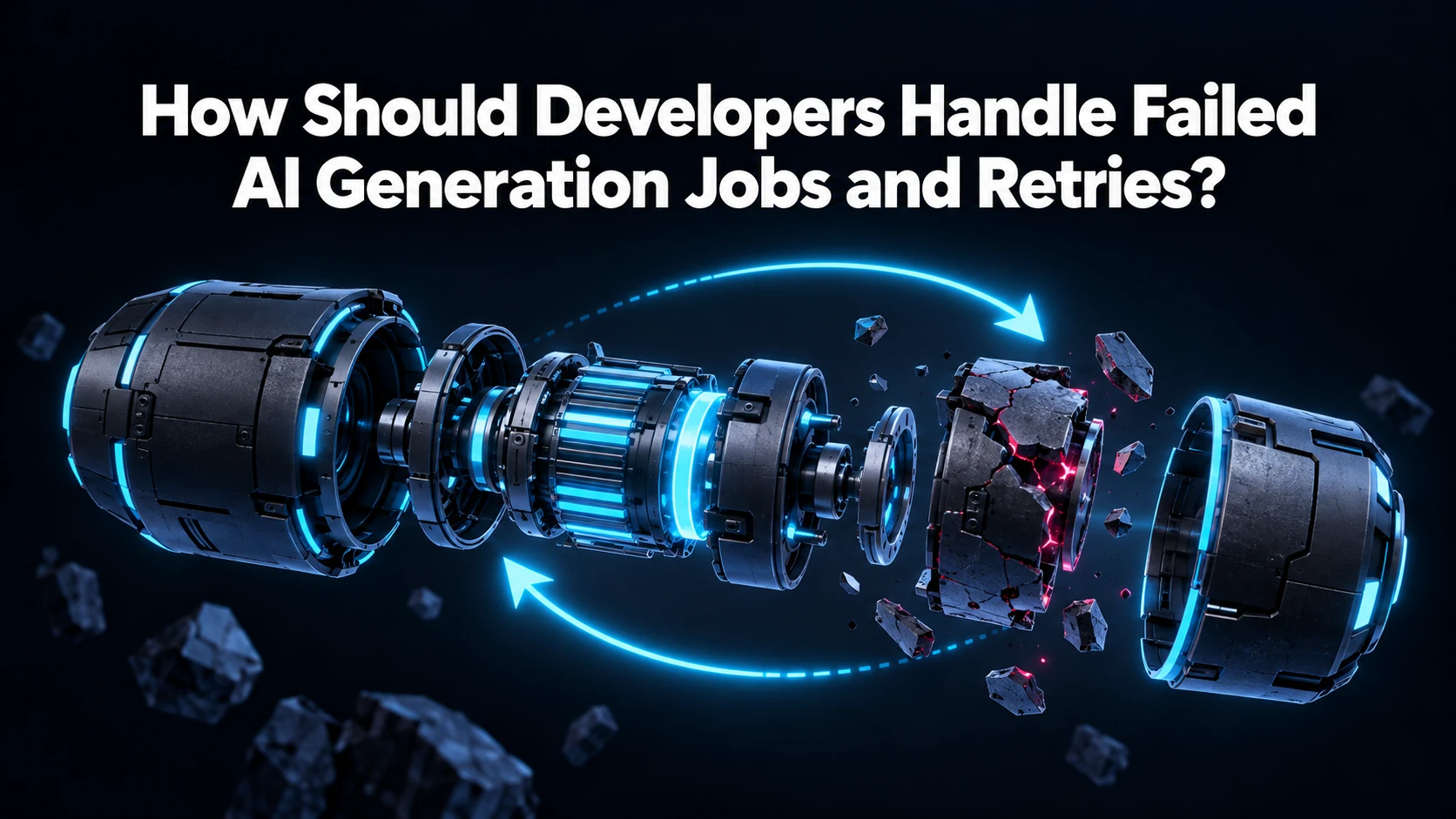
Developers should treat a confirmed failed generation differently from a submission whose outcome is unknown. Retry a failed job only after checking its error and the model’s policy; do not blindly repeat a POST when the network times out after the provider may have accepted it. WaveSpeedAI’s API examples warn that such a retry can create and bill a duplicate prediction.
Persist a local job ID before submission. Record the route, input fingerprint, user action and any returned prediction ID. If submission clearly fails before acceptance, the request may be retried under your policy. If the response is uncertain, reconcile against available provider records or show an “unknown, checking” state rather than launching another job. Once you have a prediction ID, use the result endpoint to distinguish pending, completed and terminal failure states. GET result checks are safer to retry than task-creating POSTs.
Use bounded backoff for transient status errors and respect rate-limit responses. A content-policy rejection, invalid input or depleted balance needs a different user message from a temporary server error; automatic repetition will not fix it. Retain enough event history to avoid charging or delivering the same logical job twice.
Finally, make recovery visible. The user should know whether to edit the prompt, wait, or contact support. A reliable retry policy protects user trust as much as infrastructure. Test this behavior with simulated timeouts before enabling production traffic.
Source: WaveSpeedAI API quickstart; WaveSpeedAI result API; WaveSpeedAI account levels. Source check: 2026-09-29.
/filters:quality(82)/media/images/c347367a-a007-4466-b8f7-d37f5fb52819.webp)
/filters:quality(82)/media/images/cd4db796-7728-45fb-8267-6813ed28e173.webp)
/filters:quality(82)/media/images/1791535252286714222_v4jvJT2a.webp)
/filters:quality(82)/media/images/1791451065663755033_qNqAKS1a.webp)
/filters:quality(82)/media/images/1791359984291066138_tW5eOX6f.webp)
/filters:quality(82)/media/images/1773962750383987480_n3hqzHRZ.webp)