
When Should I Use Native-Audio Video Generation Instead of a Separate TTS and Lip-Sync Pipeline?
Choose native-audio video or a modular TTS and lip-sync pipeline based on timing, voice control, localization, review, and cost.
Overview
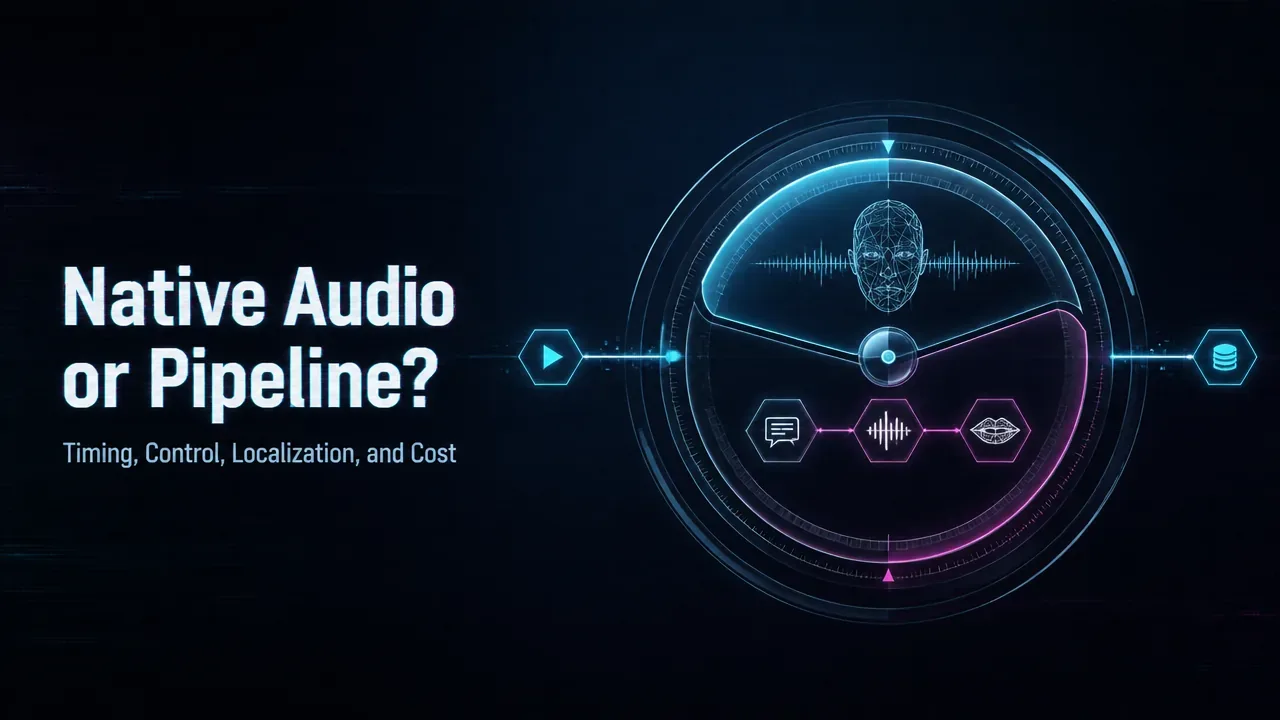
Use native-audio video generation when you want one model to create picture, motion, speech, ambience, and timing as a unified result. Use separate TTS and lip sync when voice identity, script revision, multilingual replacement, pronunciation, or independent approval must remain under your control.
Match the architecture to the job
Native audio can be effective for exploratory dialogue, atmospheric clips, and rapid concepts because audiovisual timing is created together. The trade-off is modularity: changing one line or voice may require generating the clip again, and language or voice controls depend on the specific model.
A modular pipeline generates or edits the visual first, produces speech through TTS, and applies a lip-sync model afterward. It adds orchestration and may introduce synchronization artifacts, but each component can be replaced, reviewed, localized, and costed separately. That is useful for product demos, regulated scripts, recurring characters, and campaigns with several language versions.
WaveSpeedAI provides access to models across video, audio, and lip-sync categories. Native audio is an upstream model capability, not a universal WaveSpeedAI post-processing feature. Confirm the current model schema before promising audio generation, supported languages, or voice controls.
Choose by revision pressure
For a disposable concept, optimize for speed. For approved copy, known voices, or localization, optimize for replaceable components and auditability.
Test end to end
Compare lip timing, speech clarity, emotional fit, revision time, failure rate, and cost per accepted clip. The simpler-looking pipeline is not always the cheaper production system.
/filters:quality(82)/media/images/c347367a-a007-4466-b8f7-d37f5fb52819.webp)
/filters:quality(82)/media/images/cd4db796-7728-45fb-8267-6813ed28e173.webp)
/filters:quality(82)/media/images/1791535252286714222_v4jvJT2a.webp)
/filters:quality(82)/media/images/1791451065663755033_qNqAKS1a.webp)
/filters:quality(82)/media/images/1791359984291066138_tW5eOX6f.webp)
/filters:quality(82)/media/images/1773962750383987480_n3hqzHRZ.webp)