
MiniMax H3 vs Wan Video Models: Which Should I Use?
MiniMax H3 vs Wan video models compared by scenario, speed, cost, and API availability to guide model selection.
Overview
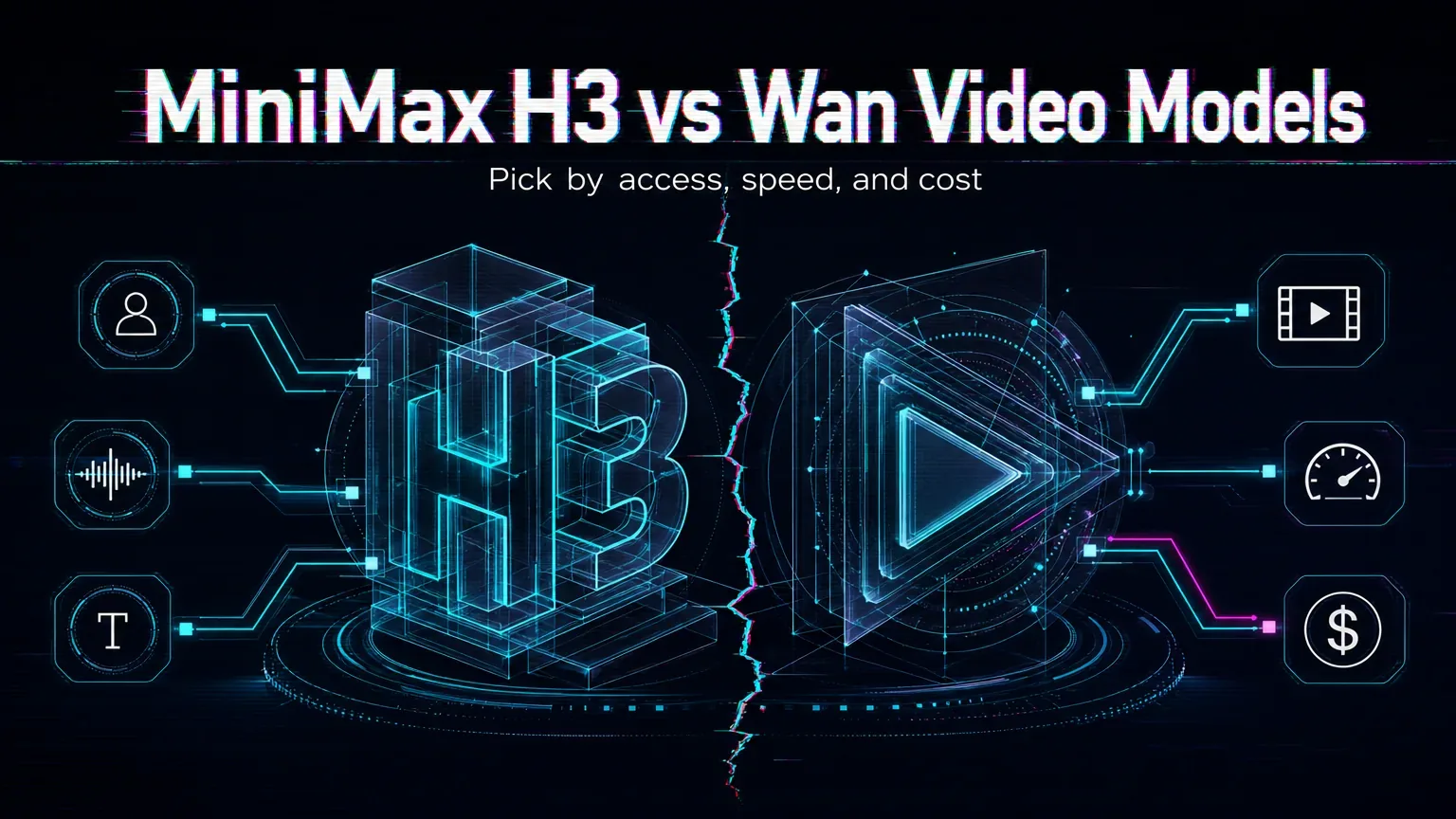
Pick by scenario and by how you want to run the model, since MiniMax H3 and the Wan family currently differ on access as well as output. As of early August 2026 H3 is API-only — announced July 31, 2026 as open-weight, but weights not yet shipped — while Wan models are available to run locally, so H3 today is a hosted service and Wan can be self-hosted. Source note: Verified 2026-08-06 against the MiniMax official H3 blog, MiniMax Video Generation API docs, and Hugging Face MiniMax-H3 model page.
On capability, H3 leans on omni-modal input (text, image, video, audio in one context), native stereo audio, and 2K output through its API. Wan models are a strong open option for teams that want local control. So the decision often comes down to: do you want managed, audio-aware 2K generation without hardware (H3’s API), or local, self-hosted control (Wan)?
Test each on the footage you actually produce, and factor in cost — H3’s per-second API price versus Wan’s GPU and operational cost at your volume.
When H3’s open weights arrive, the comparison shifts toward a direct local matchup; until then, weigh hosted H3 against self-hosted Wan on your workflow, and confirm current capabilities and access on each before committing.
/filters:quality(82)/media/images/c347367a-a007-4466-b8f7-d37f5fb52819.webp)
/filters:quality(82)/media/images/cd4db796-7728-45fb-8267-6813ed28e173.webp)
/filters:quality(82)/media/images/1791535252286714222_v4jvJT2a.webp)
/filters:quality(82)/media/images/1791451065663755033_qNqAKS1a.webp)
/filters:quality(82)/media/images/1791359984291066138_tW5eOX6f.webp)
/filters:quality(82)/media/images/1773962750383987480_n3hqzHRZ.webp)