
What Is the MiniMax H3 Video Generation Endpoint?
What the MiniMax H3 video generation endpoint does — task creation, multimodal inputs — and how to call it cleanly.
Overview
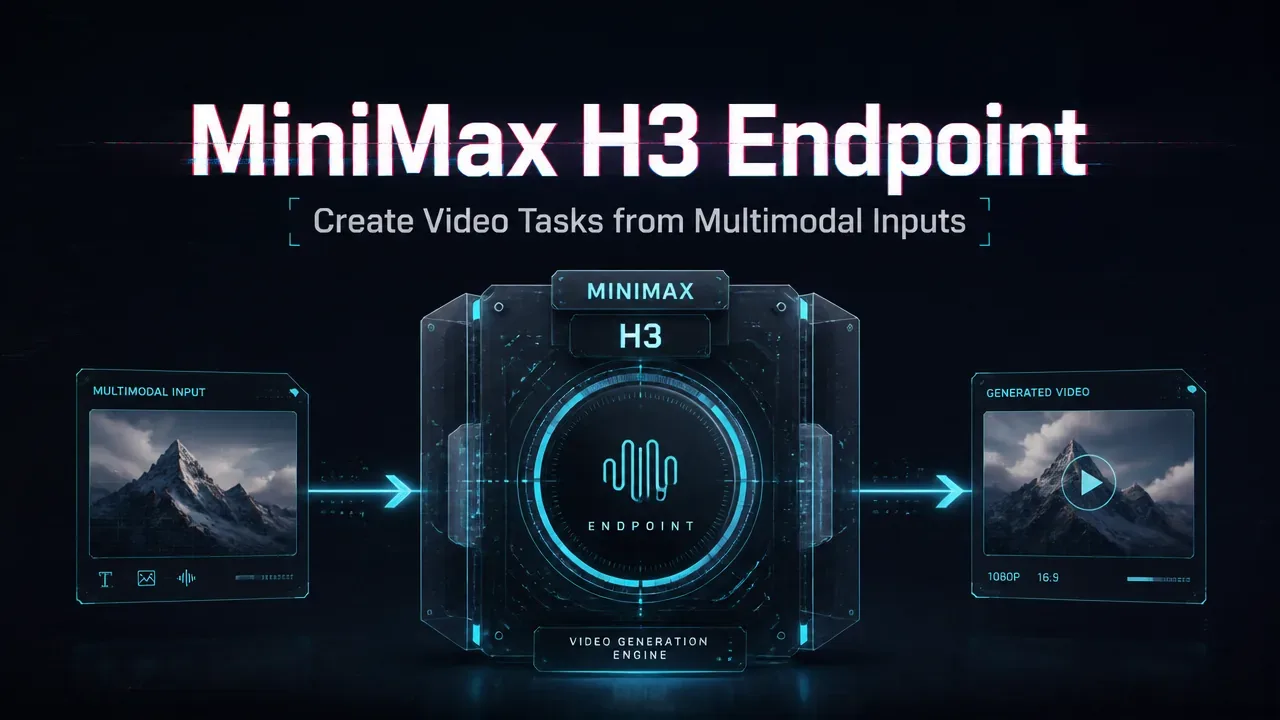
The generation endpoint is the call that creates a video task from your inputs and returns a task ID you then track. Confirm the exact path, method, and payload shape in the current MiniMax H3 documentation, because those details differ by provider and change between versions, and a mismatched payload is the usual reason a first call is rejected.
Source note: Verified 2026-08-06 against the MiniMax official H3 blog, MiniMax Video Generation API docs, and Hugging Face MiniMax-H3 model page.
Conceptually, the request carries your prompt plus any modal inputs the model accepts. Modern multimodal video APIs often take a structured content array rather than a single text field, which lets you attach reference images, video, or audio alongside the text in one request and tell the model what each item is for. You also set parameters like duration and resolution here. Because generation is asynchronous, this endpoint usually returns quickly with a task ID rather than the finished video, and you fetch the result through a separate status call once it is done.
Build your request from the documented schema, not from a guess. A malformed content array or a wrong parameter name is the most common reason a first call is rejected, and the error message is not always descriptive enough to point you straight at the fix.
Keep the task ID the moment you receive it, since every later step — checking status, retrieving output, canceling — depends on having it stored reliably against the right user and request.
/filters:quality(82)/media/images/c347367a-a007-4466-b8f7-d37f5fb52819.webp)
/filters:quality(82)/media/images/cd4db796-7728-45fb-8267-6813ed28e173.webp)
/filters:quality(82)/media/images/1791535252286714222_v4jvJT2a.webp)
/filters:quality(82)/media/images/1791451065663755033_qNqAKS1a.webp)
/filters:quality(82)/media/images/1791359984291066138_tW5eOX6f.webp)
/filters:quality(82)/media/images/1773962750383987480_n3hqzHRZ.webp)