
MiniMax H3 Official API vs Third-Party Unified API: Which Is Better for Teams?
Official MiniMax H3 API vs a third-party unified API — how teams should weigh one model against many behind one key.
Overview
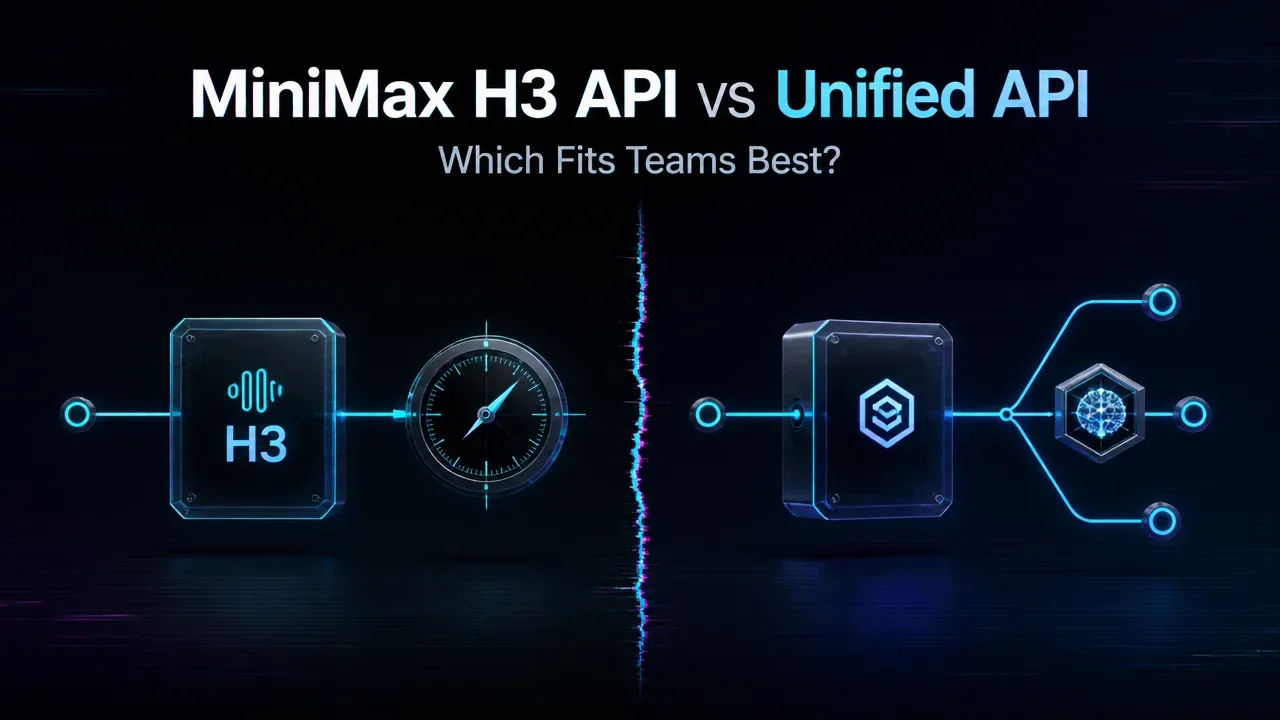
It comes down to one model with full first-party access versus many models behind one integration. The official MiniMax H3 API gives you the provider’s complete, first-party surface for that model. A third-party unified API gives you MiniMax H3 plus other video models through a single key, billing, and integration pattern. The better fit depends on how many models your team expects to use and how much you value not rebuilding integrations.
Source note: Verified 2026-08-06 against the MiniMax official H3 blog, MiniMax Video Generation API docs, and Hugging Face MiniMax-H3 model page.
Weigh the tradeoffs for a team. The official API tends to expose the newest capabilities first and avoids an intermediary, which matters if MiniMax H3 is your sole model. A unified layer’s value grows with your model count: one integration to maintain, one bill, consistent queues and error handling across models, and the freedom to switch or compare without rewiring your app. The costs are dependence on that layer’s uptime and a possible margin, plus the chance that a brand-new provider feature lands there slightly later.
For teams building durable products across a changing model landscape, the unified path often wins on maintenance and flexibility, while single-model projects may prefer direct access.
This is exactly WaveSpeedAI’s position: one API and one billing layer across many video models, with the production plumbing — queues, retries, storage — handled once instead of per model.
/filters:quality(82)/media/images/c347367a-a007-4466-b8f7-d37f5fb52819.webp)
/filters:quality(82)/media/images/cd4db796-7728-45fb-8267-6813ed28e173.webp)
/filters:quality(82)/media/images/1791535252286714222_v4jvJT2a.webp)
/filters:quality(82)/media/images/1791451065663755033_qNqAKS1a.webp)
/filters:quality(82)/media/images/1791359984291066138_tW5eOX6f.webp)
/filters:quality(82)/media/images/1773962750383987480_n3hqzHRZ.webp)